DD
MM
YYYY

PAGES

DD
MM
YYYY

spot_img

PAGES

Home Blog Page 4871

Can Big Eyes Coin Reach $10 Million In Presale During The Next Two Weeks Following The Success Of Cardano Vasil Hard Fork? 

0

If you are following the world of crypto even with half an eye open, you’ve probably heard about the presale game and how people made fortunes purchasing tokens on sale. Well, technically, this is not a sale but an opportunity to buy a coin at a smaller price with hopes of reaching astronomical highs in the future. It is a game of chance, with unforeseen contingencies along the way but surely rewarding if you make the right bet.

Don’t believe me? Just ask Billy Marcus, the founder of Dogecoin, who sold all of his shares in 2015 for an amount that would get you a used Honda Civic. Only in 2021, they soared to almost $8.4 billion, enabling him to purchase several Honda manufacturers if he wanted to. The takeaway of this story is pretty straightforward: buy early and hold it as long as possible because the game of crypto is a long one. But enough of me blabbering about the past when there is a Big Eyes Coin project right in front of us, taking names and smashing the presale records.

At the time of writing, this project has raised more than $3.2 million and aims to crush the competition by finishing the next two weeks with $10 million in the bank! Join me in today’s editorial to see whether this daring juggernaut of a project will follow through with this tricky endeavour amid the success of Cardano’s Vasil hard fork. Let’s dive in.
Cardano: What Vasil Fork Means For The Crypto Flock

After several delays, counted in years, and some setbacks, Cardano’s long-anticipated Vasil upgrade finally went live on Sept. 22. In a nutshell, this hard fork was implemented to enhance the overall system’s scalability along with general transaction capacity and pave the way for the Cardano’s DApps (decentralised applications) development capabilities.

What is a hard fork? Well, in its most basic terms, it refers to a network upgrade where those who have the rights to govern a blockchain platform (aka token holders) decide to alter, add or fix certain ecosystem features. In other words, the network splits into two versions that run separately, where the old version follows established features and rules while the new one continues with an upgraded version of the network.

Although it is too early to make any predictions, Cardano’s native token ADA has not been doing great before nor after the hard fork. In fact, purely from the price-performance standpoint, Vasil has not been able to boost ADA’s value, with the currency trading down less than 1% on the week.

Notwithstanding the grim state of affairs in the “most sophisticated crypto camp”, the fact that the Cardano ecosystem has found its wind and outmanoeuvred most of its competition and stayed afloat could indicate great things in the near medium future.
Big Eyes Coin: Not Your Typical Meme Coin

A new cute little beast called Big Eyes Coin resides among the vast terrain of meme tokens, where the community is calling the shots, and utility is a rare animal nowhere to be found. Jokes aside, a handful of projects can proudly say that they have a value proposition that goes beyond playing on volatility and some arbitrary features that no one needs. This is probably why Big Eyes Coin generates a lot of attention from the experienced crypto crowd (check out what the crypto flock is posting on Twitter) and the general folk, despite being a new kid on the block.

Unlike conventional meme coins, this project cleverly combines two of the most arguably lucrative crypto niches under its umbrella: DeFi and NFTs. With former HODLers of the Big Eyes Coin native token, BIG could earn passive income through participating in staking and liquidity pools with zero commission. While the latter ensures the growth of the project and the community around it by means of taxing each subsequent sale of cute anime-inspired NFTs.

With every sale, 4% goes to the original seller, 5% is distributed to holders of BIG, and 1% goes to a charity that protects ocean marine life; cats have to eat, after all. The project has just wrapped up its second presale stage and has entered the final round, so if you are thinking of jumping onto this crypto bandwagon, there might not be that many chances left.


For more information on Big Eyes Coin (BIG), please visit the following links:

Torturing of suspects by law enforcement agents is wrong

0

Nigeria Police: Why Parade/Torture Criminal Suspects?

There is what is known as the presumption of innocence enshrined in Nigerian laws and according to these laws, until an individual is pronounced to be guilty by a court of competent jurisdiction, that individual is merely a suspect or better still an accused person and should in all intent and dealings be treated as an innocent citizen.

It does not matter that there is irrefutable evidence pointing to the fact that the person committed the crime or that the individual during interrogation confessed to having committed the crime, for you to treat that person as guilty or as a criminal you will have to wait until the court says that person is guilty or is a criminal. The confession that the individual made during interrogation where he confessed to having committed the crime will be deemed to have been obtained under duress or undue influence which is inadmissible and will be discountenanced.

Parading suspects by law enforcement agencies is a breach of the suspect’s fundamental human rights. No matter the crime the person is accused of, he should at least be treated with the courtesy of being just a suspect until he is sentenced by a court of competent jurisdiction.

The law enforcement agents will be breaking the law and committing another crime of breaching the fundamental rights of the suspects by parading them with handcuffs or chaining them or publicly brutalizing them.

This is why after a court has found the suspect not to be guilty of the crime he was accused of and the suspect has endured the worst form of degrading treatment in the hands of law enforcement agents, the suspect ends up suing the law enforcement agent(s) that abused him for fundamental rights enforcement.

The Nigerian police system of treating suspects needs to be seriously overhauled. They need to know that by law and even constitutionally, an accused person is merely a suspect and that suspect has a right to a fair hearing to determine if he is guilty or not in the crime he is accused of and until he is determined to be guilty, every right accruing to every citizen should never be denied of him.

The Constitution of the federal republic of Nigeria, the Anti-Torture Act, and other legislations clearly provide against the parade of criminal suspects as it amounts to torture and inhuman and degrading treatment.

https://www.youtube.com/watch?v=wK3RNICPqV4

Nigeria’s NDLEA, will burning it solve the problem?

0

I was in the city of Nairobi, Kenya last month for a vacation and I visited the Nairobi National Park, a popular wildlife safari park where they conserve different species of wild animals.

My tour guild was thoughtful enough to lead me to the historical ground where the Kenyan government burnt over 105 tons of Ivory in April 2016 located somewhere inside the park 

Deep dive into the famous Kenya ivory burning history of 1989 and 2016: 

Due to its medical, ornamental, and economic value, the Asians and Europeans started buying elephant tusks in large quantities. There was a high demand for elephant tusks/ ivory around the world and those in need of it could pay any amount to lay their hands on it. 

Elephant tusk became a black diamond in Kenya and other neighboring East African countries where elephants are found. So hunters and poachers went gaga, hunting for elephants to get their tusks but an elephant must die before its tusks can be harvested. This led to a drastic reduction and massive death of elephants in Africa. 

Scouting for tusks is solely responsible for a significant decrease in the population of elephants in several parts of Africa, especially in East Africa. Between 1979 and 1989, the African elephant population decreased astronomically from 1.3 million to 600,000. This led to the first worldwide known ivory burning in 1989 in Kenya which motivated other countries to join in the protest against the harvesting of elephant tusks in their countries. 

After the 1989 burning of the elephant tusks, the harvesting of tusks dwindled, up until the early 2000s. The poachers and hunters got back fully at it and started killing elephants again and other wild lives to harvest their horns and tusks. 

As of 2014, according to a report by the  Wildlife Conservation Society, an estimated number of 96 African elephants are poached and killed every day to harvest their tusks. 

This became so terrible again, worse than the 1970s and 80s menace that the Kenyan government in conjunction with some NGOs working for the conservation and preservation of the wild lives had to take a drastic measure again to put a final end to elephant poaching. 

In April 2016, the Kenyan government gathered the tusks amounting to 105 tons confiscated from poachers and hipped it in one location and called both local and international media to witness it and stream the event live, and they set it all ablaze, tusks valued to worth millions of dollars on fire. It was a historical event. 

This burning and destruction of ivory as a technique employed by the Kenyan government and other conservation groups to end the illegal poaching of elephants to harvest their tusks and to suppress the illegal trading/exportation of ivory has so far worked as Kenya through it has recorded a huge success in protection and preservation of its wildlife since then till this day. 

Bringing this back home:
The NDLEA and by extension, the Nigerian government have come under public scrutiny and strong criticism for the act of burning cocaine seized from smugglers valued to have worth N194b the other day. Truth be told that it does not make economic sense to have it burnt, especially now that Nigeria is in a deep financial and economic crisis, but this goes to show the government’s strict policy against peddling and smuggling illicit drugs into the country.

Kenya adopted the same method in stopping elephant tusks harvesting and ivory trade and it worked for them, hence this method I am sure will work in Nigeria as well in eradicating the smuggling of illicit drugs into the country.

Let’s assume that the Nigerian government decided to sell those drugs in order to channel its proceeds into solving some financial problems, this will definitely cause a huge calamity as it will lead to the spreading of cocaine in every street and city in Nigeria in large quantities as even kids will be seen with it. The Nigerian government will thereby appear not to be serious with its fight against drug smuggling. 

Back to Kenya: Where the burnt took place is a historical sight in Kenya today, the remnants of the heap of ashes are still there for tourists to visit and see. It reminds everyone, both visitors and Kenyans of the government’s strict policy against elephant poaching for the harvesting and exportation of tusks.

So far, setting it ablaze works. 

Shell Makes It Clear As It Acquires Daystar, a Nigerian renewable energy provider

1
FILE PHOTO: A Shell logo is seen at a gas station in Buenos Aires, Argentina, March 12, 2018. REUTERS/Marcos Brindicci

This is one of the reasons why Tekedia Capital invested in TradeGrid: the path to energy companies of the future will be totally different from most things we do today. TradeGrid is built for today’s energy while primed for the energies of the future. Also, our members are currently investing in another downstream energy startup which we hope will provide the basic technology operating systems for energy systems of the future. Whether fossil fuel or energy from electrons, measurement and revenue assurance will remain critical (will share name after the cycle closes here).

Yes, Shell has bought Daystar: “Shell has made its first power sector acquisition in Africa with the purchase of a Nigerian renewable energy provider, as the oil major seeks to build out a green energy business that will eventually reduce its dependence on fossil fuels. Daystar Power, which operates in Nigeria, Ghana and three other countries across west Africa, provides solar power and battery solutions to business and industry across the region, including Nigerian Bottling Co, makers of Coca-Cola in the country.”

If Shell is buying solar tech companies, it is time for you to see energy differently.  Shell recently paid  $1.55bn for India’s Sprng Energy in April. This world is changing rapidly; rethink everything.

Peter Obi Leads in Premise Data Poll with 72% – Bloomberg

0

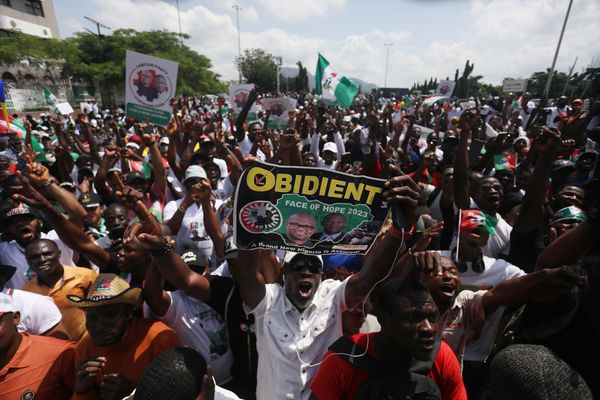
The Peter Obi universe would be excited over this one. In a Premise Data poll for Bloomberg, the Labour Party candidate picked 72% of the votes: “A clear majority of respondents said they intend to vote for Peter Obi, a former state governor, in elections scheduled for February. The results of the survey conducted for Bloomberg News by Premise Data Corp. were published on Wednesday as the official campaign to succeed President Muhammadu Buhari kicked off… Peter Obi scored 72% among those who have decided how to vote. Main party candidates much less favored in Premise Data poll”. 


A third-party candidate is the top choice to become the next president of Africa’s most populous country, according to a new opinion poll.

A clear majority of respondents said they intend to vote for Peter Obi, a former state governor, in elections scheduled for February. The results of the survey conducted for Bloomberg News by Premise Data Corp. were published on Wednesday as the official campaign to succeed President Muhammadu Buhari kicked off.

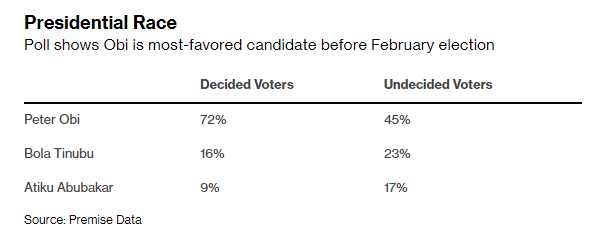
Of the 92% of participants who said they’ve decided how to vote, 72% named Obi as their first choice. Of those who are still unsure, 45% said the 61-year-old is their preferred candidate.

Presidential Race

Poll shows Obi is most-favored candidate before February election

Source: Premise Data

The San Francisco-headquartered data company surveyed 3,973 Nigerians from Sept. 5-20. Respondents to the app-based poll were selected from quotas developed by age, gender and location across the country’s six geopolitical zones. Results were then weighted against the original quotas to ensure national representation. About 44% of Nigerians own smartphones, according to the Alliance for Affordable Internet.

The candidates of the two parties that have ruled Nigeria since the restoration of democracy in 1999 fared less well. Bola Tinubu of the ruling All Progressives Congress garnered 16% of decided voters and 23% of those yet to make up their minds. Atiku Abubakar of the main opposition Peoples Democratic Party tallied 9% and 17% respectively.