DD
MM
YYYY

PAGES

DD
MM
YYYY

spot_img

PAGES

Home Blog Page 4922

Google Selects 60 African Startups For Second Black Founders Fund Cohort, Nigeria Dominates List With 23 Startups

0

American multinational technology company, Google has been on a mission in offering support to innovative startups by helping founders turn their big ideas into successful businesses.

According to the company, its Google For Startups Black Founders Fund Programme, which began in April 2012, has created over 4,600 jobs and raised more than $290 million in funding.

Recently, the company selected 60 startups for its second Black Founders Fund Cohort for equity-free $4m funding. Each selected startup will receive a total of $ 4 million in funding and support to enable them to scale up their ongoing work.

Also, these startups will receive support in the form of a 6-month training program that includes access to a network of mentors to assist in tackling challenges that are peculiar to them. They will also be part of tailored workshops, support networks, and community-building sessions.

It is interesting to note that the selected grantees were made up of 50% women-led businesses, with countries such as Botswana,  Cameroon, Ethiopia, Ghana, Kenya, Nigeria, Rwanda, Senegal, South Africa, and Uganda.

These startups specialize in sectors such as fintech, healthcare, e-commerce, logistics, agtech, education, hospitality, and smart cities.

According to the Head of Startup Ecosystem, SSA, Folarin Aiyegbusi, he disclosed that the Black Founders Fund Program was set up to bridge the gap of disproportionate funding between expat startups over local and black-led companies.

In his words;

Africa is a diverse continent with massive opportunity but the continent is faced with the challenge of limited diversity in venture capital funding flow. We hope that the Black Founders Fund program will be able to bridge the gap of disproportionate funding between expat startups over local and black-led companies.

It is however interesting to note that African most populous nation, Nigeria, dominated the list with 23 startups.

Check out the list of Nigerian startups that were selected for the Black Founders Fund Program

  1. Eden Life: Eden Life provides an operating system for receiving and rendering essential services in Africa – focused on offering food, cleaning, laundry, and beauty services to our customers.

  2. Haul 247: Haul247 is a logistics platform that connects manufacturing companies and farmers with trucks and warehouses.

  3. HerVest: HerVest offers a highly secured, women-focused financial platform that enables women to participate in key financial services, with a focus on female farmers

  4. Norebase: Norebase provides a single digital platform and technology tools for entrepreneurs and businesses to start, scale, and operate in any African country and the United States.

  5. QShop: QShop is an easy-to-use DIY e-commerce platform designed to help small and medium-sized businesses scale and sell better online.

  6. OneHealth: OneHealth is an online pharmacy & healthcare platform that provides access to medicines, healthcare information, and solutions (Laboratory services & Doctors) to the last mile patient.

  7. LifeBank: LifeBank leverages technology to provide value in multiple segments (production, marketplace, and distribution) of the healthcare supply chain such as blood, oxygen, and medical supplies.

  8. Shiip: Shiip leverages web, mobile and API technology to connect individuals & businesses to delivery services in and out of Africa.

  9. Terawork: Terawork is an online freelance marketplace focused on matching freelancers to service buyers.

  10. Wellahealth: Wellahealth provides technology and financial tools to healthcare providers and patients to enable the affordability and accessibility of healthcare in emerging markets.

  11. Scrapays: Scrapays is creating an operating system infrastructure for the recycling value chain in developing nations.

  12. Flex Finance: Flex Finance helps businesses in Africa manage approval workflow, access credit, issue corporate cards to employees and make disbursements all from one platform.

  13. Gamr: Gamr is an eSports tournament aggregation platform, that helps African gamers discover tournaments they can play and get rewarded.

  14. Pivo: Pivo is a credit-focused digital bank for trade, supporting businesses across Africa.

  15. Topset Education: Topset Education is an edtech platform that makes quality education accessible to Africans everywhere

  16. Stears: Stears is a financial intelligence company providing subscription-based content & data to global professionals. Our mission is to build the world’s most trusted provider of African data.

  17. Healthtracka: Healthtracka is a platform that allows users to access on-demand healthcare services in the comfort of their homes.

  18. Estate Intel: Estate Intel provides reliable data to businesses that are investing or operating in the African real estate space.

  19. Spleet: Spleet leverages a ‘Rent Now, Pay Late’ model to drive our mission to ensure that every African can afford a space to live in.

  20. Bookings Africa: Bookings Africa enables Africa’s gig workforce to digitize and monetize their skill by connecting clients efficiently and transparently to skilled talent across Africa.

  21. Clafiya: Clafiya connects individuals, families, and businesses to health practitioners – enabling access to convenient, quality, and affordable, on-demand primary care from their mobile phones

  22. Awabah: Awabah is a digital pension platform for Africa’s workforce.

  23. Kyshi: Kyshi provides multi-currency accounts and remittance services to and from Africa.
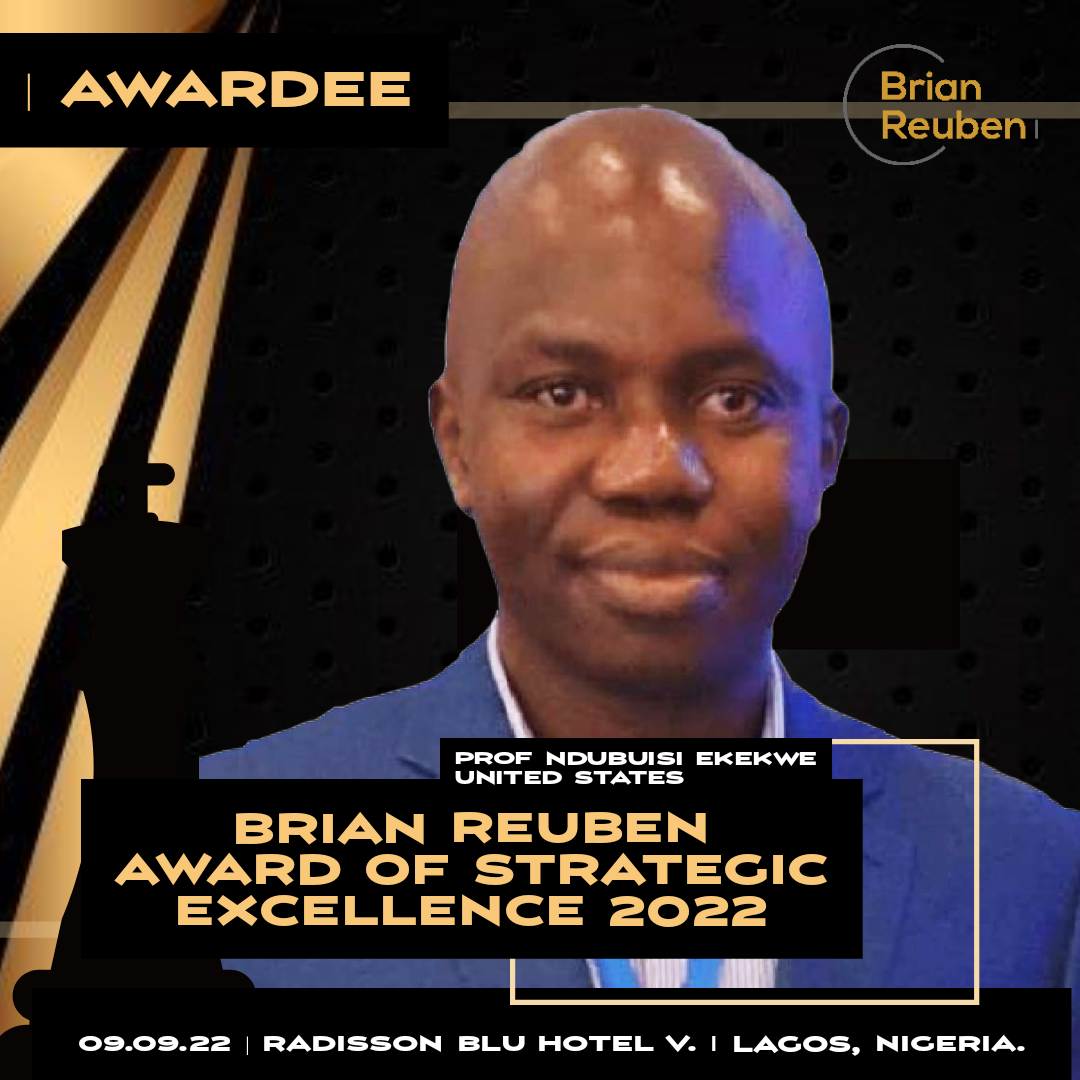
Ndubuisi Ekekwe to receive the Brian Reuben Award of Strategic Excellence 2022

0

What can I write? They want to honour a village boy from Ovim. Awesome. Daily when I wake up, I pray: precious Lord as you send your angels to bless men and women today, remember me – and remember me as my hands are constantly raised up. Details below…


The Brian Reuben’s Awards of Strategic  Excellence represents a benchmark of excellence for individuals and organisations demonstrating strategic excellence across industries. Recognising and honouring the individuals and companies who, over the years, have been at the forefront of first-class value creation, innovation, or exceptional financial and operating performance.

The Awards of Strategic Excellence also celebrates the executives who continue to change the face of their industry demonstrating outstanding leadership and performance. The Keynote Speaker for the 2022 event is the acclaimed Emmanuel Michael, SPHRi, a leading authority in human resource management.

The highly-acclaimed event scheduled for September 9, 2022, will be held at the Radisson Blu Hotel in Victoria Island Lagos Nigeria.

Recipients of the award in 2022 includes, Dr. Dominic Oduro-Antwi, President, Global Africa Trade Advisory Chamber Ghana; Engr. Steve Ayuba, TA, Gas to the CEO, Midstream and Downstream Regulatory Authority; Ms. Rosario Osobase, Managing Director, Tenaris Nigeria and Ms. Adeline Quarshie

CEO, Credence Micro Credit Limited, Ghana. Others include Prof. Ndubuisi Ekekwe, Founder, Tekedia Institute, USA; Mazi Dr. Sam Ohuabunwa, Former President, Nigeria Pharmaceuticals Society; Prof. Punit Gaur, Founder, International Institute for Eurasian Studies;

Ms. Deepti Chaudhary Saini (Mrs. India international), Director & Founder Deepra, India; Mr. Jude Ndu, Founder, The Economic Series, Nigeria and Ms. Tolulope Opayinka, CEO, Letshego MFB, Lagos, Nigeria. Also to receive this award is CJ Benjamin, South African leading media personality and Nirbhay Wadhwa, Indian film and television actor

Those expected to grace the invite-only would include business founders, Chief Executive Officers of industries, c-suite executives and other notable personalities in the world of business, finance, government, and investment.

The event will also feature the award of Honorary Doctorates to deserving individuals by the Metropolitan University of California.

The Convener of the event, Dr Brian Reuben is a leading authority on Strategy and one of the most sought-after thought leaders on the subject.

Through his senior executive workshops he has helped position several businesses to produce remarkable results even in the most challenging and turbulent business environments.

Dr Reuben who also hosts such premium events as the Leadership Agenda Summit is a featured speaker at business events globally and has trained,  advised and mentored senior executives in  several organizations around the world.

The Brian Reuben’s Awards of Strategic Excellence  is a core social gathering once a year with a bang, it’s not to be missed! To request an invite please email admin@brianreuben.com

New Cryptocurrency Tokens That Motivate Fitness – Runfy And Green Satoshi Token

0

Fitness has always been an important part of our society for a long time. As people are getting more inclined to pay attention to their health and fitness, more people are trying out different methods to stay healthy. Ranging from diest to exercises, yoga, and all other fitness-related activities, everyone is trying to stay healthy considering the amount of unhealthy food we have in circulation.

Exercise is a major part of fitness activities. Exercises involve using your muscles and burning the calories in your body. Considering the many perks of exercise, everyone, including the cryptocurrency market, is now taking advantage of the need. Exercising continuously has many perks, including weight loss, improved mood, stronger bones and muscles, and increased energy levels, amidst many others.

As fitness and exercising have gained more traction in the past few years, especially since the pandemic in 2022, the cryptocurrency market has found ways to take it a notch higher. As blockchain technology has seeped into different industries, including the health and fitness sectors, new cryptocurrency projects have emerged to improve and motivate fitness for different people. The interwoven connection between blockchain technology and the fitness industry has different benefits, which include security and reliability, improved data privacy, no middlemen, and the most motivating factor, gamification.

Keeping fit can be hard and frustrating for many people, and blockchain technology seems to have a solution by taking it up a notch. Gamification is a great retaining and motivating system, and humans enjoy gratification. The cryptocurrency market is now offering new cryptocurrency projects that motivate users to exercise more while rewarding them for exercising. This can be in the form of games to earn with or simply rewards for each milestone. Regardless, blockchain technology is here to improve the interest in fitness. This article highlights two new cryptocurrency tokens that motivate fitness with their projects. They are Runfy (RUNF) and Green Satoshi Token (GST).

Take A Leap Of Faith With Runfy Token

The creators of Runfy Token realized how hard it is to keep up and meet up with health and fitness goals, especially without the right tools, technology, and mindset. This is why the team created Runfy, a system, and software that gives fitness enthusiasts a chance to have access to the important tools that they need to achieve their fitness goals successfully. Runfy is a system that allows users to track their nutritional and calorie intake easily and also gives users tips that help them achieve their fitness goals.

The Runfy Token ecosystem is a platform that is driven by the community and also gives members the power to take charge of their health and wellness. The Runfy Token project promotes all content related to health and fitness while providing users access to earn cryptocurrency alongside. The Runfy Token ecosystem is a way of life that offers an app with innovative features to improve user adoption, such as in-app rewards, coaching, step tracking, and many more.

The Runfy ecosystem is run by the token, RUNF. The RUNF token is a token that was created to integrate health and fitness with blockchain technology and cryptocurrency, giving users a chance to earn money while they keep fit. RUNF is a utility token created on the Binance Smart Chain, resulting in less transaction fees.

Get Moving With Green Satoshi Token

Green Satoshi Token (GST) is a cryptocurrency token that serves as the powering and utility token for the Web3 lifestyle app, STEPN. GST is a Solana token that is used as a reward system for the users of the STEPN app. STEPN is a lifestyle app that encourages users to move by using the move-to-earn paradigm. STEPN also serves as an intersection between a fitness app, an NFT marketplace, and a play-to-earn gaming platform. So, STEPN uses NFTs and the Green Satoshi Token to reward its users.

To start using the STEPN system, users are required to purchase NFTs. To make it easier, users can also rent these NFTs. These NFT sneakers are important as they are the criteria for earning GST. Users earn GST with these sneakers by walking or running outdoors or even by renting to other users. These NFT sneakers can be bought in different formats depending on the owner’s choice. GST is used to pay for transactions, digital items, and upgrades on the platform.

For more information, check out the links below.

Presale: http://go.runfytoken.io/

Website: http://runfytoken.io/

Telegram: https://t.me/RunfyTokenOfficial

Tekedia Mini-MBA Graduation Hangout in Port Harcourt on Sept 10, 2022

0

Let me wish members of Tekedia Mini-MBA edition 8 a great Graduation Hangout in Port Harcourt this weekend. The Lagos one was superb. I also commend members in London who are organizing one. Kano reached out today. Tekedia Institute supports these independently organized events as a way of connecting our members to deepen their networks as they go into markets to fix frictions.

Tekedia Store and TekediaTV programs are on the way. This is a temple for the mastery of Africa’s entrepreneurial capitalism; thank you all for the opportunity to serve you.

Tekedia Institute >> learn from the best. The next edition of Tekedia Mini-MBA begins next week. We invite you to join here 

When ‘Jápa’ Meets ‘Jàgùdà: Nigerians’ Lived Experiences Prior to Migration to Developed Countries

0

Many Nigerians are pushed to negative thinking and belief zones when they get up every day and believe that lack of some fundamental amenities or facilities will prevent them from accomplishing specific activities toward achieving personal goals. Exploration of these zones has led many residents, particularly the youth, to believe that Nigeria would never get it right in terms of having a competent leadership system that will replace the perceived existing bad system. In most situations, the media‘s predilection for negativity over positive in presenting socioeconomic and political events contributes to a poor perception of the country. Aside from presenting more bad news than good news, Nigerian media has also contributed to the country’s constant migration to industrialized countries by spreading the concept of second-class citizenship for citizens who believe that a better life is achievable in the countries being promoted. These acts, as well as others that have gone unreported in the media, have pushed and drawn numerous Nigerians out of the country throughout the years. Previously, our analyst predicted that between 2021 and 2030, 9,232 Nigerians will migrate to developed countries. It would be 14,201 people between 2031 and 2040.

‘Jápa’ Meets ‘Jàgùdà

However, given the current strategy of youth immigration to nations in Europe, North America, and other continents, it is anticipated that these statistics will increase over time. This strategy has been called “Jápa,” which means “to flee” in Yoruba. This slang is frequently used by members of the Yoruba tribe in Nigeria when they have a negative interaction with another person or entity. For instance, based on the narrative views provided by the fellows, family members, relatives, acquaintances, and coworkers typically counseled their fellows to leave a hazardous employment setting or relationship. As a result, youth and those who believe that leaders are not doing enough to improve the lives of all citizens perceive ‘Jápa’ as the ideal alternative. While citizens who want to flee see macro leaders as the main source of the country’s failure in social, economic, and political aspects, our analyst observes that recent experiences of many potential migrants show that activities of micro leaders and followers are more detrimental to getting on the right track to correcting a bad macro leadership system.

Nigerians must successfully navigate a number of ministries, departments, and organizations at the state and federal levels in order to immigrate to any nation. Usually, standardizing and formalizing particular papers calls for this. Contact with key leaders at pertinent MDAs, particularly the Ministries of Education and Foreign Affairs as well as public health institutions, is necessary in order to complete these tasks. Based on recent experiences of our analyst and those who were present at the MDAs, there is a good chance that Jàgùdà will be encountered, whether at the state or federal level. Again, Jàgùdà is a Yoruba term that was coined several years ago to describe the behavior of a bunch of boys notorious for stealing from the pockets of persons who were negligent with their personal belongings. The group began in Ibadan before moving to Lagos. Later on, the concept spread across the country. A person known as ‘Jàgùdà’ does not carry a sophisticated gun. In most cases, he or she employs a knife and a pretend gun to instill panic in the victim before taking from them.

Essentially, the youth who want to emigrate are meeting micro leaders at MDAs who are utilizing ‘Jàgùdà techniques and strategies after witnessing the desperation of many potential migrants to obtain visas. Before applying for a visa, persons who want to emigrate using the study route must have the pertinent certificates examined and authenticated. Additionally, a medical certificate from a public hospital attesting to the absence of serious health conditions is required. As previously mentioned, coming into contact with micro leaders (in this case, employees) at the pertinent MDAs is the same as running into “Jàgùdà.” There are formal procedures for applying and obtaining approval for necessary documents. Micro leaders typically took advantage of the situation and made a sizable amount of money unofficially because many candidates were desperate and willing to break the law. These applicants also believed in playing the game of bribing their ways.

Ologun (not his actual name), a potential migrant based on further study, had a bad experience with Danladi (not his real name) at the Ministry of Foreign Affairs, where he is supposed to authenticate his certificates. The Authentication Unit accepts applications at 9 a.m. and closes at 1 p.m., with applicants expected to arrive by 3 p.m. or 3:30 p.m. to pick up signed certificates. Many applicants believe that the time between submitting and obtaining submitted certificates is too long for those who wish to submit at embassies in Abuja and Lagos. As a result, the desperation to get the credentials back before the deadline. Seeing the desperation, micro leaders take advantage of it, manipulating individuals who cannot wait for the period.

To avoid becoming a victim, Ologun left his location in Abuja earlier and made his way to the Ministry. Unfortunately, the guidelines that were in place for accepting applications the day before had been changed by the time Ologun arrived at the Ministry. He and others were asked to pay for the application and buy envelopes, which were not previously part of the procedures. Employee stated unequivocally that Ologun must arrive before 1pm. Ologun ran to the payment station within the Secretariat premises and returned at 12:58pm. Unfortunately, Danladi stated that the Unit had been closed. This statement did not bode well for Ologun because Danladi was in the process of compiling some  applications for final transmission to another employee who signs submitted certificates. Ologun, like others, did not want to miss his embassy appointment. For several minutes, he implored Danladi to think about him. The sole choice presented to him (Ologun) was to part with a particular sum of money.

Ologun: Please assist me. I got here with very little money. I only have N3,000 remaining. I’ll spend N1,000 to get back to my location. Please accept N2,000 from me.

Danladi: It appears you are not prepared. Your bank balance is N8,000.

Ologun: Sir, I am merely authenticating certificates and not evaluating them.

Danladi: I’ll see you later. There are eight papers in this folder.

Ologun: Sir, I only have my first degree diploma and transcript on two separate sheets. Others are duplicates.

Counting the documents

Danladi: One, two, three, four, five, six, seven, and eight, Danladi. These are the eight documents that result after signing all of these (he showed back pages and possible places of stamping)

Ologun: Sir, please consider me your brother. What can you do to help me? I only have N2,000 on me.

Danladi: I see you’re shouting a lot. You want people to hear the bargaining.

Ologun: All right, sir.

Danladi: I’m leaving because you’re not prepared.

Ologun had no choice but to leave the Ministry and return the next day. Unfortunately, his expectation of completing the forms before his embassy appointment at 10 a.m. fell through. The next day, he met with another group of staff at the Unit (Danladi was only seen moving in and out). The employee in charge stated that submission would begin only when another staff with a form for registering applicants returned to work. After a few minutes of waiting without the resumption of the said employee, the collector (employee) walked to an office and picked up the form. Ologun was duly registered and submitted his documents after complaining about special treatments being given to some applicants. The same collecting period was announced as the day before. With this announcement, Ologun concluded that he would no longer be able to meet his appointment time at an embassy. It was postponed for another day. It was, however, surprising that the same group of employees surreptitiously assisted those who offered them money and got the documents out for them before the deadline.

Legalising Express Service

Can we legalize express service, based on Ologun’s and others’ experiences in various ministries, departments, and agencies across the country? Because desperation is synonymous with express service, our analyst believes it is past time for the government to explore legalizing express service, which is now being exploited by micro leaders and their cohorts. Legalizing it will help the government increase its revenue profile while also reducing corrupt activities. Based on experience, macro leaders (particularly political leaders) not only contribute to the country’s problems in a quantum-like fashion, but micro leaders are also contributing to many socioeconomic and political challenges.