DD
MM
YYYY

PAGES

DD
MM
YYYY

spot_img

PAGES

Home Blog Page 4926

Feed3 is Bringing Innovation that Could Lead to 1000x Profit Compared to What Litecoin and Polygon Can Provide

0

Cryptocurrencies were introduced because of a desire to innovate, transform the financial sector and bring power back into the hands of the people. The innovation within Decentralized Finance (DeFi) has continued in the years since with cryptocurrencies like Litecoin (LTC) and Polygon (MATIC) being created to fill gaps and improve the industry. Another cryptocurrency wants to join these big names with a unique idea that might bring a lot of success. Feed3 (FD3) is a new cryptocurrency that wants to improve the web 3.0 decentralized apps (dApps) and games by providing a never before seen feedback mechanism that allows users to earn and provides developers with proper feedback.

Polygon (MATIC): the Perfect Scaling Solution

Intending to resolve the key issues that plagued the Ethereum blockchain while retaining its security, Anurag Arjun, Sandeep Nailwal and Jaynti Kanani created the Matic Network in 2017. It was rebranded as the Polygon Network in early 2021. Polygon serves as a sidechain to the Ethereum blockchain. It helps reduce congestion on the Ethereum blockchain by transferring some of its transactions to other polygon sidechains. After processing multiple transactions, all these transactions will be bundled together and written to the Ethereum blockchain at once. Transactions on the Polygon network are performed using Polygon (MATIC) tokens and through a process called bridging, users can convert their Ethereum (ETH) tokens to Polygon (MATIC) tokens for use on the Polygon network.

Ways to Buy Polygon (MATIC) Tokens

On Decentralized Exchanges (DEX), interested users can exchange their cryptocurrencies for Polygon (MATIC) tokens. Additionally, Polygon (MATIC) tokens can be purchased with fiat currencies on Centralized Exchanges (CEX). Another way to get Polygon (MATIC) tokens is by bridging Ethereum (ETH) tokens.
Litecoin (LTC): The Original Altcoin

A fork in the Bitcoin blockchain led to the creation of Litecoin (LTC), a Decentralized Finance (DeFi) cryptocurrency, in 2011 by Charlie Lee, a former Google engineer. It was designed to address issues that existed on the Bitcoin blockchain and be a lighter and cheaper alternative to Bitcoin (BTC). Thanks to Scrypt (pronounced es-crypt) which is Litecoin’s hashing function, transactions using Litecoin (LTC) take 25% of the time when compared to Bitcoin (BTC) and they are significantly cheaper. Both blockchains use the proof-of-work consensus algorithm but compared to Bitcoin’s SHA-256 hashing function, Scrypt is lighter, requires less processing power, and is generally more efficient.

How to Buy Litecoin (LTC)

Litecoin (LTC) has a broad range of applications and uses thanks to its popularity and stability. It is available on most of the popular CEXs for purchase using fiat currency. Users can also swap their cryptocurrencies for Litecoin (LTC) on most DEXs.

Feed3 (FD3): Bringing More Innovation to GameFi

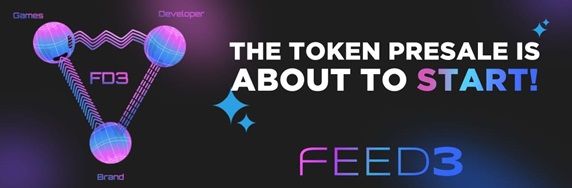
Feedback is an invaluable source of data that can give developers focus and direction but a lot of developers struggle to improve their games and apps in ways that will appeal to their audience because of a lack of feedback from the audience. Feedback usually only comes when something really bad happens and the developers are already losing members of their community. With the new Feed3 feedback system, this problem will become a thing of the past. Feed3 is the first ever web 3.0 audio feedback tool. With Feed3, users can record and submit feedback while playing their blockchain-based games or using decentralized applications (dApps).

As an incentive, users who provide feedback will receive Feed3 (FD3) tokens which are the native cryptocurrencies of Feed3. This feedback-to-earn (FB2E) model can provide users with a second income channel. With this, the developers will receive lots of authentic and useful feedback. Everybody wins with the Feed3 system. But, how will this system work?
How Does Feed3 (FD3) Work?

With the Feed3 feedback system, users can provide immediate feedback on any blockchain game or app. All the developers have to do is incorporate Feed3 technology into their UI/UX design. As an example, after completing a play session in a blockchain-based game, users will have the option to share their feedback with the developers through the Feed3 system. Players can then record their feedback in plain English and earn their Feed3 (FD3) tokens after submitting their feedback.

The developers can then use this feedback to improve aspects that players want instead of just swinging blindly and hoping for the best. Targeted updates like this can help improve overall player retention, enhance player satisfaction and improve the gameplay experience. Feed3 (FD3) token rewards are given according to the quality and length of feedback provided. To collect and organize feedback and allocate Feed3 (FD3) token rewards appropriately, Feed3 uses a deep neural network algorithm called “Freeda”.

Freeda: the Future of Feedback Collection

Freeda is a proprietary deep neural network algorithm used by Feed3 to process audio, consider different factors, and determine the amount of Feed3 (FD3) tokens to be given to each player. These factors include the length of the recording, its accuracy/precision, the emotions expressed, and the authenticity/sincerity of the recording. Users who record clear and detailed feedback with useful information will end up receiving more Feed3 (FD3) tokens. This will motivate users to provide useful information to the developers so improvements can be made.

The technology behind Freeda is similar to that used to check for authenticity and sincerity by banks and insurance companies. Freeda also measures intonation, speaking pace, and voice emphasis. Freeda also employs Natural Language Processing (NLP) technology and with it, it can process and classify audio with lightning-fast speed, identify multiple opinions with its onset detection algorithm, perform exceptional noise cancellation and prevent exploitation by scripts. To power Freeda, the team behind Feed3 (FD3) has designed an NFT collection known as intelligent NFTs (NFT).

What is an Intelligent NFT (iNFT)?

The iNFTs are a collection of 10,000 NFTs. These will be ERC-721 tokens on the Ethereum blockchain and these NFTs will be combined with the pre-trained AI language model engines that power Freeda. The iNFTs will process the audio feedback on the Feed3 system using those engines and provide users with their Feed3 (FD3) token rewards. In essence, they will be intelligent assets infused with the AI personality traits of Freeda.

The iNFTs are made up of three parts. These are:

The body, which is the ERC-721 token that represents the iNFT with an image or avatar.

The soul, which is the iNFTs intelligence level.

The mind represents the ability of the iNFT to perform tasks. This increases as the soul levels up and with each new level, higher-order tasks can be performed. The price of iNFTs will range from $2,000 to $30,000 and those with higher intelligence levels (soul and body) will be more expensive but users will be able to generate more Feed3 (FD3) tokens with them. Users can also mint their iNFTs, build them up to higher levels and sell them in the secondary marketplace to get rewards.

How Will Feed3 (FD3) Tokens be Distributed?

Feed3 is built on the Ethereum blockchain and the Feed3 (FD3) tokens are ERC-20 tokens. They have a maximum supply of 1 billion tokens and they will be distributed as follows:

  • 10% will be sold in a private sale.
  • 5% will be sold in a public presale.
  • 5% will go to the team and advisors.
  • 5% will go to marketing.
  • 15% will go to the liquidity pool.
  • 10% will be kept for operations.
  • 20% will serve as reserve capital.
  • 25% will be used for ecosystem development.
  • 5% will be used to develop strategic partnerships.

What is the Roadmap for Feed3 (FD3)?

The roadmap for Feed3 (FD3) is split into five phases.

Phase 1: in the first phase, the website will be launched and the whitepaper will be released to the public. The Feed3 team will also acquire annotated audio data and begin building Freeda.

Phase 2: here, the private sale of Feed3 (FD3) tokens will begin and so will the development of the feedback-to-earn (FB2E) model. In this stage, the blockchain partner will be selected and Feed3 (FD3) will be listed on CoinGecko and CoinMarketCap.

Phase 3: this phase is where the public presale will start. A beta version and product demo of the FB2E system will be launched and the first batch of iNFTs will be produced. This stage will also involve collaboration with influencers for marketing.

Phase 4: the development of the Feed3 dApp will begin and play-to-earn partnerships will be initiated. At this stage, Freeda will be completed and the Feed3 (FD3) token will be listed on Centralized Exchanges (CEXs).

Phase 5: this is the final phase and here, metaverse partnerships will be initiated, the Feed3 dApp will be completed, the Bug Bounty Initiative will be launched and Feed3 (FD3) will expand to other blockchain networks.

Feed3 (FD3) is a one-of-a-kind cryptocurrency and as it has been since the inception of cryptocurrencies, innovation usually leads to success. Feed3 (FD3) might provide users with profits that have not been seen in the industry yet with its innovative iNFTs and feedback systems.


Check Out Bonuses from Quilvius (QVUI) if You Have Missed Bitcoin (BTC) and Ripple (XRP) in the Recent Crypto Market Crash

0

Introduction

The cryptocurrency market had been facing a rough time till the start of the year 2022 due to the recent crypto market crash. However, as the global market is stabilizing, the crypto world is gradually getting back on track.

Developers are now designing new projects to attract people to the crypto assets with the hope – that the cryptocurrencies will recover and reach the same level as before. A similar project Quilvius (QUIV), is in the initial stages and is yet to launch to address common issues faced by crypto users.

Let’s explore the world of Quilvius Network and learn more about its features. Simultaneously, let us compare the upcoming token with existing crypto giants Bitcoin (BTC) and Ripple (XRP) to check the project’s sustainability in the market.

Bitcoin (BTC)

Bitcoin (BTC) is an all-time crypto project that dominates the world of cryptocurrencies. Almost every crypto enthusiast is familiar with the quality of security, scalability, accessibility, and transparency in the transactions performed on the network.

This platform is famous for an open source blockchain network that hosts multiple crypto tokens and provides a strong base for them. It is also a reliable crypto token in the market, which is currently selling for more than $23,000 according to CoinMarketCap.

Ripple (XRP)

Ripple (XRP) is a crypto token ad blockchain network that features decentralized exchange (DEX). The developers initially designed this project to more data from central databases to an open-source platform based on blockchain technology.

The Ripple network functions as a bridging factor to connect centralized data recording systems with decentralized databases and is a valuable addition to the crypto world.

Quilvius (QVUI): A brief introduction to the project

Quilvius (QVUI) is an upcoming project that will deal with the problems commonly faced by content creators, innovators, and artists while publishing their content on a centrally controlled network.

Even with multiple technologies, people are struggling their way to find opportunities to generate income. As a solution, Quilvius (QVUI) will introduce better ways of sharing content and monetizing its efforts.

The Quilvius Ecosystem

The Quilvius ecosystem utilizes metaverse technology. Users will be free to interact with other community members, authors, and readers associated with the network. The team will also incorporate tools of augmented reality (AR) and virtual reality (VR) to make reading books an interactive and enjoyable activity.

Introducing metaverse technology in the Quilvius network will address readers’ faces while acquiring books. During the pandemic, people watched multiple series, shows, and movies on Netflix and Amazon Prime by paying them a small subscription fee. But, while reading books, users had to buy them from a nearby store, which was inconvenient and costly.

But with Quilvius (QVUI) is situation is different. Through the introduction of a decentralized application (dApp), users will be able to access an unlimited supply of books from around the globe. In return, the reader has to pay a minimal amount as a renting fee.

Conclusion

Quilvius (QVUI) is a utility and governance token that will serve as the native cryptocurrency of the Quilvius Network. It will act as a default crypto tool to create, design, claim and exchange $QUIV coins on the platform. The project will operate on Binance Smart Chain with a total supply of 1,000,000,000 crypto assets. Using the BSC blockchain will assist the users in performing secure, stable, scalable, accessible, and economic transactions within the ecosystem. The project aims to capture a considerable market share and achieve milestones in the crypto world.

To attract users, the developing team of Quilvius Network is offering bonus opportunities to users. If people use ETH coins to buy QUIV, they will receive 20% extra tokens in return. Also, if you refer people to the platform, both parties will earn $50 each after spending $200 to purchase the tokens. 

Quilvius (QVIU)

Presale: http://join.quilvius.com/

Website: http://quilvius.com/

Telegram: https://t.me/QuilviusOfficial

When Parliamentarians Fail To Read Bills Before They Become Laws

1

Raise your hand if you read those Terms & Conditions before you signed up into that website. Of course, no one reads those things. But you would expect federal lawmakers to have their staff read parliamentary bills before they become laws. Of course in a nation where the chief media officer to a senator has his own chief media officer to the “chief media officer to a senator”, everything fails. You saw that interview where the head of media of a big time political leader excused his ignorance of top of the hour news because “his boys have not updated him”. Of course, he was too busy to have glanced through the dailies.

Where am I going? The oil producing states are realizing that the highly heralded Petroleum Industry Act (PIA) for the oil industry may be a poison pill in some areas. Ledum Mitee, a legal practitioner, commented on the 13% derivation to the states: “I think the unveiling of NNPC Ltd has grave implications to the states, especially of the oil-producing states. I think the states and the local councils took their eyes off the ball and they were done for in the passage of the PIB into PIA”. 

The information minister under General Abdulsalami Abubakar when the 1999 Nigerian Constitution was adopted has confessed that he did not see the document for once. In other words, he was not allowed even as a minister. But do not see him as a victim: he was telling Nigerians that the Constitution will drive our democracy even though he had not seen it. And he did not resign! 

That says it: most of your leaders do not read those bills. Many surprises are coming as Abuja takes over everything because the breeder (NNPC) is caged.

For most of the states too busy with local politics to read written documents or hire young lawyers looking for jobs to do the needful, the destination now could be the Supreme Court: “Mr. Mitee further urged states not to hesitate to proceed to the Supreme Court to set aside several offensive portions of the PIA.” Indeed, this PIA was drafted over years but none paid attention. Now that it has gone into production, economic freedom fighters will emerge. With PIA, Nigeria scored against the states big time across many domains!

It is typical when elected representatives are too “big” to read bills before they become laws.

NNPC Fails To Remit Funds For 7 Straight Months, Some States Badly Affected in Nigeria

NNPC Fails To Remit Funds For 7 Straight Months, Some States Badly Affected in Nigeria

0

Despite recording a gross revenue of over N2.8 trillion from crude oil and gas sales this period, the Nigerian National Petroleum Company Limited (NNPC) has failed to carry out its obligation of remitting funds to the account of the federation for seven straight months.

NNPC was expected to remit funds into the account of the federation, which will then be distributed to the three tiers of government.

They however, noted that it deducted the funds meant to be remitted to the Federation Accounts Allocation Committee, (FAAC) to cover petrol subsidy over the months, resulting in zero revenue remittances, also stating that it would no longer remit any money to the FAAC account following its transition to a limited liability company.

What the NNPC implies is that following its transition, it currently owes no money to FAAC, as all monetary arrears to the committee were owed by the old corporation and not the new limited liability company.

Recall that President Buhari in July unveiled the NNPC as a limited liability company, declaring that the new entity was henceforth free from institutional regulations. 

Currently, it has been reported that some states in Nigeria with low internally generated revenue (IGR), are badly hit, as they now owe their workforce for several months, following the prevailing development of NNPC that has worsened their financial crisis.

Displeased with the financial crisis some states are currently faced with, legal practitioner, Ledum Mitee, stated that the 13 percent derivation to the oil-producing states was under threat in the present circumstance.

In his words;

“I think the unveiling of NNPC Ltd has grave implications to the states, especially of the oil-producing states. I think the states and the local councils took their eyes off the ball and they were done for in the passage of the PIB into PIA,”

Mr. Mitee further urged states not to hesitate to proceed to the Supreme Court to set aside several offensive portions of the PIA.

Another legal practitioner Madaki Ameh commenting on the issue, disclosed that the prevailing situation was raising germane legal issues which would need to be addressed as the PIA is implemented.

He, however, differed from what Mitee suggested on the issue of 13 percent derivation, stating that while Section 44(3) of the 1999 Constitution vests ownership of petroleum resources on the Federal Government, the same Constitution provides for sharing of revenue and makes provisions for 13 percent derivation.

He stated that for accounting purposes, revenues accruing to the Federal Government from oil and gas activities carried out by the NNPC Ltd will still have to be shared in compliance with the provisions of the constitution, and this would include the NHT and CIT payable by NNPC and other companies operating in the oil and gas industry.

According to him, the funds available to FAAC for distribution to states have been coming from FIRS and Customs, adding that it has taken a toll on the revenues available to states.

Mr. Madaki insisted that the sub-national governments needed to look inwards and improve their internally generated revenue potential.

He however called on the Federal Government to devise ingenious ways to solve the subsidy quagmire, saying it has become unsustainable in view of dwindling revenues and increased debt service obligations.

There is no disputing the fact that this dwindling revenues states are currently faced with, would create an expected negative impact on the ability of affected states to meet their obligations and also lead to renewed agitations for resource control.

Defaults on payment of salaries, pensions, and delivery of basic services will continue to increase unless the governors become innovative and think outside the box.

With a projected N1.473 trillion payment to the federation for the entire year and a monthly remittance of N122.767 billion, the implication is that the federal, state, and local governments may continue to have cash shortages for a while since the payments constitute a major revenue source.

Nigeria Suspends Proposed 5% Tax on Telecom Services

0

Following the backlash from both consumers and stakeholders, the Federal Government has suspended the introduction of five percent excise duty proposed for the digital economy sector.

The tax was earlier proposed by the Minister of Finance Zainab Ahmed as a way to generate more revenue to cushion the effects of revenue shortfalls from crude oil export.

The Minister of Communications and Digital Economy, Isa Pantami announced the suspension in Abuja during the inauguration of a committee that will review the policy on Monday.

Pantami, who was among those who earlier criticized the proposal, said he personally rejected the policy and advised President Muhammadu Buhari against it in view of the effects it would have on the digital economy.

He said the introduction of excise duty in the telecommunication and information and communications technology industry would jeopardize the successes already recorded within the industry, adding that currently, the ICT sector is over-burdened with multiple taxations both at the federal and state level.

Pantami further disclosed that there are more than 41 taxes that telecommunication and ICT companies are paying and that it would be unfair to subject them to payment of excise duty.

However, a presidential committee on the review of the excise duty in the digital economy has been inaugurated by the federal government. The committee is made up of Isah Pantami as chairman and the Minister of Finance as a member.

Other members are the Executive Secretary of the Nigerian Communications Commission (NCC), Professor Umar Danbatta, the Executive Chairman of the Federal Inland Revenue Service, Muhammad Nami and representatives of the telecommunication industries.

But in response to Pantimi’s disapproval of the five percent communication tax proposal, Ahmed said he was, together with other relevant agencies, informed about the implementation, which was approved by Buhari.

The finance minister also faulted Pantami’s disapproval, adding that he was involved in the Finance Act.

“Against the comments by Isa Ali Pantami, honourable minister of communication and digital economy, concerning the five percent excise duty hike on telecoms services, it is worth noting that there was a circular stating the planned hike which was addressed to the communication minister and other relevant ministries and agencies of government,” Ahmed said in a statement issued by the ministry.

“The circular Referenced No. F. 17417/VI/286, dated March 1, 2022, and titled “Approval for Implementation of the 2022 Fiscal Policy Measures and Tariff Amendments” was addressed to different ministers, including the honourable minister, communications and digital economy and other heads of government agencies.”

The backlash generated by the federal government’s move to implement the five percent tax was based mainly on the concern that it will overburden the telecom sector with taxes. Nigeria’s telecom sector has served as the country’s cash cow in the face of economic strains emanating from Covid-19 and oil revenue shortfalls.