DD
MM
YYYY

PAGES

DD
MM
YYYY

spot_img

PAGES

Home Blog Page 4928

The Yoruba’s 256 Odu number system

1

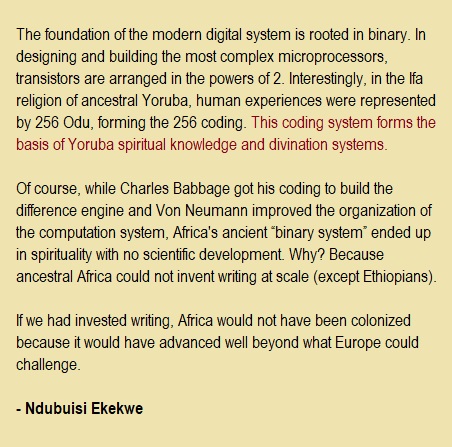
The 256 Odu number system is one your teacher did not know. As a microprocessor designer and engineer, when I look at the organization of transistors for processors, I remember that even WAEC could not mention Yoruba’s 256 Ifa Odu number system in our books. Had it been written and documented, colonization would not have happened. Yorubas pioneered the number system centuries ago.

Obatala, the son of Olodumare, had the postulation that Yorubas’ kindred (the Igbos) invented how to discover and nurture wealth. Pita Nwanna’s Omenuko – one of the most influential books in explaining the linkage of commerce and ancestral Igbo divinity – made that evident: you make wealth even in scarcity. Before the reign of Oduduwa in the 7th century AD, the Ooni nurtured that linkage.

People, you may ask: why is Nigeria still struggling?

More Perspectives from Feed

Comment 1: You’re more dangerous than we all think, Prof. Ndubuisi Ekekwe.
Here’s a trip to an Ifa priest. You greet from outside, the language you use determines if the priest would ask you in by yourself or send his/her minion to check you up and bring you in. You don’t enter with your face forward,it’s a reverse entry. The priest orders you to take a position kneeling, seating or whatever works. The priest doesn’t require you to speak to him/her what brings you, you take a valuable gift (many times just currency note) and whisper your subject of inquiry and do with it as the priest says. The priest makes a chant to invoke the spirits. He/she has a bead like tool. The bead has two connected rows of two-sided three flat beads each. When he/she is done chanting and slams the bead, there are 256 possible combinations (probability). There is a divine story for each of those 256 possibilities. Often, you hear the priest recant the story that matches what the bid reveals. Sometimes they throw the bid multiple times to validate that Ifa has only one approach to whatever the visitor has come to inquire about in which case you had better have the priest speaking positives?. It’s doom if on three occasions, you got the same negative revelation.

A trip to an Ifa priest cont’d.

When the Ifa priest has concluded his inquiry, he/she narrates the divine story (Odu) that matches the combination of the bead that he got, whatever he/she would advise the visitor stems from the story. The priest has no redemption to offer outside of those 256 stories (Odus). Given the modern era we are in and many of the commodities in the stories are almost non-existent, the priest sometimes improvise, but they usually would put out a disclaimer that there are no guarantees that an improv will be as effective. What is interesting is how the revealed story typically matches what the visitor has come to inquire about. Caveat! Ifa priests aren’t voodoo doctors.

I’m certain my brother [] would be rolling his eyes for me in contempt, wondering why Im scrambling to discuss a something I had on a platter of gold but refused. I was a teenager when I had the opportunity but without any reasonable explanation at the time, I was more comfortable in the church. Born, raised and dedicated to Christ as a child, I guess some things can’t be taken back?. And really, having seen the two side of the coin, I’m happy with the path I chose and will choose it again. Acts 4:12!

My Response: The Odu number system can be looked at from two angles: spiritual and scientific. The Yorubas because of lack of writing invention kept the spiritual but lost the scientific. If you look at the earliest works of Pythagoras, you would accuse him of serving Athena, the Greek goddess of knowledge. But because he wrote and explained, we accepted most as the basis of natural philosophy. Without writing, it would be folklores as with Yoruba’s Odu coding.

al-Khw?rizmi – the father of algebra was a highly religious man. He ran the house of wisdom and was a devout religious man in Baghdad. But as he started writing, he explained the foundation of algebra even though he was known as the puzzle solver in Mecca and Medina.

My point is this: had the Yorubas invented writing, the Odu coding could have entered the large sphere of natural philosophy and demystified the spirituality. Think about it: if Euclid had not written his works on geometry, it would have been all spiritual to many. In FUTO, students call ODE [ordinary differential equation] “o di egwu” which in Igbo means something mystical and challenging.

Tell the high priest to write what he does as an equation, some spirituality will evolve to science!

Comment 2I think the binary numbers discussed by Prof. John Anenechukwu Ume in his book; After God is Dibia dealt very well with such too where he noted 260 Igbo Afa numbers, especially for those conversant with Afa Ugiri. There is no genuine African divination, Igbo or Yoruba without numbers, which came first remains to be known. But Anene was deep in his work

Comment 3: I’m glad that a great mind has affirmed my opinion.

I read a Facebook post blaming religion for our apparent backwardness whereas India that was also colonised by the British is making stride.

I simply commented that lack of permanent recording systems in the form of writing and dating are the number one reason black Africa was colonised physically and mentally.

India has a record dating thousands of years which it held tenacious during the Moghul and British colonialisms; and it revived element if it after the colonialists left. Not so with Sub Saharan Africa. In just about fifty years, we had lost so much that those who started fighting for independence didn’t have much of our traditional wisdom to utilise, while the independent and post independent generation of leaders started building their new countries on the knowledge of their colonial masters. Now, we just have to be committed to that path.

@lotannafreeman

#freemazinnamdikanu #freennamdikanu #biafra #lotannafreeman #goviral #fyp #foryoupage

? original sound – LOTANNAfreeman8.com


Selected Testimonials from Tekedia Mini-MBA Edition 8 Learners

0

Here are selected testimonials; we will be updating them…

The words of Anthony Igbinosun: “Finally done and #Ready2Lead! The Tekedia Institute mMBA program has practically changed the way I approach business, and has greatly broadened my thinking. I was pleasantly surprised to see Prof Ndubuisi Ekekwe – someone I greatly admire- get personally involved all the way from Week 1 to Graduation Week!  The calibre of industry leaders brought in to lecture made this an invaluable experience. I highly recommend this program!” (source )


The words of Stanley Golomo, mMBA, CEO of Farmchain Finance Co-op: “Thank you so much Tekedia Institute , and all the Faculties for the just concluded Tekedia #mMBA edition 8 program. The learning curve was an exceptional one, it was like learning from the feet of Harvard University professors, the experience was topnotch. Will definitely recommend to all my proteges”. (Source)

Bappah Mohammed FCA, CIA, CISA, CRMA, CSSGB, PMP: “It was a wonderful virtual experience of meeting new people across the world of business systems, innovation, finance, law, contracting, risk management, logistics, winning markets, and importantly satellite technologies.” (source)

Three Revealing Statements on Nigeria This Week from Attorney General, Custom Boss, NNPC Boss

1

#1: This message from Nigeria’s attorney general is not sound; he ought to have said this without mentioning any name. He was wrong; being a Nigerian and living abroad does not stop one from participating in native nation’s democracy.

“Any Nigerian who lives abroad, funding the campaign of Peter Obi shall be arrested. It is against our electoral laws”

~ Abubakar Malami SAN

“One thing Nigerians who based abroad failed to understand is that they cannot stay there and detect to us how to govern our country. Someone will seat in United States of America and be telling us what to do and what not to do as if we don’t know what we are doing in this country.

“If you violate the electoral law, you will face the penalty squarely and we will do everything within our power to prosecute both you and the candidate you are funding his campaign.

“We’ve received a signal that some individuals, mostly Nigerians living abroad have taken it upon themselves to fund the campaign of Mr Peter Obi who’s the Presidential candidate of the Labour Party in the forthcoming Presidential election.

“What these individuals failed to understand is that Nigeria is a democratic nation governed by democratic rules and regulations. It is against the electoral act for those living abroad to sponsor any candidate in an election. Those involved should desist from such act or have us to contend with. We will resist it by all means. Such fund cannot enter Nigeria. Although we have put measures on ground to apprehend those who will get themselves involved in such an act.”

~ Abubakar Malami SAN

#3: Customs comptroller-general, Hameed Ali on NNPC

The Nigeria Customs Serviceon Thursday questioned the National Petroleum Company Limited’s claim that the country consumes 60 million litres of petrol daily. The Customs comptroller-general, Hameed Ali, during a session with the House of Representatives’ Committee on Finance on Thursday, said if the company puts daily consumption of petrol at 60 million litres, why does it allow 98 million litres to be lifted daily.

“I remember that last year we spoke about this. Unfortunately, this year, we are talking about subsidy again. The over N11 trillion we are going to take as debt, more than half of it is going for subsidy. The issue is not about the smuggling of petroleum products. I have always argued this with NNPC,” Mr Ali said.

“If we are consuming 60 million litres of PMS per day, by their own computation, why would you allow the release of 98 million litres per day? If you know this is our consumption, why would you allow that release?” he asked.

“Scientifically, you cannot tell me that if I fill my tank today, or tomorrow, I will fill the same tank with the same quantity of fuel. If I am operating a fuel station today and I go to Minna depot, lift petrol and take it to Kaduna, I may get to Kaduna in the evening and offload that fuel. There is no way I would have sold off that petrol immediately to warrant another load. So, how did you get to 60 million litres per day?

“That computation, to me, is not believable, because scientifically you cannot tell me that if I fill my tank today, tomorrow I will fill my tank with the same quantity of fuel. And if I’m running a petrol station today, if I go to Minna depot and lift, and I’m taking to Kaduna, I may reach Kaduna in the evening and offload that product; there’s no way I could have sold that petrol immediately to warrant another load.”

Mr Ali also opposed claims that the smuggling of petroleum contributes to the huge amounts being paid for subsidy.

“So, how did you get to 60 million litres per day? That is my question. The issue of smuggling, if you release 98 million litres in actuality and 60 million litres are used, the balance should be 38 million litres. How many trucks will carry 38 million litres every day? Which road are they following and where are they carrying this thing to?”

The deputy chairman of the House committee, Saidu Abdullahi, said the payment of subsidy has constituted a drain on the economy.

“As a government, we have not done well. We owe it to the people of this country to do what is right for this country. We are talking about over N6 trillion going for subsidy payment that almost doesn’t exist,” he said.

“You talk about 38 million litres which amount to about 500 trucks leaving our shores on a daily basis. We have an investment in NIGCOMSAT. Has there been any time that our satellite captured images of trucks leaving our shore?

“I think it is very clear that what is required is the political will to put a halt to this.

“We talk about insecurity. This is the real course of it. The money that is supposed to go into the provision of social amenities is going into private pockets. I think there is a need to work together to put a halt to this,” he said. (source)

#3: “Nigeria losing 95% oil production at Bonny terminal to theft “

“What is most difficult to manage today is the issue of crude oil theft, it is real and it is happening,” Mr Kyari told a session of state house briefing in Abuja.

“Are we helpless? No, we are not helpless and our efforts are paying off.

“As we speak now, what you see on the screen is a typical site where crude oil is stolen and processed in illegal refineries. And this is so common around the pipeline that I can tell you in one line just less than 200 kilometres we had 295 illegal connections and you see the data,” he said. – Mele Kyari, NNPC (source)


Three statements and why Nigeria must build an integrated monitoring and control center for our oil and gas sector’ Saudi Arabia has a playbook here.

1. “Any Nigerian who lives abroad, funding the campaign of Peter Obi shall be arrested. It is against our electoral laws” ~ Abubakar Malami SAN

– this statement by AGF is unfit for his office. He could have made his statement without mentioning any candidate’s name. Then president Buhari/Osinbajo duo was supported by Nigerians living abroad.

2. Nigeria has daily consumption of petrol at 60 million litres, why does it allow 98 million litres to be lifted daily. – Customs comptroller-general, Hameed Ali

– this voodoo has to be reconciled

3. Nigeria losing 95% oil production at Bonny terminal to theft – NNPC

– declare state of emergency on this oil theft

video credit: CBS

Thank You Members; Tekedia Store in Lagos, Tekedia TV Program

0

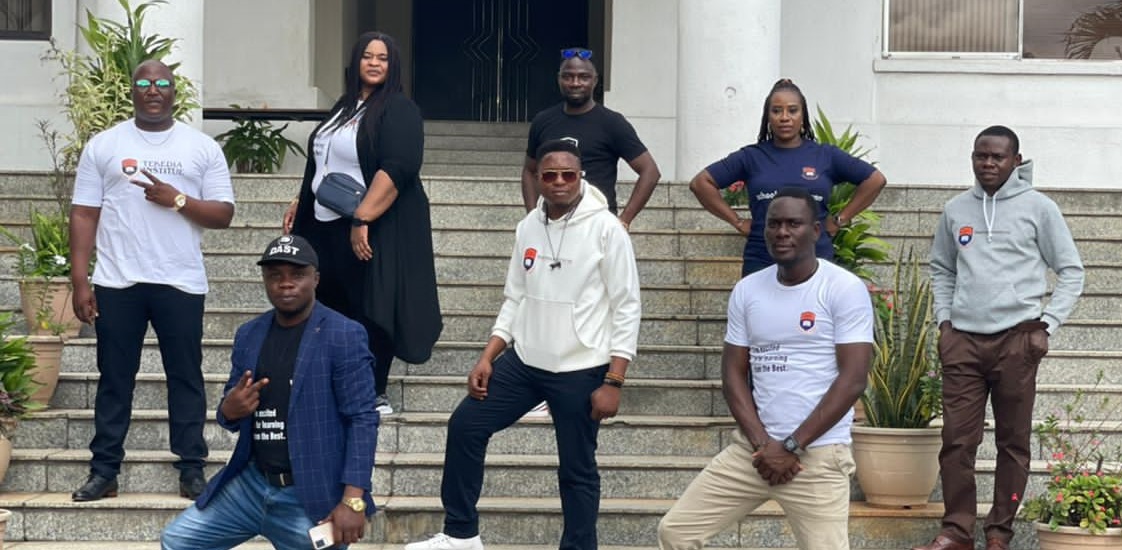
Let me thank again our learners and members who gathered yesterday at Lagos Lagoon Restaurant to celebrate Tekedia Mini-MBA edition 8 graduation. Thank you for the time, energy and every resource you committed to it. I am very happy that everyone made it home safely including those who flew into Lagos.

I also thank these amazing professionals who coordinated this independent gathering. Thank you.

Also, by next year, we plan to have a Tekedia store in Lagos where learners and members can buy business cases, selected courseware, our books, t-shirts, etc but we want every aspect to be learners-driven. Yes, admission is that you have attended Tekedia Institute with the code on your certificate as a way to validate entry. The store will issue an ID like your bank debit card. That admission will also give you discounts in car insurance premium, bulk discounts in certain stores, discounted auto repairs, etc. Call those alumni 2.0 benefits.

Tekedia Institute will not run this – we want it to be 100% learners driven. As an Institute, we want to focus exclusively on academics while our members drive the marginals. We expect the  store to have a studio as we plan to have a TV program in the near future; again, it has to be learners-driven.

Learners who are interested in this should contact Nnamdi Odumody (you will join a special alumni WhatsApp on this). Tekedia Institute will make a special one-time grant to support the Learners-community if they commit to execute the Lagos Store and the TV program. We want it setup as a public benefit entity.

Photos: Tekedia Mini-MBA edition 8 Graduation Hangout in Lagos

A Breakdown of the CBN Guidelines on Mobile Money Services in Nigeria

0

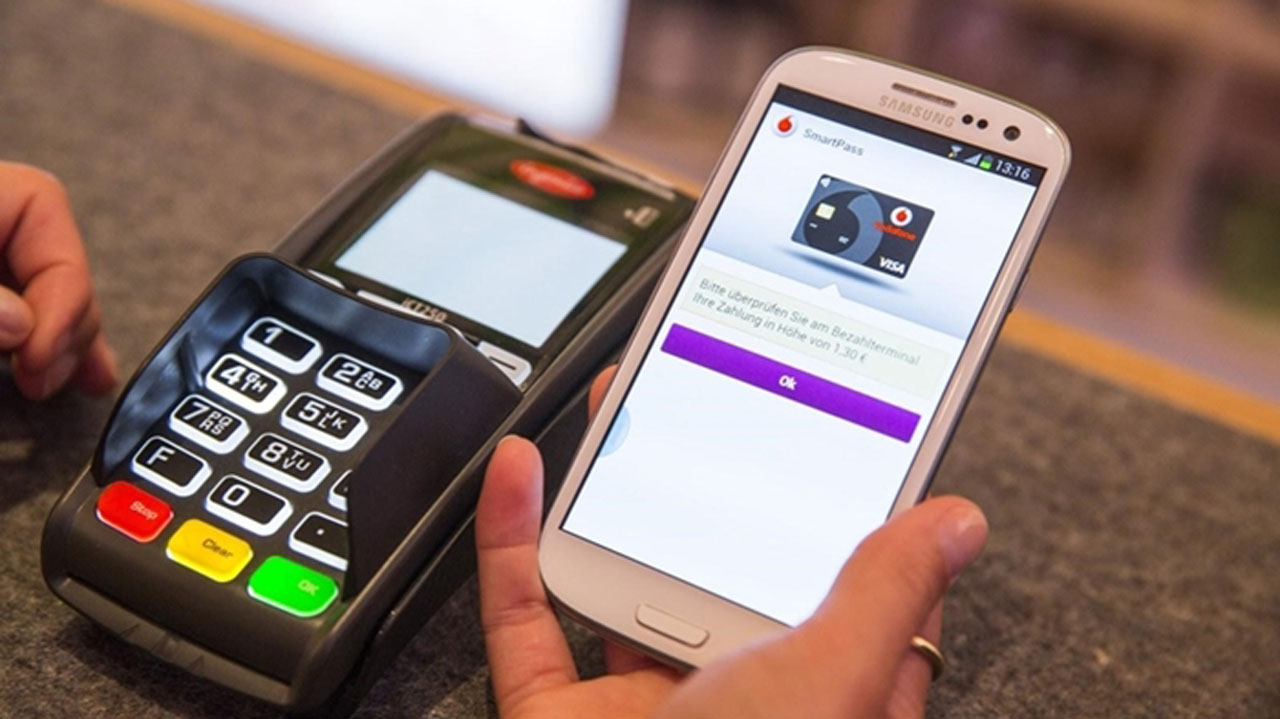
The commercial introduction of Mobile communications technology worldwide soon enough led to its practical application in the rendering of financial services through phone-based platforms for the carrying out of personal transactions, specifically electronic/digital person-to-person payments.

In Nigeria, this led to the Central Bank of Nigeria (CBN), in the exercise of its powers conferred by the Central Bank of Nigeria Act 2007, ultimately launching the Central Bank of Nigeria Guidelines on Mobile Money Services in Nigeria(or ‘the guidelines’) which will be the focus of this article, specifically the topics of:-

– The objectives of the guidelines regarding the licensing, supervision and regulation of Mobile Money services in Nigeria.

– The position of the guidelines on the proper models and participants of a Mobile Money Service scheme in Nigeria.

– The allowed operating structure of Mobile Money Operators (MMOs) in Nigeria.

– The basic provisions of the guidelines on licensing, the use of agency networks, End-user activation, transactions, and participant rights/duties.

– The licensing requirements for MMOs in Nigeria.

What are the objectives of the CBN Guidelines on Mobile Money Services in Nigeria?

The objectives of the guidelines are:-

– to promote safety and effectiveness of mobile money services and thereby enhance user confidence;

– to specify the minimum technical and business requirements for the various participants recognized for the mobile money services industry in Nigeria;

– to ensure a structured and orderly development of mobile money services in Nigeria with a clear definition of various participants and their roles and responsibilities;

– the addressing of business rules governing the operation of mobile money services and the specification of basic functionalities expected of any mobile payment service and solution in Nigeria.

What are the stated models of Mobile Money Service Operations allowed under the Guidelines?

The CBN Guidelines provided for 2 models of Mobile Money services which are :-

The Bank-led Model :- Which is a mobile money service operation having a Bank or Bank-involced consortium as its lead initiator.

The Non-Bank led Model :- This is a mobile money service operation led by a corporation other than a bank or Telecommunications company duly licensed by the Central Bank of Nigeria.

What is the operating structure of MMOs as provided for under the Guidelines?

MMOs under the Guidelines are required to operate as Consortiums having at least 3 major participant companies.

Do the guidelines have any specific provisions on the maintenance of Agency networks in Mobile Money services?

No. The CBN Guidelines on Mobile Money services relies solely on the CBN Guidelines on Agent Banking & Agent Banking Relationships in Nigeria .

What are the rules of the Guidelines on the specific issue of licensing?

The Guidelines provide that all Mobile Money Operators (MMOs) shall:-

– be licensed by the Central Bank of Nigeria;

– be issued a unique scheme code by the Nigerian Interbank Settlement Scheme (NIBBS) for the purpose of managing interoperability;

– be issued a unique short code by the Nigerian Communications Commission;

– ensure that all Telecommunications equipment are type-approved by the Nigerian Communications Commission;

– register users of its scheme based on the technological standards and requirements of the Guidelines;

– ensure that the registration process within its mobile money scheme shall fulfill the entire Know-Your-Customer (KYC) requirements specified in the Guidelines.

What are the provisions of the Guidelines on End-user activation of Mobile Money services?

The Guidelines provide that regarding the issue of End-user activation that :-

– a mobile money system shall require a registered user to activate the service before the commencement of transactions with a security code being a Personal Identification Number (PIN) or a password;

– an MMO shall ensure that the activation process is not compromised or altered within its infrastructure.

What are the provisions of the Guidelines on Mobile Money transactions?

Regarding transactions, the Guidelines provide that :-

– all MMOs shall notify the CBN of their appointed settlement banks;

– no airtime deductions shall be made in respect of charges on any transaction;

– all obligations arising from mobile payment transactions shall be settled into dedicated settlement accounts domiciled with deposit money banks. MMOs are also required to maintain separate accounts for their other business activities;

– all transactions initiated and concluded within the mobile payment system shall have an issued unique transaction reference;

– all transactions shall have a transaction reference number, payer and payee phone number, transaction amount, transaction date, time stamp, and other relevant transaction details & unique identifiers;

– where transactions involve merchants, the following details shall be provided in addition the merchant category and its addresses and codes(?);

What or who are the identified participants of a Mobile Money Service Operation as allowed under the Guidelines?

The participants of a Mobile Money Service Operation as provided for in the Guidelines are :-

1). Banks

2). Licensed corporate organizations

3). Infrastructure providers – Switching, Processing & Settlement facilities for MMOs

4). Consumers/End-users

What are the Licensing requirements for MMOs under the Guidelines?

The licensing requirements for MMOs are:-

– Evidence of the formation of the consortium that will deploy the Mobile Money project (in the form of a Certificate of Incorporation ).

– The Consortium’s profile and functional contact emails and telephone numbers.

– The MEMART (Memorandum/Articles of Association) of the Consortium.

– The shareholding structure of the consortium.

– Statutory forms for the allotment of shares and the particulars of directors of the Consortium.

– CVs (Curricula Vitae) of the Consortium’s board of directors and management team.

– An organogram of the consortium.

– A Business of the consortium which is to include:-

a). the nature of the consortium’s business;

b). the Mobile Money service scheme’s features;

c). security features of the scheme to be put in place;

d). a 3-year financial projection for the company;

e). transaction and other charges that will be borne by customers;

f). the profit-sharing agreement among the parties;

g). a diagrammatic illustration of transaction flows of the scheme.

– The consortium’s IT (Information Technology) policy (you need to consult your lawyer on the required components of an IT policy under the Guidelines).

– The scheme’s Enterprise management framework.

– The scheme’s contingency and disaster recovery plan ( Business continuity programme).

– Draft Agreements with :-

a). technical partners;

b). participating banks;

c). switching companies;

d). merchants;

e). telecommunications companies;

f). any other party.

– A 3-year Tax clearance certificate of each party in the consortium.

– A project deployment plan (time, location and operation).

– Payment of a non-refundable application fee of 100Thousand Naira to the CBN via RTGS Third party transfer.

– Evidence of a Shareholder’s fund of 2 Billion Naira.

Conclusion:- The introduction of the CBN Guidelines on Mobile Money services aided in streamlining the operation of Mobile Money services while providing for sector-wide participation and a major emphasis of End-user Data security and service efficiency. While it is imperative for the Guidelines to be constantly revised, especially in terms of minimum shareholder fund requirements, it remains a very good example of the CBN keeping in tune with the increasingly borderless and intangible nature of financial Person-to-Person transactions in Nigeria. A further understanding of the Guidelines will require a further consultation with your Legal adviser.