DD
MM
YYYY

PAGES

DD
MM
YYYY

spot_img

PAGES

Home Blog Page 4933

Thinking Alternative Energy Amidst Fuel Crisis: What is Nigeria Doing to Harness Africa’s Highest Solar Energy Potential Worldwide?

0

Strongly driven by the climate change impacts on the global economy, the alternative energy campaigns aspire toward reaching a major turning point in achieving the sustainable development goals, especially in developing countries of the world where the impacts of Climate change have been estimated to be most felt. In Africa, nearly 80 percent of the population in rural regions that depend on farming and agricultural activities is most vulnerable to the impacts of Climate Change.

Besides the Climate change impact which is often thought of as a consequence of the excessive use of or overdependence on fossil fuels, the ongoing Russia-Ukraine war which has significantly disrupted the global supply chain for energy and gas now heralds a sober reflection and reconsideration of alternative energy investment in many world countries that have had their share of pains from the gas and energy shortfall due to the war whose end is hitherto unknown.

For example, Nigeria which is the highest oil producing country in Africa and the sixth largest in the world within the Organization of Petroleum Exporting Countries (OPEC) has experienced series of economic hardships lately due to external and internal factors impacting the oil sector and mainstay of the nation’s economy. While the demand and price of crude oil produced in the country have been seriously decimated at the international market due to the Russia-Ukraine war, the incidence of crude oil theft internally have skyrocketed, with the country losing about 500,000 barrels per day.

The consequent proposal by the Federal Government for the removal of fuel subsidy in the country effective from 2023 has not really gone down well with majority of the citizens who believe fuel subsidy removal will not only increase the cost of production for the industries but will also increase the cost of living for the average citizens.

The big question therefore is; what is the nation doing to harness its alternative energy resources? Will the fuel subsidy, if eventually removed, be the opportunity cost for improved solar energy services in the country?

According to data from the Global Solar Atlas for The World Bank as analyzed by Statista, Africa has the highest potential for solar energy worldwide with an estimated average capacity of 4.51kwh/kwp-day compared to 4.48 and 4.37 estimated for Central and South America and North America respectively.

The following chart depicts the average long-term practical potential solar energy output by global region:
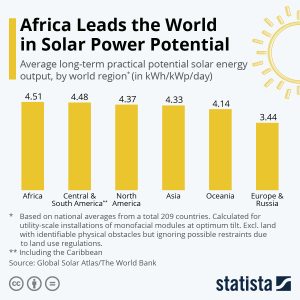
It is reported that roughly 20 percent of the world’s population lives in 70 countries which possess excellent conditions for solar power, that is, a long-term output that exceeds 4.5kwh/kwp-day. On world region basis, only the countries in Africa are said to collectively average this threshold.

However, despite presenting unique opportunities to provide affordable, reliable and sustainable electricity that could service a large share of humanity which will improve economic activities and quality of lives within the region, Africa’s solar energy potential has remained largely untapped, especially in the less developed countries of the continent.
As Naira Fades, Nigeria Needs A New Type of Leader

2

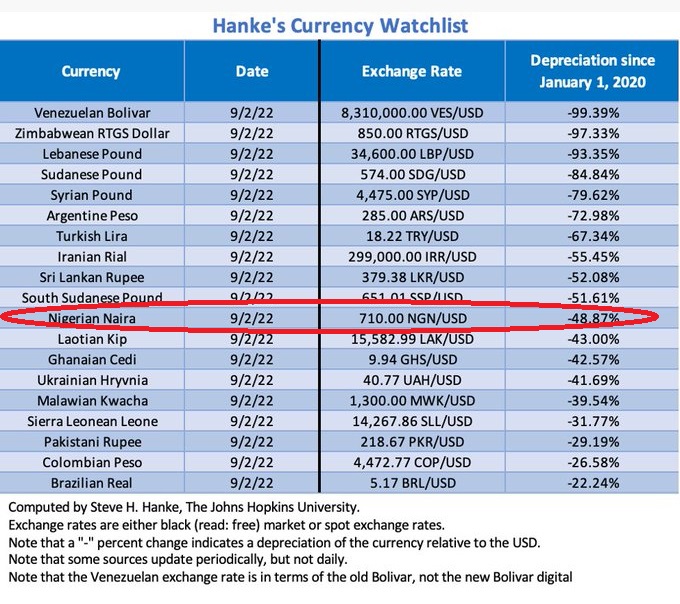
Naira moves to the 11th of all the worst performing currencies in the world (19 of them). Now, we are in the companies of Zimbabwe, Syria, Sudan, Iran, and Venezuela. Even Ukraine is doing better despite the missiles flying around its cities. People, no matter how you pray, talk or sing, can we for once look for competent people to run Nigeria, from local to federal levels, and leave our tribes and religions for once out of the equation? 

One of my finest moments as a young graduate was joining a Lagos bank IT Group in the morning and being instructed to go home – and return in the evening for a night shift. During that night shift, my supervisor (just two years ahead of me in the graduation year) was amazing.  I watched as Uche did things and by 6.30am, he said “Nd, the system is ready for all branches.” That was an accomplishment because if he had tripped, the bank would not open for customers the next day!

As we rotated, from Barth, to Blaise, to Nago, I saw young people holding responsibilities. The Software Automation Unit (SAU) is the heart of the bank; the most classified unit in any bank because you have access to the jewel of the bank.

Those were Nigerians – disciplined, competent and holding enormous responsibilities. As Nigeria continues to fade with the Naira in the miry clay, we need a leader who can motivate, inspire and connect a generation of Nigerians to #believe.

Yes, a person who can engineer Nigeria into rebirth and restoration to offer a prosperous nation that is colorful, fluidic, vibrant and open for change. Yes, a person of immense intelligence, competence, pragmatism, and unimpeachable. A person of integrity, broad knowledge, enormous vision and solid experience; one who can stimulate more vibrancy in the private sector and move the public sector out of its stasis. We need a leader!

Comment on Feed

Comment 1: Sir, I always see all our politicians as same people , who promise heaven and earth, speaks all the vocabularies in the world and once elected forgets the Task ahead and began to play a Blame game instead of focusing on improving the livelihood of the citizenry and campaign promises . May God help us

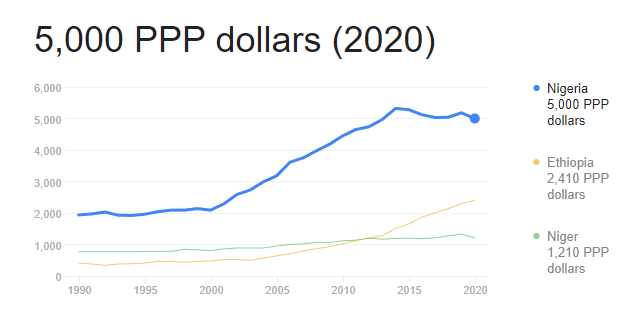
My Response: “Sir, I always see all our politicians as same people” You may be wrong. Under Obasanjo, there were jobs. Banks used big halls to hire. Under OBJ, many relocated from US back to Nigeria. Under OBJ, Nigeria was not on denial; he fought insecurity finishing bad guys. Under Jonathan, Nigeria recorded the highest per capital income in record. Yes, Nigeria was on ascension. Check this plot, the curve changed in 2015 after rising for years. The politicians are not the same!

Comment 2: “a person who can engineer Nigeria into rebith and restoration…Ndubuisi Ekekwe no one man can do that. It will be a collective efforts and determination.

My Response: Tell that to South Korea. Tell that to Rwanda. Even Nigeria was on ascension. Under Obasanjo, many relocated back to Nigeria. You underestimate the power of that word “leader”. Everyone has to contribute but someone has to LEAD. That is what it is all about.

Comment 3: “Woe unto a nation whose king is a child”
I was discussing with someone on the need for good leadership. The person told me that Nigerians need to change because the leader can’t do it alone. While I agree that Nigerians need to change, the change starts from the top. Good body cannot have a rotten head. A nation is a reflection of its leader (President)

Nigerians don’t hold leaders accountable and we mostly resort to blaming fellow victims. We have seen them as problem children and we should just leave them alone. Unfortunately, leaving them alone is causing destruction. Nigeria needs a leader with a vision and the capacity to effect change.
Nigeria shall rise again!


Naira Ranks 11th in the List of 19 Worst Performing Currencies in the World for 2022

Naira Ranks 11th in the List of 19 Worst Performing Currencies in the World for 2022

0
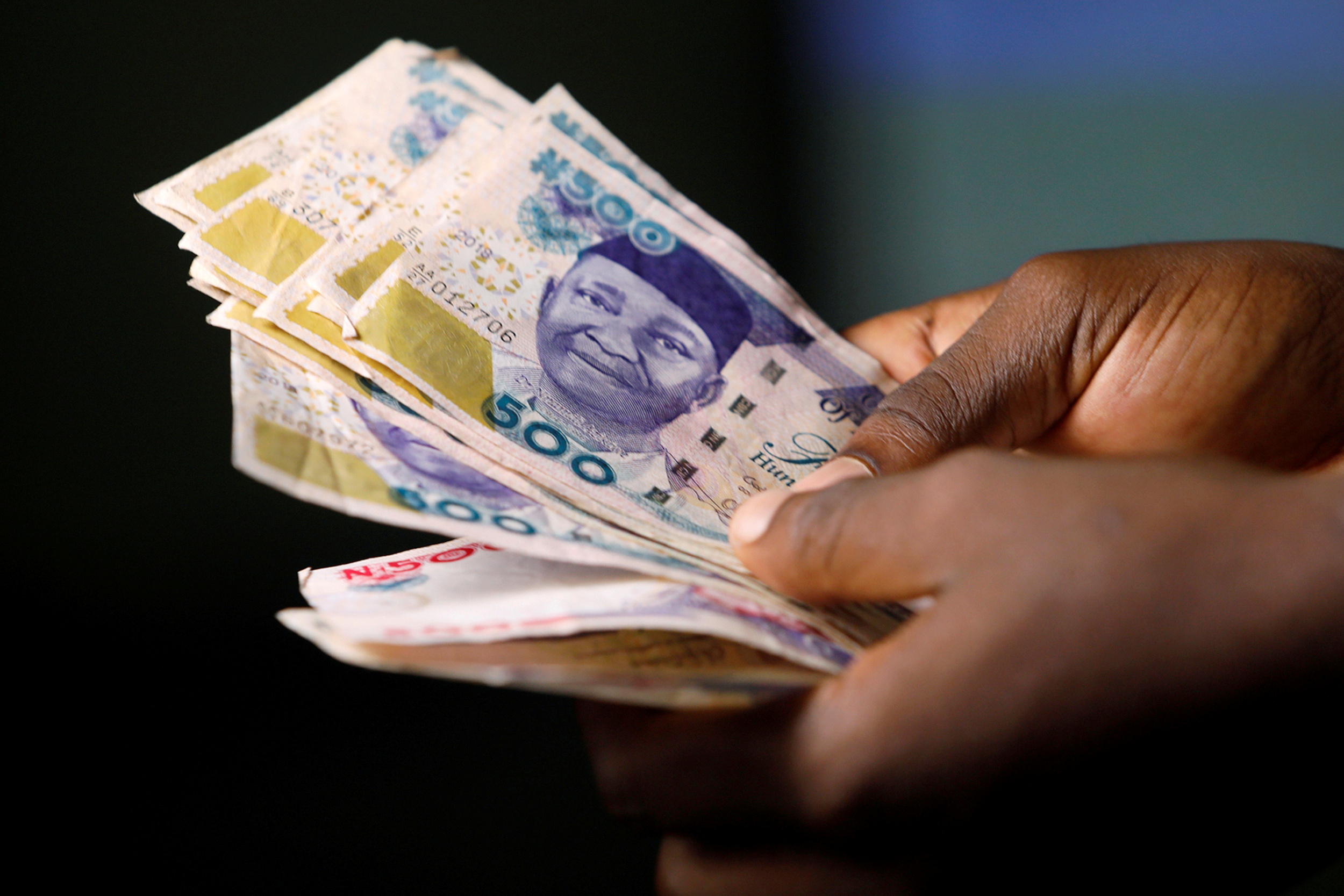
Nigerian naira banknotes are seen in this picture illustration, September 10, 2018. REUTERS/Afolabi Sotunde/File Photo

The President Buhari administration has been described as incompetent, as the nation’s currency, the Naira, is currently a mess, among several other problems.

According to Hanke’s Currency watchlist, compiled by Steve Hanke and John Hopkins University, it revealed the Naira ranked as the 11th worst-performing currency in the list of 19 worst performing currencies in the world and the fourth worst in Africa.

According to the data, the Naira had lost 48.87% of its value against the US dollar as of September 2, 2022, compared to its value in January 2020.

Steve H. Hanke a professor of Applied Economics expressed his displeasure about how the Nigerian government is handling the Naira.

He said;

“In this week’s Hanke’s #CurrencyWatchlist, Nigeria takes the 11th place. The naira has depreciated against the USD by 48.87% since Jan 2020. With Sleepy Buhari at the helm, the Nigerian naira is tanking.”

The exchange rate between the naira and the US dollar has plummeted from N565/$1 to N705/$1, representing a N140/$ loss year to date in the black market.

Amid double-digit inflation, Nigeria’s foreign reserves are dwindling as the government races to shore up a swooning currency.

Despite the numerous attempts by the Central Bank Of Nigeria CBN, to make the naira stable, the currency has continued to decline.

To defend the Naira, the Apex Bank introduced a slew of regulations, from barring the sale of dollars to BDCs to the RT200 scheme, which is designed to provide an N65 rebate on export revenues.

Nonetheless, its intervention comes at a cost in terms of Nigerian foreign reserves, which have not been growing at the expected rate despite high oil prices.

However, the CBN has maintained artificial stability in the official forex window by selling foreign exchange from its reserves.

The official exchange trades at around N430/$, expanding the gap between the official market and black market Consequently, Nigeria’s external reserves shrank by $1.496 billion year to date.

On a year-to-date basis, the reserve has reportedly lost $1.37 billion from $40.52 billion in December 2021 to $39.16 billion in June 2022. In the month of June, the external reserve gained $671.63 million, following a $1.1 billion decline in the previous month.

The drop in reserves is even more concerning given the recent spike in crude oil prices. International organizations have continually advised the CBN to abolish the official window.

Recall that the Vice President of Nigeria held a meeting with the World Bank Group President, David Malpass who advised Nigeria on the exchange rate unification.

President Malpass emphasized to the VP that a unified exchange rate will significantly improve the business-enabling environment in Nigeria, attract foreign direct investment, and reduce inflation.

He also discussed the importance of increasing domestic revenues through broadening Nigeria’s tax base and increasing the efficiency of tax administration.

What Countries Listed In The Worst Performing Currencies Should Expect

Financial experts believe that countries with worst performing currencies should expect the following;

  1. Reduction in foreign direct investment.

  2. Massive capital flight

  3. Increase inflation

  4. Reduced economic growth

  5. Reduced GDP (gross domestic product)

  6. Increase graduate unemployment

  7. Reduction in government’s expenditure on infrastructure projects

  8. Unstable prices of commodities make it difficult for any meaningful planning

  9. Reduction in trade volume

  10. Increase hardship in countries coupled with increasing crime rate etc.


Who is my neighbor: the law of tort at a glance!

0

To a layman, his neighbor is someone who lives close to him, as simple as that. This coincidentally is not just a layman’s definition but also the dictionary definition of the word neighbor, but no, the word neighbor has a whole new meaning in law. 

This question, who is my neighbor was first raised by an English jurist; Lord Atkinson in the case Donoghue v. Stevenson UKHL 100, SC (HL) 31, AC 562, All ER Rep 1; in the year 1932, and the answer to this question propagated the as new principle of law known as “the neighborhood principle” and also expanded the principle of duty of care under the law of tort. 

A duty of care, therefore, is a legal obligation that is imposed on an individual, requiring adherence to a standard of reasonable care while performing any acts that could foreseeably harm others i.e. his neighbors. 

In effect, you owe a duty of care to your neighbors in law and you must apply every caution and exercise every reasonable care to ensure that your neighbor does not get injured from your actions or inactions. 

According to Lord Atkinson, our neighbors are persons who are so closely and directly affected by our acts or inactions that we ought reasonably ought to have them in contemplation as being so affected when we are directing our mind to the acts or omissions which are called in question.

By this legal principle of the law of tort, you are under strict liability and the requirement not to carry out any act which can cause harm to others. You are under strict liability to contemplate and avert your mind towards the harm you act or failure to act would reasonably cause another person and you are expected to do everything to avert that harm because you owe that next person a duty of care as your neighbor. 

In simpler terms, your neighbor-in-law can be anybody who could suffer an injury from your actions (things you do/ did) or your inactions (things you failed to do). 

For you to establish that a person is your neighbor you must first establish that his acts or omission could be reasonably foreseen to cause an injury to you. 

The key ingredient in establishing a neighbor in law is that it must be reasonably foreseen that the actions or inactions of that fellow will likely affect you by causing a direct injury to you.

According to this principle of law, manufacturers, producers, and makers of consumable items are your neighbors and they must exercise reasonable care in manufacturing any item that is to be released to the market for consumers to purchase and any injury suffered by any consumer they will be held liable to breach of duty of care. 

Meta Handed $402m Fine for Exposing the Data of Teenage Instagram Users

0

Meta has once again been caught in the web of a regulatory authority in Ireland. The social media behemoth, which has over the years been at the center of antitrust probes, was handed €405 million (about $402 million) fine by Ireland’s Data Protection Commission.

The huge fine follows an investigation into the company’s handling of teenagers’ data on Instagram.

The Verge reports that the decision and fine were finalized last Friday, according to its conversation by DPC spokesperson Caolmhe McGuire, and that “full details of the decision will publish next week.”

According to the report, the DPC’s deadline for making a final decision on this matter was the end of this week. The investigation started almost two years ago, and focused on two ways in which the company allegedly breached GDPR rules.

The first was Instagram allowing young users, ages 13-17, to set up business accounts on the platform, which made those users’ contact information publicly available. (Users sometimes switch to business accounts because doing so comes with access to more engagement analytics.) Instagram also allegedly made the accounts of some young users public by default.

This is the third and largest fine the DPC has imposed on Meta, easily eclipsing the 225 million euros (about $267 million at the time) the company faced after the DPC found that WhatsApp didn’t properly inform EU citizens about how it collected and used their data, particularly regarding how it shared that data back with Meta. WhatsApp was ordered to change its privacy policy, and said it planned to appeal.

There was also a much smaller fine of 17 million euros (about $18.6 million) for record-keeping issues around security breaches. The DPC also has dozens of other investigations underway against Big Tech companies, including several more involving Meta’s data practices.

Meta said in a statement to Politico that it updated the public-by-default setting more than a year ago, and that “anyone under 18 automatically has their account set to private when they join Instagram, so only people they know can see what they post, and adults can’t message teens who don’t follow them.” The company told the Associated Press that “we disagree with how this fine was calculated and intend to appeal it.”

The way Meta — and Instagram in particular — handle the online experience if its youngest users has been under a huge amount of scrutiny in the last couple of years, thanks in part to Frances Haugen’s testimony about Instagram’s effect on mental health. Instagram has also simultaneously tried to build more products for those young users, which has been met with huge backlash.

Instagram head Adam Mosseri has argued in favor of this work, though: “I have to believe parents would prefer the option for their children to use an age-appropriate version of Instagram — that gives them oversight — than the alternative,” he said last year. He promised to work with regulators to make that happen, and Meta said it also cooperated with the DPC’s recent investigation.