DD
MM
YYYY

PAGES

DD
MM
YYYY

spot_img

PAGES

Home Blog Page 4994

Our production output is Knowledge and we distribute it amazingly; REGISTER today

0

“50 years ago, more than 80% of the value reflected on the balance sheets of Fortune 500 companies was physical stuff—plant, equipment, oil in the ground, inventory on the shelves. Today, more than 85% of the value on the balance sheets of Fortune 500 companies is “intangibles”—intellectual property, brand value, and a host of things more closely tied to human capital than to physical and financial capital. People are today’s value drivers.” – Fortune

At Tekedia Institute, we work  to advance the missions of firms by deepening the capabilities of the human capital through knowledge. We’re working with more Chief Learning Officers (CLO) as they architect and develop programs to ensure their firms have the skills for today and the future.

The Latin intellectuals wrote the “scientia potentia est” [knowledge is power]. Francis Bacon put it as “ipsa scientia potestas est” [knowledge itself is power]. Proverbs 24.5 wrote “..a man of knowledge increases strength…”.The Igbo Nation has “a man of knowledge dines with kings”.

I can extrapolate, when companies have knowledge, they win markets because only knowledge organizes all factors of production effectively.

At Tekedia Institute, our production output is Knowledge and we distribute it amazingly. Check out all our courses here 

Controversy Surrounds Mobil Nigeria-Seplat Deal As NUPRC Nullifies Transaction Despite Buhari Approval

0

Nigerian Upstream Petroleum Regulatory Commission (NUPRC) has rejected Nigeria’s President Muhammadu Buhari consent for Seplat’s acquisition of ExxonMobil’s shallow water assets. The rejection by the upstream regulator came hours after presidential spokesperson Femi Adesina said that President Buhari had approved the transaction.

The NUPRC, in a statement shared with the media on Monday, said the deal requires a regulatory approval instead of a presidential approval, and ExxonMobil has been notified that the deal has been declined.

“The Nigerian Upstream Petroleum Regulatory Commission (NUPRC) affirms that status quo remains in respect of ExxonMobil/Seplat Energy share acquisition. Responding to media enquiries on latest development about the transaction, the Chief Executive of the NUPRC Engr. Gbenga Komolafe clarified that the Commission in line with the provisions of the Petroleum Industry Act 2021 is the sole regulator in dealing with such matters in the Nigerian upstream sector,” said a statement by NUPRC chief executive, Gbenga Komolafe.

“As it were, the issue at stake is purely a regulatory matter and the Commission had earlier communicated the decline of Ministerial assent to ExxonMobil in this regard. As such the Commission further affirms that the status quo remains,” he added.

The contradicting development, which pits the federal government against its parastatal, has stirred backlash from the Nigerian public, who say it depicts disorderliness in the government and lack of synergy between the presidency and federal agencies.

Statement issued by presidential spokesperson Femi Adesina said Buhari had approved the transfer in his capacity as Minister of Petroleum Resources and the approval was in consonance with the country’s drive for Foreign Direct Investment in the energy sector and considering the “extensive benefits of the transaction to the Nigerian Energy sector and the larger economy.”

The sale of Mobil Producing Nigeria Unlimited got into controversy earlier in the year after Exxon Mobil Corporation had entered a Sale and Purchase Agreement with Seplat Energy. The agreement is for the acquisition of the entire share of Mobil Producing Nigeria Unlimited, Mobil Development Nigeria Inc, and Mobil Exploration Nigeria Inc.

The purchase would enable Seplat Energy to scale up production by 95,000 barrels of oil a day from assets in a joint venture ExxonMobil runs with NNPC, per Premium Times.

The transaction was halted following a court ruling obtained by the Nigerian National Petroleum Corporation Limited. The court ruling had blocked the move to purchase the entire oil assets of Mobil Producing Nigeria Unlimited. The NNPC had argued that it reserves the right to be given consideration ahead of other companies in the sale of oil blocks by ExxonMobil.

MPNU is a local unit of ExxonMobil. Per Premium Times, the July 6 decision of the High Court of the Federal Capital Territory to block the sale, includes a share sale and purchase deal it struck with Seplat in February.

NNPC’s prayer was for the court had prayed the court to declare that a conflict happened between the state-owned oil company and MPNU over the “interpretation of preemption rights under their Joint Operating Agreement (“JOA”) and order NNPC and MPNU to arbitration as required by the JOA.”

But in its response, Seplat Energy argued that neither itself nor Seplat Energy Offshore Limited was a party in the lawsuit, and insisted the share purchase agreement remained valid.

However, Buhari had taken side with the NNPC, suggesting that he did not approve of the deal. Thus, the statement of approval issued by the presidency becomes worrisome. There are indications that the approval must have come from people within the presidency, a development which lends credence to the concern that the president is not control of critical issues taking place in the country.

Nigeria Ranks Fourth in World Bank’s IDA Debtors’ List

0

Nigeria has been ranked the fourth country in the world with the highest debt according to the World Bank’s newly released financial report for the fiscal year of 2022 audited financial statements for International Development Association (IDA).

Nigeria which has the highest IDA debt stock in Africa increased its debt to $13bn since June 30, 2022 from $11.7bn in June 30, 2021

Other countries in the top five position are India in the first position, Bangladesh in the second position, Pakistan in the third position and Vietnam in the fifth position.

Whereas the other top 5 countries reduced their debts between 2021 and 2022, Nigeria increased its debt by 11.11percent after accumulating additional $1.3bn to the existing $11.7bn from the last fiscal year. India reduced its debt from $22bn in 2021 to $19.7bn in 2022, Bangladesh reduced its debt from $18.1bn to $18b, Pakistan reduced its debt from $16.4bn to $15.8bn and Vietnam’s debt reduced from $14.1bn to $12.9bn.

This debt is different from the outstanding loan of $486million from the World Bank’s international Bank for Reconstruction and Development.

According to the World Bank, even though Nigeria’s current debt may be considered sustainable for now, it is vulnerable and costly especially considering the large and growing debt financing of the Central Bank of Nigeria. Thus, the country’s debt is at risk of becoming unsustainable in the event of macro-fiscal shocks.

The bank also said the country is not far from experiencing financial and economic crisis due to increasing cost of debt servicing which has disrupted public investment and critical service delivery spending.

The Need For Fintechs In Nigeria To Develop Offline Transaction Feature – Case Study Of Safaricom’s M-Pesa

13

If you have been keeping tabs on the Fintech space in Nigeria, you will notice that there is a massive influx of Fintech startups in the country’s tech ecosystem. Nigeria is currently home to over 200 fintechs, which has placed the country among Africa’s Fintech leaders with a lively crop of startups and a growing suite of digital offerings.

One would naturally think that since there is a significant influx of Fintech startups in the country, the percentage of Financial inclusion will be at an all-time high. Unfortunately, the reverse is the case, as a recent publication on Tekedia disclosed that “only 35% of the Nigerian population have access to Fintech” which is not even above the average number of the country’s population.

No wonder, despite the influx of Fintechs in the country, tech experts continue to state that the Fintech sector has only scratched the surface. A tech expert Mr. Brian Manuwike recently disclosed that the nation’s smartphone penetration is at 35 percent, which implies that financial technology companies can only serve about 35 percent of Nigeria’s population.

Access to digital payment drives the adoption of digital financial services, however, once customers use the service for the first time and have a good experience, they will always resort to convenience, which is a common human trait. The problem with financial inclusion in Nigeria is not necessarily a lack of infrastructure, but a relatively low smartphone penetration in the country which is at 35 percent.

Nigeria’s mobile penetration rate has been described to be lower than that of developed markets, although it is estimated to rise to 130 million or about 60-65% of the total population by 2025. Although mobile Internet penetration is growing fast in the country, there are several barriers to access in Nigeria.

Affordability is one major barrier for a large percentage of people in the country. Another barrier is the high cost of internet data subscriptions. Despite the fact that there are some people using smartphones in rural areas, there is a significant rural-urban divide. Approximately 61% of Nigerians in rural areas are unconnected, compared to 40% in urban areas.

Looking at these constraints that have contributed to the low financial inclusion in the country, this is a more ideal reason why Fintech startups need to invest more in offline transaction infrastructure, where consumers can access financial products/services with cash and without necessarily needing a smartphone. This offline distribution will drastically drive the rate of financial inclusion in the country.

Using Safaricom’s M-Pesa As A Case Study

To further buttress my point on the need for Fintechs in Nigeria to include an offline transaction feature, I will use Safaricom’s M-Pesa as a case study.

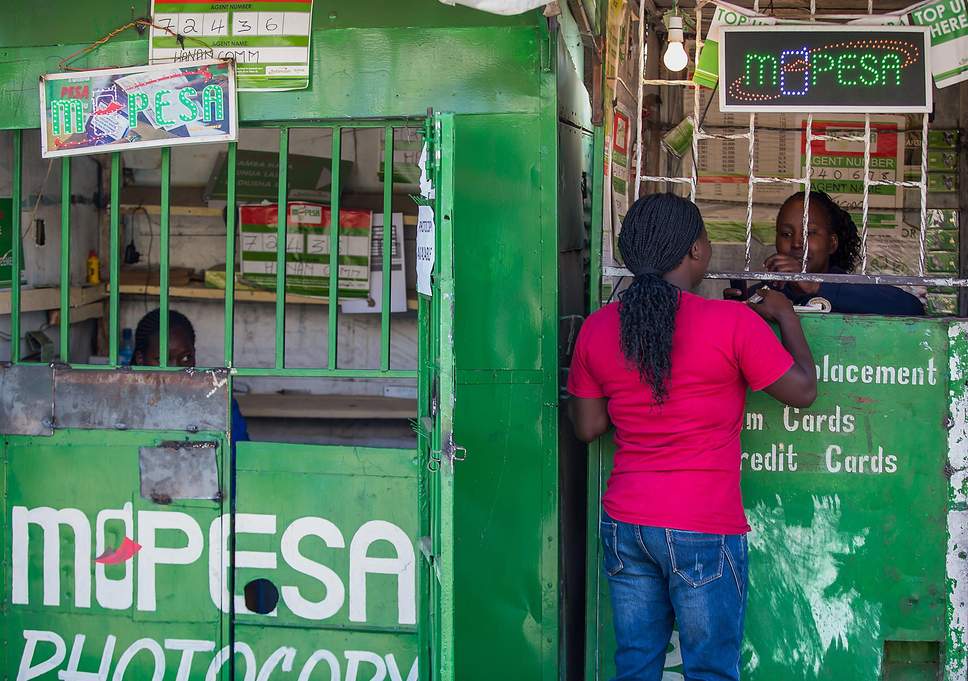
M-Pesa (M for mobile, Pesa is Swahili for money) is a mobile phone-based money transfer service payments and micro-financing service. M-Pesa allows its users to deposit, transfer money, access credit, and savings, and pay for goods and services all with a mobile phone.

An interesting feature of the new M-Pesa super app is the “offline mode” which allows customers to use it and complete transactions even without data bundles or when totally offline. In general, the app is also zero-rated and does not consume any additional data when customers use it, which is something very important most especially for Nigerian users.

M-Pesa allows users to deposit money into an account stored on their cell phones. Despite having an app where transactions can take place, to achieve large financial inclusion, M-Pesa rolled out a USSD shortcode service.

This feature made it accessible for people who do not have smartphones to use the service simply by just dialing a code on any mobile device. The fintech platform now has over 25 million customers in Kenya who rely on it for day to day purchases and payments. M-Pesa is also specifically designed to benefit customers who have no access to banks.

Conclusion

A large percentage of Nigerians are reported to be financially excluded. This means they do not use any financial products and services, both formal or informal.

However, in order to deepen financial inclusion in the country, Fintech startups needs to roll out more features, most especially the offline mode of transaction.   This feature will ensure that those who do not own a smartphone and also those who have difficulty purchasing data will be financially included.

Financial inclusion is seen as a major yardstick for economic development and individual well-being, the increase in financial inclusion is aimed to create capital accumulation which positively impacts a nation’s economy.

It strengthens the availability of economic resources and builds the concept of savings among the poor. Therefore, the development of offline distribution will drastically drive financial inclusion.

Get More Value on Your Money with Mintyn, A Tekedia Capital Portfolio Startup

0

Good People, Tekedia Capital portfolio neobank startup, Mintyn | Online Banking, achieved a major milestone today. The banks of the future must do more to thrive – and Minityn is doing just that. Mintyn’s playbook to make sure that your money delivers more value if banked with Mintyn than any bank in Nigeria is working.

You want to buy rice and you have N5,000. If you buy that rice alone from your account with other banks in Nigeria, it could give you 100 cups*. But if you are banking with Mintyn, through Mintyn Trade in its app, you can post “I want to buy rice and I live in Ikeja”. Within minutes, Mintyn will share that message. Other people who want to buy rice indicate interest.

Mintyn will then pool the funds and buy that rice in bulk – and then use its logistics systems to share the rice. But the time everything is done, your N5,000 could give you 200 cups*. Is that not smart banking? We have doubled value for you? You see why Nigerians like Mintyn!

Mintyn Trade serves estates, churches, mosques, companies, etc where many people can be served together to reduce the marginal cost of logistics. I commend the team for exceptional operation; they’re growing the numbers. Mintyn is available in all locations in Nigeria here mintyn.com