DD
MM
YYYY

PAGES

DD
MM
YYYY

spot_img

PAGES

Home Blog Page 4997

We Can Use FrieslandCampina’s Model to Fix Aba Shoe and Leather Industry in Nigeria

0

FrieslandCampina is a Dutch multinational dairy cooperative which is based in Amersfoort, Netherlands. Largely, it is “owned” by dairy farmers. What happens is this: you produce 2 trucks of milk, I produce 5, and another produces 8, etc. Because we are small in our capacities, no one pays attention. But if we all come together, we become BIG and can move global. Those farmers did just that and today, they have one of the largest companies in the world with annual revenue in excess of $11billion.

Can we run the same playbook in Aba? Use a brand name, and ask those small shoemakers to feed into the brand. As Naira continues to fade, many will buy “local”, and a business model that can feed that pipeline has a promise. I suggest a name – “Aba” or “Enyimba” leather products brand, to be owned and controlled by men and women in the leather industry, within a cooperative.

People, you can use aggregation to get scale and drive orchestration in markets. That name-brand provides one certainty: designer, we will buy whatever you produce provided it is within standards. Once that is there, those men and women will scale because the demand side has been fixed.

Comment on LinkedIn Post

Comment: This is old skool Ndubuisi Ekekwe… as I read the article, I thought, the old words worth is back, demanding big attention span from readers… until I looked at the date of the article and saw it was 2017 !

Well if an article 5 years old has been resurrected by this analyst with a penchant for business detail, it can mean only one thing… the content is just as valid today, and Aba has not changed.

Is that a good or a bad thing? It is bad because the artisans are not seeing just reward from their labour.

The problem however, that production is often by hand, or at least hand finished, and that imperfections exist, would be a selling point in other markets globally.

Top finds for numismatists and philatelists for instance are coins or postage stamps with minting or printing flaws. Where labour is at a premium, small imperfections can be seen as proof of handicraft rather than mass production. Indeed, specialist machine changes are now available to deliberately introduce small process flaws to give the hand made look.

It may not be that Aba has lost its way in being what Nigeria needs. It may be that Nigeria has failed to be what Aba needs.

No one is a prophet in their own land.

My Response: Aba is fading and that affected my village Ovim. Ovim train station was the largest train station in our area serving many communities. Typically, from Aba, every train is expected to stop at Umuahia, Uzuakoli and then Ovim, bypassing some small stations.

Ovim served Ohafia, Arochukwu, Ahaba, and many other communities. As that was happening, businessmen went and built houses around the station. But with the train station gone, everything has collapsed. The hub is gone and Ovim lost a strategic positioning which was used to supply garri to Enugu via rail!

Every kid rode a Raleigh bicycle which was used to move foodstuffs from Oriendu Market to the train station! It was great.


Fixing Aba Shoe And Leather Industry

Bonus Week [Video]

0

  Share this: Click to share on Facebook (Opens in new window) Facebook Click to share on X (Opens in new window) X Click to share on WhatsApp (Opens in new window) WhatsApp Click to share on LinkedIn (Opens in new window) LinkedIn Click to email a link to a friend (Opens in new window) […]

This post is only available to members.

The Playbooks for Winning in Africa

0

The history of money is deep; to the cowries and to the barter. Yes, humans have always figured out how to exchange goods and services for value. And across centuries and kingdoms, the quest for improving the efficiency of that exchange has remained. A moment came in 7th century China when the  Tang dynasty invented paper currency. Later on, the Song dynasty in the 11th century made it popular. The Mongol Empire and Yuan dynasty scaled it. The trajectory to frictionless exchange has never stopped.

Adam Smith postulated the  “invisible hand” in his thesis on improving the mechanics of firms. Isaac Newton in Mathematica Principia seeded the foundations of modern natural philosophy. That has morphed into the modern era of bytes, moving money via computing systems and including the Hodler Bitcon-nia!

William Shakespeare’s Lord Polonius: “What do you read, my lord?” Hamlet: “Words, words, words”. The Questioner: “What do you see  influencing intra-African trade?” The Answerer: “Currency, supply chain, products”. At Tekedia Institute Mini-MBA edition 9 which begins Sept 12, we will look at “The Playbooks for Winning in Africa”! See what we plan to do 

High Inflation: The Need For Employers To Operate A Flexible Payment System In The Workplace

0

With the inflation rate constantly spiking around the world, doubling in 37 of 44 advanced economies over the past two years, it has no doubt put a strain on so many businesses.

Showing no signs of stalling, food commodities, and the price of diesel/ petrol continue to skyrocket which has affected the standard of living for people across the globe. The high-inflation rate has made low-income households turn to loans and credit cards to be able to cope during this period.

The workplace hasn’t been exempted from the hit, as Its impact has also been felt there, which has resulted in the mass layoff of employees across the globe, over the inability of employers to meet up with their salaries.

Some employees have had their salaries slashed from the usual amount that they were being paid, as employers are now devising various strategies on how to cut costs and maximize profit to prevent their already dwindling revenue and income from further falling.

The rising cost of living is impacting the entire workforce and there is a need for employers to address this, as most employees have had their disposable income negatively affected which is taking a toll on their workplace input.

Looking at the fact that bills are increasing, coupled with the fact that a large percentage of employees still earn the same amount is a cause for concern. Few experts have urged employers to look for how they can assist their employees either through an increase in salary, incentives, or compensation package, etc.

Studies reveal that money issues affect employees’ productivity in the workplace. With the current high inflation rate ravaging global economies, there is no disputing the fact that most employees’ productivity will be affected.

Asides from the fact that offering employees compensation packages, incentives, increase in salary and the likes, is a good idea to limit the strain caused by the inflation on employees. However, I posited that employers should enable employees to get flexible access to salaries, moving away from the conventional system of month-end payment.

Flexible payment system is a new concept whereby employees are paid with an on-demand option. This means if the employee requires their pay early, they can demand it from the management, in order to fulfill their financial needs removing pressures.

This system of payment provides an on-demand solution to overcome financial difficulties without the need to ask for an advance from the employer which, in itself, is a daunting task.

I realized that a flexible salary payment system is one of the major ways employers can use to cushion the effect of inflation on their employers to enable them to have access to their salaries whenever they need it. It can be either weekly or twice in a month, depending on whichever model the employee chooses.

Often, workers find it challenging to meet everyday expenses or worry about not being able to meet them. Additional pressure stemming from inflation which has led to financial difficulties can cause mental health issues if the long-term strain on the finances of employees is not addressed.

With a flexible payment system, it provides them with a solution that does not result in additional borrowing and interest associated with borrowing. Few analysts have attributed a flexible payment system as not just a way to make employees work harder, but it can also effectively bring about organizational changes as it materializes in labor productivity.

Asides from adopting a flexible payment system in the workplace due to inflation, I am of the opinion that it should be fully adopted in every organization across the globe even when inflation subsidizes. The system has been proven to attract talent, improve productivity and also leads to staff retention.

Nigeria’s Largest Public Companies And Lessons from America – The Challenge of Lost Future

1

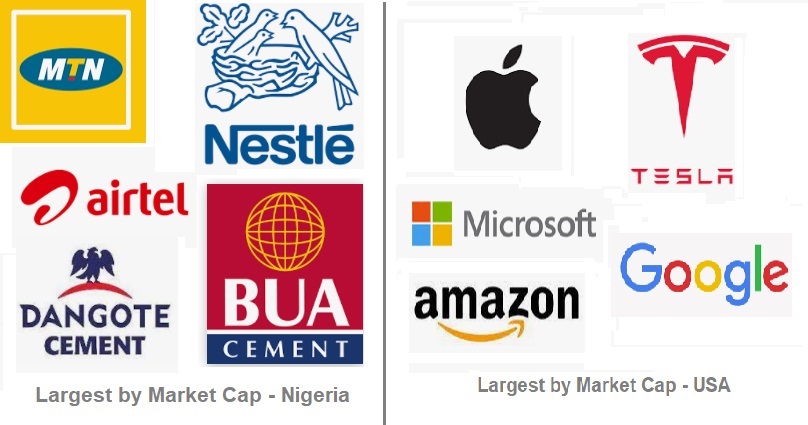
In 1917, the largest publicly traded company in the United States was US Steel. Fifty years later, in 1967, the largest recorded was IBM. Over those fifty years, American leading companies had transmuted from building and construction infrastructures to digital infrastructure companies. Before those, food companies were dominant.  Today, the largest US publicly traded companies are knowledge companies like Apple, Google and Microsoft. 

Simply, the US has moved from fundamental infrastructures  to creating wealth on numbers (yes, data) just as Greek philosophers had postulated many centuries ago.  I expect in 50 years for the leading companies to become firms where the knowledge creation is autonomous, with artificial intelligence, unbounded by pure human capabilities. In other words, dynamic numbers!

In Nigeria today, we are at the phase of that 1917 and 1967 as we are still building the constructing and core digital infrastructures with MTN, Nestle and  Dangote Cement leading the stock market. 

Looking deeper, the knowledge era has not arrived at scale in Nigeria. It will come, but it may take a few more decades looking at the unfolding paralysis ,since the companies which will anchor that future are not even Nigerian even though they do everything in Nigeria. Yes, they are legally Delaware (USA) companies with 100% of operations in Nigeria. That is Nigeria’s lost economic future, and will be more devastating than the impacts of dried crude oil wells.

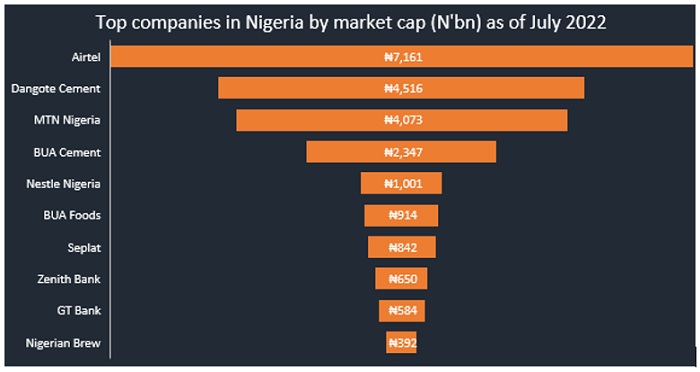
Top Nigerian companies by market capitalization, July 2022

This is the roll call, according to Nairametrics.

  • #1: Airtel Africa – N7.16 trillion
  • #2: Dangote Cement – N4.52 trillion
  • #3: MTN Nigeria – N4.07 trillion
  • #4: BUA Cement – N2.35 trillion
  • #5: Nestle Nigeria – N1.00 trillion
  • BUA Foods – N914.4 billion
  • Seplat Energy – N841.8 billion
  • Zenith Bank – N649.9 billion
  • GT Holdings – N584.2 billion
  • Nigerian Brew – N392.1 billion

Comment on LinkedIn Feed

Comment: Good point Ndubuisi Ekekwe, but part of the collateral damage is the high level of unemployment in the former manufacturing hubsof the USA that gave rise to the xenophobic followers of Trump.
Those manufacturing industries died in the USA and resurfaced in China, and LATAM countries. We must not allow the rise of knowledge industry kill off the manufacturing sector. That is what China is doing and reason for its consistent growth in the past 20years.
With the impact of the war between Russia and Ukraine, we now know that the knowledge industry means nothing without the agriculture and manufacturing industry. We must continue to champion the simultaneous growth of both industries.

My Response: Great point but knowledge companies do not mean lack of manufacturing. Tesla is a knowledge company. It sells tons of software licenses via vehicles (you cannot resell your Tesla with the licenses; the new owner has to re-license). Amazon is one of largest employers in America with 1.2M workers; it powers many small manufacturers across America. 

Your argument was made in the 1790s when farmers rejected the notion that tractors were good since they  would kill jobs. Foxconn, which makes things for Apple, is worth about $70B; Apple which depends on it, is worth $2.6 trillion. Many activists will prefer Foxconn which employs close to 1million people to Apple which employs say 40k directly but indirectly more than 5 million apps makers. I do think the activists are wrong!

Knowledge will run empires; Apple is a better company than Foxconn on all metrics. For you to thrive on knowledge, you have won the infrastructure as that is at the top of the pyramid.  The US does not have a  “high level of unemployment” to my knowledge; the problem today is that we have few people to employ. The complainers are troublemakers who find excuses to cause trouble.