DD
MM
YYYY

PAGES

DD
MM
YYYY

spot_img

PAGES

Home Blog Page 5

TRON Price Holds Strong as Stablecoin Supply Tops $83B, While ZKP’s Daily Presale Auction Becomes the Talk of the Market

0

TRON is gaining renewed attention in early 2026 as on-chain data confirms its position as one of the most active payment networks in crypto. The TRON price remains stable as the network now hosts more than $83 billion in stablecoin supply and processes over $20 billion in daily transactions.

Meanwhile, Zero Knowledge Proof (ZKP) is drawing interest for a very different reason. Instead of competing on transaction volume or speculative price action, ZKP is being evaluated through its presale structure, specifically, why it uses daily presale auctions instead of fixed token prices. This contrast is shaping how investors define the best crypto to buy now in 2026.

TRON Price and Network Growth: What the Data Shows

Reports from CoinDesk highlight TRON’s continued dominance in stablecoin infrastructure.

Key metrics supporting the TRON price prediction include:

  • Over $83B USDT supply hosted on TRON
  • More than $20B in daily transaction volume
  • Around 2.8M daily active users
  • Over 361M total accounts
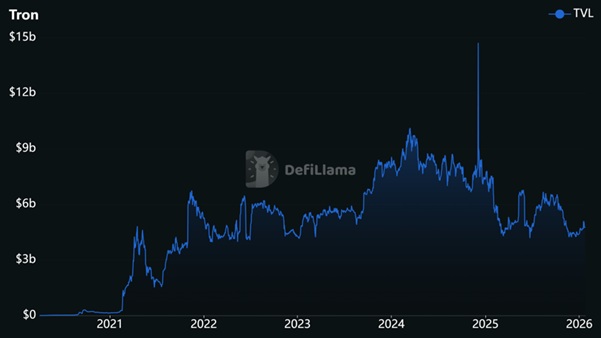
  • More than $25B TVL across DeFi

TRON also maintains a leading share of retail-sized stablecoin transfers and strong adoption in Asia, particularly in India, Indonesia, and Turkey. From a structural perspective, the TRON price is increasingly supported by real utility rather than speculative trading alone, which strengthens its profile among top crypto coins focused on payments and financial infrastructure.

TRON Price Prediction: Utility Over Speculation

Unlike many networks that depend on narratives, the TRON price prediction is closely tied to measurable on-chain activity. With stablecoin transfers, lending platforms like JustLend, and expanding institutional integrations, TRON behaves more like a financial rail than a speculative asset.

This positions TRON as one of the top crypto coins for users focused on real transaction demand. However, its size and maturity also mean that future upside is likely to be steady rather than explosive, which is why capital’s focus is shifting toward earlier-stage infrastructure projects when searching for the best crypto to buy right now.

Zero Knowledge Proof In Practical Terms

ZKP can be understood as a verification-focused blockchain system. Instead of moving assets or settling payments, ZKP is designed to prove that digital processes were executed correctly without exposing any internal data.

This shifts blockchain from a financial ledger into a trust layer for intelligent systems, which is why ZKP is increasingly discussed as one of the best crypto to invest in from a long-term infrastructure perspective.

Why ZKP Uses Daily Presale Auctions Instead of Fixed Presale Prices

ZKP’s presale structure is fundamentally different from most crypto launches. Instead of setting a fixed price or offering private discounts, ZKP uses a daily presale auction model.

Each day:

  • Participants contribute on-chain
  • Total demand is measured
  • Allocation is calculated proportionally
  • The next day resets under the same rules

This approach removes insider pricing and replaces it with mathematical allocation.

Key advantages of daily presale auctions:

  • No private rounds or preferential access
  • Transparent, on-chain distribution
  • Price discovery driven by real demand
  • Reduced concentration risk

This model is one reason ZKP is being viewed as one of the best cheap crypto to buy now, especially for investors focused on fairness and long-term positioning.

Why ZKP Attracts Long-Term Capital

ZKP stands out because it supports:

  • AI system verification
  • Privacy-first computation
  • Cryptographic accountability
  • Enterprise-grade digital infrastructure

As capital becomes more selective, infrastructure projects tend to attract stronger positioning. This is why many now see ZKP as one of the best crypto coins to buy in 2026.

In Summary

The current TRON price prediction reflects a network built on real usage, with stablecoin settlement and high transaction volume supporting long-term relevance. TRON remains one of the top crypto coins for payments and financial infrastructure.

ZKP represents a different opportunity altogether. By using daily auctions instead of fixed presale prices, ZKP introduces a transparent, demand-driven distribution model. Combined with its role in privacy-preserving verification, this positions ZKP as one of the best crypto to buy now and potentially the best crypto to invest in 2026 for investors focused on infrastructure rather than speculation.

Explore Zero Knowledge Proof:

Website: https://zkp.com/

Buy: https://buy.zkp.com

Telegram: https://t.me/ZKPofficial

X: https://x.com/ZKPofficial

FAQs

  1. What is the current TRON price outlook?
    The TRON price is supported by strong stablecoin activity and high daily transaction volumes, keeping the network structurally stable.
  2. Why does ZKP use daily presale auctions?
    To ensure fair, transparent price discovery without private allocations or insider pricing.
  3. How is ZKP different from other presales?
    ZKP uses on-chain daily presale auctions instead of fixed prices, making distribution driven by real demand rather than marketing.

500x ROI Potential: Securing Early Entry in the Year’s Biggest Crypto Presales 

0

The global cryptocurrency market remains in a consolidation phase with a total capitalization of $3.07 trillion and Bitcoin (BTC) holding firm at $89,041. While major assets seek directional cues, the spotlight has shifted toward a high-impact presale auction trend, where community-driven funding is replacing traditional venture capital dominance.

This rotation favors projects with “clean” cap tables and structured supply mechanics that eliminate insider dump risk. By focusing on these transparent distribution models, investors are targeting a 500x ROI, positioning early during Stage 2 windows before massive raise targets and infrastructure scale become primary price drivers.

Zero Knowledge Proof: The VC-Free Fortress

By aiming for a $1.7 billion target without a single dollar from venture capital firms, Zero Knowledge Proof is building the largest community-funded fortress in blockchain history. This angle focuses on the “clean” cap table that a $1.7B public raise creates. Unlike traditional launches where early VCs dump at a discount, every participant in the ZKP auction enters through the same Stage 2 window of 190 million tokens.

The presale auction has raised over $1.7M already, showing strong momentum from independent supporters who value privacy and decentralization. Currently in Stage 2, the project maintains a fixed cap of 190M ZKP coins per day to ensure a balanced and fair distribution.

For those seeking a reliable 500x ROI, the structural advantage is clear: there is no “insider selling” pressure. The $1.7B raise target ensures that when the network goes live, it does so with a massive, aligned community and a war chest that guarantees stability, making Stage 2 the last chance to enter before the project’s massive scale becomes its primary price driver.

IPO Genie: AI-Curated Access to Private Markets

While most crypto presales are built on speculation, IPO Genie introduces a sophisticated model that bridges the gap between retail investors and high-growth private companies. The platform uses an artificial intelligence engine to scan global deal flow, analyzing startup performance, founder credibility, and market trajectories. By holding the $IPO token, users gain tiered access to tokenized pre-IPO deals that were once exclusively reserved for institutional giants and venture capital elites.

The project prioritizes a “compliance-first” architecture, featuring full KYC/AML onboarding and audited smart contracts to protect participants. This institutional-grade approach has already attracted significant attention, with funding rounds surpassing the $3 million mark. For participants in cryptocurrency presales, IPO Genie offers a unique value proposition: the ability to invest in real-world private equity through a transparent, decentralized interface.

LiquidChain: Unifying Liquidity Across Chains

LiquidChain addresses one of the most significant challenges in the current market: fragmented liquidity. Operating as a Layer-3 execution network, LiquidChain connects the ecosystems of Bitcoin, Ethereum, and Solana without requiring users to rely on risky wrapped assets or complex bridge protocols. It acts as a global settlement layer where assets from different blockchains can interact within a single environment.

The $LIQUID token is the backbone of this infrastructure, used for transaction fees, staking, and network governance. The crypto token presale for LiquidChain has seen steady growth, reflecting the demand for tools that make cross-chain activity more efficient. By allowing developers to deploy applications that tap into the liquidity of multiple major chains simultaneously, LiquidChain is positioning itself as a foundational component of the next generation of decentralized finance.

Little Pepe: A Layer-2 Solution for Meme Culture

Little Pepe is redefining the meme asset sector by providing more than just viral branding. It is the native token of a custom-built, EVM-compatible Layer-2 blockchain designed specifically for the meme economy. This infrastructure allows for ultra-fast transactions and near-zero fees, solving the high gas cost issues that often hinder smaller traders on the Ethereum mainnet.

The project features “Pepe’s Pump Pad,” a dedicated launchpad for new meme tokens that includes built-in anti-rug safeguards and sniper-bot protection. With a community-focused distribution and zero buy/sell taxes, Little Pepe attracts those interested in new crypto presale opportunities that combine cultural relevance with actual technical utility. This blend of humor and hardware allows the project to build a sustainable ecosystem rather than relying solely on temporary social media hype.

Last Say

The transition toward community-funded models and high-utility infrastructure marks a new era for early-stage investing. Whether it is the VC-free fortress of ZKP, the private market access of IPO Genie, or the cross-chain unity of LiquidChain, the current presale auction landscape is prioritizing transparent tokenomics over institutional hype. With ZKP already surpassing its $1.7M milestone in Stage 2, the window for securing a 500x ROI is narrowing as supply tightens.

For investors seeking asymmetric upside, participating in these structured auctions offers a rare chance to lock in value before massive scale and global liquidity become the primary market drivers.

Safe Haven Surge Puts Switzerland on Edge as Swiss Franc Rallies to Decade High

0

The global flight to safety that has defined the opening weeks of 2026 is reshaping currency markets, lifting traditional havens while unsettling the economies that issue them.

Gold and silver have climbed to fresh records as investors hedge against geopolitical risk and policy uncertainty, but few assets capture the moment more starkly than the Swiss franc, now trading at levels last seen more than a decade ago against the U.S. dollar, per CNBC.

The franc’s surge is a familiar refuge trade for investors, while it remains a growing economic and political dilemma for policymakers.

The currency has already risen about 3.5% against the dollar this year, building on a powerful 12.7% appreciation in 2025. On Tuesday, it touched an 11-year high versus the greenback and remained close to those levels the following day, even after modest profit-taking.

The move reflects a convergence of global anxieties: unpredictable U.S. trade policy under President Donald Trump, renewed debate about the Federal Reserve’s independence, and escalating geopolitical flashpoints stretching from Greenland to Latin America and the Middle East.

Each new shock has reinforced the franc’s reputation as a store of value in turbulent times. Yet that same reputation is now complicating Switzerland’s economic management.

“Further escalation, geopolitically, means more uncertainty,” Swiss National Bank Chairman Martin Schlegel said last week on the sidelines of the World Economic Forum in Davos. “It’s not good for the Swiss franc or for Switzerland, because the Swiss franc is a safe haven. Whenever there is uncertainty in the world, the Swiss franc appreciates, and this makes monetary policy more complicated for Swiss National Bank.”

At the heart of the problem is inflation, or rather the lack of it. Switzerland is grappling with price growth of just 0.1%, far below levels seen in the United States or the euro zone. The SNB’s key policy rate is already at 0%, leaving little conventional room to counter further disinflation. A stronger franc, by making imports cheaper, risks dragging inflation even lower and pushing the economy closer to negative territory.

The challenge is magnified by the structure of Switzerland’s export-driven economy. Giuliano Bianchi, co-founder of the Quantitas Institute at EHL Hospitality Business School, points out that many of Switzerland’s flagship industries operate in markets where price sensitivity is limited. Pharmaceuticals, precision engineering, luxury manufacturing, and high-value services tend to compete on quality, reliability and intellectual capital rather than price alone.

That means foreign demand does not fall sharply when the franc rises, blunting the natural corrective mechanism that might otherwise weaken the currency. Instead, exporters absorb the shock through thinner margins, slower wage growth and restrained investment. Over time, that dynamic can weigh on domestic demand without delivering the currency adjustment policymakers might hope for.

The SNB has faced this bind before. For seven years after the global financial crisis, it relied on deeply unpopular negative interest rates to deter capital inflows and cap the franc’s strength. That policy ended in 2022, when rising global inflation allowed the central bank to normalize rates. Returning to negative territory would be politically sensitive and economically costly, particularly for savers, pension funds and banks whose profitability suffers when rates fall below zero.

Schlegel has not ruled it out anyway. “The bar to go negative is higher than normal, but if we need to go negative, we will go negative,” he said, underscoring the SNB’s willingness to act if price stability is threatened. Still, few policymakers appear eager to revisit a tool that proved controversial and blunt.

Foreign exchange intervention is another option, and one the SNB has used extensively in the past. By selling francs and buying foreign currencies, the central bank can directly weaken its currency. Today, however, that approach carries new risks, particularly on the diplomatic front.

Switzerland only recently emerged from the sharp end of President Trump’s tariff regime. Last year, the U.S. imposed tariffs of up to 39% on Swiss goods under its so-called reciprocal tariff framework, citing trade imbalances and alleged currency practices. A subsequent deal reduced those tariffs to 15%, but the episode left Swiss officials acutely aware of Washington’s sensitivity to exchange rate issues.

In June, the U.S. Treasury added Switzerland to a “Monitoring List” of trading partners whose currency practices and macroeconomic policies warrant close attention. Any overt attempt by the SNB to weaken the franc could be portrayed in Washington as manipulation, regardless of Switzerland’s domestic justification.

Trump’s own rhetoric has only heightened that concern. In a speech in Davos last week, he said tariffs on Switzerland were raised in part because then-Swiss president Karin Keller-Sutter “just rubbed me the wrong way,” a remark that reinforced perceptions of an unpredictable and highly personalized approach to trade policy. For Bern, avoiding renewed friction with the White House has become an important constraint on monetary strategy.

Market participants, meanwhile, remain largely unfazed by the SNB’s predicament. Lloyd Harris, head of fixed income at Premier Miton Investors, argues that the franc’s strength is structural rather than cyclical. Switzerland’s persistent current account surplus, political stability, and close association with rising gold prices all support long-term demand for the currency, he says.

“From a long-term perspective, the Swiss franc is the strongest currency on earth,” Harris noted, adding that even if the SNB intervenes to smooth excessive moves, the franc is likely to continue outperforming the dollar over the medium term.

Academic economists share that view, pointing to recent episodes where safe-haven inflows overwhelmed policy easing. Claudio Sfreddo, a doctor of economics and adjunct professor at EHL Hospitality Business School, says political sensitivity around FX intervention further narrows the SNB’s room for maneuver. The central bank is effectively forced into a trade-off between defending price stability and supporting growth, with limited tools and heightened external scrutiny.

For now, Schlegel insists the SNB will not be paralyzed by those constraints. “We are ready to intervene in the FX market if necessary,” he said in Davos, signaling that the central bank’s mandate will take precedence if conditions deteriorate.

The broader picture, however, is one of an economy caught in the crosscurrents of global instability. As long as geopolitical tensions remain elevated and confidence in U.S. policy direction stays fragile, capital is likely to keep flowing into Swiss assets. That reinforces the franc’s status as a haven of last resort, even as it tightens the screws on Switzerland’s exporters and policymakers.

In that sense, the franc’s surge is both a vote of confidence in Switzerland and a reminder of the costs that come with being the world’s financial shelter.

Anta’s 29% Puma Stake Sparks Market Rally, as First Abu Dhabi Bank Records 22% Profit

0

Investors welcomed a surprise shareholder shake-up at Puma on Tuesday after China’s Anta Sports agreed to buy a sizeable minority stake in the German sportswear group, a move widely seen as a vote of confidence in a brand that has struggled to regain momentum in a crowded and unforgiving global market.

According to CNBC, Anta Sports agreed to pay €1.5 billion for a near-30% stake in Puma, prompting the sportswear maker’s shares to jump sharply. Investors rushed to reassess the brand’s prospects, and analysts began recalibrating what the deal could mean for the balance of power in the global sportswear industry.

Beyond the price action, however, the transaction offers a window into how global consumer brands are being reshaped by slowing growth, shifting trade dynamics, and the growing influence of Chinese capital.

Anta’s purchase of a 29.06% stake from Artémis, the holding company of France’s Pinault family, makes the Chinese group Puma’s largest shareholder without crossing the 30% threshold that would force a mandatory takeover under German law. Anta was quick to stress that it has no current plan to launch a full bid, a point reinforced by analysts who describe the move as strategic rather than acquisitive.

Puma has been struggling to regain relevance in a fiercely competitive market dominated by Nike and Adidas, while newer and nimbler players crowd the middle and lower ends of the market. Under chief executive Arthur Hoeld, who took over last year after a long career at Adidas, Puma has embarked on a painful reset. Jobs have been cut, the product portfolio narrowed, and marketing overhauled, with management acknowledging that years of strategic drift left the company bloated and unfocused.

But that reset has come at a cost. Puma’s shares fell nearly 50% last year, weighed down by weak sales, margin pressure, and investor anxiety over U.S. President Donald Trump’s tariff policy, which has unsettled global retailers and complicated supply chains. Even after Tuesday’s rally, the stock remains close to a 10-year low, highlighting how fragile confidence has been.

Anta’s entry changes the conversation. The group has built a reputation as a disciplined, long-term owner of brands, combining local market insight in China with an increasingly sophisticated global playbook. Its 2019 acquisition of Amer Sports is often cited as proof of concept. After taking control of a portfolio that included Wilson, Arc’teryx, and Salomon, Anta invested heavily in product development, supply chains, and brand positioning, eventually taking Amer public again at a valuation that rewarded patient capital.

Analysts see parallels with Puma. “Anta is essentially buying a heritage brand at a distressed valuation,” said Melinda Hu, a China consumer analyst at Bernstein, noting that the €1.5 billion price looks reasonable relative to sector peers given Puma’s loss-making position. The attraction, she said, lies in Puma’s deep product DNA and global recognition, assets that are hard to replicate even for well-capitalized rivals.

Geography is another factor. Puma remains strong in Europe and Latin America but has struggled to gain traction in China and North America, two of the most important growth markets for sportswear. Anta, by contrast, dominates at home in China but has been seeking ways to diversify revenues and reduce exposure to an increasingly competitive domestic market.

“Puma fills a strategic gap,” said Julia Zhu, partner and head of consumer retail at consultancy firm CIC.

She described Puma as sitting squarely in the mass-market athletic footwear and lifestyle segment, positioned between premium global giants and lower-priced local brands. The limited overlap between Anta’s existing portfolio and Puma’s core strengths creates room for cooperation rather than cannibalization.

Still, the deal raises questions about governance and influence. With nearly 30% ownership, Anta will have significant sway, even if Puma remains formally independent. Reuters reported that Anta executives planned to speak with Puma management immediately after the announcement, suggesting early discussions on board representation and strategic priorities. How much influence Anta chooses to exert, and how receptive Puma’s leadership proves to external input, will shape the partnership’s success.

The transaction also has ripple effects beyond Puma. UBS analysts said the deal could sharpen competitive pressure on Adidas, particularly in Europe and Asia, where Anta’s operational discipline could help Puma close execution gaps. Adidas shares edged lower on the day, reflecting investor caution about a potentially more formidable rival.

The sale offers balance-sheet relief for Artémis. The holding company’s financial position has been under scrutiny alongside that of luxury group Kering, where Artémis is the main shareholder. UBS noted that the deal could be read as a modest positive for Kering, giving its new chief executive more room to focus on long-term strategy rather than short-term financial constraints.

More broadly, the Anta–Puma deal fits into a wider rebound in global mergers and acquisitions. Companies across sectors are reassessing where to deploy capital as technology disruption, supply-chain reconfiguration, and geopolitical uncertainty reshape risk calculations. Bain & Company estimates that global deal value jumped 40% last year to $4.9 trillion, one of the strongest totals on record, and expects momentum to continue into 2026 as firms streamline portfolios and seek growth through consolidation.

In that context, Anta’s move looks less like an opportunistic punt and more like a calculated bet on where value can be created in a fragmented global sportswear market. For Puma, the investment does not guarantee a turnaround. Execution risks remain high, consumer tastes are fickle, and competition is relentless. But the presence of a committed, well-capitalized strategic shareholder changes the backdrop, giving the brand time, resources, and credibility it has been sorely lacking.

First Abu Dhabi Bank Caps Transformative 2025 with Record 22% Profits, Signaling Strength in UAE’s Diversifying Economy

First Abu Dhabi Bank (FAB.AD), the United Arab Emirates’ preeminent financial institution by assets, concluded 2025 on a high note, posting a fourth-quarter net profit of 5.1 billion dirhams ($1.39 billion)—a robust 22% increase year-on-year—that surpassed analyst expectations of 4.9 billion dirhams, as compiled by LSEG.

The performance, announced on Wednesday, was driven by sustained business expansion, a 36% increase in non-interest income, and resilient operating income amid the UAE’s efforts to diversify its economy beyond hydrocarbons.

For the full year 2025, FAB achieved an unprecedented group net profit of 21.11 billion dirhams ($5.75 billion), marking a 24% rise from 2024 and setting a new benchmark for the bank. Total revenue climbed 16% to 36.68 billion dirhams, with net interest income edging up to 17,859 million dirhams from 17,474 million dirhams the prior year.

The earnings composition reflected a strategic pivot toward diversified, non-funded sources, as non-interest income contributed significantly to the uplift.

“The composition of earnings continued to evolve positively, with a higher contribution from non-funded income and steady delivery across business lines and geographies,” CFO Lars Kramer said in a statement.

This resilience highlights FAB’s ability to navigate a maturing interest-rate environment while capitalizing on regional growth drivers. Balance sheet metrics reinforced the bank’s solid footing. Loans and advances expanded 17% to 616 billion dirhams, fueled by demand in non-oil sectors like tourism, infrastructure, and technology. Customer deposits grew 7% to 841 billion dirhams, bolstering total assets to 1.4 trillion dirhams by December 31, 2025.

The bank’s liquidity coverage ratio and capital adequacy remained strong, supporting ongoing investments. In recognition of the year’s achievements, the Board proposed a record cash dividend of 80 fils per share, totaling 8.84 billion dirhams—the highest payout in FAB’s history. This distribution equates to a 4.6% yield based on recent share prices, underscoring the commitment to shareholder value while preserving capital for growth.

Quarterly breakdowns illustrate consistent progress. In the first half of 2025, net profit reached 10.63 billion dirhams, up 26% year-on-year, with a return on tangible equity (RoTE) of 20.5%. The third quarter added another layer of strength, with operating income rising 14% and net profit advancing 21%, alongside loans growing 12.9% and deposits increasing 3.5%.

These figures, detailed in FAB’s investor presentations and financial statements, demonstrate broad-based momentum across consumer banking, corporate finance, and international operations. FAB’s performance mirrors the UAE’s economic vitality, with GDP growth estimated at 5.2% for 2025 and projected to accelerate to 5.6% in 2026, per the bank’s own outlook. Banks have thrived on rising credit demand tied to diversification initiatives, including investments in tourism hubs, infrastructure projects, and tech ecosystems.

As the UAE reduces oil dependency, FAB—backed by top shareholder Mubadala Investment Company—has positioned itself as a facilitator of cross-border flows, with operations in 20 markets across five continents. Strategic expansions in 2025 included new branches in high-potential regions like Nigeria, Turkey, and India, enhancing FAB’s role as a global connector for trade and investment.

The bank’s investor relations reports emphasize AI-driven efficiencies and a focus on sustainable finance, aligning with the UAE’s net-zero ambitions. Comparisons to peers highlight FAB’s outperformance. While the UAE banking sector profits grew around 15-20% in 2025, FAB’s 24% net profit increase and record results set it apart, benefiting from its scale and diversified revenue mix.

Looking ahead, FAB’s 2026 guidance signals continued optimism, with expectations for sustained growth in non-interest income and balance sheet expansion. The bank’s “franchise-wide execution” notably positions it well to capitalize on emerging opportunities in a dynamic economic environment. Some analysts see the FAB’s 2025 results as affirmation of its status as a cornerstone of the UAE’s financial ecosystem, poised for further advancement in 2026.

Best Presale Cryptos to Buy Before Early Access Closes: BlockDAG, DeepSnitch AI, Tapzi, & Gassed Token!

0

As January 2026 approaches its final days, focus across early-stage crypto activity is tightening quickly. Rather than spreading funds across many ideas, traders are narrowing attention toward projects that show movement, steady build progress, and clear pricing paths. This pattern is becoming more visible when reviewing the best presale cryptos to buy, where timing now plays a central role alongside confidence in the concept itself.

AI-driven data platforms, skill-focused gaming networks, and meme-based social projects are all competing for attention. However, they are not advancing at the same pace. Some presales are entering their final phases, others already show live usage, while a few are preparing to move beyond presale access entirely.

As price windows shrink and late-stage pressure increases, delaying action carries growing trade-offs. The projects below show how different themes are unfolding right now and explain why BlockDAG is increasingly viewed as a moment-sensitive choice instead of something to track passively over time.

1.  BlockDAG: Scale, Timing, and a Narrowing Price Window

BlockDAG has reached a stage where timing now leads most discussions. The presale price is currently set at $0.0005, yet this level is widely seen as a closing window rather than an early opportunity. With public trading expected to follow after presale access ends, many are watching closely as the remaining supply becomes limited.

The scale behind BlockDAG (BDAG) adds weight to this phase. Presale funding has now exceeded $450 million, showing broad participation across multiple stages. At this level, activity is no longer theoretical. Attention has shifted toward remaining supply, with only around 1.2 billion coins left available before access permanently closes.

BlockDAG is currently in presale batch 36, with the presale ending in just a few hours. The structure is fixed and moves in one direction only. Each phase advances pricing without resets, rollbacks, or extensions. This clear structure removes uncertainty and places full emphasis on timing rather than speculation.

FINAL 48 HOURS: $0.0005 Activated marks the last release of BDAG supply. The final 1.25 billion coins have been unlocked during this closing phase. Once this countdown finishes, presale access ends forever, supply is locked, and BDAG moves fully into public trading with market-based pricing. There will be no further extensions. In the next 48 hours, full details on how to receive BDAG coins and prepare for public trading will be shared. For many, tracking the best presale cryptos to buy, BlockDAG has become a decision that can no longer be delayed.

2.  DeepSnitch AI Gains Traction Through Live AI Capabilities

DeepSnitch AI is drawing growing attention among AI-focused presales as January moves toward its final stretch. Unlike many early-stage projects, its main tools are already active. Users can access real-time sentiment analysis, scam alerts, smart contract checks, and AI-powered insights today rather than waiting for future releases.

This practical approach has helped DeepSnitch AI build momentum among traders who value working tools over promises. Discussions around the best presale cryptos to buy often highlight DeepSnitch AI for offering real functionality while still operating within a presale phase.

As its presale window nears completion, attention is shifting from discovery toward execution. The combination of live systems and a clear closing timeline adds urgency without relying only on speculation or hype-driven messaging.

3.  Tapzi Highlights Skill-Based Gaming With Clear Progress

Tapzi takes a different path within early-stage gaming by focusing on skill-based play instead of passive reward systems. Outcomes depend on player performance, appealing to users who prefer results that feel earned rather than inflated by simple activity.

Its presale has advanced steadily, with a large share of allocated coins already distributed. This level of completion reflects consistent participation and places Tapzi among the best presale cryptos to buy for gaming-focused audiences. The pricing structure clearly shows the gap between presale levels and expected post-presale pricing, making timing a visible factor.

By emphasizing skill-driven demand, Tapzi aims to support longer-term engagement rather than short bursts of attention. While ongoing success will depend on player retention, transparent staging and steady progress have helped maintain momentum as the presale continues.

4.  Gassed Token Brings Meme Culture and Gamified Interaction

Gassed Token occupies a lighter, entertainment-focused space within the presale market. Built around a meme-inspired, click-based play model, it prioritizes community interaction over technical depth. Features such as leaderboards, rewards, and themed items are designed to keep participation frequent and social.

What keeps Gassed Token relevant among the best presale cryptos to buy is its clarity of purpose. It does not attempt to compete with AI tools or gaming infrastructure. Instead, it fully embraces meme culture and gamified engagement, drawing users who enjoy social competition and playful experiences.

While highly speculative, the project reflects how diverse presale themes have become in 2026. For some participants, creativity and community energy remain strong reasons for attention in fast-moving early-stage environments.

Final Call!

Early 2026 shows how quickly momentum can form when timing and structure align. DeepSnitch AI demonstrates the value of live utility, Tapzi shows how skill-based gaming can sustain interest, and Gassed Token highlights the continued appeal of meme-driven participation. Each attracts a different group within discussions about the best presale cryptos to buy.

BlockDAG stands apart because its focus has shifted fully toward timing. With presale access ending, supply tightening, and pricing locked during its final phase, the remaining window is becoming impossible to ignore. As stages close and access disappears, hesitation itself becomes a choice. For many following BlockDAG, that choice now feels immediate.