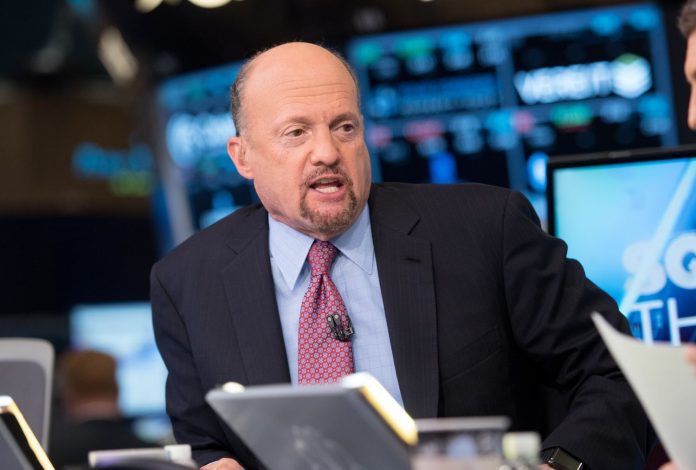
CNBC’s Jim Cramer says the prolonged U.S.-Iran conflict has amplified one of Wall Street’s most powerful trading trends, with investors increasingly buying and selling stocks in broad thematic “basket trades” rather than on company-specific fundamentals, creating pricing distortions that could offer opportunities for long-term investors.
Speaking on CNBC’s Mad Money on Monday, Cramer noted that the surge in basket trading has caused many stocks to move in lockstep with geopolitical headlines and broader market narratives instead of their underlying earnings prospects.
“The best thing? They create real opportunities, as the stocks divorce themselves from the fundamentals until the companies report,” Cramer said. “There are big gains to be had when the worth of the baskets blows up in the face of real earnings.”
According to Cramer, while thematic investing has become a dominant force in modern markets, earnings season continues to remind investors that long-term valuations are ultimately determined by business performance rather than short-term market sentiment.
Cramer said investors are grouping companies into thematic baskets that rise or fall together based on macroeconomic developments such as the Iran conflict, inflation expectations, artificial intelligence and consumer spending trends.
Those trades, he argued, have become particularly influential as geopolitical uncertainty drives rapid shifts in investor positioning.
While basket trading can dominate daily price movements, Cramer believes it often creates temporary disconnects between stock prices and corporate fundamentals, providing attractive entry points for patient investors.
Boeing Caught in Geopolitical Trading
One example, Cramer said, is Boeing.
The aircraft manufacturer’s shares have been trading alongside developments in the Middle East, rallying whenever diplomatic progress appears likely and retreating as tensions escalate.
Yet Cramer said those daily swings have little bearing on Boeing’s long-term investment case.
“Boeing, the company, not Boeing the trading plaything, gets valued on cash flow and production,” he said.
Instead of focusing on geopolitical headlines, investors should pay closer attention to the company’s production recovery and backlog of roughly 6,200 commercial aircraft, which provides years of future revenue visibility.
Retail Stocks Become Another Basket
Retailers have also become part of a broader thematic trade. According to Cramer, concerns that higher oil prices could fuel inflation prompted investors to rotate into defensive retailers such as Costco Wholesale and Walmart, companies viewed as beneficiaries when consumers seek lower prices during periods of economic pressure.
At the same time, investors sold more discretionary retailers, including Ralph Lauren, Target Corporation and Williams-Sonoma.
Cramer said the distinction has become exaggerated.
“Costco and Walmart are both excellent evergreen retailers,” he said. “You should own them regardless of the state of the war.”
His argument suggests investors should focus less on short-term macro themes and more on the long-term competitive advantages of individual businesses.
AI Creates Wall Street’s Biggest Basket Trade
Technology stocks have become the market’s largest thematic trade. For much of the year, investors overwhelmingly favored companies supplying artificial intelligence infrastructure, including semiconductor manufacturers and cloud infrastructure providers, while broadly selling enterprise software companies amid fears AI could disrupt traditional subscription-based business models.
Cramer said that trade has recently begun to unwind as investors recognize differences in company fundamentals.
Software companies such as ServiceNow and Salesforce have started outperforming as stronger earnings demonstrated that AI is enhancing rather than undermining many enterprise software businesses.
The shift illustrates Cramer’s broader point that earnings ultimately determine winners and losers, even after prolonged periods dominated by thematic investing.
“It’s good to see that the fundamentals still matter, even if it only happens during earnings season, four times a year,” he said.
Amazon Changes The AI Investment Narrative
Cramer also noted that Amazon Chief Executive Andy Jassy fundamentally changed Wall Street’s perception of massive AI-related capital spending during the company’s latest earnings call.
For months, investors questioned whether technology companies were investing too aggressively in data centers, chips and AI infrastructure without a clear path to generating adequate returns.
According to Cramer, Jassy provided the explanation investors had been waiting for.
“Until Jassy spoke, the market seemed highly skeptical of how these megacap tech companies were spending money,” Cramer said.
“That’s no longer the case.”
He said Jassy successfully shifted investor attention away from the size of Amazon’s capital expenditure budget toward the long-term economics of AI infrastructure.
Amazon recently increased planned capital spending from $200 billion to $220 billion, yet the stock recorded its biggest one-day gain in more than a decade after investors embraced management’s explanation of how those investments would generate future cash flows.
Jassy explained that much of the spending is front-loaded.
Capital is required initially to construct data centers and install servers, networking equipment and other computing infrastructure. Once operational, however, those facilities begin generating revenue almost immediately while continuing to produce cash flow for decades.
“Once a data center opens with servers plugged in,” Jassy said, “we start generating significant revenue right away and then get to monetize these data centers for 30-plus years without having to spend that startup capital again.”
For investors, the comments helped reframe AI infrastructure spending as a long-term investment rather than an ongoing cost.
Cramer contrasted Amazon’s communication strategy with those of several other technology giants.
He said Alphabet also increased its capital expenditure guidance but failed to clearly articulate how those investments would translate into future earnings.
“I believe the same numbers explained differently would’ve sent the stock higher, not lower,” Cramer said.
Microsoft, by comparison, has largely avoided investor skepticism because it is already generating substantial returns from its AI investments through the rapid expansion of Azure cloud services and increasing adoption of its Copilot AI platform.
The strongest criticism was directed at Meta Platforms.
Although Meta continues to spend aggressively on AI infrastructure, Cramer said management has yet to provide investors with a sufficiently detailed roadmap explaining how those investments will generate attractive financial returns.
In particular, he questioned whether Meta intends to commercialize excess computing capacity by renting it to external customers, a strategy adopted by cloud infrastructure providers.
“I was shocked and disappointed that Meta didn’t seem to have a plan,” he said.
Cramer’s assertion has brought to the fore two themes that are increasingly shaping global equity markets.
The first is the growing influence of thematic basket trading, where geopolitical events, inflation expectations and AI narratives can drive large groups of stocks irrespective of company-specific fundamentals. While those trades often dominate short-term market movements, earnings season continues to separate fundamentally strong businesses from weaker ones.
The second is the evolution of investor thinking around artificial intelligence spending. Markets are becoming less concerned about the absolute size of capital expenditure budgets and more focused on management’s ability to demonstrate how those investments will generate sustainable revenue, cash flow and long-term returns. Companies that clearly articulate that path, as Amazon and Microsoft have done, are now being rewarded, while those offering less visibility continue to face greater investor scrutiny.
Like this:
Like Loading...