DD
MM
YYYY

PAGES

DD
MM
YYYY

spot_img

PAGES

Home Blog Page 5010

2022 Global Fragile State Index: Nigeria Has Maintained Top Decile Position since 2007

0

Based on the strength and potency of their institutions and apparatuses to create the social good which includes security, welfare and happiness of the people, states are often described as functional, failed or fragile. A state is generally considered to have failed when it is no longer able to consistently and legitimately enforce its laws or provide its citizens with basic goods and services.

A fragile state is a state whose central government is so weak or ineffective that it has little practical control over much of its territory, characterized by inadequate or no provision of public services, widespread corruption and criminality; refugees and involuntary movement of populations and sharp economic decline.
The fragile states index provides a quantitative approach to understanding the fragility of a state; it measures the vulnerability of a state in pre-conflict, conflict and post-conflict situations.

The index comprises twelve conflict risk indicators that are used to measure the condition of a state at any given moment which includes; security apparatus, factionalized elites, group grievances, economic decline, uneven economic development, human flight and brain drain, state legitimacy, public service, human rights and rule of law, demographic pressures, refugees and IDPs and external interventions.

Since 2005, the index has included all UN member states and has been published annually by the fund for peace and the magazine foreign policy. Countries are ranked on a score of 120 with the highest rated most fragile and the lowest rated the least fragile.

According to the 2022 report, Yemen tops the fragile index with a score of 111.7 followed by Somalia (110.5), Syria (108.4), South Sudan (108.4) and the Central African Republic (108.1). Finland at 179th position is the least Fragile country in the world with a score of 15.1 followed by Norway (15.6), Iceland (17.1), New Zealand (17.5) and Denmark (18.1). The US is at the 140th position with a score of 46.6, Ukraine 92nd position and Russia is at 75th position.

Nigeria is currently the 16th most fragile state in the world with a score of 97.2 which indicates a slight improvement from 98 scored in 2021. However, since 2007, Nigeria has maintained the top decile position of fragile states in the world, oscillating between the alert zone (90-100) and the high alert zone (100-110). The worst zone is the very high alert zone which is 111-120
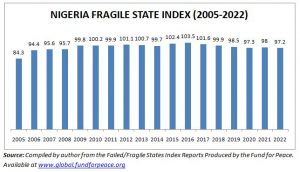
Since the FSI is based on global ranking, the unique internal pattern of a State’s fragility and its intensity across different years are often silent and overlooked. For example, in 2022 where Nigeria recorded FSI score of 97.2, the country has experienced worse economic shock compared with many years before. In June 2022, the country recorded an all time highest annual inflation rate at 18.6 percent month-on-month increase which is also predicted to further increase by the end of Q4, whereas in 2013 where the country recorded FSI score of 100.7, inflation rate was put at 8.48 percent. Even in 2016 where the highest FSI score of 103.5 was recorded, inflation rate in the country was 15.68 percent.

Between 2020 and 2022, the country has experienced the highest brain drain and human movement out of the country. The Central Bank of Nigeria reported that more than $US39billion was spent on schooling and accessing health care abroad between 2010 and 2020. More so, $220.86million was reported to have been spent on foreign education between December 2021 and February 2022.

Towards the end of 2021, the concept of Japa, which means to flee the country in search of better living conditions abroad had become a popular mantra in the day-to-day relations of many young Nigerians, showing more Nigerians are ready to leave the country to school or work abroad. Major destinations have been US, Canada, and UK. According to the CBN, the flight from the country and increase in demand for Dollars to settle foreign education bills has led to the free fall of Naira against the Dollar.


The Emerging Reign of Amazon Ad Business for Merchants

2

You are a merchant and you sell laptops; which scenario favours you?

Option A: You pay a company so that when people search “laptop”, it shows promoted links on top of the search results. Those people may not be looping for laptops to “Buy” but could be doing research on the specifications of laptops or just trying to understand how laptops work. If someone clicks on the space you have bided and won, you have “lost” money since  that person has no interest in actually buying a laptop. 

Option B: You pay a company which sells laptops so that when people come into its ecosystem and search “laptop”, your store comes on top of the search results. More than 90% of visitors are in the “spirit of buying” something when they visit that site. Yes, any click has a potential “Buy” trigger that can follow. 

Option A is  the Google search scenario while Option B goes for Amazon.  Amazon is now a huge ad company for merchants and it is growing every quarter: “Amazon generated $8.76 billion in advertising revenue in its second quarter. That revenue, which included things such as advertisements on the e-commerce website, contributed to an overall beat against Wall Street estimates”.

Amazon Ad could become another play for Amazon’s ecommerce one oasis. Indeed, the biggest threat to Google search (for merchants) is not Bing, but Amazon, because on merchant advertising, Amazon is winning that segment. Google gives you clicks, Amazon delivers sales into the bank accounts for merchants. If you understand that merchants spend a lot on adverts, it becomes easier to process why Amazon market cap rose by more than 10% yesterday. 

Facebook will be a waste of efforts if Amazon carries that item especially if you have a merchant store within Amazon. Both Google and Facebook will give you clicks from adverts; Amazon will deliver sales to the bank accounts. That makes Amazon ad business a superior business. If ads are to take users to commercial sites, Amazon wins because it is the grand-dominion of all digital commerce sites.

Why Merchants Like Amazon Ads – And Why it is Now a $31 billion Business

Feedback on LinkedIn

Comment: What’s missing in this analysis is that buyers do not always go straight to Amazon. More often than not, they would first search for where buy a laptop. So, there’s plenty of value for the seller outside of an Amazon.

Although it could be argued that they are the single largest forum, when one considers that it is not only Amazon selling laptops, limiting oneself to Amazon automatically cuts the market range for the seller’s product.

My Response: Certainly, I am not saying other channels are not useful. I am focusing on conversion efficiency and value on ads. Coca Cola can throw its money in any channel. But for a merchant with a $1,000 ad budget, that conversion rate matters. That is why Amazon has grown this from $0 to $32 billion in a very short time!

Comment follow: That conversion rate sure matters for a user with such limited ad budget. It will sure impact ad spend choices for maximum impact. Still I won’t ask them to go to Amazon by default. A number of other considerations will come: type of product and target market are critical.

I don’t know that Amazon has grown because of the ads. It is probably adding to it presently and it’s share will grow. Moving from 0 to 32bn has been a combination of innovation, customer obsession, diversification and sheer capital thrown at it. It took Amazon several years to break a profit.

My Response again: The $32b is specifically for the ad business, not other aspects of Amazon. Putting that number is to make a case that it is very viable and useful to small sellers. As I noted in the video, this is one oasis strategy because Amazon is collecting $32 billion to help people showcase things within Amazon and after they have sold, Amazon takes another cut on those sales. It is a massive positive loop!

Lack of License: Kenya’s Central Bank Orders Financial Institutions to Cut Ties with Flutterwave, Chipper Cash

0

Following investigation into fraud and money laundering allegations leveled against Nigerian fintech giant, Flutterwave and its counterpart, Chipper Cash, the Central Bank of Kenya (CBK) has ordered all financial institutions in the East African country to stop doing business with the fintechs.

The order follows the announcement on Thursday by CBK governor Patrick Njoroge that both Flutterwave and Chipper Cash are not licensed to operate in Kenya.

“Flutterwave is not licensed to operate as a remittance provider or for that matter as a PSB service provider in Kenya. They are not licensed to operate and therefore they shouldn’t be operating. We can also say the same for Chipper Cash,” he said.

The CBK’s bank supervision deputy director, Matu Mugo, directed all regulated banks, microfinance and mortgage finance institutions to cut all their relationship with the two startups with immediate effect.

“It has come to the attention of the Central Bank of Kenya (CBK) that Flutterwave Payments Technology Limited and Chipper Technologies Kenya (Chipper) have been engaging in money remittance and payments services without licensing and authorization by CBK…You are therefore directed to immediately cease and desist from dealing with Flutterwave and Chipper,” said Mugo in the letter.

Early this month, a Kenyan court had ordered the freezing of the companies’ accounts for money laundering. The court said that both Flutterwave and Chipper Cash were among over 50 companies carrying out illegal activities in Kenya.

Following investigation, Kenya’s Asset Recovery Agency (ARA), told the court that the accounts of seven targeted companies were used as conduits for money laundering in the guise of providing merchant services. The agency said it began investigations after suspicious activities and transactions in the seven companies were flagged on suspicion that they were proceeds of crime. It also said that the fintechs was illegally operating in Kenya, because it has no valid license from the CBK.

The development is a huge blow to the two startups that are occupying prominent positions in African fintech market. Flutterwave is the most valuable African fintech at $3 billion valuation while Chipper Cash is believed to have attained the unicorn status.

It is also seen as a potential setback for the African tech market that has been riding on huge investment funds from investors across the globe. African startups raised $1.2 billion in Q2 2022, indicating a 15% drop from the total funding raised in Q1.

However, Flutterwave and Chipper Cash’s lack of license has been attributed to Kenya’s irregular license schedule. Flutterwave started operation in Kenya in 2016, while Chipper Cash was launched in the country in 2018. 

Zimbabwe Launches Gold Coin (Mosi-Oa-Tunya) As Legal Tender To Tackle Inflation

0

The world is currently battling with inflation rate, as the surge in food and fuel prices is raising pressure on governments across the globe. The disruption of the supply of oil and food commodities caused by the Russian-Ukraine war has no doubt contributed to the constant increase in the prices of food and fuel.

With no hope in sight, conditions are expected to deteriorate progressively. Reacting to the constant surge in inflation, Southern African country, Zimbabwe has launched a gold coin to help curb the soaring inflation amid a slump in the country’s currency.

The coin is called “Mosi-Oa-Tunya”, which means “The smoke which Thunders” and refers to Victoria falls, on the border between Zimbabwe and Zambia. Each coin will be priced at the International market rate for an ounce of gold plus 5% for production.

The move was announced on Monday by the country’s central bank, the Reserve Bank Of Zimbabwe, which disbursed 2,000 coins to commercial banks. The coins have been disclosed as a liquidity asset, which means that they will be capable of easily converting it to cash which can be used for trade both locally and internally, and also for transactional purposes in the country.

Holders of the Gold coin will be able to trade them for cash after 180 days from the date of purchase. Individuals and companies will be able to buy them from authorized outlets such as banks and keep them at a bank or take them home. While foreigners can only purchase the coins in foreign currency.

According to the governor of the Reserve Bank Of Zimbabwe, Mr. John Mangudya, he revealed that the first batch of the coin was minted outside of Zimbabwe, but they will later be produced in the country. He disclosed that the 22-carat gold coins can be used for purchases in shops, depending on whether the shop has enough change, as well as security for loans and credit facilities.

During the launch of the coin, the cost of one Mosi-Oa-Tunya was $1,824, after which the price will be determined by the international market.

Recall that Zimbabwe under the late Robert Mugabe who ruled for almost four decades plunged the nation’s economy into chaos. With the current inflation, coupled with its past economic woes, the country is hit by double jeopardy as authorities are doing everything possible to pull the country from the grip of economic chaos.

It might interest you to know that hyperinflation in 2009, forced the country to abandon its Zimbabwe dollar, as it opted to use the US dollar as its main currency. The local currency was later reintroduced a decade later but however lost its value again. The hope in the country’s currency is very low as many retailers do not accept it.

As inflation continues to bite hard, the International Monetary Fund, IMF has advised the central banks of each country to clamp down on the rising inflation rate. Zimbabwe obviously did not want to dilly-dally on such advice,as they have taken a huge step with the introduction of its gold currency (Mosi-Oa-Tunya) to curb rising inflation.

Last month, Zimbabwe’s inflation rate surged to 191% from 132% recorded in the previous month, which eroded the purchasing power of its citizens. However, with the introduction of its gold coin currency, some citizens have commended the move while some others have faulted it, stating that it will only favor those living above poverty level in the country.

Nigerian Government to Introduce Additional 5% Tax on Telecom Services

1

As Nigeria’s revenue shortfalls bite harder, the federal government has been seeking alternatives to the dwindling oil revenue that the non-oil sector has failed to upset.

The Minister of Finance, Budget and National Planning, Zainab Ahmed, disclosed that the federal government has finalized plans to introduce additional 5% tax on all telecom services, including calls, SMS, and data services.

Zainab made the new tax plan known at a stakeholders’ forum organized by the Nigerian Communications Commission on Thursday. She said the plan will help the federal government to offset the deficit emanating from poor oil revenue.

“The issue of revenue is not something that need to be shy away from, our revenue can no longer take care of our needs as a country. Also Nigeria is no longer making enough money in oil revenue hence the attention is shifting to non-oil revenue,” she said.

The minister, who was represented by Musa Umar, Assistant Director, Tax and Policy, appealed to stakeholders to support the new tax plan.

However, the development has been greeted with scorn as it is seen as an attempt to compound Nigeria’s economic woes. Responding to the concern, Ahmed made reference to other African nations such as Malawi, Tanzania, and Uganda, who she said have successfully implemented such tax regimes to generate more revenue.

Although the minister allayed fears that the new tax plan will result in suffering with the promise that it will be implemented in a manner that bears no negative impact on Nigerians, many, including telecom industry stakeholders, disagree.

Engr Gbenga Adebayo, Chairman of the Association of Licensed Telecommunications Operators of Nigeria, ALTON, said the telecom industry won’t be able to absorb the impact on behalf of subscribers.

He lamented that the federal government is shifting taxes to services instead of goods and products. He said that subscribers will bear the burden as the telecom industry is already feeling the weight of 39 different taxes.

“It is a strange move, it appears a bit unusual. Excise duty is supposed to be apportioned to goods and products, but we are surprised this is on services,” he said.

“We currently pay a lot of taxes, running into 39 of them, so we can’t add more to our existing burden. We won’t be able to absolve this on behalf of subscribers. The five per cent excise duty will be paid by the subscribers. It will collected by the operators on all voice and data services including OTT and remitted to the Nigerians Customs”, he added.

The telecom industry served as Nigeria’s economic cash cow in the wake of the pandemic that crippled economic activities globally. But recently, the industry has been seeking approval for upward review of the cost of its services, including data, calls and SMS. It said the Russia-Ukraine conflict has resulted in a 35% hike in operational cost amidst other factors in the country that have made business difficult.

Thus, the implementation of a new telecom tax will leave the industry with no choice than to increase tariffs for its services.