Greetings! The academic festival begins tomorrow at Tekedia Mini-MBA. If you want to join, now is the time to get the ticket. I will open it tomorrow with Innovation, Mission of Firms and Building Category-King Companies.
What is your vision? What is your playbook? How is that leadership ascension evolving? Etc. At Tekedia Mini-MBA, more than 250 eminent faculty will bring clarity to advance you professionally and accelerate progress in your firm, community and nation.
Normally, Osun State should be among the states that have governorship elections every four years, in keeping with the general election cycle. The Alliance for Democracy, which was voted in 1999, was defeated by the People’s Democratic Party in 2003. Prince Olagunsoye Oyinlola, the winner, ruled the state from 2003 to 2007. The incumbent (Governor Oyinlola) and Engineer Rauf Aregbesola of the Action Congress fought hard during 2007 election.
During the pre-election period, there were widespread verbal and physical attacks across the state, particularly in cities and towns where candidates believed they could garner the most votes. The incumbent eventually won the election, and the opposition party (AC) threatened to dispute the victory all the way to the Supreme Court. Engineer Rauf Aregbesola was pronounced the election winner by the Court of Appeal in November 2010. This event shifted the year in which Osun people go to the polls to elect a new governor.
Actors and supporters worked hard and used various techniques to advertise their candidates to the electorate in all of the state’s elections. Our analyst observes that, similar to what is observed at the national level, actors and their supporters rarely engaged the public during campaign periods by highlighting essential concerns and demands. Political parties, politicians, and their followers believe in participating in extremely intensive personality disparagement rather than discussing socioeconomic and political concerns that require holistic solutions through evidence-driven policies and initiatives.
Part of the damage to Nigeria’s long-term democracy, according to our analyst, is participating in personality shaming and failing to comprehensively explore important concerns or requirements of the people. This is based on the fact that voters are not given the opportunity to make the best decision during the voting process. In developed democracies, parties and candidates are expected to focus on systemic concerns and needs rather than performance issues, as has been the case in Nigeria’s election campaign ecosystem since the country’s restoration to democracy in 1999.
While the parties and candidates who have ruled and are still in power emphasize performance issues (what they have done previously) over systemic issues and people’s needs, opposition parties and candidates often take solace in disparaging the personality traits, competence, and leadership style of those in power. Over time, it has also become clear that the ruling party prefers to court workers and retirees by approving welfare packages prior to primary and general elections, providing free monthly meals to selected people, and using established performance indicators, as well as possible involvement in vote buying and collusion with electoral bodies and security agencies.
Meanwhile, this piece focuses on the upcoming governorship election in Osun state, with an emphasis on how political parties have created and owned issues in the last four weeks of campaigning in physical settings (cities and towns), on virtual platforms (social media), and in newspapers. It also looks at how the public has taken ownership of issues and gained a better understanding of politicians and political parties by using the Internet to gather information.
Political Parties and Public Issues Owned: Divergence and Convergence
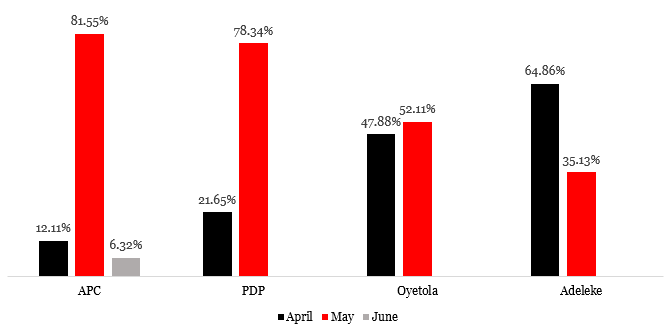
Exhibit 1: Osun Public Searches of Political Parties and Candidates
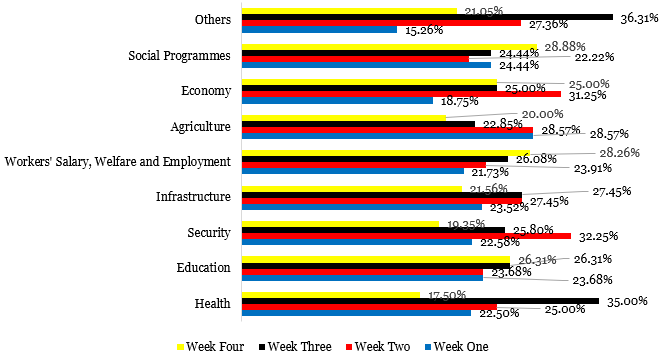
Our analyst and other researchers at the Positive Agenda Nigeria observed campaign activity of the actors (parties and candidates) between April 6 and June 1, 2022, and discovered that reputational issues dominated the period rather than systemic challenges in the state. The dominating owned issues of political parties in week one were agricultural and social programmes. Before they could own the health issue, they switched to security and the economy in week two, then to personality assaults, vote buying, and threats to life in week three. They owned the issues of social programs, workers’ salaries, welfare, and employment in week four (see Exhibit 2).
Exhibit 2: Campaign and/or Policy Issues by week
Source: Positive Agenda Nigeria, 2022 Key: Health=40, Education=38, Security=31, Infrastructure=51, Workers’ salary, welfare and employment=46, Agriculture=35, Economy=48, Social Programmes=45, Others=190
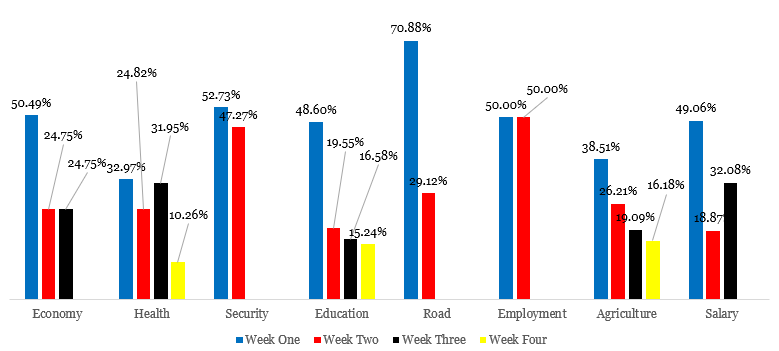
Our analyst and his colleagues noticed a glaring mismatch between what interested the public and what the political parties owned and disseminated to them (Osun public) during the monitoring period. In week one, people were interested in learning about road conditions, which falls under the infrastructure category, and the economy, according to the analysis, but political parties primarily highlighted agriculture and social programmes. People were concerned about work and security in the second week. During the week’s assessment of this, as well as the parties’ personal difficulties, a mismatch was noticed (see Exhibit 3) and in week four. When discussing and seeking information regarding salary and health, the parties and the public only aligned during week three of the campaign activities.
Exhibit 3:Issues and/or needs searched by Osun Public based on weeks
According to the findings, issues are owned differently by different parties. Throughout the four weeks, the ruling party (APC) concentrated on performance issues, with particular attention paid to the health sector, worker salaries, welfare and employment, social programs, and infrastructure. The PDP, the main opposition party, addressed concerns of reputation (personality assaults, party attacks), security, and agriculture. After the PDP, Accord was determined to be equally responsible for addressing reputational issues. The party (Accord) also engaged the public by discussing concerns and/or needs related to education and security. Like the PDP, Labour party was also discovered to owned economy, reputational issues of the members and candidate of the ruling party as well as agriculture and found them worthy of discussing.
Exhibit 4: Campaign and/or Policy Issues by Political Parties
Source: Positive Agenda Nigeria, 2022 Key: Health=40, Education=38, Security=31, Infrastructure=51, Workers’ salary, welfare and employment=46, Agriculture=35, Economy=48, Social Programmes=45, Others=190
Strategic Options
Political parties should modify their campaign communication approach in the future, according to our analyst. For example, media handlers could monitor citizens’ Internet searches on a daily basis in order to produce and disseminate targeted messaging. Parties must also focus on addressing systemic issues or needs in the state rather than on reputational issues that are important to governance competencies and democratic leadership style expectations. The ruling party’s emphasis on performance issues without specifying what it plans to do in each area or industry over the next four years if elected is insufficient to make it the best candidate for the job. On the other side, the main opposition party’s continual debate of non-critical reputational concerns does not portray it as the best alternative for the electorate.
Welcome. From all of us at Tekedia Institute, we say Welcome to the 8th edition of Tekedia Mini-MBA. And thank you for choosing us. This is the temple for the mastery of Africa’s entrepreneurial capitalism. We begin tomorrow at 12 noon WAT here
I used Zoom while on transit for this recording, it is laggy. Will make a better one.
CEO of Tesla, Elon Musk freezes hiring at Tesla in all factories worldwide, as he plans to cut about 10% of salaried staff. This is coming after he stopped remote work at Tesla, ordering staff to return full time. Due to the news about a possible recession likely to occur, Elon Musk is trying to do things necessary to ensure that the company thrives regardless.
Tesla shares fell 9% in the US Trade, which has seen Elon Musk slash the salaries of his staff by 10%, as it became over staffed in many areas. In a mail sent to employees, it reads “There will be reduction in salaries headcount by 10%, as it has become over staffed in many areas, but hourly headcount will increase. Note that this does not apply to anyone actually building cars, battery packs or installing solar”.
Musk has on several occasions warned about the possible risk of recession, but the mail where he ordered a pause in hiring at Tesla as well as the slashing of staff members salary by 10% was the most direct and high-profile message of its kind.
Analysts have disclosed that the forecasting of a recession by Elon Musk would carry high credibility. So far, at Tesla, the demand for its cars and other vehicles has remained strong and many traditional indicators of a downturn, including increasing dealer inventories and incentives in the United States have not materialized.
At Tesla factory located in Shanghai China, it has struggled to restart production due to the covid pandemic lockdown that forced costly outages. A lot of analysts have also forecasted slower deliveries of Tesla Motors to the Chinese lockdown which affected its loss of output at Tesla’s Shanghai plant.
It is revealed that the Shanghai plant in China accounted for just over a third of Tesla’s global deliveries in 2021. This is likely one of the reasons why Elon musk had to stop remote work at the company. He demanded that every staff member spends a minimum of 40 hours in the office per week, as failure to show up will pass a message to the company that they have resigned.
Elon musk might not necessarily hate remote work, but with the recent crisis the company is faced with and also the forecasting of a possible recession, I think remote work might give him the feeling that his staff members will be laid back. This is no doubt a period where all hands must be on deck to keep the company afloat.
Often, when organizations are faced with different challenges, it can bring about a change in the workplace structure, which is obviously what Elon Musk is doing at Tesla. It is so serious that he had to slash the prices of team members by 100%.
Logically, no organization will enjoy paying its staff their usual amount of salary while the company’s revenue dwindles. Few analysts have also described Musk abolishment of remote work as a disguise to layoff staff, without having to have a direct layoff, because by doing so, Musk knows that there is a percentage of workers who will likely not come back.
The 11 northern governors of the All Progressive Congress (APC), have unanimously decided to support the controversial zoning arrangement by asking President Muhammadu Buhari to focus the search for his successor on the Party’s candidates from Southern Nigeria.
The development, which now settles the dust of zoning in the ruling party – killing the suspense that it has locked Nigerians in, took place during the APC’s presidential primary election in Abuja.
A statement signed by Aminu Bello Masari, governor of Katsina state; Abubakar Sani Bello, governor of Niger; Abdullahi Sule, governor of Nasarawa; Babagana Zulum, governor of Borno; Nasir El-Rufai, governor of Kaduna among others, pointed to the withdrawal of Abubakar Badaru, governor of Jigawa state, from the presidential race as evidence of their support for the Party’s presidential from the South.
“APC governors and political leaders from the northern states of Nigeria today met to review the political situation and to further support our Party in providing progressive leadership amidst our national challenges.
“During our discussions, we welcomed President Muhammadu Buhari’s invitation to governors and other stakeholders to contribute to the emergence of a strong presidential candidate for the APC.
“After careful deliberation, we therefore wish to strongly recommend to President Muhammad Buhari that the search for his successor as the APC Presidential Candidate be limited to our compatriots from the Southern states. We appeal to all aspirants from the Northern state to withdraw in the national interest and allow only the aspirants from the south to proceed to the primaries. We are delighted by the decision of our esteemed colleague His Excellency Gov Abubakar Badru to contribute to this patriotic quest by withdrawing his presidential aspiration,” the statement reads.
In response, Southern Governors Forum, headed by Ondo State governor, Rotimi Akeredolu, issued a statement applauding the decision of their northern counterparts. Southern governors had last year, agreed that for equity to be served, the next Nigerian president must come from the Southern part of the country.
“We received with utmost joy the news of the resolution of the 11 Governors from the Northern Region.
“We did not expect anything short of this heart-warming decision from our colleagues, great patriots and reliable partners in the collaborative efforts geared towards the attainment of nationhood for our dear country. This is indeed another landmark achievement in our quest for understanding, rapprochement and continual engagements for mutual beneficence.
“We acknowledge this courageous stance for equity and moral rectitude. We applaud the zeal and determination of our brothers to engage realistically and honestly. We salute this uncommon resolve to confront issues militating against the march towards nationhood and ultimate greatness. By this gesture, we are convinced of the seriousness of our colleagues to join other patriots in ensuring that the ascendant march towards stability, progress and prosperity is not truncated by indiscretion.
“We congratulate our brother Governor, Abubakar Badaru, for his exemplary conduct. Posterity will remember him for good. We thank the leadership of the Northern Governors’ Forum for the patriotic zest displayed at this crucial moment. We look forward to conducting a hitch free Convention which will culminate in the election of a suitable candidate who will hoist the flag of the party with a sense of mission,” the statement signed by Akeredolu said.
This trims the APC 23-man presidential aspirant list and means that the search for Buhari’s successor will now be narrowed to only Southern candidates. The major opposition party, the Peoples Democratic Party (PDP), had last week chosen former vice president Atiku Abubakar, a northern candidate to be their flag bearer. Report from Abuja said some APC’s aspirants are stepping down as Buhari calls for a consensus candidate.