DD
MM
YYYY

PAGES

DD
MM
YYYY

spot_img

PAGES

Home Blog Page 5156

SEC Unveils Regulatory Guidelines for Offering and Custody of Digital Assets in Nigeria

0

The Nigerian Security and Exchange Commission (SEC), has issued new guidelines (pdf) on issuance of digital assets in Nigeria, amid growing call for regulation as Nigerians increasingly embrace digital markets.

The SEC outlined five-part rules that covers many areas of the digital market. There are as follows: 1. PART A – Rules on Issuance of Digital Assets as Securities 2. PART B – Rules on Registration Requirements for Digital Assets Offering Platforms (DAOPs) 3. PART C – Rules on Registration Requirements for Digital Asset Custodians (DACs) 4. PART D- Rules on Virtual Assets Service Providers (VASPs) 5. PART E- Rules on Digital Assets Exchange (DAX).

The stock market regulator said the first rule is applicable to all issuers seeking to raise capital through digital asset offerings, including digital token and Initial Coin Offering (ICO).

“Except in cases of follow-on offerings, all promoters, entities or businesses proposing to conduct initial digital asset offerings within Nigeria or targeting Nigerians, shall submit the assessment form and the draft white paper,” the rules say.

The SEC said the white paper must contain all necessary information that will include Brief description of the initial digital asset offering, the distributed ledger technology, value of each token, lock-up period (if any), returns, profits, bonuses, rights and/or other privileges (monetary and non-monetary) to the buyer of the token. A technical description of the protocol, platform or application of the digital token, as the case may be, the associated benefits of the technology, risks in investing in the tokens among others.

”In the case of whitepapers of initial digital asset offering projects, pending assessment by the Commission, a disclaimer that the whitepaper does not represent an offer to sell, and a statement in bold letters that ‘THE SECURITIES AND EXCHANGE COMMISSION HAS NOT APPROVED THESE TOKENS OR DETERMINED IF THE TOKENS ARE SECURITIES AND THUS, SHALL BE REGISTERED, OR THAT THE CONTENT OF THE WHITEPAPER ARE ACCURATE AND COMPLETE. ANY FALSE OR MISLEADING REPRESENTATION IS A CRIMINAL OFFENCE AND SHOULD BE REPORTED IMMEDIATELY TO THE SECURITIES AND EXCHANGE COMMISSION,” the rules say.

The Commission added that it shall, after it receives a complete initial assessment filing, review same within 30 days from receipt to determine whether the digital asset proposed to be offered, constitutes a “security” under the Investment and Securities Act 2007. The determination of the Commission shall be communicated in writing to the issuer within 5 days from the conclusion of the review.

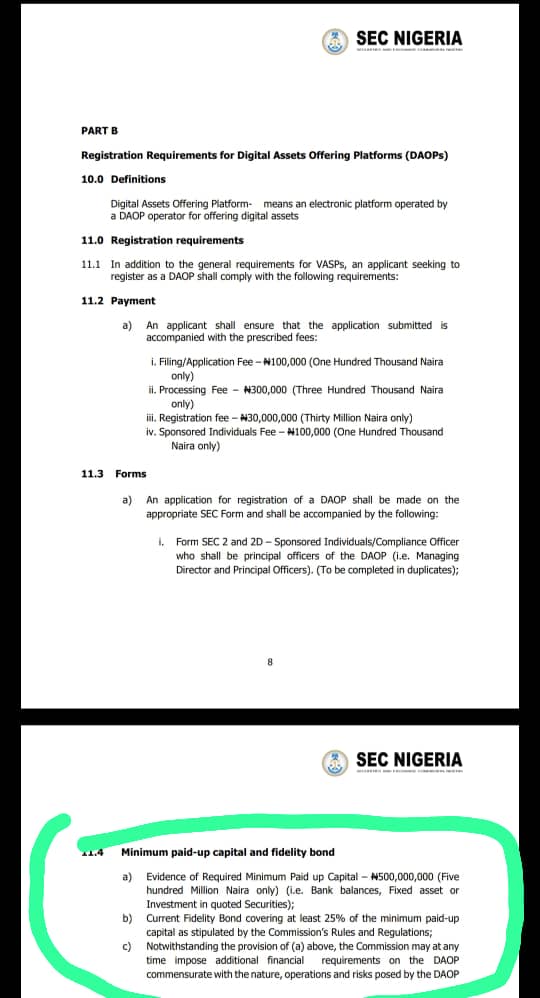
Other key aspects of the digital business covered by the new rules include the registration requirements and the cost of applications. For instance, an applicant seeking to register a Digital Assets Offering Platform (DAOP) is required to pay N100,000 application fee, N300,000 processing fee, N30 million registration fee and N100,000 sponsored individual fee.

Other requirements include, minimum paid-up capital and fidelity bond – N500 million and current Fidelity Bond covering at least 25% of the minimum paid-up capital as stipulated by the Commission’s rules and regulations.

On Digital Assets Exchange (DAX), an applicant seeking to register as a DAX Operator is required to pay N100,000 as Filing/Application Fee – N300,000 Processing Fee, N30 million registration fee and N100,000 as sponsored individuals fee.

The rules also stipulated the period of a tenure and education qualifications for principal officers of a DAOP. The Chief Executive Officer of a DAOP is required to hold office for a period of five (5) years in the first instance and may be re-appointed for a further period of five (5) years and no more.

“The appointment of a Chief Executive Officer and Principal Officers of a DAOP shall be subject to the prior approval of the Commission. The Chief Executive Officer and other Principal Officers of a DAOP shall be registered by the Commission as Sponsored Individuals be persons of proven integrity with no record of criminal conviction; hold at least a university degree or its equivalent; have at least five (5) years cognate experience,”

And a principal officer should “not have been found complicit in the operation of an institution that has failed or been declared bankrupt or has had its operating license revoked as a result of mismanagement or corporate governance abuses; not have been found liable for financial impropriety or any other misdemeanor by any court, panel, regulatory agency or any professional body or previous employer; comply with any other criteria which the Commission may, in the public interest, determine from time to time,” the rules say.

While the regulation has long been advocated and expected, concern remains that it may not provide a lasting solution to the current situation of Nigeria’s digital market. The concern is based on whether the Central Bank of Nigeria will accept the new rules.

The SEC was caught off guard last year when the CBN issued the directive prohibiting all regulated financial institutions from making crypto transactions. The Commission had backed the burgeoning market and was working on its Capital Market FinTech Strategy before the CBN’s order.

Though the regulatory bodies agreed in the wake of the controversy to work together to develop a framework for Nigeria’s digital market, the CBN’s hostility toward cryptocurrency has not changed as the apex bank strongly believes the digital asset undermines the naira. Banks are still mandated to freeze accounts carrying out crypto transactions and many fintechs offering crypto services have been targeted and shut down.

It is not clear if these new rules by the SEC will change the status quo even though it is believed to have been developed in collaboration with the CBN.
My Response on SEC Nigeria New Regulations on Cryptocurrency, NFT and Digital Assets

0

I have received many questions on the new Securities and Exchange Commission (SEC) Nigeria regulations which are designed to govern cryptocurrency, NFT and other digital assets in the nation. 

First, I commend the SEC for at least starting a conversation on regulating this fledgling sector. As I noted yesterday, only the government will save Bitcoin from itself. Yes, while some can trade and hodle $200, for the real players with $billions to come along, you need an order which only the government can offer. With what SEC has published, there is a small clarity now for innovators to navigate in Nigeria; that is better than an outright ban.

Secondly, I will also ask the SEC to work on an Act with the National Assembly to make it evident that crypto assets are clearly protected by current law. Decades ago, emails were not admissible in some courts, voiding contracts executed via emails. That loophole has been fixed with updated laws. Crypto assets must be clearly unambiguous and I do think we may need small regulations to bring that up to speed. The SEC needs to check this and ratify where necessary.

Thirdly, the $1 million paid-up capital requirement is too high: “Other requirements include, minimum paid-up capital and fidelity bond – N500 million and current Fidelity Bond covering at least 25% of the minimum paid-up capital as stipulated by the Commission’s rules and regulations.” With this amount, only well funded startups will run the show. It is going to be near  impossible for any local player to meet this requirement. The SEC would have divided this into foreign and local classes, just as we do in banking licenses, with the foreign ones required to have $1 million while local startups can go for $200,000 paid-up capital.

Finally, you can still comply with all these requirements as set up by SEC, and banks will still refuse to open bank accounts for you, because the Central Bank of Nigeria (CBN) has a standing instruction to wean the banking sector of anything cryptocurrency. Until CBN has set aside that instruction, these regulations do not help that much. The SEC must work with CBN to reverse itself since no one can confidently begin work to seek compliance when you are not sure any bank can serve you.

You can download the regulations here.

SEC Unveils Regulatory Guidelines for Offering and Custody of Digital Assets in Nigeria

OSUN 2022: PAN Urges Political Parties, Supporters to Refrain from Personality Attacks in Campaigns

0
Sample of political parties in Nigeria (Source: Punch)

A research-based non-governmental organisation, Positive Agenda Nigeria (PAN) has admonished political parties in Osun State and their supporters to refrain from attacking the personalities of their opponents ahead of the July Governorship Election in the state.

The non-partisan organisation stated this in its first weekly report recently released to the public. According to the report, the major political parties in the state, the APC and the PDP, their supporters and media teams were found attacking the personalities of their political opponents instead of focusing more attention on campaign issues that could woo the electorate.

“Both the PDP and the APC attacked each other in terms of personalities of their candidates alongside their capabilities to rule the state, although the PDP engaged in such attacks than the APC. Nonetheless, in a contest like this, concerned observers and citizens of the state would have expected that the political parties, their members/supporters and media team sell the manifestoes of their flagbearers to potential electorate, especially opposition parties that intend slugging it out with the incumbent governor in July, 2022.

With the current findings, the political parties, their members/supporters and media team are not yet addressing “real campaign issues” every informed electorate in Osun State will want to hear on why they should vote for a particular candidate. We strongly recommend that the political parties, their supporters and media teams start engaging electorate on the social media on real campaign issues/policy programmes instead of demarketing the personalities of their political opponents”, the report concludes.

In an interview with the organisation’s Team Lead, Dr Adebiyi Rasheed Ademola of Fountain University’s Department of Mass Communication in Osogbo, it was revealed that the organisation will monitor and analyse the actors’ campaign efforts for 69 days. Using diverse research methodologies, he notes that members of the team will fiercely pursue answers to informed policy engagement or extensive personality disparagement in the Osun 2022 governorship election campaign. “We posed this issue in light of the political parties’ recent pledges, particularly the two main parties in the state, that they would be respectable in their campaign activities,” Dr Adebiyi explained.

The full report is available for download here

Buhari Meets With Cabinet Members Seeking Elective Positions

0

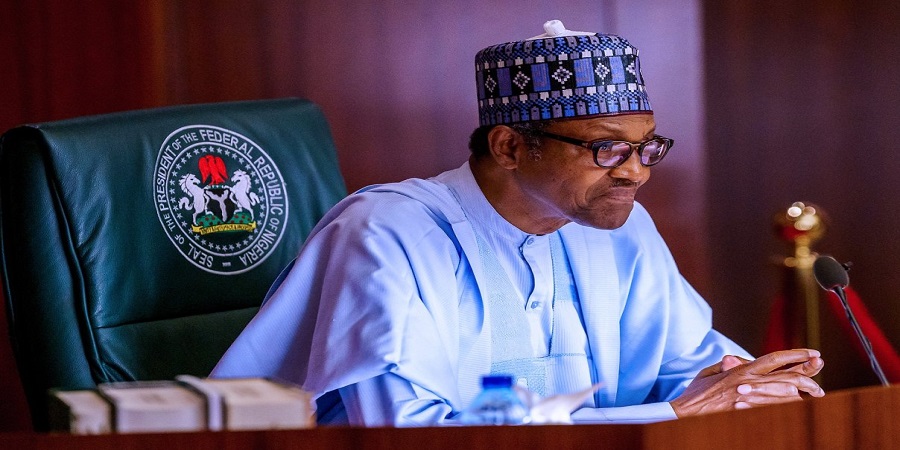
President Muhammadu Buhari, Friday 13th May 2022 in Abuja, graciously bade farewell to outgoing members of the Federal Executive Council (FEC) who had tendered their resignation, affirming that a significant number of them had been sufficiently equipped to aspire to higher elective offices, including the Office of the President.

Speaking at a valedictory session for appointees leaving the cabinet to pursue political ambitions, the President said:

“I have no doubt that if the next President emerges from among former members of this cabinet, like any other aspirant, ample competence and outstanding service delivery would be on display. This will be part of our legacies to Nigerians.”

The President, who commended the departing public officers for serving the nation sacrificially, ‘with dignity and honour’, had at the last FEC meeting on Wednesday, May 11, 2022 directed that all Ministers and other political appointees aspiring to contest for elective offices in the 2023 general elections should resign from their current appointments.

“I note that some have complied while others are in the process of doing so. I would like to use this opportunity to commend your decision and courage to contest for elective offices and your compliance with my directive.

I also wish to thank you for your invaluable services to this nation through your contributions as Cabinet members. I wish you success in the upcoming elections and in your future endeavours”.

President Buhari told the ministers that looking back as the head of the team over the years, he had fond memories of incisive and robust discussions during cabinet meetings, rendering of performance reports during special sessions and presidential retreats.

He said, “In 2015, citizens of this country overwhelmingly voted for me to become the President of this nation on the platform of the All Progressives Congress (APC).

“Selecting members of the Cabinet went through a careful process so that the best and most competent could emerge. The performance of that class of 2015 proved me right.

“In 2019, Nigerians similarly re-elected me as President. Again the selection went through another meticulous process. That re-election was significant because it served as a referendum on our performance during the first term and it inspired me to bring back some of the members of the first cabinet either to their old Ministries or re-assigned to other sectors.

“New Members were also brought on board to inject fresh energies, skills and ideas to enhance the execution of government’s programs and policies.

The President acknowledged that prior to some of them joining his cabinet, they had made their marks in other areas as governors, legislators, entrepreneurs and core professionals.

He added that the experience and expertise they brought on board had significantly resulted in enormous development in various sectors and the accomplishment of government programmes.

“These include infrastructure, agriculture, health systems, financial management, administration of justice, building social safety net systems.” he opined.

Noting that the departure of some cabinet members had undoubtedly created a vacuum that should be filled, the President said appointments would be made without delay so that the business of governance would not suffer.

President Buhari urged the remaining members of the cabinet to show more diligence, resilience and commitment to serve Nigerians better, noting “the journey to the finish line is still very far”.

“Like always, there will be challenges to address, programmes to deliver and policies to implement. You must therefore brace up for more work and target increased accomplishments. The determination to leave important legacies for Nigerians should never be compromised,” the President told members of his cabinet.”

The following outgoing members of FEC were present at the valedictory session: ministers of Transportation, Rotimi Amaechi; Niger Delta Affairs, Godswill Akpabio; Science, Technology and Innovation, Ogbonnaya Onu, State for Petroleum, Timipre Sylva; Labour and Employment, Chris Ngige.

Others are the Attorney-General and Minister of Justice, Abubakar Malami (SAN), Minister of State, Mines and Steel Development, Uche Ogah, the Minister of Women Affairs, Pauline Tallen and the Minister of State for Niger Delta Affairs, Chief Tayo Alasoadura.

However, the Minister of State for Education, Emeka Nwajiuba who had earlier tendered his resignation, was not present at the valedictory session.

Speaking on behalf of the outgoing ministers, Mr Akpabio thanked the President for granting them the opportunity to serve and contribute their quota to nation-building.

He described working with the President as a ‘‘fantastic and knowledgeable experience’’, adding as they step aside, they would continue to be great disciples of Buhari.

“As we step aside from FEC, I want you to know that you have disciples in us. I want you to know that it is time for us to propagate Buharism. I want you to know that we are going to be working closely with the Minister of Information and Culture to take your message of transformation, love, patience, administrative sagacity to Nigerians.” he stated.

The Niger Delta Minister told the President that from his interactions with colleagues leaving the cabinet, it was like the story of the Spanish play of ‘‘sadness and joy.’’

“Sadness in the sense that we are going to miss the continuous daily and weekly interaction with a Father and learning from him; joy because we now have an opportunity to go to the wider audience in Nigeria to speak more of your achievements for this country”.

Lauding the President’s deep patriotism, Mr Akpabio said he was the “best president Nigeria could ever have had at a time of difficult circumstances”, hence prayed to God Almighty to grant the President a successful tenure and protect his family.

He added, “May one of us succeed you in order to continue the good legacies you have laid on ground. We have seen and know your vision. We know where you want the country to be.”

I doubt if any Nigerian, at the moment, would wish any of the Buhari’s disciples to succeed him come 2023, having observed how the present administration has so far performed in the area of security, corruption fight and economy, despite the earlier pledge by the government to totally kick insecurity and graft out of the country in its entirety.

Meanwhile, it is now very clear to the teeming Nigerians that the journey to the 2023 general elections is becoming juicier and more palatable, hence the need to be more vigilant and wiser as we collectively await the D-day. 

ASUU Strike To Continue As Meeting With Nigerian Government Ends In Deadlock

0

The academic staff union of universities ASUU has rejected the plea of the government for the union to call off its ongoing strike action. It was disclosed that the union met with the federal government and maintained its stance on its industrial strike action.

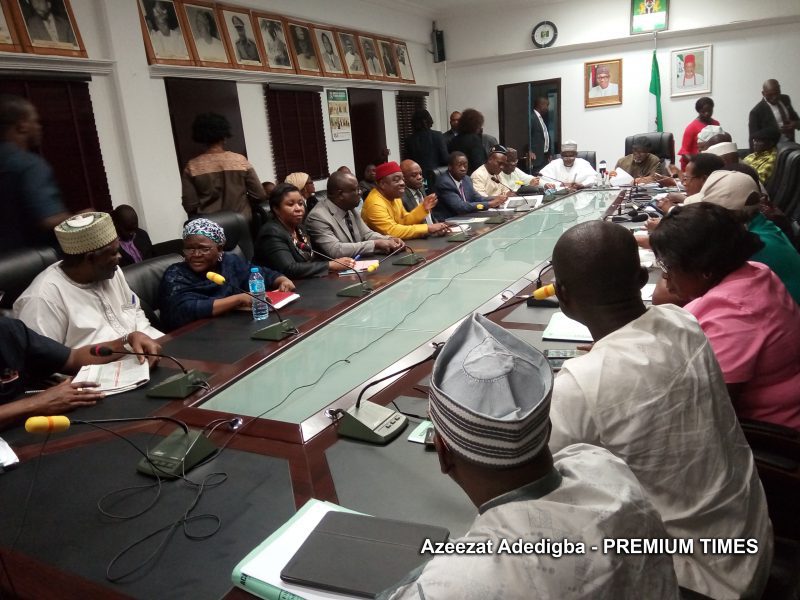
The chief of staff to President Muhammadu Buhari, Prof. Ibrahim Gambari, was said to have invited the union to a dialogue at the Aso Rock villa. The meeting had in attendance, the minister of labor Sen. Chris Ngige and the chairman of the union Prof. Emmanuel Osodeke.

The meeting was co-chaired by the sultan of Sokoto, Sa’ad Abubakar, and the Christian Association of Nigeria’s president, Dr. Supo Ayokunle. It also had in attendance other registered trade unions in universities, as well as identified interest groups and civil society groups. According to information gathered, the federal government persuaded the union to call off its ongoing industrial strike actions, with a promise that their demands will be met.

However, the chairman of ASUU Prof. Osodeke was hell-bent on maintaining his stance on the strike action. He told the federal government to meet part of their demands which they could use in convincing their members to call off the ongoing strike.

The minister of labor Sen. Chris Ngige during the meeting disclosed that the federal government had reached an agreement with ASUU in order to meet its demands. He further disclosed that there have been certain timelines set, and some specific parts of the agreement would be implemented from next week.

Recall that ASUU has on several occasions complained of its wage renegotiation of 2009 which the government has failed to pay for a long time now, which is also one of its reasons for embarking on strike. However, Sen. Chris Ngige revealed that the issues of wage review and renegotiation of 2009 would be addressed by the government.

In his words, “we have reached some agreements and we hope that by next week, those agreements will be maturing and the different unions will have something to tell their members so that they can call off the strike. We have put some timelines for some aspects like the renegotiation of the 2009 agreement in terms of the condition of service and wage review. So we are hopeful that by next weekend the unions will see a conclusion in that area”

The chief of staff to the presidency, Prof. Ibrahim Gambari however pleaded with the union to consider the plight of the students so that they can return to the classrooms. The meeting ended in a deadlock as ASUU was not convinced enough by the federal government to call off its strike action.

It is not just enough for the government to plead with ASUU to call off its strike action, the union has told the government to meet part of the demands in other for them to convince their other members to call off the strike. The reasonable thing for the government to do at this moment is to meet part of the union’s demands, that way they will show their seriousness to convince the union to call off the strike.

ASUU is in dire need of resources as it stands now, and they won’t call off the strike by just mere pleas from the government, they need to be encouraged at least with a certain amount of money. The government has on several occasions pleaded with the union to return to the classroom while they sort their demands, but has always defaulted. ASUU seem to understand their usual gimmick as they are not taking any chances this time around.

The government must come to the understanding that the only language ASUU will understand at this juncture, is money and not unnecessary dialogue.