DD
MM
YYYY

PAGES

DD
MM
YYYY

spot_img

PAGES

Home Blog Page 5216

Is The Judiciary Really The Last Hope Of A Common Man In Nigeria?

3

It is often said that “the judiciary is the last hope of a common man”. What this supposes is that the judiciary is the only place the common man can get justice. According to the known roles of the judiciary, it protects the rule of law and ensures supremacy of the law. It also safeguards the rights of individuals, settles disputes by the law, as well as punishes offenders.

I believe such practices of the Judiciary above-mentioned are mostly practiced in saner climes that do not have their judicial system infiltrated with corrupt practices. Unfortunately, this is not the case for the judicial system in Nigeria as the system has been ravaged by corruption, as judgments and orders are now based on the highest bidder, other than legal merit.

The Nigerian judicial system has been considered weak in the last two years, according to a poll conducted by Gavel, a civic-tech organization with a focus on the judiciary. According to a survey conducted by the anti-corruption Academy of Nigeria, the Nigerian Corruption Index indicates that both the public and private sectors are complicit in the high corruption levels in Nigeria. It might interest you to know that the Judicial sector had the highest level of corruption with a score of 63. The high level of corruption in the judicial sector was attributed to the amount of money being offered as bribes to lawyers handling political cases and all other cases. While scrolling through the Twitter platform yesterday, I came across a story that spurred me to write this article.

A lady once worked for a tech company where she was owed a huge amount of money. She felt strongly displeased about the injustice done to her. She then resigned from the company, and afterward, she decided to go to court. She reached out to a high-flying law firm to work on her case. The payment was made and things seemed to be moving well. Suddenly and without notice, shortly after presenting a professional opinion stating that the tech company was in the wrong and had a case to answer, the law firm quietly informed her that they had been retained by the tech company and they would have to drop her case. Apparently, the tech company has bribed those in charge of the case.

It is indeed shameful that such a profession that is held in high esteem has been turned into something despicable. Judgments are no longer based on legal merits, but rather a case of the most influential, connected, and the highest bidder. Nigeria is indeed a cruel place for the common man to survive because almost all odds seem to be against their favor.

I often say to people who care to listen that Nigeria is a very lawless country, because every rich, connected, and influential person is above the law whether he or she does something wrong, they are never penalized. They do things contrary to the law that is a punishable offense, yet they get away with it. Corruption in the judiciary is indeed happening at an alarming rate, like a wildfire it has engulfed the rooftop already, and it is visible for everyone to see.

Judges seem to no longer regard and uphold their judicial oath as it has merely been turned into a necessary ritual without much reverence for it. The painful thing is this, even if one has a case that is strong in the law, backed with enough facts, and well-built from the outset, they will likely lose the case to a bribe giver.  The chances of getting a good lawyer or judge who is upright and of impeccable character is very slim.

It is disheartening to say that a very high percentage of Judicial officers in Nigeria, fall below the standard expected of them in areas of brightness, integrity, and character. There is already a growing disposition of purchasing judgments of judges by the highest bidder. How does this sound that the judgment of a court is no longer based on law or precedents? or knowing that the law has become unpredictable, despite provisions of facts and glaring evidence.

As long as the judicial system continues to practice corruption, it is therefore imperative to say that the judiciary is not the ‘last’, but the ‘lost’ hope of a common man because the rich and highly connected ones will always emerge victorious in any case. One negative consequence of the corrupt judicial system is that lawlessness, corruption, wickedness, and the likes will continue to plague the society.


IFC Invests $15m in Algebra Fund II to Support Egyptian Tech Startup

0

The International Finance Corporation (IFC) has pledged a $15 million investment in Algebra Ventures’ $90 million second fund.

IFC’s $15 million investment in Algebra Fund II will help support the growth of roughly 20 technology startups, primarily in Egypt but also in Africa more broadly. The fund, which has a target size of $90 million, will have a special focus on women-led businesses and those serving rural communities.

Access to financial capital helps drive economic and job growth – and entrepreneurship is a key contributor. Yet, the amount of venture capital available in Egypt is just a quarter of the emerging market average, though it has grown more than 10-fold since 2016.

“We are delighted to see IFC return as a limited partner in our second fund, having invested in our first fund five years ago as well as directly into our portfolio. IFC has been one of our strongest partners since day one and believed in our vision when there was no venture capital to speak of in Egypt. We look forward to continuing to strengthen our partnership going forward,” said Tarek Assaad, Managing Partner at Algebra Ventures.

“With its young, tech-savvy population and large market, Egypt’s entrepreneurs are perfectly poised to drive change in the country’s economy – with the right support,” said Yasmine El-Hini, IFC Egypt Country Officer and Acting Country Manager for Egypt and Libya. “With this investment, we are helping to push the country’s startup scene forward and encourage innovation.”

The investment is part of IFC’s strategy to support Africa’s blossoming start-up and entrepreneurship ecosystem. Today’s announcement also marks IFC’s second investment in Algebra Ventures.

In 2016, IFC invested $10 million to co-anchor Algebra’s inaugural $54 million fund, which also attracted investments from Cisco Investments, the Egyptian American Enterprise Fund, and the European Bank for Reconstruction and Development. Algebra Fund I was the first Egypt-dedicated VC fund and has supported 21 tech startups and created over 3,500 direct and 28,000 indirect jobs.

Earlier this year, IFC directly invested $5 million in Brimore, an Algebra Ventures portfolio company and social commerce company, and $20 million in the Ezdehar Fund to help smaller businesses access finance.

As of June 2021, IFC’s global Venture Capital investments reached $1.6 billion in over 100 companies and venture capital funds, supporting nearly 1,700 companies and helping to drive innovation and growth.

Egypt has set a tech growth trajectory that is rapidly rising to rival leading nations like Nigeria and South Africa in the African tech ecosystem.

Minister of Information and Communications technology Amr Talaat said in February that Egypt’s information and communications technology (ICT) sector is the fastest growing sector in the Egyptian economy over the past two years, as its contribution to the country’s GDP rose from 3.2 percent in FY 2019/2020 to five percent in the current FY 2021/22.

Since January 2015, more than 791 million dollars has been raised by more than 320 tech startups across over 4450 individual rounds. The North African country has seen yearly increase in its start space, adding 114 tech startups to its ecosystem from a paltry 10 in 2015.  Annual funding secured by the companies rose significantly from 8.6 million dollars to 156 million dollars in 2020.

The “Bill Gates of Africa” Endorses Tekedia Mini-MBA; Enroll Today

0

If you want to master any aspect of business, consider Tekedia Institute. Today, we have students from more than 45 universities in Nigeria co-learning with us. And we also have a strategic partnership with one of the finest universities in the nation – Nnamdi Azikiwe University, Awka. Our programs are delivered by business leaders from companies you admire – and we have got great testimonials. Visit Tekedia Testimonials today here and join.

Even the “Bill Gates of Africa” trusts us. You cannot get it wrong when you follow him to train your workers in our Institute . We work with amazing companies and startups, providing knowledge factors of production that are supporting the foundation of an emerging Africa.

From beautiful Ghana, the man who possibly created the first indigenous website in Ghana  thunders  “I endorse [Tekedia Mini-MBA]”. Enroll here today.

6 Reasons Why Opening A Business Abroad Might Be A Good Idea

0

There are many reasons why opening a business abroad might be a good idea. Many entrepreneurs are starting to see the benefits of doing business in other countries. Perhaps you’re looking for new opportunities to grow your business. Maybe you’re feeling stifled by the current economic conditions in your country. Or maybe you just want to experience a new culture and lifestyle. Whatever your reason, there are many benefits to it. In this blog post, we will discuss six of the most important ones!

Opening a business abroad will require a lot of attention

This is not a process to be taken lightly. Many opening businesses are opening in other countries because they want new opportunities. You will have to work hard, though! On the other hand, you can also hire a growth marketing agency and make the process slightly easier and more understandable. Before opening, you should do your research on the market and make sure that there are no legal barriers to entry. You will also need to be familiar with the local customs and culture so that you can avoid any misunderstandings. Of course, you should not go into the entire process unprepared. Do research online and gather as much information as you can before starting the project.

#1 A lot of room for growth

One of the biggest benefits of expanding abroad is the potential for growth. In many countries, the economy is growing at a much faster rate than in developed nations. This provides plenty of opportunities for businesses to expand and thrive. There are also often fewer restrictions on businesses in developing countries, so you’ll have more freedom to operate your business as you see fit.

#2 Being introduced to a new market

Another big benefit is that you’ll have access to new markets. By opening a business in another country, you’ll be able to tap into a new customer base that you wouldn’t have otherwise had access to. This can help your business grow exponentially. You’ll also be able to learn about new cultures and lifestyles, which can be beneficial for both personal and professional growth.

#3 Many countries offer financial benefits for foreign businesses

There are also tax benefits to this. In many countries, the corporate tax rate is much lower than it is in developed nations. Additionally, there are often other financial incentives offered by governments to encourage businesses to set up shop in their country. This is a great tool to use to ensure a good and stable start.

#4 Finding a new approach

One of the best things about opening a business in another country is that you’ll be able to learn new ways of doing things. In many cases, the way businesses are run in other countries is much different than how they’re run in developed nations. This can be a great opportunity to learn new methods and strategies that you can apply to your own business.

#5 Access to a new, unexplored pool of talent

Another big benefit is that you’ll have access to a whole new pool of talent. In many countries, there is a large population of highly skilled workers who are looking for opportunities to work in foreign businesses. This can be a great way to find talented employees for your business.

#6 New business opportunities

Lastly, opening a business in another country can also lead to new business opportunities. By being in another country, you’ll be able to network with other businesses and learn about new markets and industries. This can help you identify new areas for your business to expand into. Furthermore, if you are planning an expansion abroad, these new contacts can help you improve your entire business plan back home.

Should you expect any challenges?

Of course, there are also some challenges that come with opening a business abroad. One of the biggest ones is language barriers. If you’re not fluent in the local language, it can be difficult to communicate with customers and suppliers. Additionally, cultural differences can make doing business in another country challenging at times. But if you’re prepared for these challenges, they shouldn’t deter you from taking advantage of all the benefits that opening a business abroad has to offer.

So if you’re thinking about opening a business in another country, don’t let the challenges scare you away. There are plenty of reasons why it can be a great decision for your business. With the right preparation and mindset, you can overcome any obstacle and reap all the rewards that come with doing business in another country. 

As Buhari Signs Executive Order 11, What Next?

0
Nigerian leaders

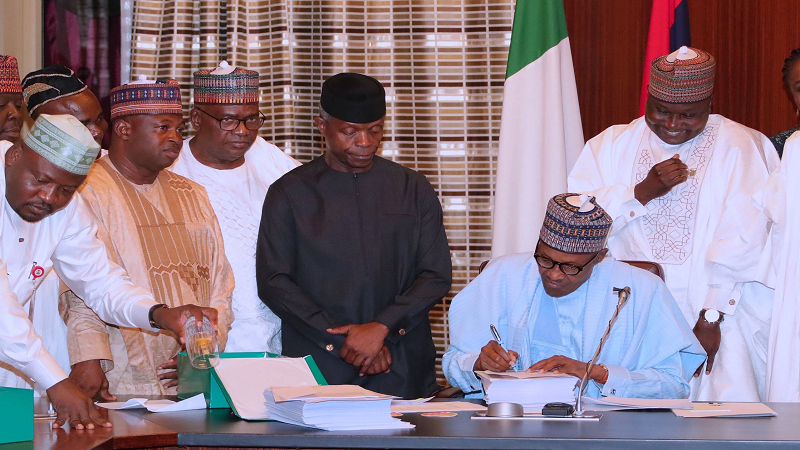
It was another story in Nigeria on 6th April 2022 as President Muhammadu Buhari graciously signed Executive Order 11 on the ‘Maintenance of National Public Buildings’.

The President, who assented to the epochal document on Wednesday morning in Aso Rock Villa prior to the commencement of the usual weekly Federal Executive Council (FEC) meeting that held at the Council Chambers of the State House, Abuja, informed that the Executive Order 11 was targeted to address some existing uncalled norms within the shores of the Nigerian public service.

Speaking shortly before signing the Order, the Nigerian number one citizen directed all Ministries, Departments and Agencies of government (MDAs) to set up maintenance departments in line with the provisions of the new Executive Order.

He stated that the Order now gives legal backing to the country’s national maintenance policy, following its earlier approval by the FEC. According to the President, the government had already started utilising the policy to give a face-lift to some of its buildings like the federal secretariat, Abuja, and 24 others spread across the country.

He said, “Since the approval of the policy by the Federal Executive Council, the federal government has consciously started the implementation of maintenance of strategic facilities like the federal secretariat Abuja and federal secretariats in 24 states of the federation, where at least 40 people are now daily employed in each of those 24 secretariats.

“The office of the Head of Civil Service of the Federation has approved the establishment of a Department of Federal Public Assets Maintenance as a vital step in support of the implementation of this national policy, which is unprecedented in our history and approach to maintenance.

“In order to ensure the fullest implementation and impact of the policy, it is my pleasure to sign this Executive Order that ties maintenance directly to our economy. By this Order, I expect Ministries, Departments and Agencies to set out and ensure the operation of their maintenance departments and make necessary procurements for their maintenance in accordance with the provisions of the public procurement act,” he landed.

It was indeed a great and commendable move as made by the Federal Government (FG) of Nigeria under the watch of President Buhari, knowing full-well that maintenance culture has been a thing of tremendous concern across the lengths and breadth of the Nigerian State.

It’s not anymore news to any citizen of Nigeria that the prime reason most of the infrastructural edifices within the shores of the country are currently moribund is simply owing to lack of maintenance culture by the government officials.

This is the reason the private sector remains the only part that grows or improves  in Nigeria as the years unfold to the detriment of the public sector and at the expense of the poor citizenry, thereby greatly affecting areas such as education, health and manufacturing.

Hence, the Executive Order 11 signed by the President could be a way forward and an avenue of liberating Nigeria’s public sector that has obviously suffered from an age-long disease, curable though. It could be a way of freeing Nigeria’s public sector from the life imprisonment it was sentenced many years ago by the country’s political leaders.

The Order could be a way of putting a full stop to the said sector that has apparently been neglected and abandoned by those meant to protect and adore it.

However, the FG must understand some pertinent facts if truly it is ready and prepared to ensure the success-story of the newly introduced Executive Order.

Aside from its assent by the President, the Presidency needs to take into cognizance that the move doesn’t just stop at signing the Order, hence some stringent actions ought to be followed towards ensuring a holistic implementation.

Overtime, Nigeria has been reckoned to be a country that’s good in bringing up a sound and laudable policy, but the major plight remains its apt implementation. This is exactly where the problem lies.