DD
MM
YYYY

PAGES

DD
MM
YYYY

spot_img

PAGES

Home Blog Page 5275

Reviewing Nigeria’s Government Advocacy On Digital Learning

0

Digital (virtual) learning is any form of learning that is accompanied by technology, or instructional practice, that makes effective use of tech-driven measures.

It encompasses the application of a wide spectrum of practices including blended and virtual learning. Through the use of mobile technologies, digital learning can be used while traveling and other related activities.

It’s noteworthy that there are a plethora of tools and resources online, many which are free, that can be used to create and enhance a digital learning environment.

Some of the tools being used by the 21st Century digital learning tutors include Google+, YouTube, RSS, iTunesU, cloud-based Word Processors (Google Drive), Evernote, file-sharing platforms (Dropbox), Zotero and digital pocket.

Two years back, precisely on 2nd April 2020, unsure of how long the Coronavirus Disease (COVID-19) pandemic that causes pleurisy would linger, the Nigeria’s Minister of Education – Mallam Adamu Adamu – engaged 237 Vice-Chancellors (VCs), Rectors and Provosts of the various higher citadels of learning across Nigeria on a rigorous talk concerning how to reopen their respective institutions using virtual learning.

In the amazing discussion that lasted for hours, which was held via a teleconference, the said boss directed all universities, polytechnics and colleges of education to activate virtual (online) learning environments to enable students to continue their studies through digital devices.

He however acknowledged the fact that the Academic Staff Union of Universities (ASUU) was still on strike, hence assured the Federal Government (FG) would do its best to resolve the lingering labour crisis.

Mallam Adamu who was physically flanked by the Executive Secretaries of the National Universities Commission (NUC), National Board for Technical Education (NBTE) and the Universal Basic Education Commission (UBEC) as well as the Registrar of the Joint Admissions and Matriculation Board (JAMB), among others, further stated that the FG could not afford to shut schools for a long time, thus called for the meeting to ascertain remedies to the challenges posed to the nation’s school calendar by the COVID-19.

The minister, who affirmed at the online session, that he had tested negative to the COVID-19, said “We cannot be held down by the pandemic. We have to deploy all e-platforms to keep our universities, polytechnics, colleges of education, and other schools open”.

He frowned that the outbreak of the COVID-19 had negatively changed everybody – both individuals and institutions – therefore asked the leadership of the higher citadels of learning to devise alternative ways towards ensuring that the education of the young ones would not be truncated.

Mallam Adamu, who urged the education leaders to take advantage of technology as it was found in other parts of the world, stating the country could not shut down all schools when it could boast of other means to teach the students, equally disclosed that the government was already collaborating with the World Bank and the United Nations Children’s Education Fund (UNICEF) on how to create platforms for virtual learning classrooms.

Having reiterated determination to end the ongoing impasse between the FG and the ASUU, the minister stated that the private universities that were not on industrial action could immediately commence the virtual learning prior to the anticipated resumption of the public varsities that were still on strike.

On their part, most VCs of the private varsities welcomed the idea, hence expressed readiness to reopen their institutions having claimed they already had a top grade virtual (online) learning system. They however pleaded with the FG to amend the Tertiary Education Trust Fund (TETFUND) Act to enable private citadels to benefit from the intervention funds.

Mr. Adamu went further to join the UBEC to work out modalities on how primary school pupils and secondary students could learn by using digital channels such as the radio and television stations. He said the FG would involve the state governments in this regard.

This could be referred to as a clarion call made by the education minister, conscientizing the stakeholders in the education industry to embrace the current realities. He was apparently making an effort to let them comprehend that digitalization – or technology at large – could not be kept in abeyance at such a critical time like this.

It’s really appalling that at this moment when virtually everything is being digitalized across the globe, most Nigerian higher educational institutions are yet to fully key into the language of digitalization let alone granting access to the teeming students.

It’s not news that till date, most of these citadels are still finding it difficult to engage their students in e-library platforms and what have you, let alone educating them virtually.

Though face-to-face contact – or physical presence of a tutor – plays a very major role in impaction of knowledge, hence cannot be jettisoned, it’s imperative for these leaders of thoughts to acknowledge that the impact of a tech-driven teaching mode in contemporary society cannot be overemphasized.

Hence, it’s needless to assert that time has come for the teeming Nigeria’s institutions to deploy new and alternative means of learning in their various jurisdictions in line with the present global realities.

However, come to think of it; one of the prime reasons that informed the recent incessant industrial actions, as well as the ongoing one, embarked upon by the Nigerian varsities’ dons was reportedly the continued poor funding of the institutions by the governments at all levels.

The last time I checked, the main reason that resulted in the ongoing strike by the ASUU members remained the compelling need to revitalize the country’s various universities in the area of learning, infrastructure and research.

If the above paragraph holds water, we will then wonder how the governments at all levels would expect these institutions to duly embrace digital patterns of learning when they are ostensibly facing paucity of funds in their respective purses.

It’s worthy of note that Nigeria’s numerous universities have recently been deprived of their rightful place. The current move by the governments to totally deny them their right for autonomy is a tangible proof to this assertion.

As if the Treasury Single Account (TSA) policy wasn’t enough, the FG still went ahead to involve the varsities in the newly introduced Integrated Payroll and Personnel Information System (IPPIS) policy after several relevant stakeholders and experts had condemned the initiative.

As much as we eagerly want these citadels to improve or grow in terms of learning content and research quality coupled with patent development and innovations, the needed support must equally be granted without involving pranks.
Extradition as a Legal cum Political Concept

0

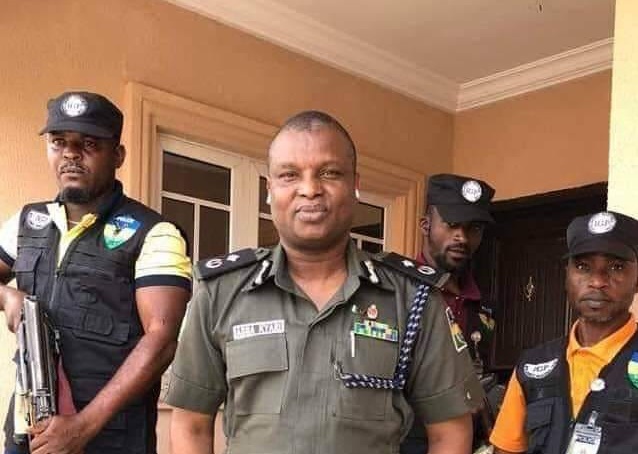
The word “extradition” became a very popular and common word in Nigeria recently due to the Abba Kyari/ Hushpuppi international fraud case and the usage and mis-usage of the word clearly point to the fact that some people don’t fully understand the meaning of the word (Extradition) as a legal cum political concept hence the need for this piece to give a general and brief overview of the word “extradition” as a legal concept.

The federal government of Nigeria have been going back and forth with the United States of America as to whether to extradite Abba Kyari to the United States to go and answer for the criminal allegations bordering on conspiracy to commit wire fraud and money laundering, and identity theft. The Attorney General of the Federation finally approved the extradition request of the United State government against the dismissed erstwhile Deputy Commissioner of Police some days back.

               *******************
Extradition is the process whereby a country surrenders its citizen that is wanted in a foreign country to go and answer for the crimes he has been accused to have committed in that foreign country.

It is simply the surrender of an alleged criminal usually under the provisions of a treaty or statute by one authority (usually the home country of the alleged criminal) to another foreign country that has jurisdiction to try the alleged criminal for the crime.

There is a clear cut difference between extradition and deportation. Deportation is the expulsion of foreign nationals back to their home country whereas the former is the expulsion of a national or citizen from their home country to a foreign country. Extradition can also be referred to as banishment, exile, or penal transportation.

If you are a foreigner, and you are been accused of committing a crime in your country, and you decide to flee to another country to seek refuge, the country you fled to can choose to grant you refuge or deport you back to your country but a citizen of a country can only be released to a foreign country to be tried for criminal offenses by extradition process duly authorized by the attorney general of the federation.

Extradition of a national  can only happen when a country has an existing extradition treaty with the other country. No country of the world has an extradition treaty with all other countries; for instance, the United States lacks extradition treaties with China, Russia, the United Arab Emirates, North Korea etc, and therefore the US government cannot request the Chinese government or the Russian government to extradite its citizen to the USA to be tried for any crime despite the gravity of the crime the foreigner has committed in the US soil.

Nigeria and USA and other commonwealth nations are under extradition treaties and that is why the United state can ask Nigeria to extradite its citizen to be tried for crimes in the United State and Nigeria will be under the legal obligation to honor the request but if Nigeria is not on extradition treaty with the USA, the US government cannot ask Nigeria to give up it’s citizen to be tried for any crime under the US jurisdiction.

Therefore, for extradition to take place in a country, it must be within or amongst the county that are on extradition treaties with each other.

The Extradition Act of 2004 is the extant law in force that supervises and  regulates the process of extradition in Nigeria.

By the reason of section 1 the of act, Nigeria is under a legal obligation to release her citizen to the hands of foreign jurisdiction to be tried for offense the citizen has been accused of committing in that foreign country. The section provides thus:

1. (1) Where a treaty or other agreement (in this Act referred to as an extradition agreement) has been made by

Nigeria with any other country for the surrender by each country to the other, of persons wanted for prosecution…

According to this act, it is the Attorney General of the Federation that has the power to grant the extradition request of a foreign jurisdiction. So the request for extradition of a Nigerian National must be made in writing directly to the Attorney General of the federation.

This is the provision of s. 6 of the Extradition Act of 2004 and it reads thus:

S.6. (1) A request for the surrender of a fugitive criminal of any country shall be made in writing to the Attorney- General by a diplomatic representative or consular officer of that country and shall be accompanied by a duly authenticated warrant of arrest or certificate of conviction issued in that country.

(2) Where such a request is made to him, the Attorney-General may by an order under his hand signify to a magistrate that such a request has been made and require the magistrate to deal with the case in accordance with the provisions of this Act, but shall not make such an order if he decides on the basis of information then available to him that the surrender of the fugitive criminal is precluded by any of the provisions of subsections (1) to (7) of section of this Act.

This section further provides that the AGF may refuse to honor the extradition request of a foreign government if there’s no extradition agreement between Nigeria and the foreign jurisdiction. This is the provision of S.6(3) of the act:

S.6(3) Except insofar as an extradition agreement in force between Nigeria and the requesting country otherwise provides, the Attorney-General may refuse to make an order under this section in respect of any fugitive criminal who is a citizen of Nigeria.

If MIGHT is Right, do you think others will give you MIGHT?

0

#Nigeria, no one will fix that nation but #Nigerians. Can we become a little stubborn, do great things in our economy and get respect globally? Japan did and got its seat. South Korea did; got its seat. China did and got its seat. In 100% of the cases, the changes were endogenous. If MIGHT is Right, do you think others will give you MIGHT?

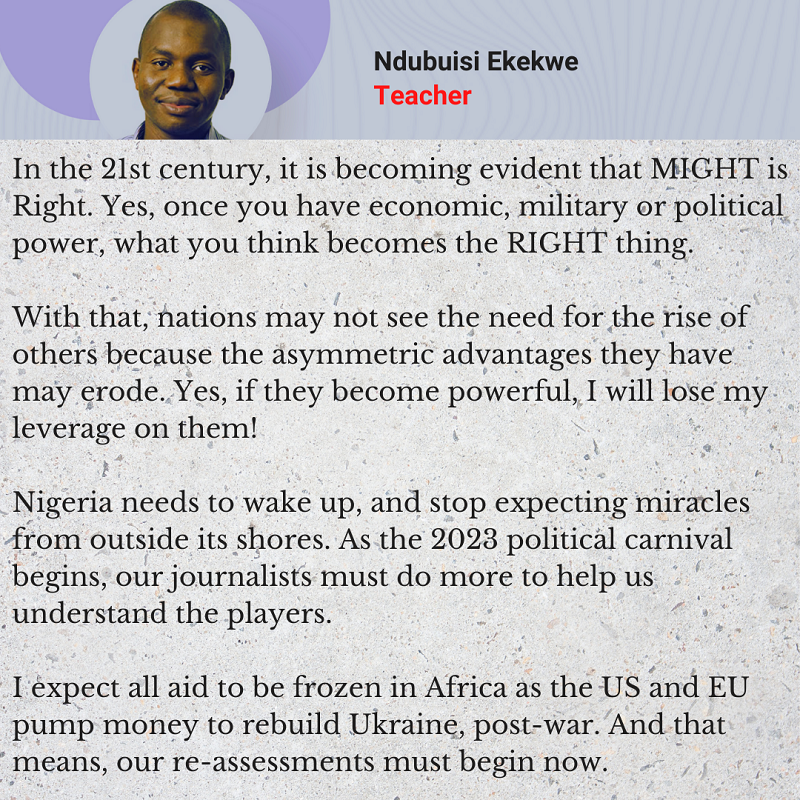
In the 21st century, it is becoming evident that MIGHT is Right. Yes, once you have super economic, military or  political power, what you think becomes the RIGHT thing.

And under that construct, nations may not see the need for the rise of others because the asymmetric advantages they have may erode. Yes, if they become powerful, I will lose my leverage on them!

Nigeria needs to wake up under this reality, and stop expecting developmental miracles from outside its shores. As the 2023 political carnival begins, our journalists must do more to help us understand the players. 

I expect all aid to be frozen in Africa as the US and EU pump money to rebuild Ukraine, post-war. And that means, our re-assessments must begin now.

Comment on LinkedIn Feed

Comment 1: Merchants and mercenaries don’t build a nation, only patriotic citizens do, unfortunately Nigeria has more of the former than the latter.

How many people are queuing up at the embassies? Some spend over N5 million, just to leave Nigeria. You cannot build a prosperous nation if majority of your compatriots have such mentality.

How many Nigerians have been evacuated from Ukraine so far? If you run the numbers, many of them never had the intention of returning to Nigeria, after their studies. But when crisis struck, Nigeria became an option, a safe home of some sort.

No matter what they tell you, no matter the shiny objects and fanciful things dangled in your face, you can only have one true home: the land of your birth. You can deceive yourself for decades, they can entice you with scholarships and juicy positions in private and public institutions, but remember that it’s your own heritage they are trying to erode. If Nigeria disappears or collapses, just know that you have lost out, and you will now be labeled as immigrant, refugee, people of colour, or whatever label your headmasters deem fit.

Never discard or undermine the very thing that makes you great and unique, without Nigeria roaring, you have not really excelled.


Global Media Is Actually Rigged

1

I do not usually agree with President Trump but he seems to be completely correct: global media is rigged. I supported when Twitter banned him. But reading how the media is covering the Russia-Ukraine war and the way they covered the Arab Spring, Trump deserves apologies. Journalists are indeed humans and what they package as products of professionalism are colored with personal opinions and prejudices.

BBC reported how Russia is censoring it. Then Russian newspapers reported how Facebook, Twitter, etc are censoring them. Largely, everyone is censoring to ensure their citizens remain in order.

Vladimir Putin has blocked social media sites, Facebook and Twitter, as the war between Russia and Ukraine enters a new phase.

Both the EU and the UK have warned social media companies not to allow Russia to use their platforms to spread propaganda, prompting Facebook and others to ban state media outlets Sputnik and RT.

The Russian media watchdog accused Facebook of censorship and ‘discrimination towards Russian media’ after Instagram joined in banning the Russian news outlets.

It is only Africa that allows global media to shape its future. That has to change.

I did an experiment today. I used Google translator to read some Russian newspapers. The conclusion from those websites was evident: US-based digital platforms are censoring Russian perspectives; Facebook has taken down many Russian media outlets. Then I went to BBC; and noticed how it reported that the Russian government has largely banned it. So, Russia censors and America also censors! 1-1.

Yes, Facebook, Twitter, etc receive heat to censor what the public does not want to see. And that got me to a conclusion: Africa is making terrible mistakes by allowing every junk news to get to our airwaves and digital ecosystems. And I seem to now agree with Trump that the media empires are not fair and balanced. 

Please next time you read that Chinese digital platforms are censoring content, do not think that China is doing anything that is not done in the US. The real issue here is that everything has open doors to Africa; that has to change.

Comments on LinkedIn Feed

Comment 1: To control the people in any society, just take hold of the education sector and media, you can add religion into the basket, then you can control the people like herds.

When most people tell you they are speaking their opinions, it’s not really their opinions they voicing, rather they are under the influence of those who own them.

The man Trump unpacked many things people had been believing to be real, and majority of the people roaming the face of the earth hated him for that, because when you were brought up with lies that seemed like truths, anyone telling you otherwise is obviously the enemy.

They told you he’s racist, and you believed them; they told you he would cause wars, you believed them; they told you he was incompetent and couldn’t lead, and you believed them; they told you that Russia made him the POTUS and he’s Putin’s puppet, and you believed. They told you many things, and you thought you were listening to the real people with any dose of knowledge or wisdom, and you kept believing.

Now the peacemakers are causing wars, those who call others liars have lived their entire lives lying, but they belong to the privileged class, they own the media and education sector.

Keep believing nonsense, we shall see.

Comment 2: African leaders will learn to use this wisely when they are strategic and strong enough to stand for their geopolitical interests. Right now, taking foreign trips and begging for more loans (while sitting on important human and natural resources) will do just fine.

People who removed history subject from school teachings are not ready to leverage the agenda-setting function of the mass media. This is what is at play everywhere.

What we think about, how we think about them and what importance we place on them, are largely based on what is packaged and shared by powerful media organisations.

That’s conditioning, and as Prof. Ndubuisi Ekekwe stated, personal/group interests are usually fiercely woven into these reports. Most times, forming an opinion on a particular depends on who you listen to. Notice how the Ukraine Crisis has displaced covid-19 in most social conversations?

Comment 3: More respects for Channels.Just watch Seun get big shots to open up and come charging back at him..The truth shall set us free. We must teach our kids to critically think for themselves. Analyse the data individually and as a team (which is able to spot more pitfalls,using its different eye views) ,and then draw the most logical conclusion or inference .

Comment 4: Why make a statement at all about this? Trump deserves no such apology and Russia enacted a new law that prohibited any narrative other than the one created by the Kremlin – violators face incarceration. Russian newspapers are free to report whatever they like with no such threats against them.

And I beg your pardon about African media – African media is no different than any other. They shape their own narrative. They are beholden only to the governmental forces under which they are governed.

My Response to #4: please take time and use Google Translator to read some European newspapers. Some said that refugees were evils in the past. But today, refuges are heroes. They ought to have told us that refugees from Africa were evil or Arab nation refugees were so without hiding the real deal.

We’ve been conditioned to think that China censors even when Facebook, Twitter, etc do the same thing.  How do you defend that YouTube took down some news channels? Is that not censoring?

Comment 5: 1..Poland said refugees from Europe are ok and so says some eu countries, but then the refugees from middles east and other African countries can’t be accepted as the definition of refugee at the moment doesn’t apply …that is double standard

2..many European journalism stated this incident in Ukraine should rather be happening in places like Africa or middle east rather than an European country ..uhmm they forgot history never lies as Europe Is regularly in war

3..if Nigeria senate can copy Singapore rules to be incorporated into Nigerian system then one is not even sure if we are Nigerians or Singaporean

In a simple way. The MSM is rotten to the core and it’s an instrument use by a few to shape things in their favor and it’s so pathetic that we humans are always so sentimental to situations rather than logically analysing the situation properly..

Trump should be given credit in some quarters

Russia Blocks Twitter, Facebook As Ukraine Crisis Escalates

1

Vladimir Putin has blocked social media sites, Facebook and Twitter, as the war between Russia and Ukraine enters a new phase.

Both the EU and the UK have warned social media companies not to allow Russia to use their platforms to spread propaganda, prompting Facebook and others to ban state media outlets Sputnik and RT.

The Russian media watchdog accused Facebook of censorship and ‘discrimination towards Russian media’ after Instagram joined in banning the Russian news outlets.

Facebook and Instagram have blocked Russian outlets RT and Sputnik in the UK and EU.

Russia’s media regulator Roskomnadzor announced on Friday, a week after Moscow invaded Ukraine, that Facebook would be banned, citing ’26 instances of discrimination toward Russian media’.

Earlier on Friday Facebook’s parent company Meta announced that RT and Sputnik would be barred from Facebook and Instagram in the UK, three days after the sites were banned across Europe.

Russia is also taking steps to keep the media under its control. Russia’s media regulator Roskomnadzor ‘restricted access’ to social media network Twitter after blocking Facebook in the country, Russian news agencies reported on Friday. Access to Twitter was restricted based on the request from the Prosecutor General from February 24, according to Interfax and RIA Novosti news agencies.

In addition to banning social media sites, Russia is working on a legislation that would impose harsh jail terms and fines for publishing ‘fake news’. The penalty for fake news stories that led to serious consequences, according to Russia’s lower house, is imprisonment of up to 15 years. The lawmakers also amended laws to fine or jail people calling for sanctions against Russia.

A host of independent media houses, including BBC, Bloomberg, CBC, CNN and Financial Times, have announced that they’re halting operation in Russia.

The BBC has a large bureau in Moscow and runs a Russian-language news website. Director-General Tim Davie said in a statement that “this legislation appears to criminalize the process of independent journalism,” adding that journalists could face “the risk of criminal prosecution simply for doing their jobs.”

Two Russian outlets, Nobel Prize-winning newspaper Novaya Gazeta and business news website The Bell, said Friday they will stop reporting on Russia’s invasion of Ukraine to protect their journalists.

The Kremlin’s push to control the narrative is seen as fear that Russians may revolt if they find out the truth about Ukraine’s invasion. Reports said that Russians are being fed propaganda since the war started, including that soldiers are being sent to Ukraine to fight Nazis.

Russian media have been instructed to publish only information provided by official sources, which describe the invasion as a military operation. This means, without independent media, the Kremlin will determine what Russians know about the war.

Like other independent media in Russia, Ekho Mosvky – a liberal-leaning radio station majority-owned by Russia’s energy giant Gazprom, said Thursday it would shut down after being taken off air over its Ukraine war coverage.

Ekho Moskvy website was blocked on Tuesday as punishment for spreading “deliberately false information” about the conflict. Its editor-in-chief Alexei Venediktov said on Telegram Friday that the station will be deleting its website and social media accounts to protect journalists.

A media war has just started as the US, UK and the EU push to limit Russian propaganda and Russia is pushing to ensure that the majority of Russians hear only its version of the story.

The development deals further blow to Meta’s revenue crisis that started early in the year. Facebook’s lost about 30% of its shares, wiping over $250 billion off its market capitalization. Far more than Twitter with about 10 million users in Russia, Facebook has about 66 million users in Russia, according to data tracking firm Statista. The social media giant earned $19.68 per user in Europe last year, according to the company’s annual report. This means, Facebook will lose about $3.6 million per day or $1.3 billion per year in Russia due to the ban.