DD
MM
YYYY

PAGES

DD
MM
YYYY

spot_img

PAGES

Home Blog Page 5276

The intention may be pure but the act is criminal – petrol as souvenirs in Nigeria

0

A lady identified as Chidinma Pearl Ogbulu last weekend took her (owambe) party  to a whole new level. She caught the attention of Nigerians everywhere and the entire media with her choice of souvenirs at her installation ceremony as Erelu Okin in Oniru, Lagos last weekend. 

A video from the installation party shows stacks of 10-litre gallons containing fuel with the picture of the celebrant pasted on the gallon that are intended to be given out to guests as souvenirs and thank you for coming gifts.  

There has been fuel scarcity in major cities of Nigeria like Lagos and Abuja for a better part of this year and the lady with her party organizers deemed it as a nice gesture to share gallons of petrol to attendees and guests at her party. 

It is a nice gesture actually but she and her organizers didn’t think it through, they never thought about how combustible fuel can be and turning an event Centre to a petrol station is really a dangerous act. Although the intention may be pure but the act itself is criminal and a life threatening one which is highly condemnable.

The Lagos state government did not take this kind of act likely, the commissioner of information of the state stated clearly that such an action is obviously a dangerous and life threatening one that can lead to loss of lives and properties and it is definitely beyond every safety measure. 

The government of Lagos state through the Lagos Safety Commission and the Rapid Response Squad has reacted by sealing off Havillah Event Centre, Oniru- Lagos, the event Centre that the party took place last week for Contravening Public Safety Rules and the government have also ordered the arrest of the celebrant and organizers of the party. 

The state police command also issued an official statement condemning the act and forewarning indigenes not to engage in such a life threatening act of playing with petrols in a party; “The attention of the Lagos State Police Command has been drawn to a video going viral on social media in which some individuals and organisers of an event were seen giving out some kegs containing PMS (petrol) as souvenirs.

“It’s regrettable that in spite of a series of warnings and sensitization carried out by the police and other relevant government agencies, some individuals could be handling such combustible substances in a public place in total disregard for the safety of lives and properties”.

Tekedia Capital Publishes Key Dates for Q1 2022 Investment Cycle

0

Here are the key dates and deadlines for Q1 2022 investment cycle:

  • Publication of the startups: March 16
  • Demo Day: Demo Day is scheduled for March 26 at 4pm-6.30pm WAT (Zoom link will be provided later)
  • Valuation Update: By March 30, we will share the current valuations of the startups to guide on the expected percentages any investment will buy. We will also request to know how much you plan to invest, if investing. 
  • Tell us how much and startup you’re investing: April 6
  • Fund Transfer: Between April 8 and April 15. Transfer could be in US Dollars or local currency; bank details will be provided.
  • Master Agreement Signing: upon payment

To join this cycle, register here and join the Syndicate and co-invest with others, in Africa’s leading startups.

Meanwhile, yesterday, Tekedia Capital had an OPEN session; vide below.

Nneka. NigeriaKA. Nigeria Remains HOME As Nigerian Students Return from Ukraine

1

Let me congratulate the Nigerian government for the efforts the nation has put to bring our young people studying in Ukraine home. While we continue to wish for an improving nation, moments like this should challenge everyone of us: you can say anything you want about home, home remains home. 

In the Igbo Nation, we name our daughters “Nneka” [mother is supreme]. There is a reason for that. In ancestral Igbo, when you lose your land, your kingdom and your kinsmen cannot help, the last hope is your mother’s land. Interestingly, your mother’s people have an unalloyed obligation to help you. As a result of that, men pay special attention to mothers because when everyone abandons you, you remember your mother’s land.

In your mother’s land, you are Nwa-ada [child to our daughter] and by tradition, you assume immediate ascension, even well ahead of most men of that land. How do you know? Go to Obi (the temple) as elders gather, and before any meeting starts, a wine is offered.

Before the lead elder (usually the most senior) begins to do libations, he will ask “do we have any Nwa-ada here”. If there is an Nwa-ada, the person is acknowledged immediately. And when they begin to serve the drink, the Nwa-ada despite his age will drink well ahead of the indigenes of that land. Yes, he drinks with the elders and by tradition, his security is absolute and guaranteed while in the mother’s place. 

(In Things Fall Apart, Chinua Achebe brought this tradition when Uchendu gathered his entire family, including Okonkwo; a man belongs to his fatherland and stays there when life is good, but he seeks refuge in his motherland when life is bitter and harsh. Many have called Nigeria the motherland!))

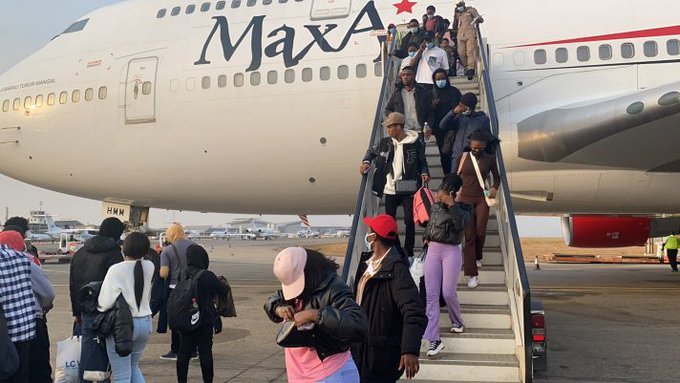
Nneka. NigeriaKA. We need to make Nigeria better because that is our home. As I watched those young people descend from the aircraft, you should be proud that in the time of need, your nation answered. That is what it is all about, even in the imperfection of that nation.

Many have called Nigeria a “motherland” – more than words!

The second batch of Nigerian evacuees from Ukraine arrived, on Friday evening, at the Nnamdi Azikiwe International Airport, Abuja.

They arrived on a plane owned by Air Peace, one of the airlines billed to airlift Nigerians returning from Ukraine. The plane took off from Poland, where the Nigerians had fled to following the war in Ukraine.

“The journey was very stressful but we take joy because we are saving lives, rescuing our compatriots, our future because these are our children. We all did it with excitement…,” Akinremi Bolaji, the director of consular and legal services, ministry of foreign affairs, told journalists at the Abuja airport.

According to Mr Bolaji, there were 180 adults and three infants aboard the aircraft.

Reviewing Nigeria’s Government Advocacy On Digital Learning

0

Digital (virtual) learning is any form of learning that is accompanied by technology, or instructional practice, that makes effective use of tech-driven measures.

It encompasses the application of a wide spectrum of practices including blended and virtual learning. Through the use of mobile technologies, digital learning can be used while traveling and other related activities.

It’s noteworthy that there are a plethora of tools and resources online, many which are free, that can be used to create and enhance a digital learning environment.

Some of the tools being used by the 21st Century digital learning tutors include Google+, YouTube, RSS, iTunesU, cloud-based Word Processors (Google Drive), Evernote, file-sharing platforms (Dropbox), Zotero and digital pocket.

Two years back, precisely on 2nd April 2020, unsure of how long the Coronavirus Disease (COVID-19) pandemic that causes pleurisy would linger, the Nigeria’s Minister of Education – Mallam Adamu Adamu – engaged 237 Vice-Chancellors (VCs), Rectors and Provosts of the various higher citadels of learning across Nigeria on a rigorous talk concerning how to reopen their respective institutions using virtual learning.

In the amazing discussion that lasted for hours, which was held via a teleconference, the said boss directed all universities, polytechnics and colleges of education to activate virtual (online) learning environments to enable students to continue their studies through digital devices.

He however acknowledged the fact that the Academic Staff Union of Universities (ASUU) was still on strike, hence assured the Federal Government (FG) would do its best to resolve the lingering labour crisis.

Mallam Adamu who was physically flanked by the Executive Secretaries of the National Universities Commission (NUC), National Board for Technical Education (NBTE) and the Universal Basic Education Commission (UBEC) as well as the Registrar of the Joint Admissions and Matriculation Board (JAMB), among others, further stated that the FG could not afford to shut schools for a long time, thus called for the meeting to ascertain remedies to the challenges posed to the nation’s school calendar by the COVID-19.

The minister, who affirmed at the online session, that he had tested negative to the COVID-19, said “We cannot be held down by the pandemic. We have to deploy all e-platforms to keep our universities, polytechnics, colleges of education, and other schools open”.

He frowned that the outbreak of the COVID-19 had negatively changed everybody – both individuals and institutions – therefore asked the leadership of the higher citadels of learning to devise alternative ways towards ensuring that the education of the young ones would not be truncated.

Mallam Adamu, who urged the education leaders to take advantage of technology as it was found in other parts of the world, stating the country could not shut down all schools when it could boast of other means to teach the students, equally disclosed that the government was already collaborating with the World Bank and the United Nations Children’s Education Fund (UNICEF) on how to create platforms for virtual learning classrooms.

Having reiterated determination to end the ongoing impasse between the FG and the ASUU, the minister stated that the private universities that were not on industrial action could immediately commence the virtual learning prior to the anticipated resumption of the public varsities that were still on strike.

On their part, most VCs of the private varsities welcomed the idea, hence expressed readiness to reopen their institutions having claimed they already had a top grade virtual (online) learning system. They however pleaded with the FG to amend the Tertiary Education Trust Fund (TETFUND) Act to enable private citadels to benefit from the intervention funds.

Mr. Adamu went further to join the UBEC to work out modalities on how primary school pupils and secondary students could learn by using digital channels such as the radio and television stations. He said the FG would involve the state governments in this regard.

This could be referred to as a clarion call made by the education minister, conscientizing the stakeholders in the education industry to embrace the current realities. He was apparently making an effort to let them comprehend that digitalization – or technology at large – could not be kept in abeyance at such a critical time like this.

It’s really appalling that at this moment when virtually everything is being digitalized across the globe, most Nigerian higher educational institutions are yet to fully key into the language of digitalization let alone granting access to the teeming students.

It’s not news that till date, most of these citadels are still finding it difficult to engage their students in e-library platforms and what have you, let alone educating them virtually.

Though face-to-face contact – or physical presence of a tutor – plays a very major role in impaction of knowledge, hence cannot be jettisoned, it’s imperative for these leaders of thoughts to acknowledge that the impact of a tech-driven teaching mode in contemporary society cannot be overemphasized.

Hence, it’s needless to assert that time has come for the teeming Nigeria’s institutions to deploy new and alternative means of learning in their various jurisdictions in line with the present global realities.

However, come to think of it; one of the prime reasons that informed the recent incessant industrial actions, as well as the ongoing one, embarked upon by the Nigerian varsities’ dons was reportedly the continued poor funding of the institutions by the governments at all levels.

The last time I checked, the main reason that resulted in the ongoing strike by the ASUU members remained the compelling need to revitalize the country’s various universities in the area of learning, infrastructure and research.

If the above paragraph holds water, we will then wonder how the governments at all levels would expect these institutions to duly embrace digital patterns of learning when they are ostensibly facing paucity of funds in their respective purses.

It’s worthy of note that Nigeria’s numerous universities have recently been deprived of their rightful place. The current move by the governments to totally deny them their right for autonomy is a tangible proof to this assertion.

As if the Treasury Single Account (TSA) policy wasn’t enough, the FG still went ahead to involve the varsities in the newly introduced Integrated Payroll and Personnel Information System (IPPIS) policy after several relevant stakeholders and experts had condemned the initiative.

As much as we eagerly want these citadels to improve or grow in terms of learning content and research quality coupled with patent development and innovations, the needed support must equally be granted without involving pranks.

Extradition as a Legal cum Political Concept

0

The word “extradition” became a very popular and common word in Nigeria recently due to the Abba Kyari/ Hushpuppi international fraud case and the usage and mis-usage of the word clearly point to the fact that some people don’t fully understand the meaning of the word (Extradition) as a legal cum political concept hence the need for this piece to give a general and brief overview of the word “extradition” as a legal concept.

The federal government of Nigeria have been going back and forth with the United States of America as to whether to extradite Abba Kyari to the United States to go and answer for the criminal allegations bordering on conspiracy to commit wire fraud and money laundering, and identity theft. The Attorney General of the Federation finally approved the extradition request of the United State government against the dismissed erstwhile Deputy Commissioner of Police some days back.

               *******************
Extradition is the process whereby a country surrenders its citizen that is wanted in a foreign country to go and answer for the crimes he has been accused to have committed in that foreign country.

It is simply the surrender of an alleged criminal usually under the provisions of a treaty or statute by one authority (usually the home country of the alleged criminal) to another foreign country that has jurisdiction to try the alleged criminal for the crime.

There is a clear cut difference between extradition and deportation. Deportation is the expulsion of foreign nationals back to their home country whereas the former is the expulsion of a national or citizen from their home country to a foreign country. Extradition can also be referred to as banishment, exile, or penal transportation.

If you are a foreigner, and you are been accused of committing a crime in your country, and you decide to flee to another country to seek refuge, the country you fled to can choose to grant you refuge or deport you back to your country but a citizen of a country can only be released to a foreign country to be tried for criminal offenses by extradition process duly authorized by the attorney general of the federation.

Extradition of a national  can only happen when a country has an existing extradition treaty with the other country. No country of the world has an extradition treaty with all other countries; for instance, the United States lacks extradition treaties with China, Russia, the United Arab Emirates, North Korea etc, and therefore the US government cannot request the Chinese government or the Russian government to extradite its citizen to the USA to be tried for any crime despite the gravity of the crime the foreigner has committed in the US soil.

Nigeria and USA and other commonwealth nations are under extradition treaties and that is why the United state can ask Nigeria to extradite its citizen to be tried for crimes in the United State and Nigeria will be under the legal obligation to honor the request but if Nigeria is not on extradition treaty with the USA, the US government cannot ask Nigeria to give up it’s citizen to be tried for any crime under the US jurisdiction.

Therefore, for extradition to take place in a country, it must be within or amongst the county that are on extradition treaties with each other.

The Extradition Act of 2004 is the extant law in force that supervises and  regulates the process of extradition in Nigeria.

By the reason of section 1 the of act, Nigeria is under a legal obligation to release her citizen to the hands of foreign jurisdiction to be tried for offense the citizen has been accused of committing in that foreign country. The section provides thus:

1. (1) Where a treaty or other agreement (in this Act referred to as an extradition agreement) has been made by

Nigeria with any other country for the surrender by each country to the other, of persons wanted for prosecution…

According to this act, it is the Attorney General of the Federation that has the power to grant the extradition request of a foreign jurisdiction. So the request for extradition of a Nigerian National must be made in writing directly to the Attorney General of the federation.

This is the provision of s. 6 of the Extradition Act of 2004 and it reads thus:

S.6. (1) A request for the surrender of a fugitive criminal of any country shall be made in writing to the Attorney- General by a diplomatic representative or consular officer of that country and shall be accompanied by a duly authenticated warrant of arrest or certificate of conviction issued in that country.

(2) Where such a request is made to him, the Attorney-General may by an order under his hand signify to a magistrate that such a request has been made and require the magistrate to deal with the case in accordance with the provisions of this Act, but shall not make such an order if he decides on the basis of information then available to him that the surrender of the fugitive criminal is precluded by any of the provisions of subsections (1) to (7) of section of this Act.

This section further provides that the AGF may refuse to honor the extradition request of a foreign government if there’s no extradition agreement between Nigeria and the foreign jurisdiction. This is the provision of S.6(3) of the act:

S.6(3) Except insofar as an extradition agreement in force between Nigeria and the requesting country otherwise provides, the Attorney-General may refuse to make an order under this section in respect of any fugitive criminal who is a citizen of Nigeria.