DD
MM
YYYY

PAGES

DD
MM
YYYY

spot_img

PAGES

Home Blog Page 5315

As food costs reach 58.9% of Nigeria’s household income, why regulatory price control won’t work

1

I read an article a few days ago on LinkedIn suggesting that Nigeria needs a ‘price control policy’.

The post postulated that FGN need to ‘ to set minimums and maximums for the prices of goods and services in order to make them more affordable for consumers’.
A reference was made to California State law, (US) which limits the price raising to 10% after the market has been impacted by crisis phenomenon.

The law is intended to prevent ‘price gouging’ which creates inflation, reducing the purchasing power of the masses, and then leads to poor people getting poorer.

The question is, would it work? I’m thinking, with a few provisos and caveats that I am leaning in the direction of ‘NO’.

One of the reasons is the profound difference between doing business in California and Nigeria

Ease of Doing Business Index

The Ease of Doing Business Index was operated by The World Bank. Even if an investor has never done business in a country, the index provides a headline estimation of challenges, difficulties and risks (obstacles to profitability) condensed to a rating out of one hundred (x/100).

It’s changed its methodology multiple times. Iterative methodology regimes are signified by ‘DB’ followed by a year abbreviation… so DB10 started in 2010, DB15 in 2015 and DB17 in 2017.

The overall trend across successive methodologies has been to ‘mark upwards’, so it is dangerous to pick a particular country and celebrate how its index has improved between 2010 and 2017 as the results involve being measured by very different ‘yardsticks’.

What has been more credibly retained across methodology evolution, is the RELATIVE EDB rating between different global geos.
World bank notice on its EDB service suspension

World Bank suspended its ‘Ease to Do Business’ reports following some methodology inconsistency discoveries in 2020.  2021 reports were not published. A statement on their website suggests they have  completed a process in which ‘historical data up to Doing Business 2020, (were) revised to correct data irregularities’

They are currently working on a new framework called Business Enabling Environment (BBE), which is yet to be launched.

Nevertheless, they are still the defacto reference point for macro data like this.

Nigeria rarely, if ever, gets out of the bottom 10 in EDB ratings. The system does not provide ratings for different internal states, but does provide for some metropolis. The Lagos rating is only 56.5 against a Los Angeles rating of 82.2 and a Pan-US rating of 84. By comparison, war torn Yemen is 38.4. (2020).

To approximate, the gulf of business amenability between California and Nigeria is comparable to a preference for Nigeria over Yemen!

In a country where draconian import bans, killer herdsmen inhibiting backward integration and other supply chain challenges inhibit regularizing both cost of production and cost of sales, unregulated pricing is probably one of very few tools left to stop many businesses running at a loss.

Governance Inefficiency

There are three types of Governance in Nigeria.

The first is the duly elected representatives both at state and federal level; The Presidency; State Governors,  The two houses; and then the civil and military institutions over which they preside.. army, navy, air-force, police, immigration, customs, civil departments … the list goes on.

The second type are Nigeria’s various traditional structures, with different leadership titles depending on the tribal culture. There are titles such as Emir, Igwe, Oba, Oniru, and Sultan depending on what part of Nigeria.

With the advent of colonial rule, traditional leadership structures became fractured and with the gaining of independence, a very fudged version of constitutional monarchy completely lacking any form of federal uniformity emerged.

A myriad of mini-dynasties sprawled the land, each with their own powers of granting non-hereditary honours for notable ‘acts of service’ or from achieving esteemed notoriety in ‘far away lands’.

The third form of Governance is the unregulated governance structures.

This covers a wide range from terrorist organisations to self determination groups, bandit organisations, agbero and local ‘area boys’. They developed either out of control gaps in the other forms of Governance in certain parts of Nigeria, or, because of disaffection with their performance. In some cases they become introduced under funding of foreign actors. From time to time, reports appear in media alleging links and tacit approval from elements within the previously mentioned formal structures. Some of the actors appear to have religious objectives.

But, recall this passage from my New Years’ article on ’11 predictions of the decade’:

‘While a religion is often a significant generator of armed conflict both in the past and in the present, the two principal causes of human warfare are in fact culture and greed for territory, resources or power’   –  Meic Pearse – Author of: ‘Why the Rest Hates the West: Understanding the Roots of Global Rage’

This ‘third sector’ Governance however has predictable ‘civil authority’ hallmarks, such as the imposition of standardized behaviours by ‘control’; (varied levels of) restrictions on personal and autonomous freedoms, extracting income from subjects (taxes) without providing any free market type product or service; and lack of consumer choice or the means to opt out!

Corruption

I don’t like using the C word. It exists. It will always exist. Anywhere in the world it has always, does now, and will always exist. I try not to get involved in too many discussions about it.

The main reason is that the ‘go to’ topic is a sort of dismissive and resigned hopelessness, and I prefer a position that acknowledges the potential for ways forward.

Ultimately it matters less that it exists, and more that ‘continual improvement’ can happen in spite of it.

Theft, for instance, is a form of societal corruption. Modern trade and retail outlets don’t ‘break their brains’ trying to achieve zero theft. They just find a way of factoring it in as a cost of sales, as long as it doesn’t impact sales volume and hurt profit.

What matters is not achieving squeaky clean Governance. What matters is that Governance profits its people.

Irrespective of the nature of Governance, the reality is the overall collective cost of it in Nigeria is too high, and some serious slashes need to be made collectively across the sector to align its cost meaningfully against GDP.

Nigeria currently has the highest average percentage of household expenditure on food in the world (58.9%), with the US (8.6%) being the lowest.

Reduction in the cost of food as a percentage of household income, not only improves quality of life, but it also stimulates the business intellect in the economy, by freeing up extra disposable income to be spent on individuals, improving their value prospect in the job market, contract or entrepreneurial space.

The reality is nobody in Nigeria would complain of ‘corruption’ if Governance was delivering an economy in which food only accounted for 8.6% of the income of households among ‘the masses’.

A ‘price control policy’ will not work, as driving food producers bankrupt would translate a market with foodstuff price challenges, to a market with no foodstuffs at all.

The only area which holds some flexibility is an assault on the cost of Governance as a proportion of GDP, which in turn would bring flexibility to reduce various taxations, generating more demand in the free job market and other improvements.

Please visit my site www.johnmckeown.eu

URLs and online content were referenced between February 12 and 15 2022

brandspurng.com/2019/06/17/nigerian-consumer-inflation-edges-up-to-11-4-in-may-nbs/

theeasternupdates.com/2020/09/23/the-disregard-for-chhieftancy-titles-in-igbo-land/

www.refworld.org/docid/41501c3a15.html

www.worldatlas.com/articles/countries-with-the-highest-expenses-on-food-relative-to-household-expenses.html

www.ers.usda.gov/data-products/chart-gallery/gallery/chart-detail/?chartId=76967

guardian.ng/features/tackling-basic-challenges-in-nigerias-food-production-industry/

www.worldbank.org/en/programs/business-enabling-environment/doing-business-legacy

dailypost.ng/2022/02/10/climate-change-threatening-food-production-supply-in-nigeria-expert/


Let’s Commend NDLEA On Abba Kyari’s Drug Trafficking Case

0

I understand that many people will be focusing on the Abba Kyari guy and his antics in the nation. But I want to use this moment to commend and thank the men and women of the National Drug Law Enforcement Agency (NDLEA). Let us focus and see hope through such corridors and not dwell on Abba Kyari. To the boss of NDLEA, Brig. Gen. Mohammed Buba Marwa (rtd), and his men and women, well done. Let me hope that the nation sees a turning point, going forward, where even the powerful cannot be protected.

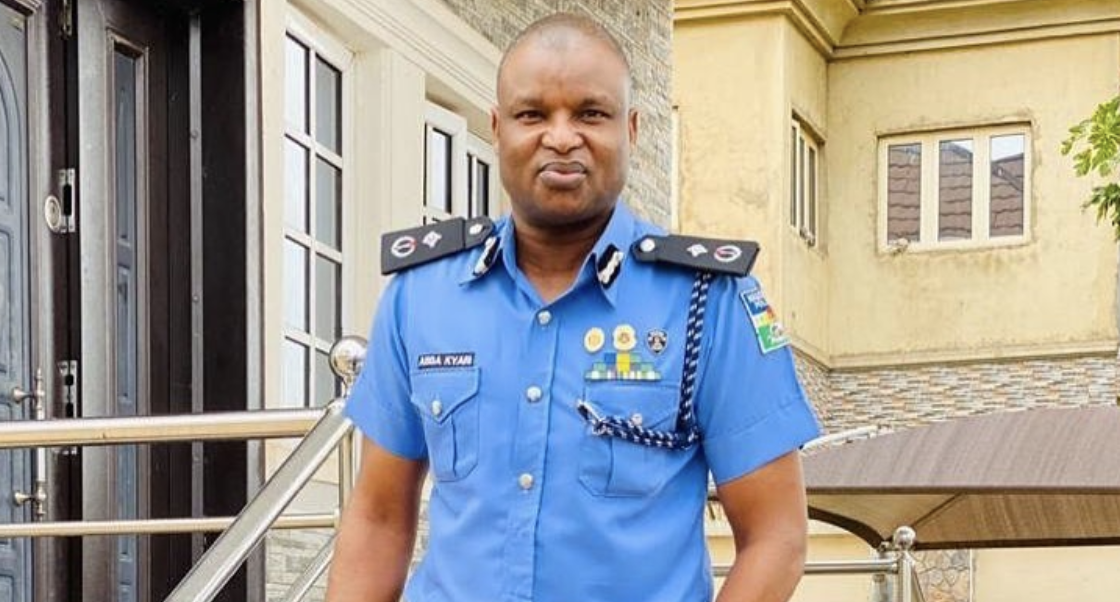
Today, we are forced to declare one of such law enforcement agents wanted in the person of suspended DCP Abba Kyari, the erstwhile Commander of Intelligence Response Team (IRT) at the Force Intelligence Bureau of the Nigerian Police Force.

With the intelligence at our disposal, the Agency believes strongly that DCP Kyari is a member of a drug cartel that operates the Brazil-Ethiopia-Nigeria illicit drug pipeline, and he needs to answer questions that crop up in an ongoing drug case in which he is the principal actor. His failure to cooperate forced the hand of the Agency and that is the reason for this press briefing.

Let me give a synopsis of what transpired.

The saga started on Friday, January 21, 2022, when DCP Kyari initiated a call to one of the NDLEA officers in Abuja at 2:12 pm. When the officer returned the call two minutes later, Kyari informed him he was coming to see him, to discuss an operational matter after the Juma’at service.

As many have noted, most of the challenges in Nigeria are not done by ghosts. The problem has been one thing: who has the gut power to go after them.  If we follow the spirit of NDLEA, from banditry to many other evils, this nation will release fresh air for all. Well done NDLEA.

The video in this Tekedia piece will push you to tears on what a man (allegedly) did to his nation even when in a uniform.

Nigeria’s “Supercop” Abba Kyari Who Was Declared Wanted for Drug Trafficking, Now in NDLEA Custody

Register a Company and Look BIG before your clients

0

Get a registered business name with a business bank account. Look BIG before your clients.

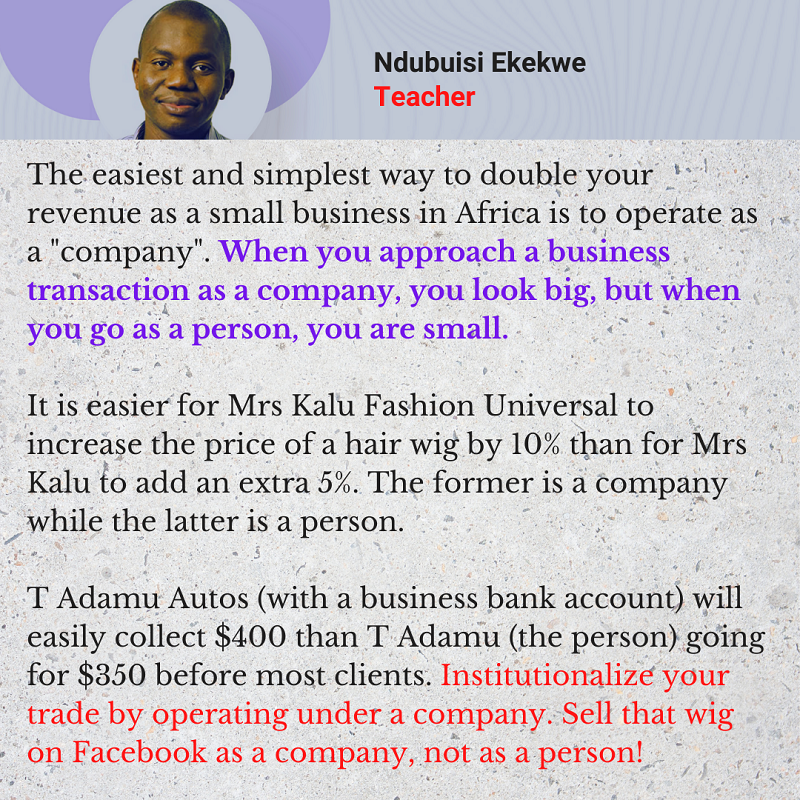
The easiest and simplest way to double your revenue as a small business in Africa is to operate as a “company”. When you approach a business transaction as a company, you look big, but when you go as a person, you are small.

It is easier for Mrs Kalu Fashion Universal to increase the price of a hair wig by 10% than for Mrs Kalu to add an extra 5%. The former is a company while the latter is a person.

T Adamu Autos (with a business bank account) will easily collect $400 than T Adamu (the person) going for $350 before most clients. Institutionalize your trade by operating under a company. Sell that wig on Facebook as a company, not as a person!

Comment on LinkedIn Feed

Comment 1: Our market is quite asymmetric, the same way being a company can help you command bigger fees, it can also cause you losing many deals as well.

It’s the buyers’ market, not producers, the people paying have more options and leverages than those selling, except you are offering uncommon services. The profile of the client matters more than what you may believe to be the standard.

A company can quote N150k (plus VAT) as cost of building a standard website, a standalone developer can jump out and quote N50k (freestyle), before you know what’s going on, the job is gone.

There’s no price control or standard procedures in our market system, so the same thing that could increase your fees can also limit your opportunities. At B2B level, it’s more tenable, but again, we do not have many businesses here yet, rather individuals starting a business, the price sensitivity in both instances is quite different.

The market space here remains a betting scene, with hits and misses changing hands all the time.

My Response: Everything has pros and cons but operating as a company offers overwhelming advantages. Someone can say taking medication as prescribed by a doctor has a disadvantage since you have to spend money to buy it . But that does not make it better. Most government benefits go to companies. While we always look at tax and fees, when the government has something, the goodies also go to companies.


Kannywood’s Ladin Cima And Using Registered Business Name To Improve Negotiations

The Abba Kyari never ending criminal wonders

0

The erstwhile commander of the Intelligence Response Team (IRT) of the Force Intelligence Bureau (FIB); DCP ABBA Kyari keeps getting himself into trouble and always setting himself up for public ridicule so he can be shredded off the last strands of honor that he still possesses before the public eyes.

He was initially fingered to be a member of the Hushpuppi’s international scam empire and this led to his suspension from the Nigeria Police Force and his immediate replacement as the commander of the Intelligence Response Team while he submitted himself to be investigated of the allegations leveled against him for his involvement in the Hushpuppi’s fraud scheme.

Whilst the publicly disgraced “super cop” is still fighting his extradition to the United State for the alleged involvement in an international fraud scheme, he was again today declared wanted by the National Drug Law Enforcement Agency (NDLEA) over his involvement in illegal drug deals. He was caught on record and on camera negotiating with an NDLEA officer to take part in the drug deal and even went ahead to offer some money to the officer as a bribe in order to stifle their ongoing investigations on him and the drug cartel.

This is shocking because, it is obvious that while he was purportedly suspended by the Nigerian police force,  he still carried out an operation with his team  and arrested a drug trafficker and sold some of the seized cocaine from the arrested drug smuggler. This begs for answers; how many operations has he been involved in whilst suspended from the police force; was the purported suspension from the police force a fluke? These are open questions to the  Police Service Commission (PSC) and the Nigeria Police Force (NPF) and the general public is looking forward to receiving their answers.

He was invited by the NDLEA to come over and answer some questions and he declined their  invitation and this led to the agency declaring him wanted while releasing evidence of his involvement in the illegal drug world and the video and audio recording of him negotiating and offering a monetary bribe to the officer of the NDLEA, little did he know that the officer was just playing along with him to get enough evidence on him as a leading  member of a drug cartel to nail him.

News reports from Vanguard News this evening confirmed that the police force has arrested the senior officer with four others today and handed him over to the NDLEA for proper action. According to the Vanguard News Source;  he was arrested and brought in with handcuffs just like every other criminal.

Abba Kyari who was styled as the Nigerian super cop has been accused of series of corruption, professional misconducts and malpractices whilst he is still even in the office; he was accused of being a very corrupt police who collects money and bribes from yahoo boys and corrupt politicians to use the police power to arrest, intimidate intimidate their opponents for no just legal cause and reason.

Some of these accusations in most cases were feigned off as the handiwork of his haters and distractors, but since the Hushpuppi’s saga, he has been caught in a web of series of  allegations. This makes Nigerians to wonder what other illegal deal could the super cop be involved in that will come to the public fore in no distant time.

Intel to Acquire Israeli Chip Company Tower for $6bn

0
Pat, new Intel boss

The race to capture more shares in the burgeoning semiconductor market means the players are buying other chip firms to boost production.

Last week, Nvidia called off efforts to acquire Arm due to regulatory objections to the $40 billion deal that has lasted more than one year, and would have given it a huge chance to dominate the market.

However, other semiconductor industry firms have been picking one deal after another, even though it’s at lower prices. Intel Corp. is close to a deal to buy Israeli chip company Tower Semiconductor Ltd. for nearly $6 billion, WSJ reports citing people familiar with the matter.

The deal, which bolsters Intel’s plan to make chips for other companies, could be unveiled as soon as this week, assuming the talks don’t fall apart, the people said.

It would likely include a hefty premium, given Tower’s market value of roughly $3.6 billion. The shares soared 49% in after-hours trading on Monday after The Wall Street Journal reported on the expected deal.

Tower, whose shares trade in the U.S. on the Nasdaq Stock Market, makes semiconductors and circuits used in everything from cars and consumer products to medical and industrial equipment.

It operates manufacturing facilities in Israel, California, Texas and Japan, according to its website. The company is based in Migdal HaEmek, in northern Israel near Nazareth.

Tower is similar to GlobalFoundries Inc., a much larger manufacturer that Intel explored a deal for over the summer. GlobalFoundries and its owner, Mubadala Investment Co., an investment arm of the Abu Dhabi government, ultimately decided to pursue an initial public offering instead, and the company now trades publicly with a market value of around $30 billion.

Intel in January said it plans to invest at least $20 billion in new chip-making capacity in Ohio, bolstering the company’s production ambitions as greater demand for digital products and a global chip shortage have amplified the need for more semiconductor manufacturing. Intel Chief Executive Pat Gelsinger said the Ohio site could eventually grow to accommodate eight chip factories, also known as fabs, with spending potentially reaching around $100 billion over the next decade.

The company, with a market value of nearly $200 billion, had already made more than $100 billion in investment pledges over the past year.

Intel has been busy on the strategic front lately. The company plans to publicly list shares in its Mobileye unit in a deal that could value the self-driving-car unit at north of $50 billion.

Intel lost its leadership in the semiconductor industry, and has struggled to bounce back as competition intensifies amidst pandemic-induced global chip scarcity. The move to acquire Tower is part of its push to regain its place in the market.