DD
MM
YYYY

PAGES

DD
MM
YYYY

spot_img

PAGES

Home Blog Page 5335

New York Times Acquires Word Game Wordle

0

In a big announcement on Monday, the New York Times said it has acquired Wordle, a simple word guessing game, for an undisclosed price in the low-seven figures.

“As The Times looks to entertain more solvers with puzzles every day — especially during these anxious times — we’re thrilled to announce that we’ve acquired Wordle, the stimulating and wildly popular daily word game that has become a cultural phenomenon,” The Times said.

Wordle was created by a Reddit engineer, Josh Wardle, and launched in October as a free to play game. Wordle gives players just six guesses to determine a five-letter word that changes every day. It has soared in popularity in less than three months of its launch, attracting hundreds of thousands, then millions, of players.

Players of the game share their scores on social media along with screenshots of the game’s distinctive grid. Following The Times acquisition, the game will continue to be free to play for a while.

Wardle initially created the word game, which he named after his surname, for his partner, who he’d known was a fan of puzzle.

Wardle told the Guardian this month that he felt overwhelmed by the game’s viral success.

“It going viral doesn’t feel great, to be honest. I feel a sense of responsibility for the players. I feel I really owe it to them to keep things running and make sure everything’s working correctly,” he said.

On Nov. 1, the game had 90 players. Nearly two months later, the figure ballooned to 300,000, according to the release from The New York Times.

“The game has gotten bigger than I ever imagined,” Wardle wrote in a statement on Twitter. “I’d be lying if I said this hasn’t been a little overwhelming. After all, I am just one person, and it is important to me that, as Wordle grows, it continues to provide a great experience to everyone.”

Since the launch of The Crossword in 1942, The New York Times has seen its game business rise exponentially. In 2014, the newspaper platform introduced the mini crossword, followed by Spelling Bee, Letter Boxed, Tiles and Vertex. Together, its games have reached one million subscriptions, and were played in 2021.

The acquisition of Wordle will augment The Times’ growing games enterprise. Wordle has been praised for its simplicity. Times’ crossword editor, Will Shortz, described Wordle as “a great puzzle”, saying that “it doesn’t take long to play, which makes it perfect for our age when people have short attention spans.”

Jonathan Knight, general manager for The New York Times Games, said the game has done what so few games have done: It has captured our collective imagination, and brought us all a little closer together.

“As part of our portfolio of games, Wordle will have an exciting future with the help of a team of talented engineers, designers, editors and more, furthering the user experience,” he added.

Wardle said he’s proud that the game is ending up with New York Times, which has been part of its story from the beginning.

“If you’ve followed along with the story of Wordle, you’ll know that New York Times Games play a big part in its origins, and so this step feels very natural to me. I’ve long admired The Times’s approach to the quality of their games and the respect with which they treat their players. Their values are aligned with mine on these matters and I’m thrilled that they will be stewards of the game moving forward,” he said.

Apple’s India Fourth Quarter Sales Up 34%, Leading the Market for the First Time

0

In 2020, Apple launched its first online store in India, marking a major step for the American smartphone maker’s ambition to expand iPhone sales in the fast-growing Indian smartphone market.

The Indian market had been dominated for long by Chinese phone makers, like Xiaomi and Oppo, who won over a large section of Indian consumers through affordable phones.

Apple used third party vendors and e-commerce operators, such as Amazon and Walmart to sell products in India. But that was partly responsible for its meagre share in the huge South Asian market. Before now, Apple accounted for only one percent of all smartphone shipment to India, far behind Chinese companies, Xiaomi and Oppo and South Korea’s Samsung.

The online store which kicked off September 23, 2020, came with incentives designed to draw Indian consumers. Apple planned to offer services such as; personalizing some devices, including iPads, with engravings, providing assistance in English and Hindi to enable customers to personalize their device according to their preferences. The website was also designed to allow customers to configure Mac laptops according to their needs.

The new decision to open a retail store and the incentives introduced alongside it seems to have paid off in less than two years. Bloomberg reports below that Apple had its strongest quarter for iPhone sales in India yet, indicating that the Cupertino, Calif.-based company is finally making progress in the world’s fastest-growing smartphone market.

Sales increased to 2.3 million units in the fourth quarter, up 34% from a year earlier, according to numbers from the market research firm Counterpoint. China’s Xiaomi Corp. and South Korea’s Samsung Electronics Co. sold 9.3 respectively, leading in terms of units.

Apple appears to have pulled in more revenue than any of its rivals, however, because of the iPhone’s high price tag, according to Counterpoint’s calculations. The U.S. company took in an estimated $2.09 billion for the quarter, edging aside Samsung with revenue of about $2 billion.

“It’s a turning point for Apple in India,” said Neil Shah, the Mumbai-based partner and research head at Counterpoint Technology Market Research. “Indians were willing to lavish money on premium phones during the pandemic because everyone’s lives revolved around their devices and there was nothing else to spend on.”

While Apple has become the most valuable company in the world on the popularity of its iPhone, it has struggled in the 1.3 billion-person India market. Pricey iPhones are far beyond the reach of many local consumers, a situation aggravated by stiff import tariffs Apple had to pay on devices made outside the country.

In 2018, the company stumbled through multiple top-level executive departures in the country, sliding sales and irate retail partners who protested its online discount practices. Apple sold 1.8 million iPhones for the entire year, fewer than it sold in the most recent quarter.

In addition to the online store, Apple has applied other strategies including streamlined discounts and local manufacturing of iPhones. It’s planning to open company-owned retail outlets in multiple cities in the coming quarters.

During the recent October to December period, India’s festival buying and gifting season, the phone maker priced its basic iPhone 12 model at less than 50,000 rupees ($668), offering cashback incentives and easy payment plans.

Apple is still a tough sell in a country where per-capita income was under $2,000 in 2020, according to World Bank data. For the most recent quarter, the average iPhone selling price in the country was $908, while Samsung’s was $278 and Xiaomi’s was $172, according to Counterpoint.

Apple has resisted introducing a cheaper device just for the local market, a common strategy for foreign brands such as Netflix and Kellogg’s. While Apple’s market share has climbed, it remains in the single digits at just over 5% for the quarter. Indians purchased 44 million smartphones in the period.

It has challenges beyond price in the market. Apple manufacturing partners, Foxconn Technology Group and Wistron Corp., have faced blowback in India because of their treatment of workers. The U.S. company took the unusual step of placing a Foxconn factory near the southern Indian city of Chennai on probation after protests about food safety and accommodation standards.

In addition, the country’s antitrust regulator, the Competition Commission of India, has begun a probe into app store fees.

As Facebook’s Shares Slump, Zuckerberg Announces Seven Investment Priorities for 2022(full text)

0
Facebook founder and properties

On Thursday, Meta’s chief executive, Mark Zuckerbrg issued a statement outlining seven major investment priorities for 2022. Meta opened the month of February with a huge loss that has rattled the company and its shareholders.

On Wednesday, Facebook’s shares dipped 22%, wiping more than $200 billion off the company’s value. Zuckerberg has anticipated some revenue loss since last year when Apple announced iOS policy change that gives iPhone users the right to reject being tracked across web by Facebook for targeted ads. But no one knew it would be this huge.

Facebook’s revenue is ad-based and has been under attack recently, with the UK and Europe tightening their privacy policies in addition to Apple’s ad-unfriendly policy. The threat to Facebook’s future has never been this real, and Zuckerberg knows Meta will need to change its business model to scale. He thus has, among other plans, outlined seven investment priorities; Reels, community messaging, commerce, ads, privacy, AI, and of course the metaverse, to ensure growth for his social media behemoth in 2022.

Read his statement below:

I just shared an update on our company strategy and results on our earnings call. I talked about the areas we’re investing in to build the future and lay the foundation for the metaverse. Here’s what I said:

This was a solid quarter for our products and business. It was also an important one for our company. In October, we announced that “Meta” would be our new name and laid out our vision for the metaverse. When we shared our plans at Connect, I said this is not something we’re going to do on our own. The metaverse will be built by creators and developers, it will be interoperable, and it will touch many different parts of the economy. In the months since, it’s been exciting to see lots of other companies share their own plans for the metaverse and how their experiences and products might show up too. And I look forward to partnering with many of them as we all work to bring this to life together.

If last year was about putting a stake in the ground for where we’re heading, this year is going to be about executing. Today I’m going to discuss our seven major investment priorities for 2022: and they’re Reels, community messaging, commerce, ads, privacy, AI, and of course the metaverse. These are the areas that we’re putting a lot more talent and budget towards.

Before I get to that, I want to briefly touch on our Q4 results, which I know Sheryl and Dave are going to go deeper on. I’m proud of the work our teams did here. We shipped products, our community continued to grow, and businesses of all sizes turned to us to help them reach people. But there are two things that I want to call out that are having an impact on our business.

The first is competition. People have a lot of choices for how they want to spend their time and apps like TikTok are growing very quickly. And this is why our focus on Reels is so important over the long-term. As is our work to make sure our apps are the best services out there for young adults, which I spoke about on our last call.

The second area, and related to this, is that we’re in the middle of a transition on our own services towards short-form video like Reels. So as more activity shifts towards this medium, we’re replacing some time in News Feed and other higher monetizing surfaces. So as a result of both competition and this shift to short-form video as well as our focus on serving young adults over optimizing overall engagement, we’re going to continue to see pressure on impression growth in the near term. Now I’m confident that leaning harder into these trends is the right short-term tradeoff to make in order to get long-term gains. We’ve made these types of transitions before with mobile feed and Stories, where we took on headwinds in the near-term to align with important trends over the long term. And while video has historically been slower to monetize, we believe that over time short-form video is going to monetize more like feed or Stories than like Watch – so I’m optimistic that we’ll get to where we need to be with Reels too.

Ultimately, our continued success relies on building products that people find valuable and enjoy using. And in a competitive marketplace, we’re focused on understanding the areas we need to deliver on for people and executing against our strategy.

Dave is going to share more on these impacts to the business in a minute. But before we get to that, I want to discuss our investment priorities for 2022.

First is Reels. It’s clear short-form video will be an increasing part of how people consume content moving forward, and Reels is now our fastest growing content format by far. It’s already the biggest contributor to engagement growth on Instagram and it’s growing very quickly on FB too. As we continue to improve tools for creators, ranking for the people watching, and as we roll out the product everywhere across the world, we expect that this will continue growing quickly. So looking ahead, we’re investing in simplifying video across Instagram, building more great creative and monetization tools for creators, and helping more people discover and interact with relevant Reels.

The next investment priority is community messaging – which is about chatting with groups of people that you have something in common with, whether that’s a shared community, experience or interest. We already run some of the world’s most popular messaging platforms where people connect 1:1 or in groups with friends, family and colleagues. And we’re seeing people increasingly want to share more things in messages that they would’ve previously maybe posted to feed. I think the popularity of apps like Slack in the workplace, or Discord or Telegram reflects this trend too. So we’re going to help people on WhatsApp better organize their group chats and make it easier to find information for the communities they’re part of – like parent groups or neighborhoods. And we’re also building Community Chats on Facebook and Messenger for real-time conversations within those groups and communities.

I also want to call out business messaging too, since it’s an area where there’s real momentum. We estimate more than 1 billion users are connecting with a business account across our messaging services every week. And we’re partnering with companies like Uber and Jiomart to help people book a ride or have their groceries delivered right from a chat. And we’re building new tools to make buying online better for people and easier to manage for businesses. And we believe this can be an important business for us in the years to come.

We’re also making good progress on our broader commerce efforts. We already help a lot of businesses reach new and existing customers with personalized ads, and our commerce tools are an extension of that – it’s a seamless experience for people and businesses to buy and sell through our apps. Our strategy since introducing Shops a year and a half ago has been to make it as easy as possible for people to make a purchase after discovering a new brand or product, without having to switch over to a browser or re-enter their payment info. Sheryl will share more about our progress here, including some of the success we saw over the holidays.

Next up is ads. With Apple’s iOS changes and new regulation in Europe, there’s a clear trend where less data is available to deliver personalized ads. But people still want to see relevant ads, and businesses still want to reach the right customers. So we’re rebuilding a lot of our ads infrastructure so we can continue to grow and deliver high-quality personalized ads.

The next two priorities I want to discuss focus on the infrastructure that underpins all our products. First is privacy. We’ve made huge investments in strengthening our approach to privacy, including rebuilding our privacy program and our privacy review process. We made updates to bring greater privacy to our products, including end-to-end encrypted backups and disappearing messages on WhatsApp, and end-to-end encrypted voice and video calling on Messenger. Over the next few years, we’re focused on building out a major privacy infrastructure project that will encode our privacy commitments at a deeper level of our technical foundation to make them more durable and make product development faster in this evolving environment.

Now onto AI. This is one of the areas where we’ve routinely seen stronger returns on our investments over time than we’ve expected. Advances in AI enable a lot of the experiences I’ve spoken about so far – it enables us to deliver better ads to people while using less data; its core to all of our safety and security work; it’s meaningfully improved the relevance of Reels and overall content ranking in general; and it plays a big role in our commerce efforts.

Artificial intelligence is also going to play a big role in our work to build the metaverse. We just announced our AI Research SuperCluster, which we think will be the world’s fastest supercomputer once it’s complete later this year. This is going to enable new AI models that can learn from trillions of examples and understand hundreds of languages – which will be key for the kinds of experiences that we’re building.

Looking ahead, we’re focused on further scaling our computing power and transforming our AI infrastructure through advances in foundational research, as well as improvements to data center design, networking, storage, and software.

Now the last investment priority here is the metaverse. We’re focused on the foundational hardware and software that are required to build an immersive, ??embodied internet that enables better digital social experiences than anything that exists today.

On the hardware front, we’re seeing real traction with Quest 2. People have spent more than $1B on Quest store content, helping virtual reality developers grow and sustain their business. We had a strong holiday season and Oculus reached the top of the App Store for the first time on Christmas Day in the US. We’re working towards a release of a high-end virtual reality headset later this year and we continue to make progress developing Project Nazare, which is our first fully-augmented reality glasses.

As for software, Horizon is core to our metaverse vision. This is our social VR world-building experience that we recently opened to people in the US and Canada. And we’ve seen a number of talented creators build worlds like a recording studio where producers collaborate or a relaxing space to meditate. And this year, we plan to launch a version of Horizon on mobile too, that will bring early metaverse experiences to more surfaces beyond VR. So while the deepest and most immersive experience are going to be in virtual reality, you’re also going to be able to access the worlds from your Facebook or Instagram apps as well, and probably more over time. This will enable us to build even richer social experiences where you can connect with friends in the metaverse whether they’re in VR or not.

We’re also focused on avatars, which will be how you represent yourself in Horizon and across other developers’ experiences in the metaverse. In December, we rolled out our Meta Avatars SDK to all Unity developers on Quest, Rift and Windows-based VR platforms, letting developers bring Meta Avatars to their own VR experiences. We just announced an update that lets you further customize your avatar to better express yourself – and we’re introducing digital clothing too, starting with an NFL partnership so you can cheer on your favorite team. You can use your avatar across Quest, Facebook, Instagram and Messenger. So it serves as another bridge between our 2D social apps and 3D immersive virtual reality experiences. We have a bunch of work ahead of us to make avatars as expressive and high-fidelity as they need to be to fully represent us and help us feel present with one another. But I’m very excited for the advances we’re making here.

Making meaningful progress across all seven of these areas is going to improve the services we offer today and will help power a more social, intuitive, and entertaining metaverse, where people, businesses and creators can all thrive. This fully realized vision is still a way off, and although the direction is clear, our path ahead is not yet perfectly defined. But I’m pleased with the momentum and progress we’ve made so far and I’m confident these are the right investments to take us forward.

2022 is the first page of the next chapter for our company. I’m grateful for all the talented teams at Meta and our partners for executing on this important work. And of course for all of you who are on this journey with us.

The Menace of Godfatherism in Nigerian Politics

0

In Nigerian politics, needless to emphasize that for you to achieve some level of recognition and occupy some juicy political positions you must have a godfather. Just like the role of “The Godfather” is undeniably a crucial one in the mafia empire in the western world so also there’s undeniably a crucial role a godfather plays in the survival and ascension to the throne of his political protege in politics in Nigeria.

A picture surfaced on the internet some days ago and it has been driving everyone crazy. A commissioner of land and water resources of Akwa Ibom  state, Mr. Umo Eno a man in his 50s or even 60s was kneeling down before Gov. Udom Emmanuel of Akwa Ibom state who according to report just anointed the former as his  successor to the governorship throne. That picture of a 60 years old man (in the voice of Asari Dokubo) kneeling down before his mate or even his younger person who just happened to have occupied a higher position is a replica of how Nigerian politics plays out. 

Politicians kneeling down, prostrating and bowing down in worship of other politicians who they deem as gods is not new in the Nigerian political atmosphere; remember sometime last year when another picture surfaced online where a political figure in Delta state, a 61 years old Nigerian top tier senator, Mr. Manager, the senator representing the Delta South Senatorial District was also pictured on his kneels, begging the former Governor of Delta state, Mr. James Ibori to push his 2023 governorship ambition.

It is now a tradition. Some call it humility but we all know better, it can be anything but humility; it actually looks stupid, and clearly an act of desperation, it’s concept is pointing to how much decadence the Nigerian politics have suffered, it shows in clear terms that you can’t occupy a juicy political position in Nigeria based on your credibility and merit but based on favoritism as you must be ready to kneel before, worship, bow down and adore some political majesties who will place you in their pockets and control you within their whims and caprices.

The western Nigeria is the pace setter when it comes to godfatherism politics. Just like the Godfather is the overall boss in the mafia family that other lords pay homage to him, Tinubu is the overall governor, overall senator and overall political figure in that region that other governors, senators, house of representative members and other political occupiers worship him and take instructions from him. If you dare to do otherwise and fail to follow his instructions you will be treated like an insubordinate and such act of insubordination is punished by making sure you don’t ever return to the political position you were occupying before your frolicked or ever win election again unless you have grown some huge wings to help you flourish independent of your political godfather.

This was the case of the former Governor of Lagos state, Mr Akinwunmi Ambode; based on his track records and achievements in the state, he was to return for the second term, he deserved it, but due to his insubordination to Tinubu, “the Lagos mafia God father”, he was denied the second term ticket. It has been the tradition and you can’t help it. If you try to do otherwise the mafia gang will come after you and make sure you don’t ever get close to any political seat, ever again and make you lose your political popularity for daring to be insubordinate to “the Godfather”. 

Adams Oshiomole was to try out this system in Edo state but it failed woefully as the opposition was able to introduce and sell a propaganda to fight the grip of Adams in Edo state. They introduced and sold the “Edo nor be Lagos” slogan. Which was a political propaganda sponsored by the opposition to fight the Adams Oshiomole system and structure and extol Godwin Obaseki. 

Obaseki was clearly a political stooge of Oshiomole but due to unresolved differences, the two fell off, Oshiomole tried to play the Tinubu/Ambode card on Obaseki, but Obaseki unlike Ambode decamped and fled the party and joined the opposition party and he was able to stand his ground and fight for his return ticket. He won and he made Oshiomole lose his popularity in Edo state, a state that was under his whims and caprices but he didn’t fully grasp the state like the Tinubu of Lagos state.

This godfatherism political system has never had a known or recorded success in the history of eastern Nigeria’s political arena. Maybe the Igbos right from the time of colonial rules hate to be controlled or answer “yes sir yes sir” to anybody; little wonder the colonial indirect rule system failed woefully in that region. An Igbo man will always tell you “anyi cha bu cha Oga”, meaning, everybody is his own boss. There is no state in eastern Nigeria where a Governor or past Governor will boldly boast to be the Tinubu of that state.

Martin Elechi of Ebonyi state tried it when he was about to leave the governor’s seat with his Labour Party but his deputy, the current governor of the state whom Elechi never endorsed to be the next governor made sure Martin Elechi is retired out of politics back to his farm land in Ikwo. Rochas Okorocha also tried to play the Tinubu game in Imo state when he wanted to place his son in-law in the governorship seat but it failed woefully, Rochas is still getting some heavy blows because this is his failed game till today. The list goes on, even in Rivers state, Riverians told Amechi categorically that he can’t play the Tinubu Godfatherism game in  Rivers state and Wike was/is really a worthy match.

If you want to shove The Godfather factor in Nigerian politics under the carpet, especially in the western Nigerian and feign surprises when we see pictures of a figure kneeling and bowing before a higher figure then we are not ready for the discussion of emancipation and freedom from the menace. 

It is abysmally bad that if  you want to go into the political arena and throw in your interest, the question folks will ask you after asking you how much you are ready to throw around and buy supports is “who’s your godfather”, who’s backing you, just like the street guys will size you up by asking you “who’s your daddy”, meaning who’s your support system; if you don’t have a political figure as your godfather then you are likely to fail than to succeed in the Nigerian political sphere.

The Bitcoin’s Poison Pill

1

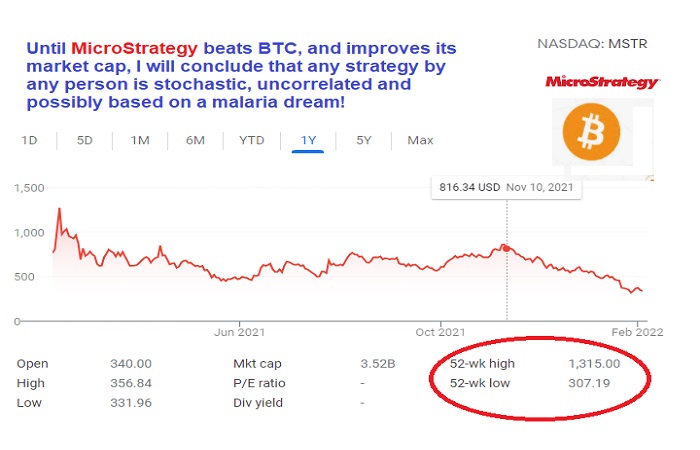
MicroStrategy unloads again on Bitcoin. They have the “mathematics of Bitcoin” but not sure the equations are balanced. Yes, I do not see the results in their balanced sheets. A share is now worth $340 from the high of $1,315 within the last 12 months. Yet, Michael Saylor, the CEO of MicroStrategy, just bought more, spending $25 million in cash.

Can anyone really claim that he/she can beat Bitcoin? A product no one can claim where it came from with certainty. I do not blame China for disconnecting from this “ghost” with no clear lineage. Even Russia has gone cold.

The biggest disservice to BTC is making it an investment asset instead of a currency, to buy and sell. That hodling is the reason this coin has not reached my village at scale. When people buy it and digitally pray that it rises up, it hurts the original vision of the coin. That is the poison pill they gave BTC and it is causing more harm.

People, until MicroStrategy beats BTC, and improves its market cap, I will conclude that any strategy by any person is stochastic, uncorrelated and possibly based on a malaria dream!

BTC is currently worth $37,257.00 per unit.