DD
MM
YYYY

PAGES

DD
MM
YYYY

spot_img

PAGES

Home Blog Page 5406

The reasons why you should get a prenuptial agreement

0

The reasons why you should get a Prenup

DRE PAYS $100 MIL TO NICOLE IN DIVORCE SETTLEMENT: Nicole Young is getting a fraction of Dr Dre’s estate. Dre and Nicole just filed their property settlement agreement, in which Dre agreed to pay Young $100 million. (Source: TMZ News, 29 Dec., 2021)

A London judge ordered Sheikh Mohammed bin Rashid Al Maktoum to pay his estranged wife Princess Haya Bint Al Hussein. Dubai’s ruler was ordered to provide his estranged wife and their children at least 554 million pounds ($734 million) in the largest financial award the U.K. family courts have ever seen. (Source: Aljazeera News, 21 Dec., 2021)

These are some of the recent divorce cashout and payments that were reported in the news because those involved are celebrities and public figures. This goes to show how expensive divorces and judicial separations could be as it can get more expensive especially for the richer spouse who can either be the lady or the man but in most instances it’s always the man.

These huge sums are payments that the court orders a spouse to pay the other partner and it is called “alimony”. Alimony is financial support that a person is ordered by a court to give to their spouse during separation or following divorce for maintenance and taking care of kids, it is generally for spousal support. 

Due to these payments of alimony ordered by the court which is usually huge and sometimes it can be half of the wealth of the spouse or even more than as it is whatever amount of the court deemed to be fair and equitable to be granted to the other spouse, People have been asking and consulting their lawyers on how to protect their wealth and estates against divorce or especially “gold digging spouses” who could just want to get married to a rich partner just because that individual is rich and wealthy with the sole aim of divorcing the spouse immediately and running to court for alimony to get a huge split of the spouse’s estate and wealth.

This is where prenuptial agreement comes in.

Rich kids or individuals who have gathered wealth for themselves before marriage are always advised to get a prenup or prenuptial agreement to protect their estates/wealth against future divorces and judicial separation. In the absence of prenuptial agreement you will be subjected to marital laws for the split of properties during divorce/ judicial separation and you never can tell how far the court can go in dividing your estate between you and your spouse in the event of divorce as the court are guided by ‘fairness and equitability’. 

What is a prenup? 

Prenuptial agreement or prenup is a written agreement entered into by spouses who are about to get married where they agree upon terms and conditions that specify their marital rights when they finally get married. Prenuptial agreement supersedes other default marital laws that would otherwise apply in the event of divorce or judicial separation such as the Matrimonial Causes Act which applies to statutory marriages in Nigeria and the court will only enforce the contents of the prenup.  This law (The Matrimonial Causes Act) governs the split and division of property, retirement benefits, savings, and the right to approach the court for spousal support (alimony) etc.

Prenuptial agreement does not only provide for what happens in the event of a divorce or how the properties are to be shared in the event of divorce but it is also entered by spouses to protect some properties acquired during the marriage or some properties which have a sentimental value to a spouse.

It should however be noted that for a prenuptial agreement to be enforceable by the court it must be made in good faith. A prenuptial agreement may be declared unenforceable when such an agreement was made or signed under fraud, made or signed by a partner under duress or undue influence or without adequate disclosure of all the assets and liabilities. 

Prenuptial agreement is the only best way ‘legally’ to protect your assets or wealth before embarking into marriage especially in contract marriages or marriages which are not meant to last for the lifetime.

A Loaf of Bread through the Bars

0

“What’s that siren?!” I wondered as I turned to its direction from where I stood at the bus stop; there was a sudden hysteria as a convoy of Black Marias with heavily armed escort was making its way through the crowd that swarmed it. Then I heard the distressed voices of the incarcerated crying out to be free in the streets. They were all shirtless, bathed in their sweats and bundled together like sardines in the oven-like Black Marias. 

Many stirred by compassion forced through the bars all they could lay their hands on: water, food, money…and the sight that weakened my spirit and made my shoulders drop was seeing how one of the prisoners held tightly with both hands a loaf of bread through the bars. There was deep darkness inside the Black Marias and all I could see and hear were nervous eyeballs and voices of men wailing as they were driven to where they would never go if they had their freedom especially on Christmas Eve. 

On my way home that day, the event I just witnessed took control of my mind. I was overwhelmed by the display of compassion by my fellow countrymen as much as I was deeply concerned about the plight of the men in the Black Marias. They all belong to particular families and occupy conspicuous and significant roles of fathers, husbands, sons, brothers, cousins and nephews. Their Christmas wish and that of their respective families would be to celebrate Christmas and New Year together. 

My purpose for sharing this experience is for us to use the condition of these men to reflect on our lives. Yes, some of them could be guilty of the crimes they were accused of while others are innocent. Whatever the case, their fundamental human rights have been suspended and their lives are subjects to the dictates of the punitive laws of the country. They would give anything to walk the streets again as free men, something we all take for granted. 

Finally, as 2021 fades into history like its predecessors, if you can read this, you most likely have your fundamental human rights intact. This is all that counts regardless whether you are sick or healthy; have money or not; achieved your goals for this year or not; you should be thankful because only the free can try again given the opportunities laden in 2022. 

“Freedom is not the right to do as you please; it is the liberty to do as you ought.”-Anon 

Wishing You a Prosperous New Year!

In Defense of Union Bank On Titan Trust Acquisition And Lessons from Aliko Dangote

37

I have read many articles on the acquisition of Union Bank Nigeria by Titan Trust Bank. Many of the hypotheses have focused on digital Darwinism of the century-old bank, chronicling how young people are not patronizing the bank, giving it an imperiled future. The remedy postulated by the authors is this: adapt or you will die like Union Bank.

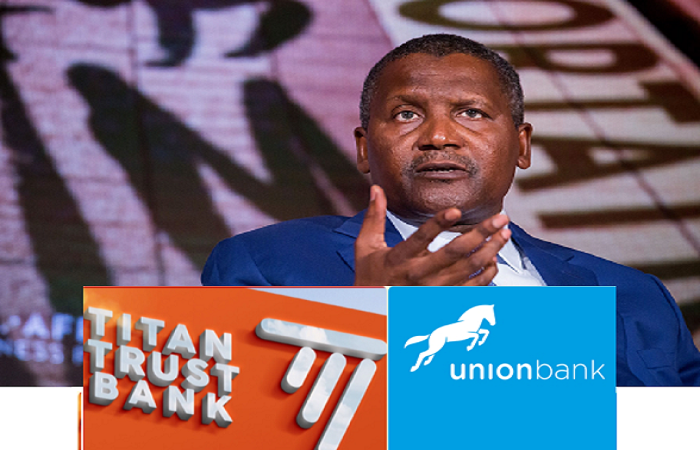
But today, the lender has put a notice: “Titan Trust Bank Limited (TTB) has become the majority shareholder in Union Bank of Nigeria Plc. This followed an agreement by Union Global Partners Limited, Atlas Mara Limited and other majority shareholders to divest 88.39 per cent  shareholding in Union Bank to TTB….subject to regulatory approvals and other financial conditions, would upon completion transfer 89.39 percent of Union Bank’s issued share capital to TTB.”

For academic purposes and since we’re not in session in Tekedia Mini-MBA, I will present an alternative way to look at this deal. Typically, I would have scheduled a Zoom  session for our members so that we can have a synchronous conversation so that at the end, everyone learns. We can still do that in Feb when we resume.

Here is what I want to posit: what happened to Union Bank was not majorly because the bank was not performing well. Simply, even if the bank was performing at 4x its current numbers and its major shareholders decide to exit, they could have still gone ahead. Sure, great numbers would have made the acquisition very expensive, diminishing interests from bargain hunters. 

The real issue is this: Union Bank has lost control of itself when it had more than 51% of its shares out there. That three of its shareholders banded together and sold to a 4th investor, giving it super-majority, is part of market systems. If you do not want that, never allow 51% to be floating as those external players can team together and change the equation.

Union Bank’s only option was bidding higher than Titan Trust Bank on whatever those investors were asking for. In other words, Union Bank would be expected to buy itself back by paying investors who held its shares. Unfortunately for the bank, it does not have the funds to do that. Afterall, it sold part of itself to get money from those investors to start with!

That those investors sold to Titan Trust Bank, and from rumors, at a great premium to what the bank was trading at the stock exchange, is actually a great confidence in the bank’s operations. This is not similar to what happened to Blockbuster and Nokia which faded due to massive disruptions from new innovators. This is simply that some investors wanted to exit because one of them needed money badly to pay down maturing debts, and they looked for someone with cash to bail them out. 

Union Bank is to a large extent a bystander. But since this is banking where anyone with at least 10% control cannot be hidden, it was looped in as those shares moved hands. So, the bank just watched as the deals were concluded, and at the end, a very small bank swallowed it. Titan Bank has a balance sheet of N136.3 billion while Union Bank is at N2.56 trillion, more than 18x larger.

In the United States where markets allow different classes of shares which make it possible for someone to own 25% of a company and still control up to 70% of its voting rights, this might not be possible, assuming someone holding the special shares is on Union Bank side.  

That US structure is the reason no one can remove Mark Zuckerberg  who who owns about 13% (down from 28% at IPO) of Meta (yes, Facebook)  via different classes of shares but still controls 60% of the votes. Nigeria law does not allow that type of structure; we’re largely 1-by-1 which means 1% ownership delivers 1% voting right in the company.

So, how do you avoid what happened to Union Bank? Follow the playbook of Aliko Dangote: never make more than 50% available for the public. With that, even if all the hunters and vultures gather, they will still be short of the majority! Dangote controls about 85% of Dangote Cement’s available shares and what that means is this: even if all you thousands team together, you can only get to 15%, and that means he remains the Oga.

Of course Union Bank could have avoided the acquisition but for those government bailouts from Central Bank of Nigeria and AMCOM which forced the bank to raise capital, and in the process created the super-holders. But that old Union Bank is different from the current one. The problem though is that the current leadership cannot change the structure because they do not have the funds. Of course, it was the bank that put itself into the old position to start it: creative destruction, people.

National Development Plan 2021-2025: Nigerian Govt to Increase Public Debt to N50.tn by 2023

0
Nigeria leaders

Amidst the persistent backlash following the Nigerian government’s public debt, which has spiraled upward in the past five years, the federal government is poised to borrow more next year.

The National Development Plan 2021-2025, which contains projections that include 30% capital expenditure increment, reveals that the government plans to fund its infrastructural and social programs with loans. The move will push Nigeria’s public debt stock to N50.22tn by 2023, with domestic debt at N28.75tn and external debt at N21.47tn.

In the plan is also a plan of N348.1 trillion, which the government says it needs to finance. The borrowing framework in the plan is 45% each for both foreign and domestic borrowing.

“The plan will require an investment of about N348.1tn to achieve the plan objectives within the period of 2021-2025. It is estimated that the government capital expenditure during the period will be N49.7tn (14 per cent) while the balance of N298.3tn (86 per cent) will be incurred by the Private Sector. Of the 14 per cent, government contribution, FGN capital expenditure will be N29.6tn (9 per cent) while the sub-national governments’ capita

“The borrowing framework in the plan is 45 per cent each for both foreign and domestic borrowing while the other financing sources account for 10 per cent. Domestic bonds and concessional external loan financing, amongst others, will account for the borrowing strategies for the plan. Thus, the government will improve on current debt management strategies to ensure sustainability,” the plan reads partly.

The plan has not only increased the anxiety emanating from Nigeria’s rising debt profile, which is believed to have mortgaged the future of young Nigerians, it has also put the government’s ability to fund the 2022 budgetary allocations under serious question.

The government has been spending 98% of its revenue generation on debt servicing, a situation that has largely impacted its ability to finance budgetary allocations. Nigeria’s public debt stood at N38 trillion at the end of the third quarter of 2021, according to the Debt Management Office.

Although the plan showed that Nigeria’s revenue is expected to hit 25 trillion in four years and the government also intends to reduce total public debt by 2025, the current situation has cast doubt on its economic ability to achieve that aim. President Muhammadu Buhari’s administration has been nearly helpless in grappling with revenue shortfalls with no sight of reprieve in the near future.

Nigeria’s dwindling economic situation, which is expected to plunge more Nigerians into abject poverty, is stirring opposition to the government’s move to borrow more, as it is believed that it will exacerbate suffering.

What experts are saying

Kingsley Moghalu, former Deputy Governor of the Central Bank of Nigeria, who contested the last presidential election, described the government’s constant borrowing as “irresponsible.”

“I condemn the borrowing plan in its entirety. I think the Federal Government of Nigeria has been borrowing irresponsibly and mortgaging the future of the youth of Nigeria.

“This should stop. The damage will be very difficult to repair. There is no need for Nigeria to be borrowing at the rate it is borrowing and the huge sums it is borrowing.

“There is an element of callousness in this. They are doing everything as possible to borrow before 2023, and then walk away and hand over the problem to someone else,” he said.

Sheriffdeen Tella, a professor of Economics at the Olabisi Onabanjo University, Ago-Iwoye, Ogun State, said the government should not be thinking of adding to the already worrisome debt level.

“Even at the level that we are now, it is worrisome, not to talk of planning to borrow more. It is unfortunate that the government is always thinking of borrowing, instead of thinking of other ways to generate revenue.

“They can ensure that public-private partnership projects are built, once operational and yielding capital, though whoever implemented it can generate their money plus interest and then the project becomes ours and we can generate revenue from those. There are projects that we can scale down until we have enough funds to implement and there are projects that can generate money on their own,” he said.

Another economist, Dr. Muda Yusuf, who is the Chief Executive Officer of the Centre for the Promotion of Private Enterprise, said that the increasing debt profile is becoming a problem as the government’s revenue base is not strong enough to sustain it.

“The rising debt profile of the government raises serious sustainability concerns. Although the government tends to argue that the condition is not a debt problem, but a revenue challenge. But the truth is that debt becomes a problem if the revenue base is not strong enough to service the debt sustainably. It invariably becomes a debt problem.

“What is needed is the political will to cut expenditure and undertake reforms that could scale down the size of government, reduce governance cost, and ease the fiscal burden on the government,” he said.

He also advocated true federalism and downsizing the cost of governance.

“It is imperative for the country to operate as a true federation which it claims to be.  The unitary character of the country is making it difficult to unlock the economic potentials of the sub-nationals.  It is perpetuating the culture of dependence on the federal government.

“It is necessary to scale down the size of government and cost of governance.  Fiscal sustainability is driven by both cost and revenue. Therefore managing the major drivers of cost and revenue is imperative. As far as possible, the government should push back in sectors or activity areas where the private sector has the capacity to deliver desired outcomes. We should see more concessions and privatizations at all levels of government,” he said.

He added that the debts, which should be concessionary, should be used to strictly fund capital projects that would boost the productive capacity of the economy.

“It is important to ensure that the debt is used strictly to fund capital projects that would strengthen the productive capacity of the economy.  This is the position of the Fiscal Responsibility Act.

“Additionally, emphasis should be on concessionary financing, as opposed to commercial debts which are typically very costly,” he said.

The Executive Director of Centre for Anti-Corruption Open Leadership, Mr Debo Adeniran, said that the government is becoming reckless in borrowing at a fast pace.

“The government is fast becoming reckless in the way it is borrowing, yes, it might have its reasons to have resorted to borrowing because of the infrastructural deficit and collapse which was in existence before this administration came in. but this administration needed to understand that it could not solve all the problems of more than 50 years overnight.

“And taking interest-yielding loans is likely to enslave us and the generations to come. Most of the countries that are giving us loans are entrapping us like China. All the infrastructures we are using their loans to build are very sensitive and if they are to take over it Nigerians will suffer,” he said.

From July to September, Nigeria’s total debt stock rose by N2.540 trillion. Last month, Senate approved a fresh $17 billion, and earlier this month, $5.8 billion loan requests made by Buhari under the 2018-2020 borrowing plan.

Government’s borrowing plan focuses on domestic bonds and concessional external loans, but has been on justifiable rise. The National Development Plan 2021-2025 means that Buhari’s administration will accumulate about N12tn debt in two years from 2021 to 2023.

The borrowing pace has been described as unsustainable because almost all the revenue generated by the country is used to pay the current debt, making the government incapable of paying for a lot of its expenditure.

DuckDuckGo’s Privacy-Focused Search Techniques, Drives its Growth to 47% in 2021

0

2021 has been great for the tech industry, especially fintech, which has birthed many unicorns, opening the African continent to its biggest investment year so far. But outside the finance industry, several companies in the tech space attained ground-breaking feats – one of them – DuckDuckGo.

The privacy-focused search engine averaged over 100 million daily search queries, growing by almost 47%. It is an unprecedented growth for DuckDuckGo, who has been insignificant in the web search business dominated by Google. The growth has been attributed to the company’s privacy-protecting business model which is increasingly attracting users.

DuckDuckGo has been building on the progress from the past. Analysis by Bleeping Computers found these privacy-driven techniques as the secret of the search engine’s recent growth.

Unlike other search engines, DuckDuckGo says they do not track your searches or your behavior on other sites. Instead of building user profiles used to display interest-based ads, DuckDuckGo search pages display contextual advertisements based on the searched keywords.

This means that if you search on DuckDuckGo for a television, that search query will not be used to display television ads at every other site you visit.

Furthermore, to build their search index, the search engine uses the DuckDuckBot spider to crawl sites and receive data from partners, such as Wikipedia and Bing. However, they do not build their index using data from Google.

DuckDuckGo shows rapid growth

While Google remains the dominant search platform, DuckDuckGo has seen impressive year-over-year growth.

In 2020, DuckDuckGo received 23.6 billion total search queries and achieved a daily average of 79 million search queries by the end of December.

In 2021, DuckDuckGo received 34.6 billion total search queries so far and currently has an average of 100 million search queries per day, showing a 46.4% growth for the year.

While DuckDuckGo’s growth is considerable, it still only has 2.53% of the total market share, with Yahoo at 3.3%, Bing at 6.43%, and Google holding a dominant share of 87.33% of search engine traffic in the USA.

However, as people continue to become frustrated with how their data is being used by tech giants like Google, Facebook, Microsoft, and Apple, we will likely see more people switch to privacy-focused search engines.

To further help users protect their privacy, DuckDuckGo released an email forwarding service in 2021 called ‘Email Protection’ that strips email trackers and allows you to protect your actual email address.

They also introduced ‘App Tracking Protection for Android,’ which blocks third-party trackers from Google and Facebook found in apps.

More recently, DuckDuckGo announced they are releasing a DuckDuckGo Privacy Browser for Desktop that will not be based on Chromium and will be built from scratch.

“No complicated settings, no misleading warnings, no “levels” of privacy protection – just robust privacy protection that works by default, across search, browsing, email, and more,” explains a recent blog post about the new browser.

“It’s not a “privacy browser”; it’s an everyday browsing app that respects your privacy because there’s never a bad time to stop companies from spying on your search and browsing history.”

For those looking to take back control of their data and add more privacy to their search behavior, DuckDuckGo may be the search engine for you.