DD
MM
YYYY

PAGES

DD
MM
YYYY

spot_img

PAGES

Home Blog Page 5466

Public Agenda Analytics and Netizens’ Salience Issues in Time of Lagos Building Collapse

1

For the last three decades, building collapse has been one of the primary critical infrastructure incidents in Nigeria. Out of the 36 states and Abuja, the Federal Capital Territory, Lagos State has always been the only state which records significant number of cases every year. In one of the previous analyses, our analyst reported that the Lagos would continue to have cases, if appropriate measures and controls are not established and followed by every stakeholder. Existing measures and controls, according to our analysts, are not really bad, but the failure of the concerned stakeholders to do the needful whenever the need arises has continued to be the key contributing factor to the incessant building collapse in the state.

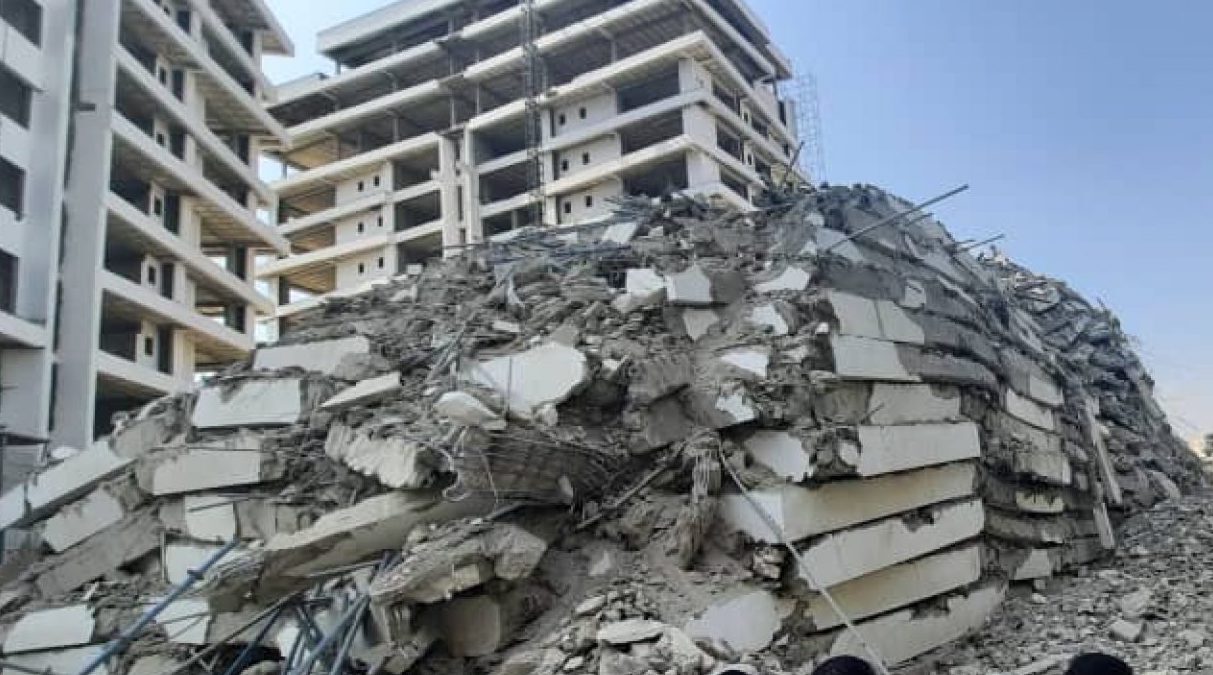
The Ikoyi building, a 21-storey, which collapsed on November 1, 2021, furthers reinforced the call for better processes and qualified people for ensuring sustainable built environment in the state. From the physical to the digital sphere, residents and non-residents expressed their feelings about the building. Several stakeholders were accused of failing those who lost their lives in the building.

This piece is not about x-raying what the conventional newspapers and broadcast stations have reported. The piece aims at pointing out how the state government, concerned public officials and political leaders in the state can explore comment section of the state government’s official Facebook page for ‘instant policy making’ in times of crisis such as building collapse.

From November 1 to November 6, 2021, the early period of the incident, the Lagos State Government used her official Facebook page extensively for disseminating latest happenings about it to the public. Our analysis shows that during the days, the state government posted 10 messages, which most relevant comments to all the messages were 85. The number of comments represents netizens, who reacted to the management of the incident by the state government.

Similar to what is obtainable when governments and other stakeholders in the policy making are seeking the views of the public, our analysis reveals that the netizens vehemently expressed views that were within the critical to high and medium to the low impact on the state’s built environment. With this, our analyst notes that the netizens remind the policymakers how powerful they [netizens] could be telling them [policymakers] what should be done in times of crisis.

The Exchanged Words

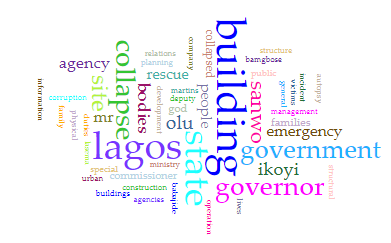
Collective examination of the posts and comments indicates a total of 5,608 words were used by the state government and the netizens during the six days. From the both actors, building, state, Lagos, collapse, governor, site, government, Sanwo-Olu and Ikoyi were predominantly used to narrate the incident, particularly the ordeals of the victims who were trapped under the rubbles. They equally employed these words to pinpoint what should be done and who should be prosecuted.

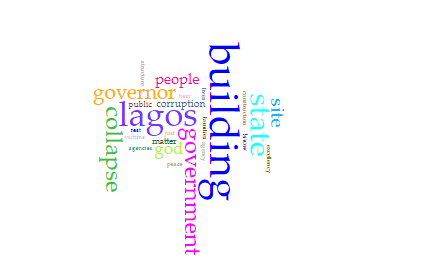
When the views of the netizens were specifically subjected to corpus analysis, it was found that 3,847 words were employed. Building, Lagos State, collapse and Lagos State Government were copiously used to attack the concerned stakeholders in the government, especially the governor and members of the regulatory agencies, including the State Emergency Agency, which according to them failed to organize quick rescue activities on the site. They specifically emphasised regulations, control, emergency and corruption in their views.

Exhibit 1: Emerged Dominant Words in Lagos State Government’s Posts and Netizens’ Comments
Source: Lagos State Government’s Official Facebook Page, 2021; Infoprations Analysis, 2021

Exhibit 2: Emerged Dominant Words in Netizens’ Comments
Source: Lagos State Government’s Official Facebook Page, 2021; Infoprations Analysis, 2021

What Netizens Told Lagos State Government During Early Stage of Managing Ikoyi Building Collapse

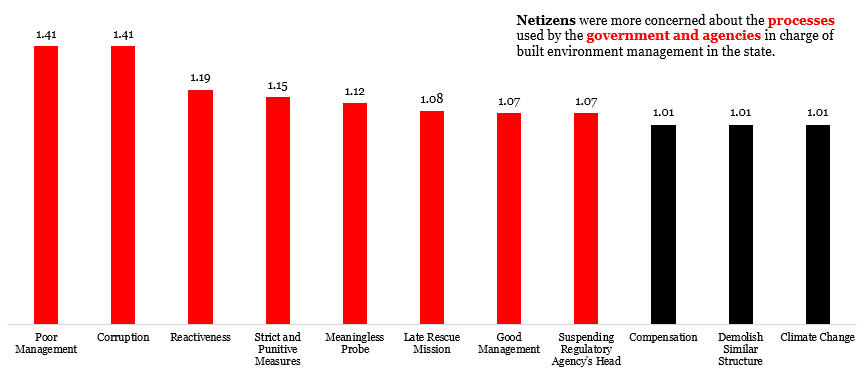
From our analysis, poor management, corruption, reactiveness, strict and punitive measures, meaningless probe, late rescue mission, good management and suspending regulatory agency’s head were the salient issues among the netizens. When they mentioned poor management, they vehemently referred to how the regulatory agency failed to ensure proper checks of the site and give approval based on the ability and capacity of the developer to handle such building.

Apart from these, poor management also referenced to the failure of the government in handling of the emergencies during the rescue operations. They largely noted corruption among the professionals, regulatory agencies and individuals as the core issue of incessant building collapse in the state. In our data, we also learnt that the netizens considered visitation of the governor, deputy governor and political leaders as reactive. According to them, the leaders failed to act when it is necessary, that is, ensuring proper management of regulation and control of the built environment in the state.

Ordering and setting up probe panel were also considered as reactive by the netizens, our analyst examined. Late rescue mission as a salient issue to the netizens was mainly found to be associated with the ways the state emergency agency handled rescue operations. They were of the view that the responders responded late. However, our checks of the state emergency agency’s Facebook page reveal a number of efforts of the responders on the site. The agency posted series of activities of its personnel on the site. Despite this, analysis shows low communication of supportive and collaborative messages to the public, which are usually needed during emergency situations such as the Ikoyi building collapse.

Exhibit 3: Netizens’ Early Salience Issues about Ikoyi Building Collapse
Source: Lagos State Government’s Official Facebook Page, 2021; Infoprations Analysis, 2021

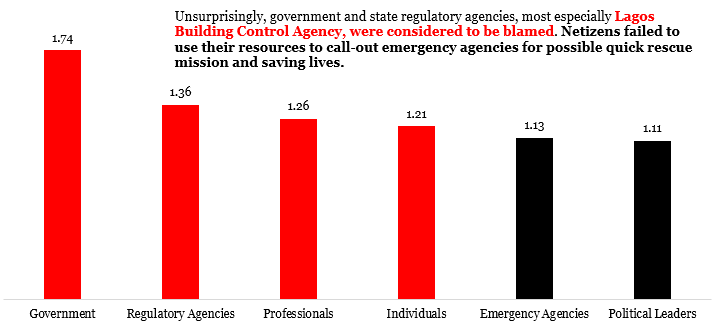
Who should be blamed for the incident? In our analysis, we discovered government, regulatory agencies, professionals and individuals as the stakeholders who failed to do the needful at one point or the other. As it is applicable to every state or national issue, especially an issue that connects with the political elites and public servants, the state government was fingered as the main stakeholder worthy of blame during the early stage of the crisis. According to our analyst, it is really surprising that the netizens considered the Lagos State Building Control Agency as the second stakeholder.

The astonishment lies with the fact that an agency saddled with approval of building construction should be first seen as the culprit before considering the state government. However, the netizens position could be viewed from the issues that have been identified with the agent-principal relationships over the years in management. It means the agent prioritised its own benefits over the benefits of the state government and the residents of the state.

Exhibit 4: Blame Worthy Stakeholders
Source: Lagos State Government’s Official Facebook Page, 2021; Infoprations Analysis, 2021

In what context did the netizens consider these stakeholders blameworthy? Our analyst explored this question with the examination of the posts of the state government. When their salient issue was reactiveness, they mentioned the state government more than 3 times before considering professionals, which was less than 1 time.

Unsurprisingly, the state government was referenced more than 7 times when poor management was the brunt burner issue before referencing emergency agencies, which was more than 4 times. While the emergency agencies were not seen as critical stakeholders worthy of blame within the poor management issue, the netizens predominantly referenced the agencies, especially LASEMA more than 14 times before mentioning the state government.

It is really surprising that the netizens failed to mention the state government as the main stakeholder that should ensure strict and punitive measures in the built environment. Instead, they deployed their resources towards significant identification [more than 8 times reference] of the state government when corruption was the salient issue to them followed by professionals and regulatory agencies. Considering the impact of the collapse and public outcry that trailed it during the period of the analysis, our expectation that the head of the regulatory agency would be copiously referenced was not met.

Salience Issues in Which Contexts

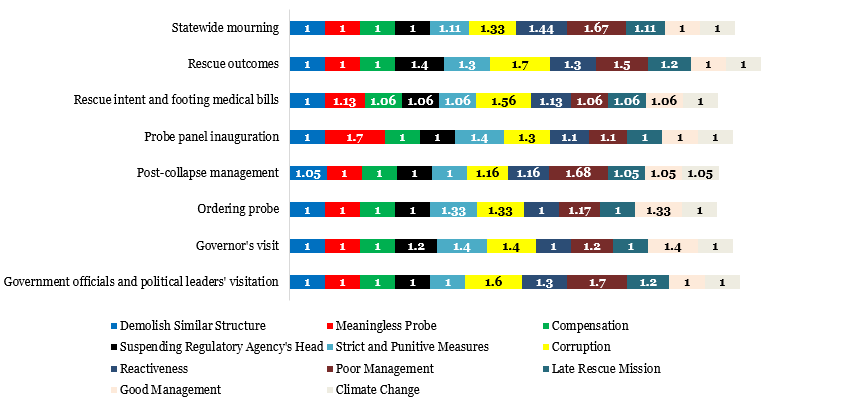
Similar to the contexts in which the netizens found the stakeholders worthy of blame, our analyst also examines the contexts in which the netizens used to express the salient issues. Demolish similar structure, climate change and poor management were significant issues to the netizens when the state government disseminated information that addresses post-collapse management. In our data, the state government mainly posted messages that established specific information about casualties in the hospital and activities of the emergency agency.

Meaningless probe was an issue when messages that focused on the probe panel inauguration, and rescue intent and footing medical bills were posted by the government. Suspending regulatory agency’s head was an issue when rescue outcomes, and rescue intent and footing medical bills were the most appropriate by the state government to communicate.  As captured in Exhibit 5, it is obvious that the netizens utilized the state government’s intended elements and meanings before expressing their salient issues.

Exhibit 5: Contexts appropriated by Netizens for agendas setting
Source: Lagos State Government’s Official Facebook Page, 2021; Infoprations Analysis, 2021

The emerging insights have several implications for the policy making in the state and Nigeria in general. Our analysis has shown that political leaders and public servants have numerous benefits to gain from exploring netizens’ behaviour in times of crisis for early management strategy development and execution.

One of the significant implications is that rescue mission could be initiated and coordinated via social networking sites. In terms of posting messages, the state government performed well. However, the handlers of the Facebook page failed to react to the comments of the netizens. This is not a behaviour that should be exhibited and nurtured in terms of crisis.

Flour Mills Acquires Majority In Honeywell for N80 Billion

0

Flour Mills of Nigeria announced on Monday that it has reached an agreement to acquire Honeywell Group. The announcement was contained in a press statement issued by the companies.

The statement says that Honeywell Group Limited has agreed to sell a 71.69% stake in Honeywell Flour Mills to Flourmills of Nigeria, giving the latter the majority stake of Honeywell shares. Flour Mills currently has market value of N29 billion.

“For the proposed combination of FMN through its affiliates and Honeywell Flour Mills Plc (“HFMP”), a portfolio company of HGL. At a total enterprise value of NGN80 billion, HGL will dispose of a 71.69% stake in HFMP to FMN,” it said. Enterprise Value includes the debt of the company.

The majority of Honeywell shares is owned by billionaire Oba Otudeko, who was controversially removed recently as the chair of FBNH.

The two companies are heavily indebted, with Flour Mills having a larger share of the debt. The acquisition is aimed at consolidating Nigeria’s food industry, according to the statement.

“The proposed transaction will combine two businesses with shared goals and create a more resilient national champion in the Nigerian foods industry, ensuring long-term job creation and preservation” it stated.

The total cost of the 71.69% stake stood at N80 billion. The companies’ press statement further explained that the final equity price per share payable will be determined based on HFMP’s adjusted net debt and net working capital at the date of completion.

“The country and its food security agenda will benefit from both companies’ focus on developing Nigeria’s industrial capability, its agricultural value chain and specifically backward integration of the food industry,” it said.

Per Naira Metrics, Honeywell currently has a debt balance of N78.5 billion and a cash balance of N27.3 billion as of the latest results, while Flour Mills is also debt-laden with about N142.8 billion in debt and N52.6 billion in cash. While it’s not clear how the deal was executed, the companies’ debt burden suggests that Flour Mills funded the acquisition from debt.

Honeywell’s large volume of loans is scattered across Nigerian banks, but seems to be all covered by the acquisition.

Based on its last audited accounts for the period ended March 2021, Naira Metrics named some of the Honeywell’s and Flour Mill’s loans. They include a N10.4 billion loan from First Bank, N2.3 billion from Bank of Industry, N6.2 billion from Fidelity Bank, and N3.5 billion from Polaris Bank, for Honeywell. Flour Mills on the other hand owes about N50 billion in several intervention loans to Bank of Industry and the CBN, and N68.6 billion in commercial papers and bonds.

Honeywell Group Limited Managing Director, Obafemi Otudeko said the investment will help the company to expand its production capacity.

“Today’s announcement is in line with the evolution of Honeywell Group and our vision of creating value that transcends generations. For over two decades, we have supported Honeywell Flour Mills to build a strong business with a production capacity of 835,000 metric tonnes of food per annum.

“Following the transaction, Honeywell Group will be strongly positioned to consolidate and expand its investment activities, including as a partner of choice for investors in key growth sectors,” he said.

The agreement enables Flour Mills to purchase 71.69 per cent stake in Honeywell,

However, Premium Times reported, citing a regulatory filing at the Nigerian Exchange Limited on Monday, that separate pact with FBN Holdings Group allows the Mills to acquire the financial services group’s stake of 5.06 per cent in Honeywell, bringing its consolidated holding in Honeywell to 76.75 per cent.

Based on that, Flour Mills may have a claim over about 6.09 billion units of Honeywell’s 7.93 billion ordinary shares, priced at an opening price of N3.39 per unit on Monday.

Speaking on the acquisition, Omoboyede Olusanya, Group Managing Director of Flour Mills of Nigeria said “The proposed transaction is aligned with our vision not only to be an industry leader but a national champion for Nigeria. We believe that this will create an opportunity to combine the unique talents of two robust businesses.

“As a result, we will have a better-rounded and more comprehensive skill set available to us as a combined diversified food business, thus enabling us to better serve our consumers, customers and other stakeholders, whilst providing employees with access to broader opportunities.”

Now Ole Gunnar Solskjaer Is Out; Who Will Manage Manchester United?

0

After several seasons of continuous losses, draws and unsatisfying wins, Ole Gunnar Solskjaer has been taken off the wheels of Manchester United. His role as the club’s manager has been terminated.

The club announced the decision on Sunday through its Twitter handle: “Manchester United announces that Ole Gunnar Solskjaer has left his role as manager.”

The decision came following another woeful result on Saturday. The Manchester club disappointedly fell 4-1 to underdog club, Watford, compounding the underperformance that has characterized Man U right from before Ole was appointed as the Manager.

“Ole will always be a legend at Manchester United and it is with regret that we have reached this difficult decision. While the past few weeks have been disappointing, they should not obscure all the work he has done over the past three years to rebuild the foundations for long-term success,” Man U said in a statement confirming Ole’s sack.

In the latest series of the losses culminating to his sack, Ole led Man U to humiliating 5 0 defeat to Liverpool, and 2 0 derby loss to Manchester rivals, Man City. The recent losses escalated the #OleOut hashtag that has remained a regular trend for long. “Ole on the wheels”, which became a slogan due to the redemptive emotionalism ignited by his appointment in 2018, eventually became eclipsed by the disapproving #OleOut.

Ole has been under intense pressure to win games as severe criticism by supporters of Man United became a weekly thing, which aggravated with every match he lost. In his three seasons at the helm at Old Trafford, Ole won no trophies and Man U is currently 12 points below Premier League leaders Chelsea.

The #OleOut calls by fans have been answered by Man United hierarchy. But then it leaves a vacuum in the club that needs to be meticulously filled. But who will fill the vacuum? Who will take the wheels of Man U in the place of Ole?

Cristiano Ronaldo, who was signed in the summer in the hope of helping Man U overcome its subpar performance, is understood to have a preference for Spanish national team coach, Luis Enrique. The Spaniard has successful records during his time as Barcelona’s manager in 2015, winning the Champions League, La Liga, and Copa del Rey, and currently, has led Spain to World Cup qualification. Given these records, Ronaldo believes Enrique fits what is needed at Man United now.

On the other hand, fans are clamoring for former Real Madrid coach, Zinedine Zidane, who left the Galaticos last summer. Zidane led Real Madrid to win both domestic and European leagues titles, and is a person of interest in ‘who takes the wheels of Man U?’ case.

Another candidate under consideration is Ajax coach, Erik Ten Hag, whose contract with the Dutch side runs until 2023. But it is understood that Ajax is not willing to let him go, narrowing the choices for Man United.

Among the coaches under Man U’s consideration, it is understood that PSG’ coach, Mauricio Pochettino, is the top target. The former Tottenham Hotspur manager is said to have caught the interest of the Red Devils due to his work at the French side. PSG is currently leading the Lique 1 table with 12 points.

Having attained his legendary status during his time as Man U player, Ole was chosen to do what his predecessors, including Jose Morinho, Luis Van Gall and David Moyes, couldn’t do. Revamp Manchester United to become a team to beat, not only in England, but also in Europe. His failure to achieve that aim has not only added to the growing list of failed coaches at the Old Trafford, it has also made his replacement, a more daunting task.

Man u said “Michael Carrick will now take charge of the team for forthcoming games, while the club looks to appoint an interim manager to the end of the season.” It will be a long search. And whoever takes the wheels, will have to be a better driver.

Ndubuisi Ekekwe, Eminent Global Business Leaders, Inaugurated Into Advisory Board of Africa Fintech Network

0

I am very happy to share that Ndubuisi Ekekwe has joined the Advisory Board of the Africa Fintech Network (AFN). This is the most important organization for the advancement and development of the fintech sector in the continent.

Other members include Andrew Davis – Ambassador for Stone & Chalk Australia; Alastair Lukies CBE – Member UK Prime Minister Business Council; Yiting Shen – Citibank; Prof. Bitange Ndemo – Kenya; Ade Ayeyemi – Group CEO Ecobank Transnational Incorporated and Dr. Patrick Saidu Conteh – former Governor, Central Bank of Sierra Leone.

To Segun Aina and the entire executive leadership, let’s take African fintech and the broad economy to the mountaintop.

—press release

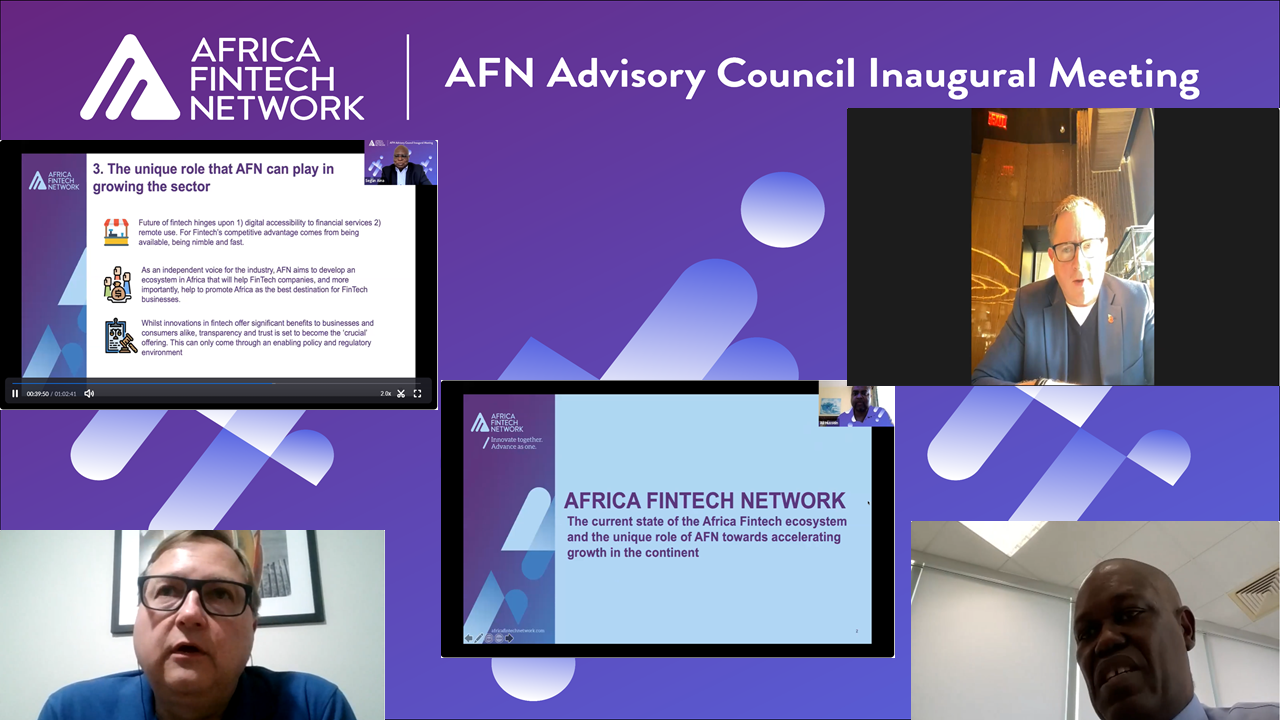
Africa Fintech Network (AFN) in its drive to connect Africa and the global community for open dialogue, build synergies and create diverse opportunities in Fintech and allied matters has set up an Advisory Council made up of highly influential business and fintech thought leaders from within and outside of Africa.

We are pleased to announce that the AFN Advisory Council was inaugurated on 18th November 2021. The members include – Andrew Davis – Ambassador for Stone & Chalk Australia; Alastair Lukies CBE – Chair of UK Fintech Alliance and Member UK Prime Minister Business Council; Prof. Bitange Ndemo – Prof of Entrepreneurship at University of Nairobi and former Permanent Secretary Kenya Ministry of Information and Communications; Prof. Ndubuisi Ekekwe – Founder Tekedia Institute; Yiting Shen – Citibank Global Head of External Network Management; Ade Ayeyemi – Group CEO, Ecobank Transnational Incorporated and Dr. Patrick Saidu Conteh – Regional Lead, Sub Sahara Africa, Cambridge Centre for Alternative Finance and former Governor, Central Bank of Sierra Leone. Participants at the inauguration event included AFN Executive Board Members as well as Moyosore Odeyemi – Ernst and Young and Ladi Asuni – KPMG.

While inaugurating the Advisory Council, the AFN President Dr Segun Aina remarked that the event is significant as it marked a turning point for the future of the organization. Ali Hussein, Executive Board Member AFN and Chairman of Association of Fintechs in Kenya in his special presentation describes the current state of Fintech in Africa and the prospects for growth. A major highlight from the presentation is the increasing investment within Africa’s fintech ecosystem that is catalyzed by activities in payments, lending, savings and wealth management.

The newly inaugurated members of the Advisory Council also commented on how the AFN can position itself as the go-to institution when it comes to fintech engagements within the continent. Andrew Davis remarked that “AFN must work with regulators towards opening their minds on the positive strides that fintechs can make on the continent”. Yiting Shen mentioned the need for “learning best practices from other parts of the world and explore potential collaborations with other global actors”.

As stated by Prof. Ndemo, “It is inevitable that we are experiencing new forms of financial innovations and currencies and it will be important for AFN to take up that leadership role in ensuring we can create access for more fintechs within the ecosystem”. Mr Ade Ayeyemi stated that “As a working officer of a bank, part of my role is to bridge the gap between fintechs and traditional banks because I believe it is through working together, partnership and collaboration that we can solve the problems ahead of us and I will commit my efforts to that even as a member of the council”.

Alastair Lukies CBE did highlight some of the key factors that are affecting the fintech ecosystem currently and they include; regulation, innovation, capital, talents, and lastly education. He believes the AFN can be developed and branded to be the knowledge bank of fintech education within the continent.

Moyosore Odeyemi and Ladi Asuni who represented EY and KPMG respectively mentioned that they are happy to see a development of this nature take effect at the Africa Fintech Network and that with their current support to the Nigerian fintech ecosystem through the Fintech Association of Nigeria (FintechNGR)- a key member of AFN- their institutions will equally be happy to support and contribute to the success of the Africa Fintech Network.

AFN President, Dr Segun Aina rounded up by expressing optimism that through the set up of the Advisory Council and support from the broader stakeholders, AFN will be able to further develop and showcase the enormous talents and capabilities that exist in the fintech ecosystem and Africa at large.

We are truly excited about the future.

For bios and pictures of the AFN Advisory Council members, click here: https://docs.google.com/document/d/1km91Icuud6oY-kEqunbxQiRdpHblrTvD/edit?usp=sharing&ouid=102667543206579818848&rtpof=true&sd=true

For more details about the AFN, visit: www.africafintechnetwork.com

You’re Invited To 2021 Tekedia Innovation Week (Nov 22-27, 2021)

0

You are invited to 2021 Tekedia Innovation Week (Nov 22-27, 2021 ). The sub-theme is Growth Makers, and it is packaged within the Tekedia Mini-MBA theme of Innovation, Growth and Business Execution. All participants of Tekedia programs (mini-MBA, CollegeBoost, advanced diploma, etc) in  the year 2021 qualify to attend free.

For Zoom links, login with your registered email for access.

  • Theme: Growth Makers
  • Date: Monday – Saturday (Nov 22-27, 2021 )
  • Time: 7pm – 8pm WAT daily
  • Venue: Zoom Click here https://school.tekedia.com/updates/2021weeks/

Here are our Faculty members; they will be speaking on different topics, covering many domains of innovation, and innovation cases. It’s always an amazing academic festival in our Institute.

Schedule/ Faculty (Nov 22-27, 2021):

  • Mon – Aderinola Oloruntoye, Dean, Workforce Group
  • Tue  – Olanrewaju Oyinbooke, Head, DMO, AXA Mansard
  • Wed  – Seun Ayegbusi, CEO, Insurpass
  • ThurDotun Jegede, Partner, Dee Bee Consulting
  • FriEmeka Obiodu, Manager, NVIDIA
  • SatNdubuisi Ekekwe, Tekedia Institute

To register for the next edition of Tekedia Mini-MBA or other Tekedia programs, go here.