DD
MM
YYYY

PAGES

DD
MM
YYYY

spot_img

PAGES

Home Blog Page 5487

Cryptocurrency Market Hits $3 Trillion Value

0

Shrugging off months of decline that saw half of its value wiped off, the cryptocurrency market is now worth more than $3 trillion.

Tesla’s CEO, Elon Musk’s decision to part ways with bitcoin earlier in the year, triggered a decline that resulted in mass selloffs. It was exacerbated by the crackdown on cryptocurrency in China. Now, a wave of new factors is driving a rally that has witnessed bitcoin and ether beat the all-time highs they set earlier in the year.

Bloomberg highlighted some of the factors driving the bull market.

The little more than a decade old market for digital assets has already roughly quadrupled from its 2020 year-end value, as investors have gotten more comfortable with established tokens such as Bitcoin and networks like Ethereum and Solana continue to upgrade and attract new functionality. Excitement about the possibilities of decentralized finance and non-fungible tokens is growing, and memecoins like Dogecoin and Shiba Inu continue to attract attention.

“Bitcoin appears to be pushing out of a bullish flag pattern, and Ether is likely to confirm a long-term breakout on a close above resistance this Friday,” said Katie Stockton, founder and managing partner of Fairlead Strategies, in a note.

As of 9:54 a.m. in New York, the overall market cap of cryptocurrencies hit $3.3 trillion, according to CoinGecko pricing. The third- and fourth-biggest tokens, Binance Coin and Solana, have added more than 20% in the past seven days; all of the seven biggest coins are up over the last week.

Bitcoin rose as much as 5.6% on Monday to $66,414, nearing its previous record of about $67,000. Ether advanced as much as 3% to a new high of $4,768.

Crypto companies such as miners Marathon Digital Holdings Inc. and Riot Blockchain Inc. each rallied more than 10% Monday. Coinbase Global Inc., the largest U.S. exchange, gained as much as 3.6%, a day before reporting third-quarter results.

Of course, crypto is notoriously volatile. The last time Bitcoin reached these levels, it fell back several thousand dollars, and it’s undergone multiple corrections that take it down by half or more. Other coins are even more volatile — the memecoins bounce back and forth wildly at times — and scams and hacks occur with some frequency.

Bitcoin’s current rally has been fueled by the U.S. trading debut of a Bitcoin-linked ETF as well as Elon Musk’s weekend Twitter poll, said Ben Caselin, head of research and strategy at crypto exchange AAX. “With Shiba and other memecoins having surged recently, and Facebook’s rebranding to Meta, interest in altcoins continues to rise.”

Crypto optimists had predicted $100,000 all-time high for bitcoin by December. The prediction is appearing increasingly possible as metaverse, web 3.0, NFT and EFT keep sustaining the market’s rally.
Nigerian Banks Smile As FX Income Hits New Levels

4

Big one: “With Central Bank of Nigeria (CBN) suspending Foreign Exchange (FX) supply to Bureau De Changes (BDCs), a total of six banks in nine months of 2021 generated N145.6billion income from trading in FX. The six banks in prior nine months of 2020 had generated a total of N47.16billion from trading in the FX market.”

(Source: Thisday)

Understand The Relationship Between Quality and Price

2

Many US-focused ecommerce startups in Nigeria are struggling and closing. Yes, it is a nice vision: make it possible for Nigerians to buy shoes, bags, shirts, etc from Macy’s, JCPenney, etc as everyone wants quality things. However, when currency runs wild, bad things happen. It takes us to one of my core teachings: Product Minimum Viable Quality (PMVQ).

The deal is this: the construct of quality has no meaning until the price of the product is put into considerations. I always ask entrepreneurs to consider the Minimum Viable Quality (MVQ) bounded by the product target price which the market will respond to. You can build rockets to fly people around the world; that is an engineering possibility. But does that make business sense if no one can afford it? Ask the makers of Concorde Airlines for answers.

As apps mushroomed across Africa to help Africans dress like British and Americans, investors came along. But as currencies struggle, those apps are fading. Why? You may like Mercedes Benz over Toyota but can you pay for it? Etisalat had the best broadband service in Nigeria, but it priced many out – and ended up struggling. A crappy affordable service might have helped it because it is very hard to make money in places with limited money. Until you understand the relationship between price and quality, you will not make progress in the African business scene.

Sure, this does not mean making fake products. But it does mean finding a path to a market with things your target market can afford. It is the same company that makes those electric bulbs they use in airport towers and the ones we use at home. Those airport ones can go for $10k per unit while the home one is about $1. 

The airport versions can last for a decade because the real cost is the replacement cost while the crappy ones we use at home can go for 2 months and bust. A company which pursues quality, thinking that families will spend $10k to have an electric bulb that will last for 10 years has no mission! So what happens? You build for a minimum viable quality of $1 because that is what the market can pay!

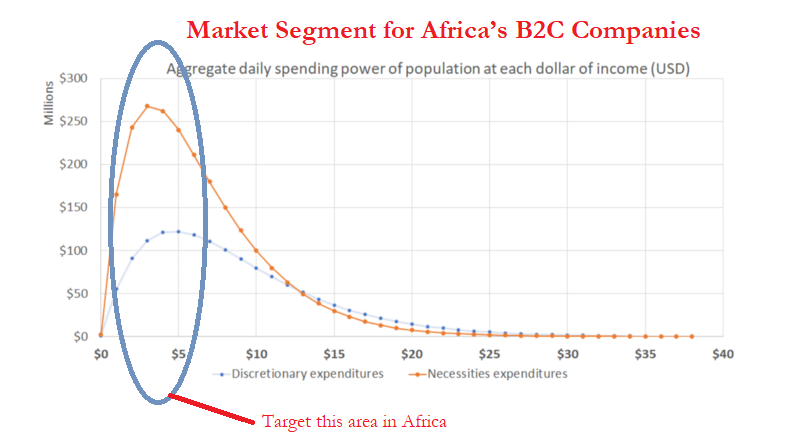
Stretch it, you are outside the sweet spot of spending in Africa (see the plot).

The Core Market Segment in Africa - Middle of the Pyramid - Tekedia

LinkedIn Comment on Feed

Comment: This reminds me of an observation made by one of my lecturers back then in the university. The Chinese by then had started flooding African markets with all sorts of cheap lookalike products to the ones we grew of consuming from Nigeria. Of course the Nigerian products were of better quality but before long, everyone started crying fowl of how quickly the cheaper Chinese products were getting bad. When i asked my lecturer back then why people kept buying the Chinese products only to complain afterwards, he smiled. I probed further…even America is complaining about Chinese products…why do they allow them do this…his response keeps resonating inybears till date. The problem in America is different from the one here in Cameroon. Over there, Americans are complaining of high quality products from China that sells cheaper than American products of the same quality. Here we have products with quality equivalent to what we can pay.

My Response: I have a video on this where  I used the Chinese toy industry and how that playbook made it possible for them to win markets across developing regions of the world. Who wants to spend $50 to buy a Christmas race-car toy from Germany when China offers one for $1 even though it may not last more than 2 hours on Christmas day. Because mothers are smarter: China’s $1 will win as they can save money for more important things. The kid has his toy even though it did not work for many hours!

Again, Despite Court’s Restraining Judgement, CBN Orders Freezing of Crypto-Trading Accounts

0

Again, the Central Bank of Nigeria (CBN) has ordered all Nigerian commercial banks to freeze the accounts of some individuals, who it said have been trading in cryptocurrency.

In a Post-No-Debit circular signed by the Director of Banking Supervision, J. Y. Mammanand, and addressed to the bank on November 3, the financial regulator directed that the funds belonging to Nnamdi Francis Okereke, Nwaorgu Kingsley Chibuzor, and a company called TVS Hallmark Service Limited be frozen.

“You are hereby directed to close accounts of the underlisted bank customers and place the funds in the accounts in suspense accounts for engaging in cryptocurrency trading in contravention of CBN Circular BSD/DIR/PUB/014/001 dated February 5, 2021.”

This is in continuation of the step taken by the apex bank early in the year, against those trading cryptocurrency in Nigeria.

In February, the apex bank ordered banks and other financial institutions to close all customer accounts used in trading cryptocurrencies and other related transactions.

The order was proclaimed through a circular distributed to deposit money banks, non-bank financial institutions and other financial institutions to “identify persons and/or entities transacting in or operating cryptocurrency exchanges within their systems and ensure that such accounts are closed immediately.”

Consequently, a host of individual and company accounts were suspended from carrying out any financial transactions. The CBN had banned all regulated financial institutions from dealing in any crypto-related transactions, on the allegation that cryptocurrencies pose a threat to Nigeria’s economy, and it’s being used to sponsor terrorism.

“Further to earlier regulatory directives on the subject, the Bank hereby wishes to remind regulated institutions that dealing in crypto currencies or facilitating payments for cryptocurrency exchanges is prohibited,” the CBN said in the circular.

Among the accounts frozen by the banks following the central bank’s directive were; Bamboo, Risevest, Trove and Chaka. These companies facilitate cryptocurrency trading and brokerage services for Nigerians to invest in foreign stocks, a service the CBN said it contravenes its circular.

However, these companies and other individuals, whose bank accounts were frozen based on the circular, filed a lawsuit challenging the banks’ action.

Last month, A Federal High Court sitting in Abuja vacated the interim order which directed the banks to suspend all funds belonging to the affected accounts.

In his ruling, the presiding judge, Taiwo O Taiwo, said the CBN failed to provide any law showing that it is illegal to deal in cryptocurrency in Nigeria.

“I have perused the counter affidavit of the Respondent and I see that the reason for freezing the account of the applicant is based on the alleged infraction of the circular of the CBN.

“The law is trite that any conduct that must be sanctioned must be expressly stated in a written law.

“Being unknown to law, circulars cannot create an offence because it was not shown to have been issued under an order, Act, Law or Statute,” Justice Taiwo said, and ordered the responsible banks, Zenith Bank Plc and Guaranty Trust Bank, to unfreeze the accounts.

Based on this judgment, CBN’s latest directive to banks to freeze the accounts of individuals, purportedly trading cryptocurrency, has been described as utter disregard for the rule of law.

It has also added to the culminating events, where the financial regulator has been accused of trampling on people’s rights and acting with impunity. One of those events occurred during the End SARS protest, when the central bank illegally blocked the bank accounts of some protestors, on the unfounded allegation of terrorism.