DD
MM
YYYY

PAGES

DD
MM
YYYY

spot_img

PAGES

Home Blog Page 5503

LinkedIn Launches Marketplace, A Feature for Freelance Services

0

LinkedIn has launched Service Marketplace, a new front in the job market for freelancers. The new feature, which has been in the pipeline for long, will let people advertise themselves for short-term engagements to those looking to hire people for such roles.

It is a major shift since the Microsoft-owned platform closed down in China. The new feature shares similarities with the likes of Fiverr and Upwork, skills and knowledge outsourcing platforms.

Per TechCrunch, Service Marketplace was first leaked out as a small test in February this year. Since then, LinkedIn has been running a quiet beta of the service in the U.S., which has already picked up 2 million users from among the nearly 800 million users (as of Wednesday’s earnings report) that LinkedIn now has globally.

The feature has gone live globally: to set up a freelancer profile, you go to your own profile page, find the button near the top and follow the script to set it up and flag what you might be interested in working on.

LinkedIn aims to use the new feature to expand its recruitment services. The company said in Wednesday’s earnings call, per TechCrunch, that confirmed hires on the platform increased more than 160% year over year, with advertising revenue overall up 61% in the same period. It is managing to upsell those doing recruiting to its wider suite of training content, too: LinkedIn Learning now has more than 15,000 enterprise customers.

Product manager Matt Faustman told TechCrunch in an interview that the Service Marketplace is launching with 250 job categories, and the plan is to expand that to 500. He thus explained how the feature will work.

“We are barely scratching the surface,” he said. Marketing has been one of the stronger categories to date on the marketplace, he added.

“Barely scratching the surface” may be the operative phrase here.

For now, there is no way of negotiating a fee for work, nor for invoicing, and those looking to find people are not required to give any specific guidance on fees until they get into a deeper conversation with a candidate.

When it comes to reviews, clients can review those they have engaged, but the individuals cannot leave a reciprocal review for the clients.

And, those listing their profiles on the Marketplace have no way of finding jobs themselves: they are there to be discovered, not to search for work.

Clients looking to fill jobs will be able to look for people by way of LinkedIn’s bigger drop-down search menu: for example, looking for specialists in brand marketing, you can start to type in that phrase in the search window, and LinkedIn will suggest “in Service Marketplace” as an auto-complete, which will take you to a list of candidates in that category.

In turn, those candidates will be sorted based on how closely you the client might be connected to each individual, either via a work or personal connection.

But again, those who are brand marketing specialists, as one example, will not be able to scan a wider list of opportunities. Faustman said that all the current limitations are intentional: they have, for now, built this for the client experience, and the idea is that by letting them make targeted tasks, they do not get inundated with applications that they then have to spend time triaging.

Over time this, plus all of the other features that are missing such as payments, will be re-evaluated, he said.

That will be critical if LinkedIn hopes to get the credibility of the workforce that it’s trying to cultivate here. Freelancers often suffer from a lack of transparency on rates, and run the risk of being exploited as a result through low-balling, a point Faustman acknowledged is an issue and said was a point of contention within LinkedIn’s product team.

“We will address the pricing point, but we decided not to for now,” he said.

Another interesting turn will be how and if LinkedIn will bring in other kinds of workers into the marketplace, covering the wider population of people who are working on the front line and other service jobs. There is no immediate roadmap to include them in the Service Marketplace, Faustman said, but “the long term is that we can extend this into any category that exists on LinkedIn.”

Mark Zuckerberg Explains His Metaverse Vision (full text)

0

Meta, a name that put the long-held anticipation of the planned new name for Facebook to a stop, was announced Thursday by the company’s CEO Mark Zuckerberg.

Zuckerberg, who in July announced the formation of metaverse product group, as he pushes to build something brilliantly different, which he believes will take the place of mobile internet, unveiled the metaverse plan on Thursday.

He explained his meta vision and what he aims to achieve with it. Read below.

We are at the beginning of the next chapter for the internet, and it’s the next chapter for our company too.

In recent decades, technology has given people the power to connect and express ourselves more naturally. When I started Facebook, we mostly typed text on websites. When we got phones with cameras, the internet became more visual and mobile. As connections got faster, video became a richer way to share experiences. We’ve gone from desktop to web to mobile; from text to photos to video. But this isn’t the end of the line.

The next platform will be even more immersive — an embodied internet where you’re in the experience, not just looking at it. We call this the metaverse, and it will touch every product we build.

The defining quality of the metaverse will be a feeling of presence — like you are right there with another person or in another place. Feeling truly present with another person is the ultimate dream of social technology. That is why we are focused on building this.

In the metaverse, you’ll be able to do almost anything you can imagine — get together with friends and family, work, learn, play, shop, create — as well as completely new experiences that don’t really fit how we think about computers or phones today. We made a film that explores how you might use the metaverse one day.

In this future, you will be able to teleport instantly as a hologram to be at the office without a commute, at a concert with friends, or in your parents’ living room to catch up. This will open up more opportunity no matter where you live. You’ll be able to spend more time on what matters to you, cut down time in traffic, and reduce your carbon footprint.

Think about how many physical things you have today that could just be holograms in the future. Your TV, your perfect work setup with multiple monitors, your board games and more — instead of physical things assembled in factories, they’ll be holograms designed by creators around the world.

You’ll move across these experiences on different devices — augmented reality glasses to stay present in the physical world, virtual reality to be fully immersed, and phones and computers to jump in from existing platforms. This isn’t about spending more time on screens; it’s about making the time we already spend better.

OUR ROLE AND RESPONSIBILITY

The metaverse will not be created by one company. It will be built by creators and developers making new experiences and digital items that are interoperable and unlock a massively larger creative economy than the one constrained by today’s platforms and their policies.

Our role in this journey is to accelerate the development of the fundamental technologies, social platforms and creative tools to bring the metaverse to life, and to weave these technologies through our social media apps. We believe the metaverse can enable better social experiences than anything that exists today, and we will dedicate our energy to helping achieve its potential.

As I wrote in our original founder’s letter: “we don’t build services to make money; we make money to build better services.”

This approach has served us well. We’ve built our business to support very large and long term investments to build better services, and that’s what we plan to do here.

The last five years have been humbling for me and our company in many ways. One of the main lessons I’ve learned is that building products people love isn’t enough.

I’ve gained more appreciation that the internet’s story isn’t straightforward. Every chapter brings new voices and new ideas, but also new challenges, risks, and disruption of established interests. We’ll need to work together, from the beginning, to bring the best possible version of this future to life.

Privacy and safety need to be built into the metaverse from day one. So do open standards and interoperability. This will require not just novel technical work — like supporting crypto and NFT projects in the community — but also new forms of governance. Most of all, we need to help build ecosystems so that more people have a stake in the future and can benefit not just as consumers but as creators.

This period has also been humbling because as big of a company as we are, we’ve also learned what it’s like to build on other platforms. Living under their rules has profoundly shaped my views on the tech industry. I’ve come to believe that the lack of choice for consumers and high fees for developers are stifling innovation and holding back the internet economy.

We’ve tried to take a different approach. We want our services to be accessible to as many people as possible, which means working to make them cost less, not more. Our mobile apps are free. Our ads model is designed to provide businesses the lowest prices. Our commerce tools are available at cost or with modest fees. As a result, billions of people love our services and hundreds of millions of businesses rely on our tools.

That’s the approach we want to bring to helping to build the metaverse. We plan to sell our devices at cost or subsidized to make them available to more people. We’ll continue supporting side-loading and streaming from PCs so people have choice, rather than forcing them to use the Quest Store to find apps or reach customers. And we’ll aim to offer developer and creator services with low fees in as many cases as possible so we can maximize the overall creative economy. We’ll need to make sure we don’t lose too much money along the way though.

Our hope is that within the next decade, the metaverse will reach a billion people, host hundreds of billions of dollars of digital commerce, and support jobs for millions of creators and developers.

WHO WE ARE

As we embark on this next chapter, I’ve thought a lot about what this means for our company and our identity.

We’re a company that focuses on connecting people. While most tech companies focus on how people interact with technology, we’ve always focused on building technology so people can interact with each other.

Today we’re seen as a social media company. Facebook is one of the most used technology products in the history of the world. It’s an iconic social media brand.

Building social apps will always be important for us, and there’s a lot more to build. But increasingly, it’s not all we do. In our DNA, we build technology to bring people together. The metaverse is the next frontier in connecting people, just like social networking was when we got started.

Right now our brand is so tightly linked to one product that it can’t possibly represent everything we’re doing today, let alone in the future. Over time, I hope we are seen as a metaverse company, and I want to anchor our work and our identity on what we’re building towards.

We just announced that we’re making a fundamental change to our company. We’re now looking at and reporting on our business as two different segments: one for our family of apps and one for our work on future platforms. Our work on the metaverse is not just one of these segments. The metaverse encompasses both the social experiences and future technology. As we broaden our vision, it’s time for us to adopt a new brand.

To reflect who we are and the future we hope to build, I’m proud to share that our company is now Meta.

Our mission remains the same — it’s still about bringing people together. Our apps and their brands aren’t changing either. We’re still the company that designs technology around people.

But all of our products, including our apps, now share a new vision: to help bring the metaverse to life. And now we have a name that reflects the breadth of what we do.

From now on, we will be metaverse-first, not Facebook-first. That means that over time you won’t need a Facebook account to use our other services. As our new brand starts showing up in our products, I hope people around the world come to know the Meta brand and the future we stand for.

I used to study Classics, and the word “meta” comes from the Greek word meaning “beyond”. For me, it symbolizes that there is always more to build, and there is always a next chapter to the story. Ours is a story that started in a dorm room and grew beyond anything we imagined; into a family of apps that people use to connect with one another, to find their voice, and to start businesses, communities, and movements that have changed the world.

I’m proud of what we’ve built so far, and I’m excited about what comes next — as we move beyond what’s possible today, beyond the constraints of screens, beyond the limits of distance and physics, and towards a future where everyone can be present with each other, create new opportunities and experience new things. It is a future that is beyond any one company and that will be made by all of us.

We have built things that have brought people together in new ways. We’ve learned from struggling with difficult social issues and living under closed platforms. Now it is time to take everything we’ve learned and help build the next chapter.

I’m dedicating our energy to this — more than any other company in the world. If this is the future you want to see, I hope you’ll join us. The future is going to be beyond anything we can imagine.

For The Elephant To Dance in First Bank

0

I congratulate one of the finest titans of the Nigerian banking sector, U.K. Eke, as he retires as the Group Managing Director of FBN Holdings Plc, the parent of First Bank Nigeria. Also congratulating Nnamdi Okonkwo as he prepares to assume that position, one of the most important in the nation when it comes to business. First Bank is more than a bank; it is the symbol of the nation. So, anyone holding it must hold it with honour, dignity and strength.

More so, as a very very minority shareholder of FBN, let me appeal to Tunde Hassan-Odukale and Femi Otedola to quickly attain an equilibrium point on the control. We need to make sure that the First is not hurt. The last few weeks have been promising; let’s keep the party and rally!

First Bank has not delivered much value to many of us who got in during the Big Naija Offer. So, despite the percentages and control, the focus must be on making this company deliver on its latent opportunities.  A market cap of N418.180 billion, from my angle, is poor. Everyone must focus on making sure the bank uses its data and unlock the promises many of us had invested on!

The elephant can still dance and let us play the drum of innovation.

Multichoice (DStv, GOtv) Loses $342 million Tax Appeal; Companies Owing Nigeria $17 billion Tax

1

The entertainment giant, Multichoice, the owner of DStv and GOtv, has lost an appeal against the Nigerian government which is insisting that it pays $342 million tax backlog. The company had appealed against Nigeria’s Federal Inland Revenue Service (FIRS) which concluded that Multichoice has an unpaid VAT principal of $123.7 million. With a penalty of $218 million tagged along, the sum came down to $342 million. The company appealed but has now lost that phase.

Crazy things do happen and on this one, I am 100% with Nigeria. While I am not a lawyer to know what they do in court, from my common knowledge, MultiChoice can open its books, providing what was paid, and based on that, it can provide a good figure on its VAT obligations. There is no need to do guesswork; it has the books to stop this waste of money on lawyers! 

But as always, there will be a settlement and the case will magically close. But it must not be this way. VAT does not EVER belong to any company. So, it ought never to be fought in the court.

As MultiChoice plots its next move, the government is saying that companies in Nigeria owe it $17 billion on taxes:  “local and foreign corporations are owing the Nigerian government over N7 trillion [about $17 billion] in taxes, limiting the government’s revenue and helping to fuel massive borrowing, the head of the country’s financial intelligence unit has said. The Director of the Nigerian Financial Intelligence Unit (NFIU), Modibbo Tukur, said the companies are partly responsible for the rise in the debt profile of the country.” That seems very scary for a country which is borrowing left and right.

In Ovim (Abia State), we have women called Ojengwa (“move fast”). These women are the ones who resolve difficult matters – and they are very effective. Maybe Nigeria should engage them because one technique they use is this: if you cannot behave, you cannot remain in Ovim! So, if companies cannot pay tax, they must cease to operate in Nigeria.

Why must Nigeria be a victim all the time? Revoke operating licenses for tax-cheats.

E Naira, Crypto Trading Court Cases, and the Ekekwe Spoof/Parody Election Poll

0

As ‘nairametrics’ report that Google has dropped the eNaira app from the playstore, I think back to a parody/spoof Nigerian Election poll I created on LinkedIn a week or two ago.

The reason I did the poll was actually a protest post against genuine polls on the same topic that polluted my LinkedIn feed.

When I was a little kid, people didn’t have a lot, but they tried to do what they could for kids. One common gift was a puzzle book that cost only a few pence. Print quality was poor, and on the cover with explosions of stars and garish ‘riot colour’ you would see in big and bold ‘100 PAGES’. At the back said ‘Made in Taiwan’ This was an example of how Taiwan made money long before they had TSMC !

So you would have pages to colour with crayon or pencils, you would have word search, you would have ‘join the dots’, and you would have ‘odd one out’. Odd one out, involved four pictures, from which one picture needed to be chosen because it failed to conform to some quality the other three shared.

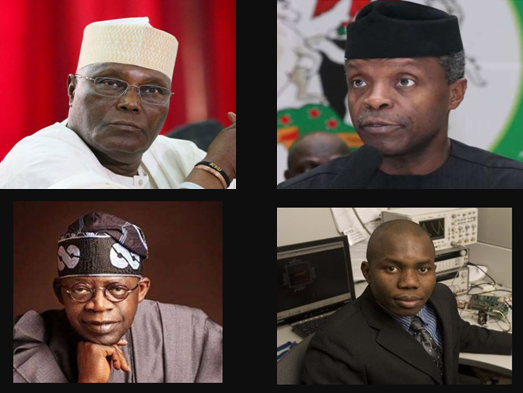
So I set my parody poll up like one of the ‘odd one out’ puzzles of my childhood. I used three of the most widely published and established Nigerian politicians in the specific  polls causing annoyance in my feed, and with them, I had to pick an ‘odd one out’

Who will I pick? They have to be someone who is legally electable. They have to be someone who a large portion of the LinkedIn Community in  Nigeria will be aware of and will respect. Sure, I could pick Tony Elumelu or Austin Okere and many other fine Nigerian folk to fill the space, but I don’t know how they will feel about being parachuted into a ruse like this, and I don’t want to offend anybody. One thing Prof. shares with me is this sort of insatiable sense of curiosity for its own sake, so he was my best guess at who would be game for it.

The thing is.. people actually started taking the poll seriously and much debate ensued.  One of the most common points of contention was the choice of the three ‘common’ elements of the parody. There was very little criticism of choice of ‘odd one out’.

And I’m there gnashing teeth and pulling hair out thinking… ‘Why do people have a problem with understanding the meaning of the words… ‘Parody’… ‘Spoof’….  It is a ‘skit’. It is a humorous ‘gibe’.

And someone says.. ‘Peter Obi’ should be there… or ‘Kingsley Moghalu’ should be there… (non exhaustive list).  And I say it’s a parody… and a little later, I get another reply saying.. ‘but I still think that … (complete as required!)

And I feel like saying… ‘Look up the meaning of the word ‘parody’, then think if you still want to add another comment that starts with ‘but’… if so, go back and read the meaning of ‘parody’ again… rince repeat, ad infinitum until you get to the point you feel  you no longer need to start a new comment with ‘but’.

However the post got endless comments and reactions, and 200k views – off the charts for a post from a member with only an 8k network and no ‘airbrushed’ photo of a well appointed young woman.

And then it hit me.. a wound exists here and a scab has just been picked. Maybe I am the one that does not get the point.

A NATION IS GENUINELY UPSET

When all was said and done, the ‘odd one out’ candidate, Ndubuisi Ekekwe, won 50% of the vote, with the nearest other choice, Prof Yemi Osinbajo on 35% and two other career politicians on 7% each.

One of these things is not like the other…..

Now anybody can be thinking, ‘ok, great to have this review, but what has that got to do with eNaira or Crypto?’

Well, while lauding the unexpected success of Ndubuisi Ekekwe in the poll, I wheeled out one of my old stock phrases suited to this scenario:

‘LinkedIn no dey spray Maggi Cube fuh Village’

This is no hail by me for Nestle or bad word for Unilever. Knorr  ranks as boss of Bullion Cube Market in Nigeria many times, but still, Maggi Cube has entered the pidgin lexicon.

While the electricity grid and services have been broken up in Nigeria, and commercial parts have been named and renamed…

Media hails achievements and appointments across the various companies.

But, when it comes to complaining of outages, all over Nigeria the ghost of a long gone entity is raised to take the blame – Yes.. still, voices of Nigerians only allow NEPA to take light!

Elders talk of ‘Quaker Oats’ long gone from their market. Pidgin collect brand fuh lexicon she?

Ndubuisi  Ekekwe knows he has won his ‘LinkedIn Nation’

What has eNaira really won?

Ekekwe’s ‘LinkedIn Nation’ as he calls them, while they cast their vote in a parody Presidential election, they have also cast their vote in  very real ‘value instrument’ by-elections.

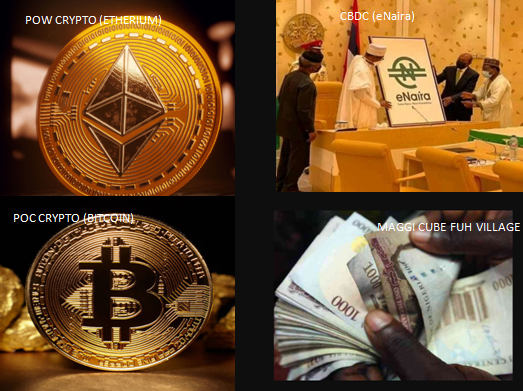
Both POW Crypto and POC Crypto parties have gained seats in the by Elections across Nigeria. They have taken Nigerian ‘LinkedIn Nation’

‘eNaira is like one 10 kobo guy like dat, leave village gone Abuja and collect General stars or DIG Police title.’ But when he return village, if is Oba, Igwe or Sultan.. when he is in that hall, to his ruler, he is still that same 10 Kobo that left.

But because of dis his new shakira, Ruler no dey know am

So village all over Naija no dey know am.

So can anybody blame Google play no dey know am?

And some small people wan say oh , take Google to court… fuh weitin? Take ur time-oh. Take ur time!

FIAT, ie. ‘paper’ Naira has been smart.

In this by-election she done spray  Maggi Cube fuh Village already.

Paper Naira has won the by-election of the very local mass markets.

OK.. as Samuel Nwite for Tekeia reports : ‘Crypto Exchange Platform, Luno, Plans to Reintroduce Naira Deposits and Withdrawals’

Though what would be really interesting, would be if Luno members can exchange eNaira with other ‘value instruments’ without a BVN number from a Nigerian commercial bank. This would declare Naira as a globally tradable currency by proxy.

No ‘one of these things’ dynamic here… these guys are competing for different parts of Nigeria’s ‘economic’ electorate

But as Judge Taiwo Taiwo overrules CBN ’s August 17 decision to freeze Crypto Trader bank accounts, that same ‘LinkedIn Nation’ that compose only about 0.8% of Nigeria’s population that have  4G smartphone access, possibly internet@work and possibly able to shop in ‘Modern Trade’ outlets…  will soon be free to engage with the ‘value instrument community’ they ‘voted’ for.

This is the community the eNaira party campaigned to win and failed.

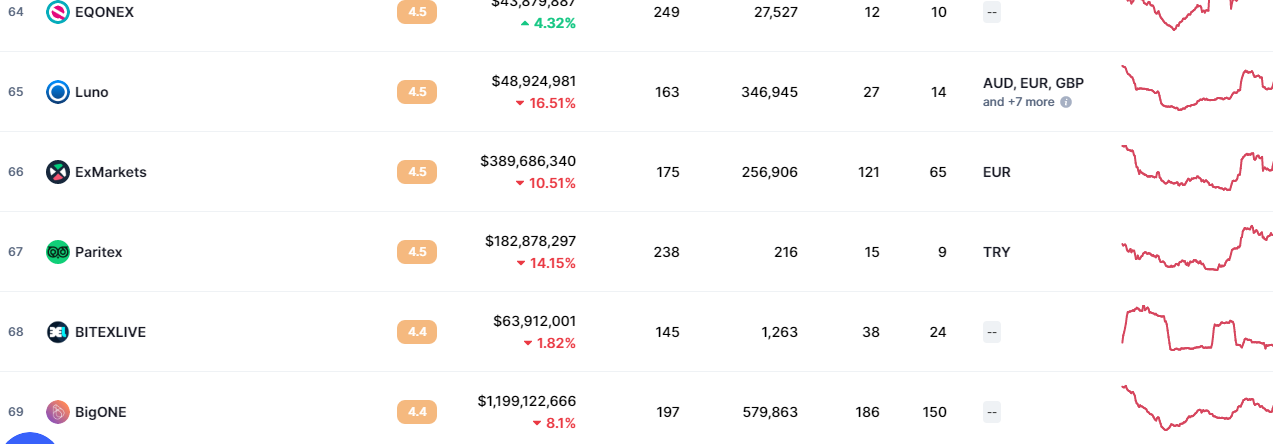
Luno only ranks 65 on the Crypto currency exchanges, so unlikely to lead any revival in eNaira’s fortunes. Top three exchanges are Binance, Coinbase Exchange and Kraken

Maybe FGN as a campaign funder should try to fund candidates the electorate actually want rather than pushing ones surplus to requirements.

Getting back to the original parody… Is it likely Ndubuisi Ekekwe would win the 2023 election if he declared? Probably not. But is it possible? Yes.

There is a process flow for the ‘Maggi Cube’ dynamic that starts with, in Ekekwe parlance, a ‘friction’ and ends in a ‘fix’ I know this process flow and. I know the process stations in it. I just have not defined the process instructions in those stations. I will not say more here.

eNaira on the other hand is an ill-conceived child forced on the family by a disconnected father, born of a reluctant mother and won’t be received well by openly aggressive peer siblings. Crypto and traditional FIAT have conspired to end its life directly as it exits the womb.

I’m not a gambling person, but if someone forced me to put a million Naira on which would come first – Prof Ndubuisi Ekekwe as Nigerian President or eNaira establishing itself as a global CBDC, I know the alternative  which offers the best route to challenge Maggi Cube Spray Mentality.

References/Further Reading:

www.tekedia.com/crypto-exchange-platform-luno-plans-to-reintroduce-naira-deposits-and-withdrawals/

nairametrics.com/2021/10/27/breaking-enaira-speed-wallet-app-disappears-from-google-play-store/

news.bitcoin.com/nigerian-judge-rules-in-favor-of-accused-crypto-startup-accounts-to-be-reopened/