DD
MM
YYYY

PAGES

DD
MM
YYYY

spot_img

PAGES

Home Blog Page 5510

Even Angola Spends More Than Nigeria!

3

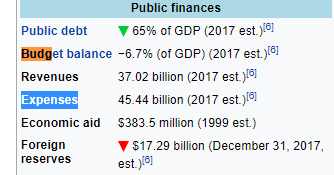
Is Nigeria really a giant? I do not understand the basis of that illusion! These days I have stopped using South Africa in my speeches because many told me that it was not a fair comparison. So, I switched to Angola, and no one has explained why Angola budgets $45 billion for 33 million people when Nigeria can only manage $35 billion for 210 million with most of that $35 billion borrowed.

Angola data (Wikipedia)
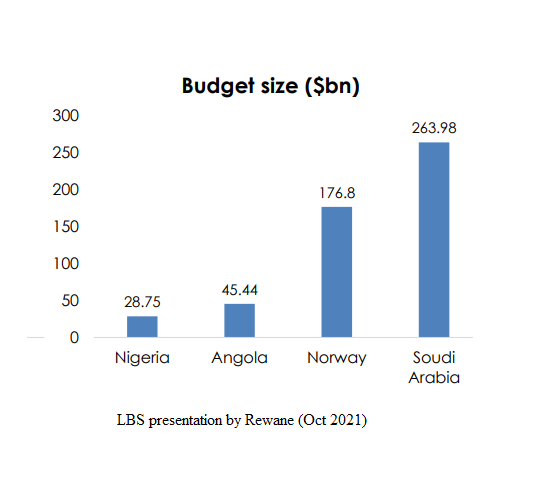
Oct 2021 Lagos Business School presentation by Bismarck Rewane, CEO of Financial Derivatives Company Ltd


Fellow citizens, Angola is an oil nation. How can we retire all these men who have been running Nigeria since 1999 since whatever they are doing is not working? I mean we are severely underperforming as a nation across major metrics.

Sure, Angola may be running a unitary government which means most of its spending is concentrated at the federal level; Nigeria runs a federal system with states having their own budgets. Yet, that does not change the underperformance of Nigeria. Except Lagos with $2.3 billion and Rivers state with $1 billion, many of the states in Nigeria spend really not much; Zamfara is around $300 million. That noted, even if you add all the states in Nigeria, on per capita income, Angola does better than Nigeria.

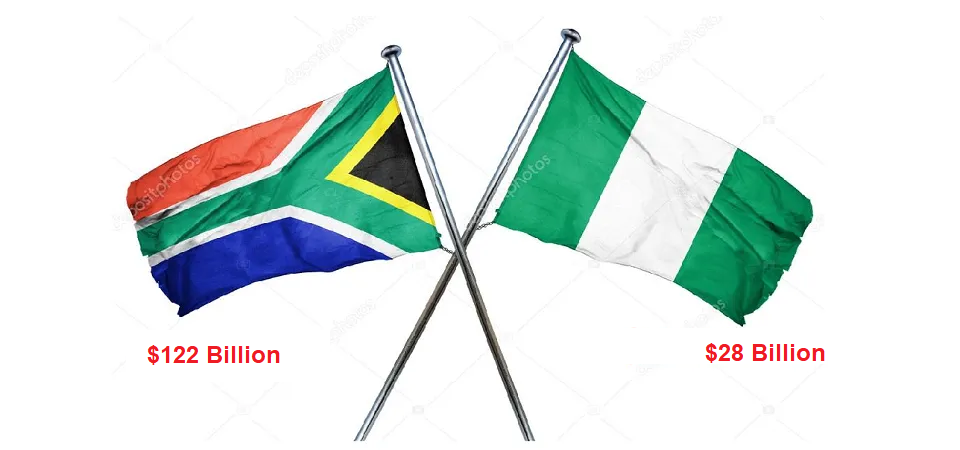
Nigeria vs South Africa budget, 2019


Notice after the post:

Good People, I have received dozens of inmails asking for the source of my Angolan budget. But one from a Director-General in one of our government agencies is driving this notice. Possibly, there are many people asking for the same thing.  Typically, anything I post here has an extended copy in my blog (next time, just go to tekedia as I archive all posts there).

But in summary, I relied on the Oct 2021 Lagos Business School presentation by Nigeria’s smartest financial analyst, Bismarck Rewane, CEO of Financial Derivatives Company Ltd. On page 25 of that presentation, he has this plot on the left. He is certainly a smarter man than yours truly that anything he puts out there must be correct. In short, he put the budget of Nigeria at $28.75 billion when I was gracious to put it at $35 billion. He is certainly right considering that our budget execution is never 100%.

But just to be sure it was not a typo, I also checked Wikipedia and saw the public expense at $45 billion. With that, I entered that number for Angola.

This is the full piece https://www.tekedia.com/even-angola-budgets-more-than-nigeria/ where I also noted the unitary structure of the Angolan budgetary system. But despite all, the trajectory is evident.

(I cannot share Mr Rewane’s 115-page document due to copyright issues. But you can go to LBS library for the Oct edition)

Nigeria Needs To Make It “We Rise Together”

1

In the next 10 years, Nigeria is going to experience one of the fastest and largest accumulation of wealth in its recorded history. The indicators are evident – this is a cambrian moment of entrepreneurial capitalism at an unprecedented level. But as this happens, many would be left behind. In short, the inequality would create many pockets of nano-conflicts in the nation if policymakers fail to lead. 

Wealth which will be created between now and 2030 would be concentrated in the hands of extremely well educated young people, and creating that wealth will not touch many people through employment.

Today, we have startups in Lagos with valuations in excess of $50 million with just 25 staff when banks that employ more than 6,000 people are struggling with a valuation of $40 million. 

If our policymakers are thinking, now is the time to begin to look at ways to ensure the Nation can rise #together. And most importantly, investing in digital education should be a human rights matter in Nigeria now. If not, the dislocation will trigger huge consequences in our future.

Right to protest is a constitutional right

0

By recent events, it may have seem that protesting or ‘peaceful’ protest is a crime against the state, not just a minor crime but a grievous one which attracts capital punishments as protesters have been treated like common criminals in Nigeria; harassed, intimidated, brutalized, arrested and detained for lengthy period of time by security agents in Nigeria. This circumstance makes one to wonder if it is really legal and a fundamental right to protest in Nigeria.

No matter how the government of Nigeria May try to rewrite the law, right to protest is a constitutional right; a fundamental right duly provided for in the constitution of the federal republic of Nigeria, 1999. Citizens have the right to assemble, organize and lead ‘peaceful protest’. This right is not just an ordinary right but a fundamental human right, just like individuals have right to life, freedom to move about, right to vote and be voted for etc so also citizens have right to hold opinion, join peaceful association, register their displeasures with the government when they feel that the policies and decisions of the government doesn’t not serve their interest.

This citizens’ right to peacefully protest; join associations, assemble freely and hold public opinion was provided for in sections 39 & 40 of the constitution of the federal republic of Nigeria, 1999. These sections read:

39. (1) Every person shall be entitled to freedom of expression, including freedom to hold opinions and to receive and impart ideas and information without interference.

(2) Without prejudice to the generality of subsection (1) of this section, every person shall be entitled to own, establish and operate any medium for the dissemination of information, ideas and opinions:

Provided that no person, other than the Government of the Federation or of a State or any other person or body authorised by the President on the fulfilment of conditions laid down by an Act of the National Assembly, shall own, establish or operate a television or wireless broadcasting station for, any purpose whatsoever.

(3) Nothing in this section shall invalidate any law that is reasonably justifiable in a democratic society –

(a) for the purpose of preventing the disclosure. of information received in confidence, maintaining the authority and independence of courts or regulating telephony, wireless broadcasting, television or the exhibition of cinematograph films; or

(b) imposing restrictions upon persons holding office under the Government of the Federation or of a State, members of the armed forces of the Federation or members of the Nigeria Police Force or other Government security services or agencies established by law.

40. Every person shall be entitled to assemble freely and associate with other persons, and in particular he may form or belong to any political party, trade union or any other association for the protection of his interests:

Provided that the provisions of this section shall not derogate from the powers conferred by this Constitution on the Independent National Electoral Commission with respect to political parties to which that Commission does not accord recognition.

The right to protest is not just a territorial fundamental human right as provided in section 39 and 40 of the constitution of the federal republic of Nigeria as it not limited to the jurisdictional shores of Nigeria, it is a continental right which is duly provided for in Article 11 of the African Charter of Human and People’s Right. It provided thus:
Every individual shall have the right to assemble freely with others. The exercise of this right shall be subject only to necessary restrictions provided for by law in particular those enacted in the interest of national security, the safety, health, ethics and rights and freedoms of others.

When a right is provided for in the constitution it points to how important that right is to individuals of the community and democracy cannot flourish when citizens of the state accepts whatever been thrown at them by the government hook line and sinker.

This is not just a political thing or a political agenda as people may think, so when citizens protest it is not a sponsored attack against the ruling government but it is a way of citizens who have the interest of the state at heart register their displeasures and force the government to see reasons with them, rethink and revisit their previous decisions and policies. It is in the human nature to resist some events or policies which he feels won’t benefit him.

The New Graduates of Baze University

0

Let me congratulate Senator Ifeanyi Ubah for graduating from Baze University Abuja with a bachelor of law degree yesterday. Sure, he has gotten that paper but of course the Senator does not need any certificate. There are many positives looking at the graduating class with Senator Dino Melaye, and Osita Chidoka (ex-federal minister). 

Yes, getting an extra degree could possibly become the evening beer parlour culture. And if that happens, it would be a huge positive for Nigeria. One of the graduates holds a PhD and is a deputy managing director in one Nigeria’s largest banks. 

I congratulate them, not because they will remember where those certificates are in 24 hours, but as a sign to challenge young people that education is not just about jobs, but mind liberation and acquisition of knowledge. If not, Senator Ubah who employs thousands will have nothing to do with a university!

Role Of Constructive Criticisms In Nation-Building

0

Though it has different interpretations by various individuals, entities, and schools of thought across the globe, criticism is arguably a veritable tool in countless human endeavours.

It can be defined as the expression of disapproval of someone or something. In the same vein, a critic of a person, policy or system disapproves of them and expresses such a view publicly.

One who writes reviews and expresses opinions about books, films, music or any art work having considered it carefully can equally be referred to as a critic. Hence, it’s all about expressing a contrary view about something or someone in strong terms.

Criticism remains a matter of flushing out certain thoughts, policies and/or attitudes, or trying to change them. It is to show that things are not as self-evident as one believes.

Thus, criticism ensures that what is accepted as self-evident will no longer be accepted as such. It suffices to say that observance criticism in any society is a matter of making facile gestures or remarks difficult.

Criticisms are essential recipes in any area of human endeavour. For instance, in steward-client relationship, if the latter has a criticism to tender, it means he or she wants to give feedback on the services being rendered to him/her, thereby creating an opportunity for the former to learn more about the person he is working for and how to convert them into a satisfied client member. Same measure is applicable in a trader-customer relationship.

Similarly, in a business venture, working or partnering with someone who is patient and able to receive as well as act on criticism signifies that both parties involved can work towards a better or greater outcome. Furthermore, in movie production, criticism enables the producer to know what his audience actually wants.

If one always thinks he is right but doesn’t get feedback from anyone else, he wouldn’t know if he is really doing well. Whether you are selling, servicing, performing, or leading, listening and acting on those honest views or reactions will tell you precisely what is good and what could be done better. Perhaps, you can use the information to change your performance, exhibition or product, as the case may be.

In public service, criticism has the tendency of guiding the public servants away from bad practices, and towards good and acceptable ones. It would enable the said workers to take a step back or have a rethink with a view to making amends or adjustment where need be.

The socio-political arena is not left out while discussing the inevitable role of criticism in nation-building. Undoubtedly, a little constructive criticism from the members of the public such as the civil society groups, the electorate, the religious organizations, or what have you, channeled towards the political office holders can yield the anticipated change in the country or society in question.

Considering the positive impact of constructive criticism, there is no gain reiterating the fact that it is indeed a welcome gesture or required factor toward the socio-economic development of any nation, hence ought to be sustained. To this end, there is a need for us to acknowledge that the language we use in response to criticism is vitally important.

Whenever criticism is tendered by any concerned individual or group, the recipient is expected to try at all costs to avoid getting into an argument. Instead, they should turn the exchange into a discussion on how to resolve the predicament. Such an approach would keep the door open for the required change or correction.

Also, criticisms are not meant to be taken personally. Even if one feels he or she is being criticized unfairly, he shouldn’t retaliate with an extreme knee-jerk reaction. Such a response will worsen the situation and can even harm the person’s reputation as well. Therefore, it is important to always remember to not be offended by someone’s remarks even if you think it is a personal attack.

On the other hand, having noted the enormous significance of constructive criticism in nation-building, there is also a compelling need for the critics to be mindful at all times when tendering their criticisms. They ought to know when to tender the criticism and how it ought to be presented.

It’s worthy of note that some critics lack the orientation on when and how to present their criticism. This set of persons invariably tender their contrary opinions as a form of antagonism, thereby making the supposed/target recipient misunderstand the gesture.

More so, critics are meant to comprehend that criticism is expected to be accompanied by the presumed remedy to the anomaly that is being criticized. Most so-called critics usually end up raising a cloud of dust in the name of criticism.

Unequivocally, a criticism that is not tendered with a presumed solution to the problem being criticized is simply a mere noise that is intended to cause a pandemonium or controversy rather than addressing the situation at hand.

In view of these assertions, everyone at all levels including political leaders, followers, craftsmen, traders, businessmen, teachers and public servants, as might be the case, is expected to take criticism seriously regardless of the circumstance in order not to abuse the remarkable tool.

Criticism is arguably a veritable device, but it’s however required to be deployed reasonably and selflessly.