DD
MM
YYYY

PAGES

DD
MM
YYYY

spot_img

PAGES

Home Blog Page 5528

Beyond The Vice President’s Proposal; Only Factories and Warehouses Will Save Naira, not CBN!

2

Sometimes you wonder if Vice President Prof Osinbajo is part of Nigeria’s national government. I write that because he has many GREAT ideas but yet translating those ideas into actions remains the missing link. He has written on independent power generation but yet men who work “partly” for him seem not to be listening; it must be frustrating indeed. The latest is a brilliant hypothesis on our exchange rate. I agree with Mr. Vice President – the official rate of the naira to USD makes no sense.

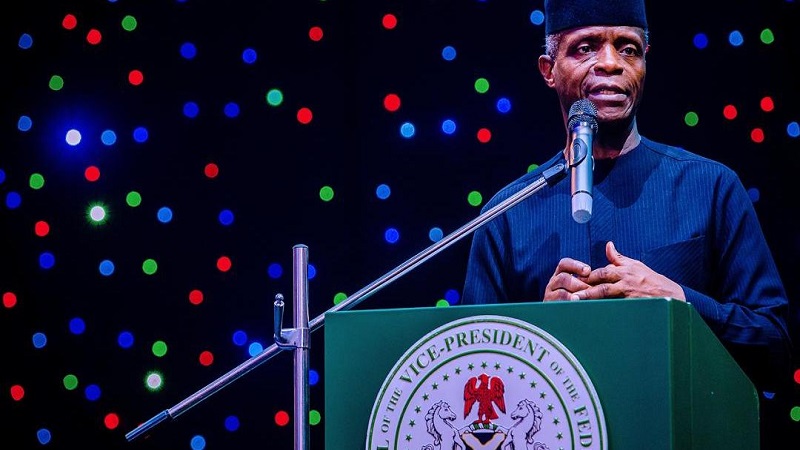
The Vice President said this on Monday during a speech at the Midterm Ministerial Performance Review Retreat which was held at the Banquet Hall, Presidential Villa, Abuja. He noted that Nigeria’s official exchange rate is “artificially low”, asking the CBN to rethink its strategy in tackling the forex crisis.

“As for the exchange rate, I think we need to move our rates to be more reflective of the market as possible. This, in my own respectful view, is the only way to improve supply. We can’t get new dollars into the system when the exchange rate is artificially low. And everyone knows by how much our reserves can grow.

“So I’m convinced that the demand management strategy currently being adopted by the CBN needs a rethink. All those are issues, I’m sure, that when the CBN Governor has time to address, he will be able to address in full,” he said.

There is no way you would expect me to invest at N410/$ and cash out at N570/$. Oh yes, you are talking of devaluation which means Naira has to be devalued to say N480/$ – a number I think is a possibility by next quarter. And that will happen and another cycle will come, and come, but that will not fix anything until Nigeria begins to ramp up production.

So that takes me to the national budget which was pegged at N410/$. Privately, I noted to some friends that our national budget is already off by more than 30% in absolute purchasing/expendable value because the exchange rate is not realistic.

Yet, it is not easy as the apex bank looks at many things to make these calls. It has cogent reasons for its strategy. But get it from me: there is nothing CBN, President Buhari, Vice President Osinbajo, etc will propose that will work if Nigeria does not begin to make things. We need to stimulate production for both factories of the old and the modern ones. That is the only way the Naira will rise. If not, the paralysis will continue for Naira because the strength of Naira comes from warehouses and factories, and not from CBN headquarters.

Update – The Office of the Vice President has clarified his statement

The Office of the Vice President put this statement, according to the News Agency of Nigeria:

“Our attention has been drawn to statements and reports in the media mis characterising as a call for devaluation, the view of the vice president that the Naira exchange rate was being kept artificially low.

“Osinbajo is not calling for the devaluation of the Naira; he has at all times argued against a willy-nilly devaluation of the Naira.

“For context, the vice president’s point was that currently the Naira exchange rate benefits only those who are able to obtain the dollar at N410, some of whom simply turn round and sell to the parallel market at N570.

“It is stopping this huge arbitrage of over N160 per dollar that the vice president was talking about; such a massive difference discourages doing proper business, when selling the dollar can bring in 40 per cent profit,” he said.

“It is a well-known fact that foreign investors and exporters have been complaining that they could not bring foreign exchange in at N410 and then have to purchase foreign exchange in the parallel market at N570 to meet their various needs on account of unavailability of foreign exchange.

“Only a more market reflective exchange rate would ameliorate this; with an increase in the supply of dollars, the rates will drop and the value of the Naira will improve.

“The real issue confronting the economy on this matter is how to improve the supply of foreign exchange, but this will not happen if we do not allow mechanisms like the importers and exporters window to work.

“If we allow this market mechanism to work as intended, we will find that the Naira will appreciate against the dollar as we restore confidence in the system,’’ he said.

(NAN)
Allow Forex Rates to Reflect Market Realities – Vice President Osinbajo Tells Central Bank of Nigeria


Allow Forex Rates to Reflect Market Realities – Vice President Osinbajo Tells Central Bank of Nigeria

0

Following the accelerating free-fall of the naira that has compounded Nigeria’s forex crisis, Nigeria’s Vice President Yemi Osinbajo has asked the Central Bank of Nigeria (CBN) to allow market forces to determine forex rate.

The Vice President said this on Monday during a speech at the Midterm Ministerial Performance Review Retreat which was held at the Banquet Hall, Presidential Villa, Abuja. He noted that Nigeria’s official exchange rate is “artificially low”, asking the CBN to rethink its strategy in tackling the forex crisis.

“As for the exchange rate, I think we need to move our rates to be more reflective of the market as possible. This, in my own respectful view, is the only way to improve supply. We can’t get new dollars into the system when the exchange rate is artificially low. And everyone knows by how much our reserves can grow.

“So I’m convinced that the demand management strategy currently being adopted by the CBN needs a rethink. All those are issues, I’m sure, that when the CBN Governor has time to address, he will be able to address in full,” he said.

Last month, the CBN accused an online forex rate aggregator, AbokiFX, of manipulating parallel market prices to the detriment of the naira. The apex bank had vowed to go after the media outlet, forcing it to shut down the forex rates publishing aspect of its business.

However, the development has changed nothing in the Nigeria’s forex market. Currently, the exchange rate remains $1/N570 and above in the parallel market, though the central bank’s rate remains N410.

Experts have pointed at insufficient dollar liquidity as part of the reasons the naira is depreciating. Data from the CBN shows $116 billion to be the total dollar inflow to Nigeria’s economy in 2020, which compared to 2019’s $142 billion and 2014’s $160 billion, has 20% and 30% drop in dollar inflow to the economy respectively. The drop in oil prices, which is Nigeria’s dominant source of revenue, is largely responsible for dollar scarcity in Nigeria. There is also the massive drop in diaspora remittances as people switch to cryptocurrency for cross-border transactions.

However, like Osinbajo, experts have advocated that the CBN allow market realities to determine naira’s fate. Last month, former CBN deputy governor Kingsley Moghalu, said the financial regulator should stop subsidizing the naira.

“As I have said before, and say again, we have two options. One is to let the Naira find its level in the market. In order, words, the central bank should stop subsidizing the currency. While there will likely be an immediate spike in the price of the dollar, this move will have two advantages. The first is that, because Nigeria has a big, profitable economy and market, dollars will likely swamp the market seeking profits for investors. When this happens, the laws of demand and supply will work in favor of the Naira. Alongside this, maintaining different exchange rates for different kinds of transactions must end. This is called rate convergence,” Moghalu said.

With many voices calling on the central bank to change its forex regulatory approach, as every measure it has taken so far has failed to yield the needed result, all eyes are on the governor, Godwin Emefiele, to make a shift from the status quo. However, there is a strong belief that removing the naira’s subsidy will amount to further depreciation reflecting Nigeria’s current economic situation.

UAV Application in Agriculture

0

Just going through one of the finest courses I have ever watched on UAV (unmanned aerial vehicle) application for agriculture. Thank you Nnadozie Onyeukwu,  Victoria Madedor and African Farmers team for preparing that for Tekedia Institute Practice of Agriculture 

Is Your Name in Nigeria’s Pandora Papers?

0

In an Igbo axiom, Diochi, the palm wine tapper, said that only a fool tells everything he sees while on top of the palm tree. I went through the list of Nigerians in the Pandora Papers and it seems that we may need to wait longer for the real deal. These papers are leaked financial documents of companies and people warehoused in tax havens like Jersey. Nigerians are well represented. Hope, Diochi will change his mind – and reveal all!

As you would expect, no teacher like me was represented. Check to be sure the tax man is not coming; the Federal Inland Revenue Service (FIRS) has promised to call those as necessary.

Pandora Papers. Pandora Box… do not send your money to Jersey, Cayman Islands, etc. You are free to call Dangote on what to do with it in Nigeria. I can also help you; we have many startups looking for $50,000 in Tekedia Capital.

If you made it in Nigeria, be kind to keep it working in Nigeria.

Elon Musk Hits $200 Billion Net Worth, Becomes World’s Richest Again

0

The wind of fortune blew Tesla’s stock to shoot CEO Elon Musk up to the top of the billionaires’ leaderboard once again on Monday. Tesla’s stock surged to Musk’s worth at $200 billion, making him the third person ever to hit that record, Forbes reports.

Since June, Tesla has been on a high profit ride that has seen its shares closing up 2.2% at $791.36, the highest they’ve been since February this year. Following the electric vehicle’s rally, Musk added $3.8 billion to his fortune on Monday, putting his worth at $203.4 billion at the close of markets.

Musk’s new milestone comes after his billionaire and space shuttle rival, Jeff Bezos suffered a $1 billion loss due to a 0.6% stock decline in his e-commerce company Amazon. Now Bezos has fallen behind Musk in the billionaires’ index.

Musk is now the third person to reach the $200 billion threshold. Bezos hit the mark in August last year, while the third person on the list, luxury magnate Bernard Arnault, briefly hit the record in September.

Forbes report explained how Musk attained the billionaires’ elite status now, and why not in the past when Tesla’s stock was above $700.

Musk is richer now than he was at Tesla’s peak in January—when he briefly became the world’s richest tycoon for the first time—because he’s received additional stock option grants that have increased his stake in Tesla; he has about 73.5 million Tesla options worth about $53 billion. Musk owns more than one-fifth of Tesla; Forbes discounts a portion of this stake to account for shares he has pledged as collateral for loans.

Musk’s fortune is heavily tied to his ownership of Tesla, which ended the day Monday with a market cap of more than $792 billion, and SpaceX, which was valued at $74 billion after a funding round in February. After promising last year that he would ditch almost all his personal possessions, including six mansions, he now owns one house and counts his primary residence to be a 400-square foot rental unit.

Shares in Tesla rocketed up more than 720% in 2020, helping to increase Musk’s net worth by more than $125 billion in a year. After trading places with Bezos as the world’s richest person for several days in January, Tesla stock began to decline. By April, Musk was surpassed by Arnault as well.

The unusually frequent shuffling atop the billionaire leaderboard continued last month, when Musk became second richest again, trailing only Bezos.

Musk’s wealth is expected to increase soon following the launch of Tesla’s gigafactory in Berlin. Musk said the company will begin production of its Model Y cars before the year ends. The factory is expected to produce between 5,000 and 10,000 vehicles weekly by the end of 2022.

“We’re aiming to start production in a few months, basically, November or December, and hopefully deliver our first cars in December,” said Musk at the launch of the gigafactory.

Tesla said the Berlin factory will aim to produce up to 500,000 cars a year and have 12,000 employees at the plant.