The Microsoft MVP (Microsoft Most Valuable Professional) and the godzilla of enterprise productivity, Olanrewaju Oyinbooke, CDMP, MVP, mMBA , will be at Tekedia Live in the next few minutes.
Tue, Oct 5| 7pm-8pm WAT | Workplace Productivity, Collaboration, and Automation – Olanrewaju Oyinbooke, Head of Data Management Office, AXA Mansard. Zoom link in the Board.
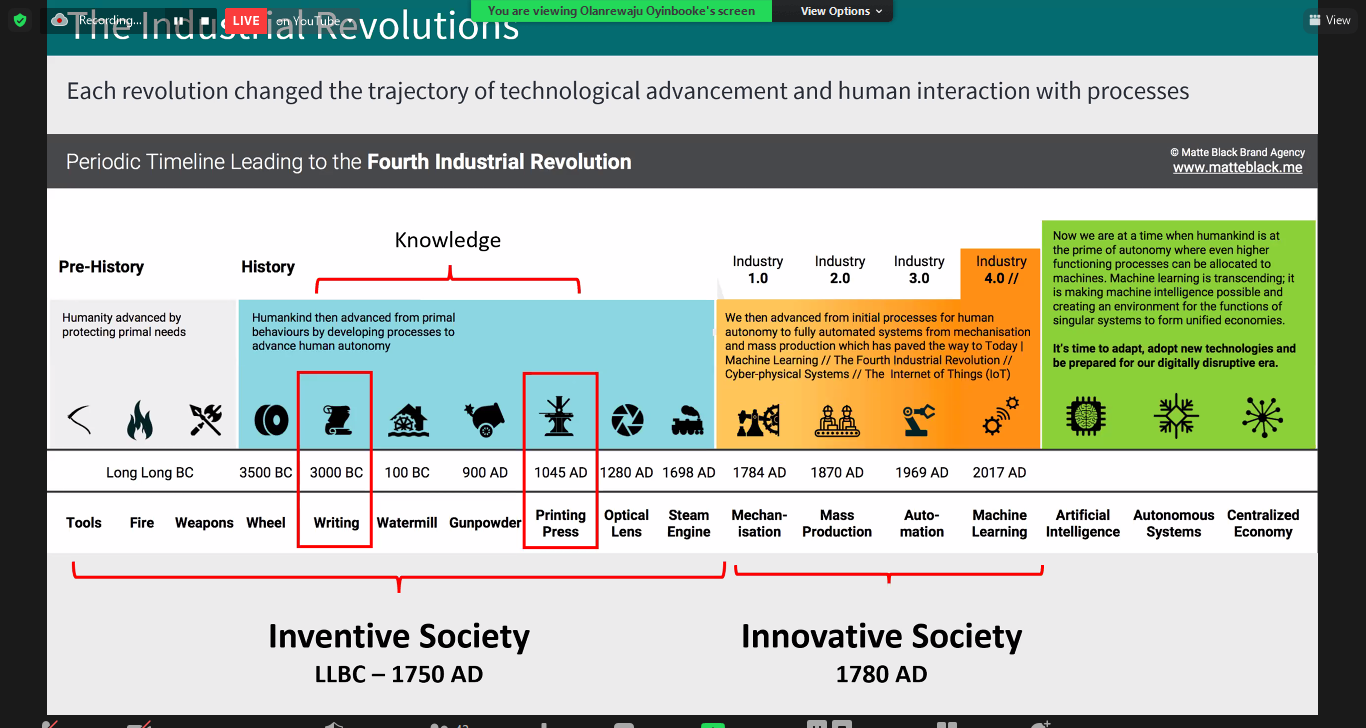
Our Tekedia Institute Faculty Olanrewaju Oyinbooke, CDMP, MVP, mMBA just shared the most fascinating plot on the evolution of technology. He inserted my well-received Harvard Business Review plot where I classified societies before 1750 AD as Invention Societies and the one from then … as Innovation Societies. And amazingly, he postulated another one which he titled Accumulated Capability.
Facebook and its subsidiary apps – Instagram, WhatsApp and Messenger are gradually returning back online after a six hour outage that kept billions of users out of services.
The social media behemoth went offline on Monday in what happens to be its worst outage since 2008, stirring up theories about what might have happened.
The popular opinion on the outage has been a problem with DNS (domain name system), which converts human-readable web addresses into machine-readable IP addresses to find where a web page is located on the internet. John Cumming, CTO at Cloudflare, a networking firm said it could be BGP (border gateway protocol), the system that networks use to figure out the fastest way to send data over the internet to another network.
Facebook did not immediately offer an explanation to what happened, but apologized to users in a statement, saying the company is working to restore services.
“To the huge community of people and businesses around the world who depend on us, we’re sorry,” the social media platform said.
Following the outage, which has been exacerbated by the social media giant’s antitrust concerns, Facebook shares dropped 5%, wiping $6 billion off its value.
However, putting the theories to rest, Facebook offered explanation shortly after services were restored, while admitting that the underlying cause of the outage impacted many of the internal tools and systems used in day-to-day operations.
“Our engineering teams have learned that configuration changes on the backbone routers that coordinate network traffic between our data centers caused issues that interrupted this communication.
“This disruption to network traffic had a cascading effect on the way our data centers communicate, bringing our services to a halt,” Facebook said in a statement.
Consequently, the development, which coincided with the notorious Facebook data leak, has fuelled calls for social media companies to be held to account over what they allow users to post on their platforms. The outage occurred around the same time a whistleblower released tens of thousands of pages of internal research documents, indicating that Facebook knows its platforms are used to spread hate, violence and misinformation, and that the company has tried to hide that evidence.
Two members of the European parliament have called for an investigation into the allegations that Facebook prioritized profits above the public good.
Alexandra Geese, a German lawmaker at the European parliament and Danish lawmaker Christel Schaldemose, the lead rapporteur for the European Commission’s Digital Services Act, are calling for further investigation.
“The Facebook Files – and the revelations that the whistleblower has presented to us – underscores just how important it is that we do not let the large tech companies regulate themselves,” said Christel Schaldemose.
The whistleblower, Frances Haugen, who happened to be a former Facebook product manager, is due to testify before a Senate hearing today. She is pushing for regulation to contain the excesses of Facebook, a line the European lawmakers have jumped on.
“The documents finally put all the facts on the table to allow us to adopt a stronger Digital Services Act,” Alexandra Geese said.
“We need to regulate the whole system and the business model that favors disinformation and violence over factual content – and enables its rapid dissemination,” she added.
The European Union has been pushing for a tighter regulation of the big tech, as a way of protecting users from harm. Facebook, Google, Apple, Amazon and Microsoft have all been caught in the web of European regulators, who have been amending their regulatory laws to address emerging concerns.
The data leak and service outage are putting Facebook up for further scrutiny. The outcome of the Senate hearing today will play a big role in what other governments around do about to address the concerns emanating from the data leak.
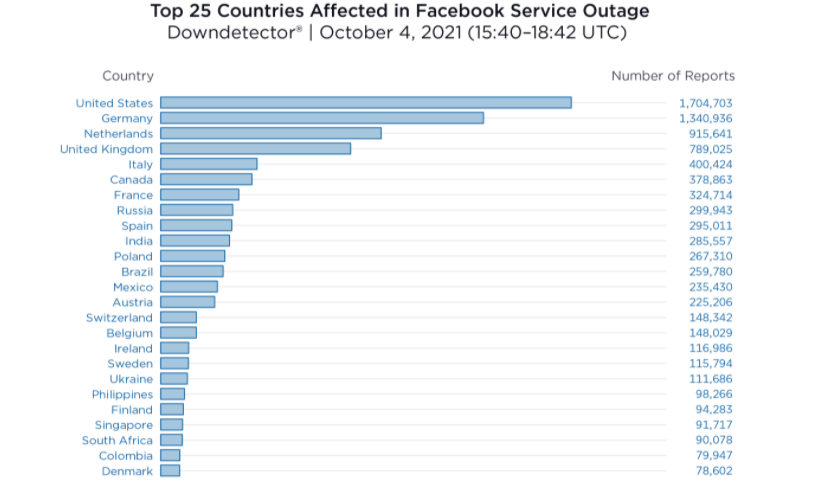
On October 4, 2021, Facebook, WhatsApp and Instagram experienced downtime, leading to total disruption of business and interpersonal communications across the world. Report has it that the sites were down at exactly 11:30am. Downdetector, an organisation which tracks downtime of new technologies, describes the Facebook outage as the largest ever seen its platform with over 14 million problem reports submitted across the world.
Our examination of the public interest and fear about the site and others shows that the world interest in knowing the downtime and its impacts throughout the world was at a slow pace between 08:04pm and 16:28pm before picking some seconds and minutes after. The trend continued till 23:48 before declining 07:56 on October 5, 2021, the time which shows the possible return of the sites after several hours of working on bringing them to the previous functional position.
Our analyst reports that the late interest in seeking information about the downtime of all the social networking sites could be linked with the fact that majority of the users were aware of the downtime late. According to our analyst, the downtime period, which is in the morning and fell within the working time belts for most people could also be considered as a significant factor in seeking information about the outage of the sites.
Exhibit 1: Countries with the Number of Reports during the Downtime
Source: Downdetector, 2021
During the jittery period, it is obvious that the world wanted to know the downtime of Facebook in relation to WhatsApp, Facebook downtime in connection with understanding Instagram and WhatsApp in line with Instagram. Ninety-eight percent of the world interest in WhatsApp could be discerned from the interest in Instagram. This is closely followed by Facebook, which accounted for 97.3% in Instagram. More than 93% of the interest in Facebook could be determined from the interest in WhatsApp.
In Nigeria, interest in these sites was high to the extent that it was the top search of the day. This is really surprising to our analyst, who have been tracking what Nigerians and other nationals in the country are searching daily since January 2021. Any of the most used social networking sites has never made it to the top five of the most areas of interests being considered in the data collection procedure.
Having Interest in Why Facebook Downtime Doesn’t Mean Submitting Reports
In terms of number of users of Facebook, WhatsApp and Instagram, there are mixed statistics on the countries with the highest number of people deploying the sites for personal and business purposes. According to a July 2021 report, India is the leading country in terms of Facebook use based on its over 340 million people using the site. The United States, Indonesia and Brazil have over 200 million, 140 million and 130 million users respectively, making them followers of India. For Instagram, India still occupies the leading position while the United States follows, Brazil and Indonesia.
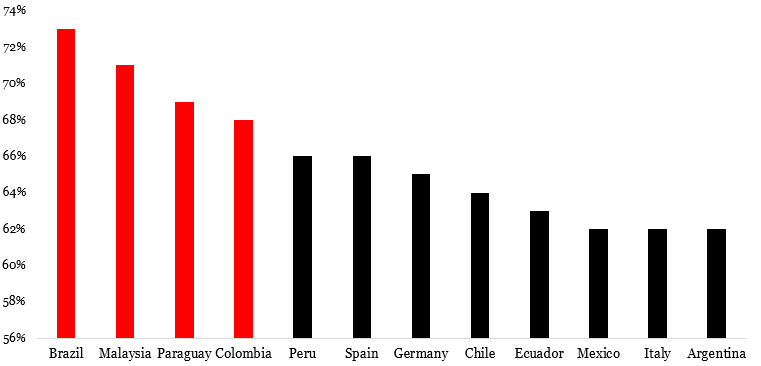
Existing statistics on the number of users of WhatsApp looks complex. This is hinged on the fact that producers of the statistics adopted a share of total internet users against the number of the site users and also considered the site market share alone. For instance, based on July 2021 statistics, Kenya, South Africa, Nigeria, Argentina, Malaysia, Colombia, Brazil, Turkey, Spain and Indonesia are the top countries with the number of WhatsApp users based on the share of total internet users. Surprisingly, people in Brazil, Malaysia and Colombia only developed significant interest in understanding WhatsApp downtime.
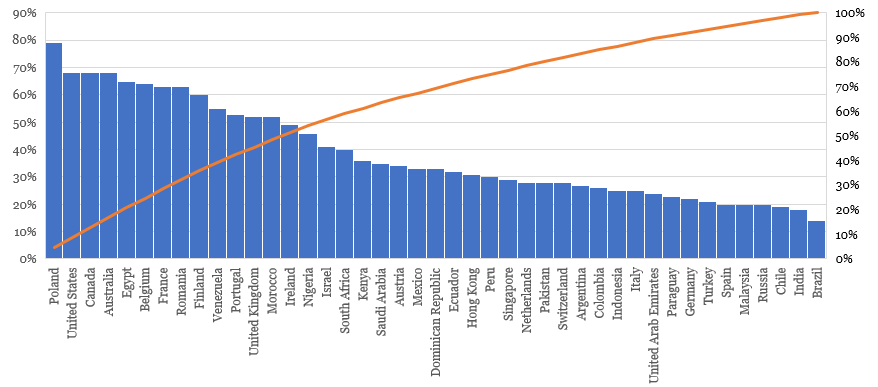
Exhibit 2: Countries with Highest Percentage of Interest in Facebook during the Downtime
Source: Google Trends, 2021; Infoprations Analysis, 2021
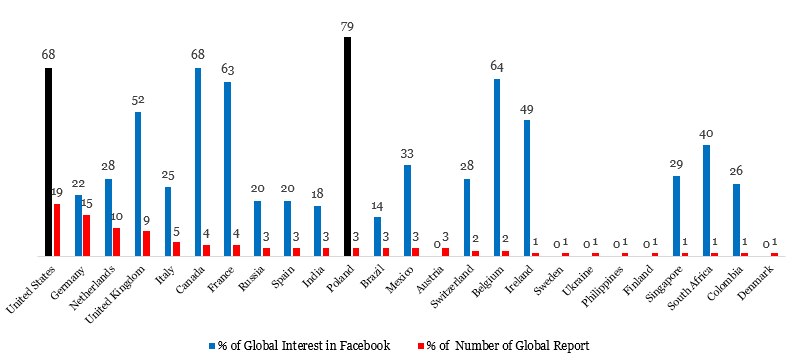
Top 25 affected countries [see Exhibit 1] submitted a total of 8,896,273 problem reports. Analysis shows that the interest of people in these countries in Facebook downtime connected with the number of reports submitted by 33.7%. This suggests that when people in the United States of America and others [see Exhibit 3] developed 1% interest in understanding the downtime of the social networking site, the percentage translates to 33.7% of submitting problem reports to Downdetector.
However, our analysis only establishes 11.4% of actual submission of problem reports to Downdetector. With this, our analyst notes that people in the top 25 affected countries, where problem reports were submitted, might have explored other means of understanding the site downtime not only the Google Search Engine, which normalised the world interest in the site during the downtime.
Exhibit 3: Countries with Interest in Facebook during downtime and number of problem reports submitted [in percentage]
Source: Downdetector, 2021; Google Trends, 2021; Infoprations Analysis, 2021
Exhibit 4: Countries with Highest Percentage of Interest in WhatsApp during the Downtime Period
Source: Google Trends, 2021; Infoprations Analysis, 2021
Is the World Moving Towards Possible Global Technology Lockdown?
This month downtime is not the first time the social networking sites are not functioning as expected. There are several reports that establish micro hitches while using the sites. To our analyst, the recent lockdown occasioned by the spread of Covid-19 further indicates that the world cannot survive without technologies. The first wave of the virus forced a number of people to use new technologies and technology-driven devices they hardly use before the pandemic. Indeed, the ongoing pandemic is changing how people and businesses use technologies.
While the emerging issues and needs are pointing towards the need to consider and prioritise certain technologies for personal and business use, the big question remains their present use without jeopardising the chance of using them in the future. In every concept, sustainability remains the key element of the concept to the survival of the system where it is being applied. This is also applicable to every object being considered or used for personal, business and societal growth.
No doubt, the world without technologies would be difficult for people and businesses to be. This is the main reason the world needs tech-companies that can create and deliver sustainable value. This is not sufficient. They also need to ensure protection of every user’s data because our checks reveal that some people believe that the downtime is an artificial one with the intent of stealing users’ data.
(Please talk to others in your company/group as we need one session per group or company.)
Tekedia Institute is scheduling Tekedia Growth Hour where we have conversations with group or corporate participants at Tekedia Mini-MBA edition 6. This meeting is essentially to discuss at more specific levels the mechanics of business systems as they relate with business innovation and growth, in your company and sector. We do batch this throughout the program and we have opened a link for your batch.
Go to this link [check your email] and select a time slot for your company – one slot only as we will meet all the members at once.
Once you do that, on the day and time, each member should visit this Zoom link [check your email] (If you have other alternatives like Microsoft Teams, please send and we will use it).
Please note that besides your members currently attending Tekedia Mini-MBA, you are free to bring other staff, associates, clients and partners of the company to this meeting.
Our Lead Faculty, Prof Ndubuisi Ekekwe, personally coordinates this. His vision is that through these specific conversations, we can point out areas of growth and opportunities in the business, using some frameworks discussed in our school.
From Nkechi Oguchi: “The Pursuit of Growth: I recently started taking a course on the growth playbook by Ndubuisi Ekekwe at Tekedia Institute. I would share snippets of things I find interesting in class during the course of the program. You may find it useful.
One thing that has kept resonating with me is that you cannot scale a faulty business model. Even if you managed to raise millions of dollars and open in more locations, all you would have done is to take a problem and made it exponential. This is why businesses go through a validation phase. During validation you test your assumptions and ascertain the viability of your business model. It should be seen as an experiment. Everything does not need to be perfect, but the pieces should be coming together, this would be evident by traction.”