DD
MM
YYYY

PAGES

DD
MM
YYYY

spot_img

PAGES

Home Blog Page 5563

China Tech Begins African Voyage, Escaping Clampdown at Home

1

In this piece, I postulated that Chinese technology companies which are under severe attacks at home would begin to explore Africa for growth. With the American market extremely hard to break into, and India a no-go area (yes, the government banned some of the apps), Africa is the remaining core natural destination.

Just as predicted, it is happening. Didi, the Uber-for-China, is launching in Nigeria. Expect it to give heat to Uber, Bolt and the local players in this sector. Didi will not be alone. Pinduoduo, Alibaba and others which are listed in New York are coming.

People, if you have a really huge customer base in Africa, expect big knocks at the door; China tech will like to come in to ensure that New York is not rattled as it loses steam in the home nation.

But note one thing: these paralyses would not be the end. Yes, these companies would work hard to find ways to grow so that they can keep trading in foreign stock markets where they currently trade. Alibaba has been wounded in China due to the clampdown, and the US investors are certainly not happy.  So Alibaba needs to find ways to mitigate this domino. Simply, I expect it to look for more markets and territories to enter.

Africa seems to be a good destination. Do not be surprised if Alibaba decides to acquire Jumia in the next coming months to pacify investors in the US that it is looking beyond China for its future. I also see opportunities for leading promising startups in the continent. Chinese firms will need to pick many pieces from many countries, and then combine them for a continental impact.

But Africa, do not sell cheap and remember this –  the largest financial institution in Nigeria by market cap is now OPay which was last valued at $2 billion after Softbank invested $400 million, meaning that China tech is a master of blitzscaling. People, it’s time to upgrade the gameplan or another chance may not come.

Central Bank of Nigeria to Allow Banks Exceed FX Limits As Demand Surges

0

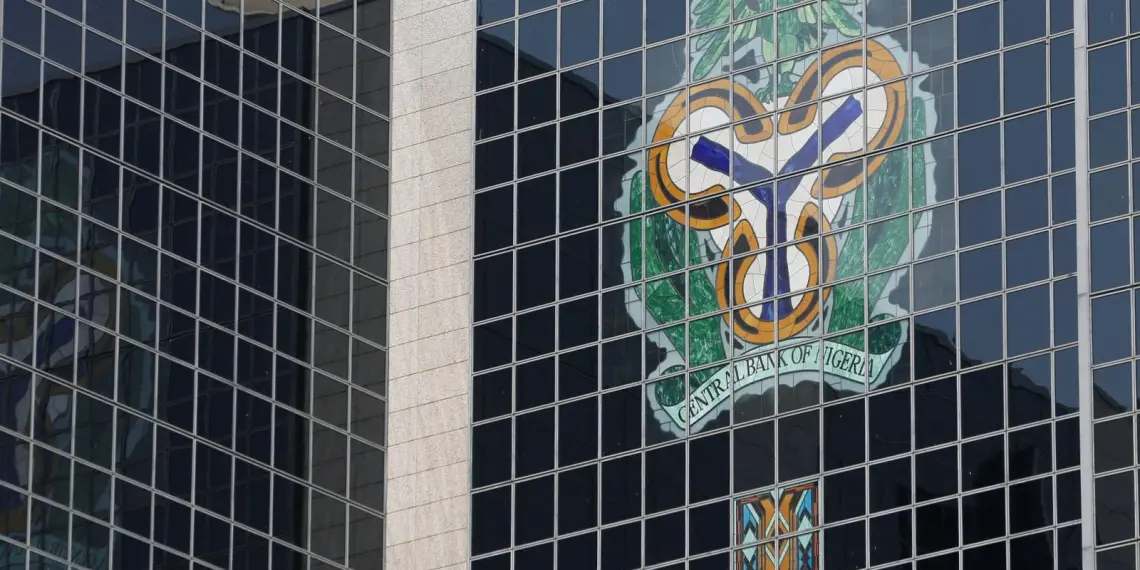
Amidst the criticism following Nigeria’s FX crisis and the decision of the Central Bank of Nigeria (CBN), to go after online FX rates publisher, AbokiFX, the CBN governor Godwin Emefiele has said the apex bank is ready to compromise on the approved forex transaction limits if applications meet stipulated requirements.

The current FX policy limits transactions to $5,000, which highly falls short of consumers need and has been fuelling consumers’ patronage of the parallel market.

Poor liquidity has been largely fingered as the bane of the current FX crisis in Nigeria, which has seen the naira nose-dived from N540/$1 to N570 /$1 and N412.88/$1 on Friday from N412/$1 the previous week in Investors and Exporters (I&E) window.

To curtail the whirlwind, Emefiele said the CBN was ready to approve requests from commercial banks to exceed the limit if it is proven that the extra demand for FX is for legitimate purposes.

“Indeed, I want to put it on record; if the amount you want is even above the limit that is recognized and we find that the reason you are making those demands is legitimate, your bank will speak to us and we will give you more than what is even the limit,” he said.

The financial regulator had placed FX restrictions on many import items, which are part of the transactions categorized as illegitimate. Since they cannot access the Investors and Exporters (I&E) Window, importers who deal on the restricted items have embraced the parallel market.

Emefiele said the I&E Window of the central bank remains the major market which anyone seeking to procure or sell foreign exchange should patronize. He urged customers to approach the banks for their FX transactions.

“The only exchange rate that I recognize today in the Nigerian foreign exchange market which is the dominant market remains the Investors and Exporters (I&E) window.

“I am sorry to say that I do not and I do not intend to recognize that there are any other rates in the market,” he added.

However, experts have blamed CBN’s policies for the naira’s plunge, alleging that the apex bank’s determination to fix market price is responsible for Nigeria’s FX woes.

Former Director-General of the Lagos Chamber of Commerce and Private Sector Advocate, Dr. Muda Yusuf, said the regulator should suspend the pegging of exchange rate so that the market would determine the value of the naira, upholding the admonition given on Friday by former deputy governor of CBN, Kingsley Moghalu.

Yusuf said during an interview with ARISE News Channel, that the CBN’s intervention is not only discouraging suppliers of foreign currency, becoming a disincentive to export spooking Foreign Direct Investment (FDI), it is also stymieing the chances of stabilizing the naira, which lies largely on the demand and supply market principle.

While rebuking the CBN for attempting to scapegoat AbokiFX, who he said has no power to jolt the market, Yusuf said the CBN, instead of treating the ailment, is rather concentrating on the symptoms by trying to control the demand of forex. When the major challenge with Nigeria’s FX is inappropriate pricing of the exchange rate and the gap in the window between the parallel market and the Nigerian Autonomous Foreign Exchange Rate Fixing (NAFEX), which officially pegged the dollar at N420.

“You don’t have to fix a rate in the market which cannot be supported by demand and supply. The gap between the parallel market and NAFEX window is about 30 per cent, which is big. It could be managed if it is about five to 10 per cent. The major demand is on the parallel market because NAFEX window can only meet about 20 per cent of the demand. The high demand is putting pressure outside the official window.

“So it is like subsidy, which cannot work, so we should deal with the fundamentals of the problem. If we don’t deal with the cause of the problem and continue to treat the symptoms, we create greater problem for the economy.

“By fixing the rate, CBN is blocking free supply to the economy because those who are willing to supply to the market will not do so when the rate is pegged. Apart from oil, we have FDI, we have embassies and the Diaspora that can supply foreign currency to the market. What are we doing to encourage them to supply to the market? People are doing business under the table because CBN fixed a rate that is not sustainable. There is premium of 30 per cent between the official and parallel market. This regime is creating the problem. We are doing fractioning.

“If you have a system that functions well, CBN cannot be selling forex because it should be sourcing its own forex. The critical factors of demand and supply, if well managed, will create incentive for people who want to bring in forex. CBN should allow a system that works. You can never win when you are confronting the market. One of the major problems in the market is the insistence that people should sell at a fixed rate. That policy has created a problem of compliance,” he said.

Waiting for AbokiFX Whitepaper On How It Determines The Naira Rates

9

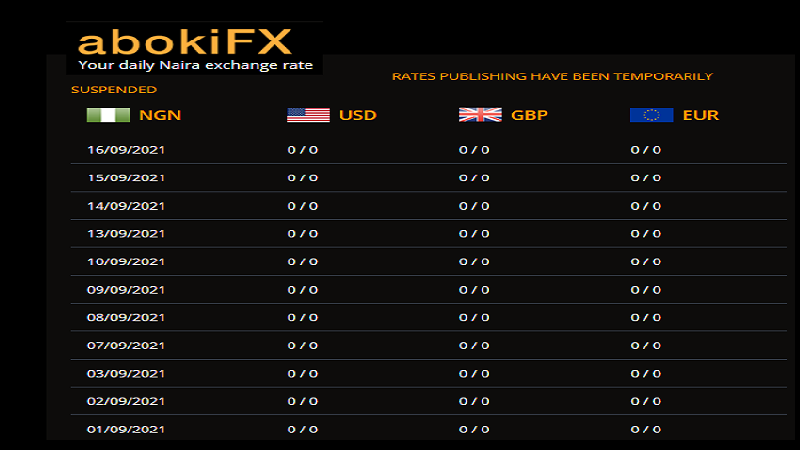
I am very surprised that abokiFX has easily suspended publishing rates. This is what simpletons do. Yes, instead of publishing a white paper to defend its data collection mechanism, it froze. And with this universal suspension, it does appear increasingly that the Central Bank of Nigeria (CBN) was right on the money!

Companies are accused of things all the time. Typically, you open your playbook and explain what you are doing. Coinbase, Rohinhood, etc do not suspend operations because of regulatory accusations or oversights. So, when companies easily chicken-out, the implication is that something bad may be happening.

It would be a serious betrayal to all Nigerians if indeed AbokiFX was pushing those rates without any supporting data. I mean, the FX business is built on data and that data system is expected to be empirical. But here when a company is not even bold to defend its process, you get a sense that it was flaming.

Do not remind me that CBN may be a bully. That does not qualify here. You do not push fake “data” to markets without consequences. I am hoping that CBN is wrong and AbokiFX was improperly maligned. But if otherwise, that would be troubling.

May it not be that they were just playing with numbers without any core basis and in the process dragging a nation down. What abokiFX does is not bad but it has to be data-driven and unbiased. Aggregators are vital in markets provided the data collection process has no fudge factor. I do think by having an easy way to know the parallel rates, transactions can move faster.

With that, I am still asking, without AbokiFX to rely on, what is the current black market rate of Naira? If you struggle with that, you will then appreciate why digital aggregators are super-amazing in redesigning market equilibrium points.


Comment On LinkedIn Feed

Comment #1: Very apt perspective. I couldn’t agree more.

This action taken by AbokiFx suggests they have deliberately acted in bad faith and outrightly broken the law which may be subject to prosecution. However, if this is not the case, the basis for their price discovery should be published for public review.

It is pertinent to underscore the importance of a price agregator in the parallel market and in my view, I disagree that publishing figures based on market price discovery (for a non-bank) is in violation of of the law but what do I know?

My Response: “I disagree that publishing figures based on market price discovery (for a non-bank) ” – the premise of your point is that there was a price discovery to start with. What if they were waking up and fudging numbers, what would you say?

Also, not being a bank is irrelevant. You do not need to be a bank to be operating in the “banking industry”. People went to jail in UK for manipulating libor rates. People are being prosecuted in US for inflating stocks in Reddit. Governments do not see “financial institutions” as only those who wear suits. The game has since changed.

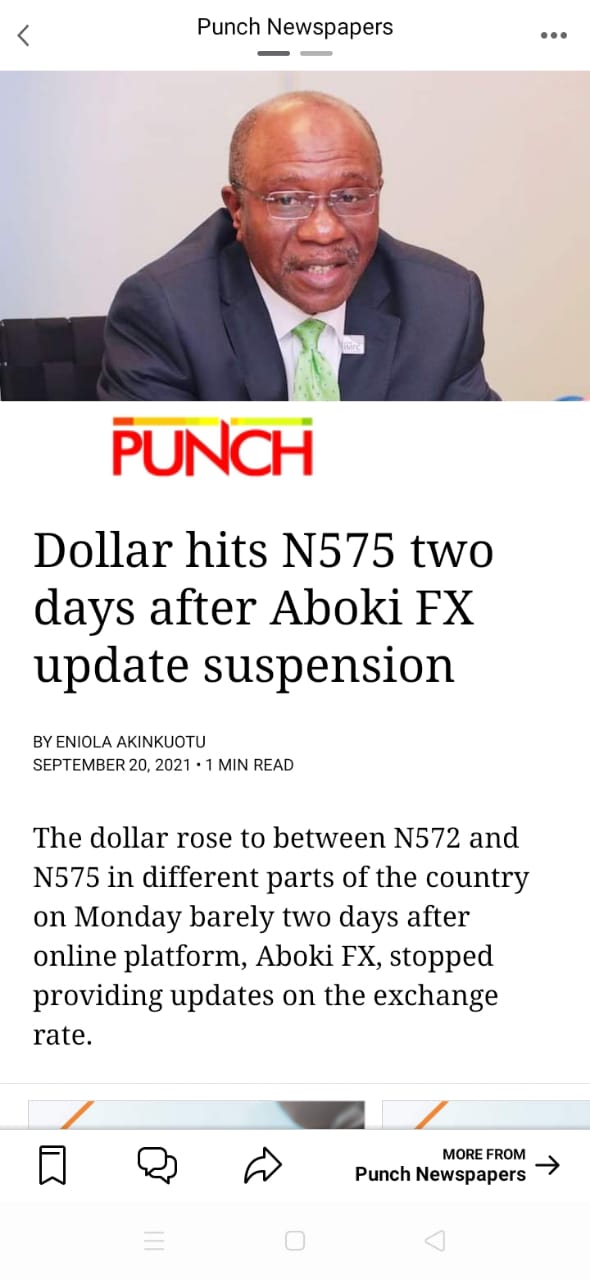
Comment #2: On Friday, the dollar exchanged at 570, today it goes for 575 two days after AbokiFX suspended operations. There is a reason why AbokiFX decided to shut down operations and anybody who knows Nigeria under these guys would know that its best to just shutdown to appease them.

My Response: the issue is not the rate. The issue is the process for the largest parallel market rate supplier in Africa. You called and got N570 possibly in Lagos. But Lagos, Aba, Kano, Owerri, etc have different rates at any time. AbokiFX quotes for Nigeria, not Aba, Lagos or Abuja. How does it come to that number. If it has that data, it does not need to suspend. AbokiFX, CBN, etc will not fix FX crises, only factories and warehouses (modern and old) will do. That is a constant.

As Nigeria Waits for Dangote Refinery on Fuel, CBN Detours To AbokiFX on Naira

How Information Asymmetry or Symmetry Determines Competition, Currency Performance in FOREX Market

0
Nigerian market currency

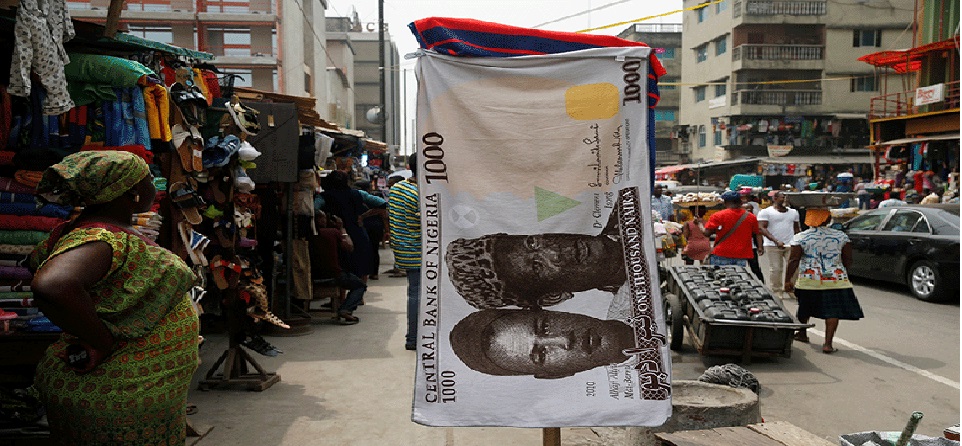
In every market, there are buyers and sellers. Both the buyers and sellers are usually in competitive environments, where the power of negotiation and access to information would greatly impact what they capture as values. Globally, foreign exchange market has buyers and sellers, and regulators such as the Central Banks and other agencies saddled with the responsibility of ensuring sustainable performance of the national currencies against the global ones.

Access to adequate information helps the participants in making informed decisions during trading times. Apart from the fact that apex banks are expected to be the main key information disseminators about the exchange rate, news media and information portals with the focus of providing daily foreign exchange information are also others expected to feed the public. However, it is logical that news media and others source their information from the apex banks, being the main regulators.

This seems not to be the ideal as the recent events, especially in the developing worlds, indicate gathering and dissemination of market information from parallel markets. Since forex is mostly influenced by the forces of supply and demand, it is expected that information that certain participants have and others do not have would help them in gaining competitive advantage within the context of buying and selling of currencies. Whereas, having the same information would benefit all the market participants.

Having information that others do not have has been described as information asymmetry, while having the same information others possess mean information symmetry. In both situations, as stressed earlier, there are positive and negative gains to all the participants.

Recently, through the Central Bank, the Nigerian government noted that Aboki FX, a platform that provides foreign exchange information, is causing Naira dwindling every day. This has been previously analysed by our analyst. Meanwhile, if the second allegation of the bank against the platform, that the founder engages in the forex business is true, it means he is taking advantage of his access to some other aspects of the data the platform gathers and disseminates daily.

There are a number of researches that establish the consequences of information asymmetry in the foreign exchange market. For example, asymmetric information is pervasive across currency pairs, blockchain transaction activity is a relevant aspect of Bitcoins microstructure, as informed traders make use of the information in general and adjust their expectations based on the degree of information asymmetry and the asymmetric impact of exchange rate changes on the demand for Korean Won.

The underlying transparency of the Bitcoin blockchain allows transactions in the network to be tracked in near real-time. When someone transfers a large number of Bitcoins, the market receives this information and traders can adjust their expectations based on the new information. This paper investigates trading volume and its relation to asymmetric information around transfers on the Bitcoin blockchain. We collect data on 2132 large transactions on the Bitcoin blockchain between September 2018 and November 2019, where 500 or more Bitcoins were transferred. Using event study methodology, we identify significant positive abnormal trading volume for the 15-minute window before a large Bitcoin transaction as well as during and after the event. Using public information about Bitcoin addresses of cryptocurrency exchanges as proxies for information asymmetry, we find that transactions with high levels of information asymmetry negatively affect abnormal trading volume once the event becomes public knowledge, while some effects are even opposite for transactions with lower information asymmetry. The results show that blockchain transaction activity is a relevant aspect of Bitcoinns microstructure, as informed traders make use of the information in general and adjust their expectations based on the degree of information asymmetry.

Editor’s Note: In a subsequent piece, relevant insights that emerged from robust data analysed and established impacts of the two information categories will be published.


A Powerful Testimonial On Tekedia Mini-MBA: “Very impactful lecture…blessed to be your student”

0

This is just the first week of class and the impacts are already evident.

Exactly what Ndubuisi Ekekwe did last Saturday.

Very impactful lecture from identifying every business evolves from frictions, to developing and maximizing capacities, the higher your capacities the more your making an innovations from your ideas and invention. Am highly inspired with the real life case studies , from Mama Nkechi restaurants experiences in Owerri to discussing facts of the blue chips (Dangote, IBM, Toyota, Tesla etc) am indeed blessed to be your student in Tekedia Institute Faculty, I now process businesses and ideas differently.
Innovations of Firm is fundamental and a godd foundation for the Mini-MBA Programme

Thank you once again Tekedia Institute

Source: LinkedIn