DD
MM
YYYY

PAGES

DD
MM
YYYY

spot_img

PAGES

Home Blog Page 5567

China Must Deliver Bailout Vaccine to Evergrande’s Financial Pandemic

1
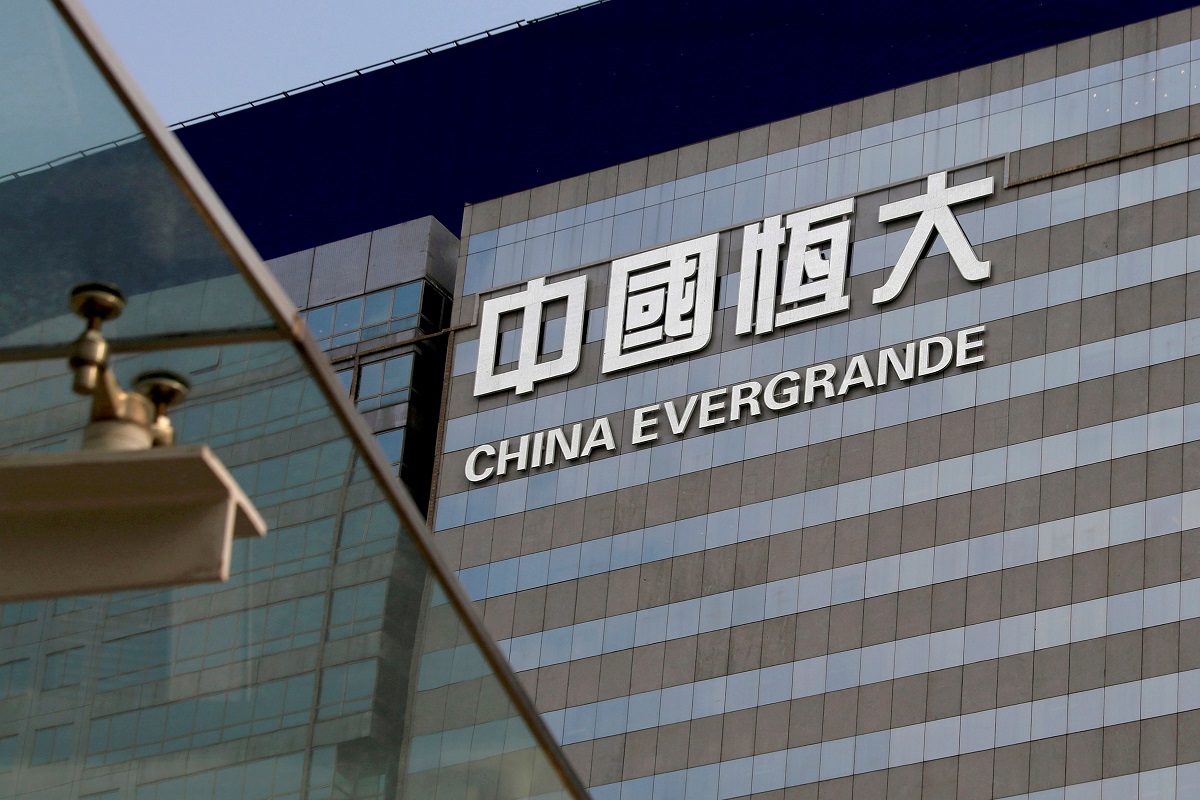
FILE PHOTO: An exterior view of China Evergrande Centre in Hong Kong, China March 26, 2018. REUTERS/Bobby Yip/File Photo/File Photo/File Photo

There are growing fears that China’s Evergrande, a real estate giant, will default on its massive loan: excess of $305 billion. If that happens, expect a financial pandemic which can rattle markets. Today, most leading stock markets gave up huge numbers as investors look for safer assets. But this is just the beginning, especially if China decides not to administer the right vaccine of financial bailout.

  • Chinese officials are expected to stem the spillover from liquidity issues at Evergrande, the country’s largest property developer, before it slams the banking system and bleeds into foreign financial centers.
  • But strategists also say Beijing needs to act quickly to restructure Evergrande, because markets are becoming nervous and it is hurting sentiment.
  • The problems at the property developer could damage China’s economy and from there also dent the world economy.

Shares in Evergrande, which has been scrambling to raise funds to pay its many lenders, suppliers and investors, closed down 10.2% at HK$2.28 on Monday, after earlier plummeting 19% to its weakest level since May 2010.

Regulators have warned that its $305 billion of liabilities could spark broader risks to China’s financial system if its debts are not stabilised. […] A major test comes this week, with Evergrande due to pay $83.5 million in interest relating to its March 2022 bond on Thursday. It has another $47.5 million payment due on Sept. 29 for March 2024 notes.

I call on the Chinese government to quickly deliver the right dose of financial vaccine bailout and arrest this evolving financial pandemic which Evergrande is possibly going to spread. Speed is key!

Twitter Agrees $809.5 Million Settlement for Class Action Lawsuit

0

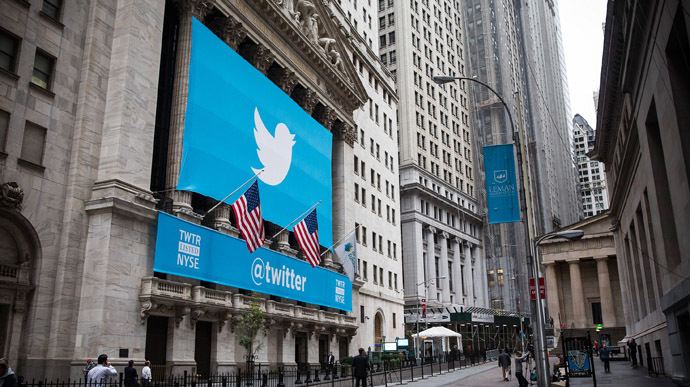
Twitter Inc said Monday it will pay $809.5 million to settle a 2016 shareholder class action lawsuit in which the social media company is accused of defrauding investors.

The lawsuit was based on an allegation of metric manipulation of the microblogging app’s traffic.

The case has been amicably resolved by the agreement and the litigation will no longer proceed. Jury selection was due to begin on Monday, but at a September 17 hearing, US District Judge John Teagar in Oakland, California, postponed it until the end of November.

Twitter, former CEO Richard Costolo and former CFO Anthony Noto have denied misconduct in agreeing to a settlement that requires Tigar’s approval.

“The jury is a great equalizer for even some of the most powerful organizations on the planet,” said Thor Gronborg, partner at Robbins Geller Rudman & Dowd, representing shareholders.

Twitter shares fell 3.8% to $ 60.11 in the afternoon. Twitter said it expects to use the cash to pay the settlement amount in the fourth quarter of this year and fix the related expenses in the third quarter.

In September 2016, shareholders filed a lawsuit against Twitter, claiming that it artificially inflated the stock price, misleading them about user interactions.

According to the complaint, Twitter stopped reporting “timeline views” at the end of 2014 and covered up stagnation or decline in user activity by reporting vague descriptions of user metrics.

Shareholders said Twitter acknowledged the truth after Costolo left the company in June 2015 and his share price fell 20%.

The class action lawsuit applies to investors who acquired shares from February 6, 2015 to July 28, 2015.

Since 1996, only nine of the more than 5,000 US securities lawsuits filed by equity investors have gone through a trial pending verdict, the Securities Intelligence Service said.

Slightly more than half of the claims were rejected, and most of the rest were satisfied. The final settlement agreement between Twitter and the aggrieved shareholders will be subject to approval by the Court.

Facebook faced a similar class action suit in 2018, brought against it by DZ Reserve and other participating plaintiffs. The lawsuit alleged that the social media giant deceived advertisers about the actual metric of its ads reach, overruling an employee’s warning to adjust it in order to avoid revenue hit.

Advertisers depend on the metric to know how many people they reach, which shapes ad buying decisions. But according to employees, the metric available to advertisers contains fake and duplicate accounts, which they said it’s deceptive.

Removing the fake or duplicated accounts would cost Facebook 10% revenue drop. So the company objected to the employee’s suggestion to eliminate the accounts to serve accurate metrics.

Twitter has taken a different route by agreeing for a settlement instead defending itself in court. In 2019, Facebook settled a similar lawsuit after admitting an error in metric calculation had caused it to inflate viewing time for video ads.

China Tech Begins African Voyage, Escaping Clampdown at Home

1

In this piece, I postulated that Chinese technology companies which are under severe attacks at home would begin to explore Africa for growth. With the American market extremely hard to break into, and India a no-go area (yes, the government banned some of the apps), Africa is the remaining core natural destination.

Just as predicted, it is happening. Didi, the Uber-for-China, is launching in Nigeria. Expect it to give heat to Uber, Bolt and the local players in this sector. Didi will not be alone. Pinduoduo, Alibaba and others which are listed in New York are coming.

People, if you have a really huge customer base in Africa, expect big knocks at the door; China tech will like to come in to ensure that New York is not rattled as it loses steam in the home nation.

But note one thing: these paralyses would not be the end. Yes, these companies would work hard to find ways to grow so that they can keep trading in foreign stock markets where they currently trade. Alibaba has been wounded in China due to the clampdown, and the US investors are certainly not happy.  So Alibaba needs to find ways to mitigate this domino. Simply, I expect it to look for more markets and territories to enter.

Africa seems to be a good destination. Do not be surprised if Alibaba decides to acquire Jumia in the next coming months to pacify investors in the US that it is looking beyond China for its future. I also see opportunities for leading promising startups in the continent. Chinese firms will need to pick many pieces from many countries, and then combine them for a continental impact.

But Africa, do not sell cheap and remember this –  the largest financial institution in Nigeria by market cap is now OPay which was last valued at $2 billion after Softbank invested $400 million, meaning that China tech is a master of blitzscaling. People, it’s time to upgrade the gameplan or another chance may not come.

Central Bank of Nigeria to Allow Banks Exceed FX Limits As Demand Surges

0

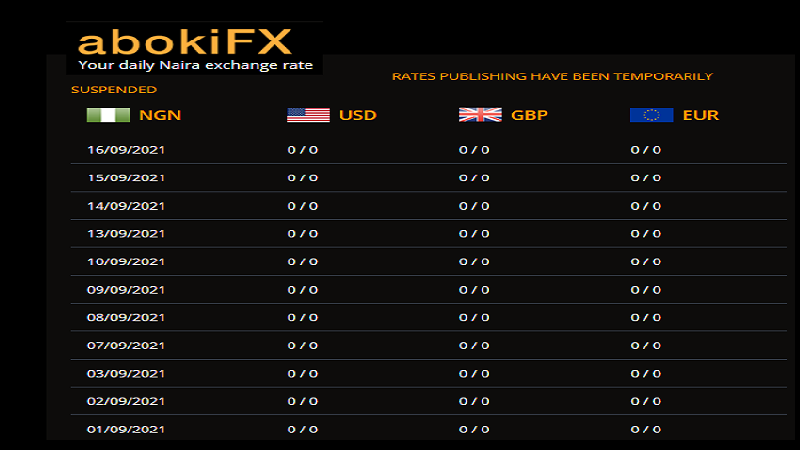
Amidst the criticism following Nigeria’s FX crisis and the decision of the Central Bank of Nigeria (CBN), to go after online FX rates publisher, AbokiFX, the CBN governor Godwin Emefiele has said the apex bank is ready to compromise on the approved forex transaction limits if applications meet stipulated requirements.

The current FX policy limits transactions to $5,000, which highly falls short of consumers need and has been fuelling consumers’ patronage of the parallel market.

Poor liquidity has been largely fingered as the bane of the current FX crisis in Nigeria, which has seen the naira nose-dived from N540/$1 to N570 /$1 and N412.88/$1 on Friday from N412/$1 the previous week in Investors and Exporters (I&E) window.

To curtail the whirlwind, Emefiele said the CBN was ready to approve requests from commercial banks to exceed the limit if it is proven that the extra demand for FX is for legitimate purposes.

“Indeed, I want to put it on record; if the amount you want is even above the limit that is recognized and we find that the reason you are making those demands is legitimate, your bank will speak to us and we will give you more than what is even the limit,” he said.

The financial regulator had placed FX restrictions on many import items, which are part of the transactions categorized as illegitimate. Since they cannot access the Investors and Exporters (I&E) Window, importers who deal on the restricted items have embraced the parallel market.

Emefiele said the I&E Window of the central bank remains the major market which anyone seeking to procure or sell foreign exchange should patronize. He urged customers to approach the banks for their FX transactions.

“The only exchange rate that I recognize today in the Nigerian foreign exchange market which is the dominant market remains the Investors and Exporters (I&E) window.

“I am sorry to say that I do not and I do not intend to recognize that there are any other rates in the market,” he added.

However, experts have blamed CBN’s policies for the naira’s plunge, alleging that the apex bank’s determination to fix market price is responsible for Nigeria’s FX woes.

Former Director-General of the Lagos Chamber of Commerce and Private Sector Advocate, Dr. Muda Yusuf, said the regulator should suspend the pegging of exchange rate so that the market would determine the value of the naira, upholding the admonition given on Friday by former deputy governor of CBN, Kingsley Moghalu.

Yusuf said during an interview with ARISE News Channel, that the CBN’s intervention is not only discouraging suppliers of foreign currency, becoming a disincentive to export spooking Foreign Direct Investment (FDI), it is also stymieing the chances of stabilizing the naira, which lies largely on the demand and supply market principle.

While rebuking the CBN for attempting to scapegoat AbokiFX, who he said has no power to jolt the market, Yusuf said the CBN, instead of treating the ailment, is rather concentrating on the symptoms by trying to control the demand of forex. When the major challenge with Nigeria’s FX is inappropriate pricing of the exchange rate and the gap in the window between the parallel market and the Nigerian Autonomous Foreign Exchange Rate Fixing (NAFEX), which officially pegged the dollar at N420.

“You don’t have to fix a rate in the market which cannot be supported by demand and supply. The gap between the parallel market and NAFEX window is about 30 per cent, which is big. It could be managed if it is about five to 10 per cent. The major demand is on the parallel market because NAFEX window can only meet about 20 per cent of the demand. The high demand is putting pressure outside the official window.

“So it is like subsidy, which cannot work, so we should deal with the fundamentals of the problem. If we don’t deal with the cause of the problem and continue to treat the symptoms, we create greater problem for the economy.

“By fixing the rate, CBN is blocking free supply to the economy because those who are willing to supply to the market will not do so when the rate is pegged. Apart from oil, we have FDI, we have embassies and the Diaspora that can supply foreign currency to the market. What are we doing to encourage them to supply to the market? People are doing business under the table because CBN fixed a rate that is not sustainable. There is premium of 30 per cent between the official and parallel market. This regime is creating the problem. We are doing fractioning.

“If you have a system that functions well, CBN cannot be selling forex because it should be sourcing its own forex. The critical factors of demand and supply, if well managed, will create incentive for people who want to bring in forex. CBN should allow a system that works. You can never win when you are confronting the market. One of the major problems in the market is the insistence that people should sell at a fixed rate. That policy has created a problem of compliance,” he said.

Waiting for AbokiFX Whitepaper On How It Determines The Naira Rates

9

I am very surprised that abokiFX has easily suspended publishing rates. This is what simpletons do. Yes, instead of publishing a white paper to defend its data collection mechanism, it froze. And with this universal suspension, it does appear increasingly that the Central Bank of Nigeria (CBN) was right on the money!

Companies are accused of things all the time. Typically, you open your playbook and explain what you are doing. Coinbase, Rohinhood, etc do not suspend operations because of regulatory accusations or oversights. So, when companies easily chicken-out, the implication is that something bad may be happening.

It would be a serious betrayal to all Nigerians if indeed AbokiFX was pushing those rates without any supporting data. I mean, the FX business is built on data and that data system is expected to be empirical. But here when a company is not even bold to defend its process, you get a sense that it was flaming.

Do not remind me that CBN may be a bully. That does not qualify here. You do not push fake “data” to markets without consequences. I am hoping that CBN is wrong and AbokiFX was improperly maligned. But if otherwise, that would be troubling.

May it not be that they were just playing with numbers without any core basis and in the process dragging a nation down. What abokiFX does is not bad but it has to be data-driven and unbiased. Aggregators are vital in markets provided the data collection process has no fudge factor. I do think by having an easy way to know the parallel rates, transactions can move faster.

With that, I am still asking, without AbokiFX to rely on, what is the current black market rate of Naira? If you struggle with that, you will then appreciate why digital aggregators are super-amazing in redesigning market equilibrium points.


Comment On LinkedIn Feed

Comment #1: Very apt perspective. I couldn’t agree more.

This action taken by AbokiFx suggests they have deliberately acted in bad faith and outrightly broken the law which may be subject to prosecution. However, if this is not the case, the basis for their price discovery should be published for public review.

It is pertinent to underscore the importance of a price agregator in the parallel market and in my view, I disagree that publishing figures based on market price discovery (for a non-bank) is in violation of of the law but what do I know?

My Response: “I disagree that publishing figures based on market price discovery (for a non-bank) ” – the premise of your point is that there was a price discovery to start with. What if they were waking up and fudging numbers, what would you say?

Also, not being a bank is irrelevant. You do not need to be a bank to be operating in the “banking industry”. People went to jail in UK for manipulating libor rates. People are being prosecuted in US for inflating stocks in Reddit. Governments do not see “financial institutions” as only those who wear suits. The game has since changed.

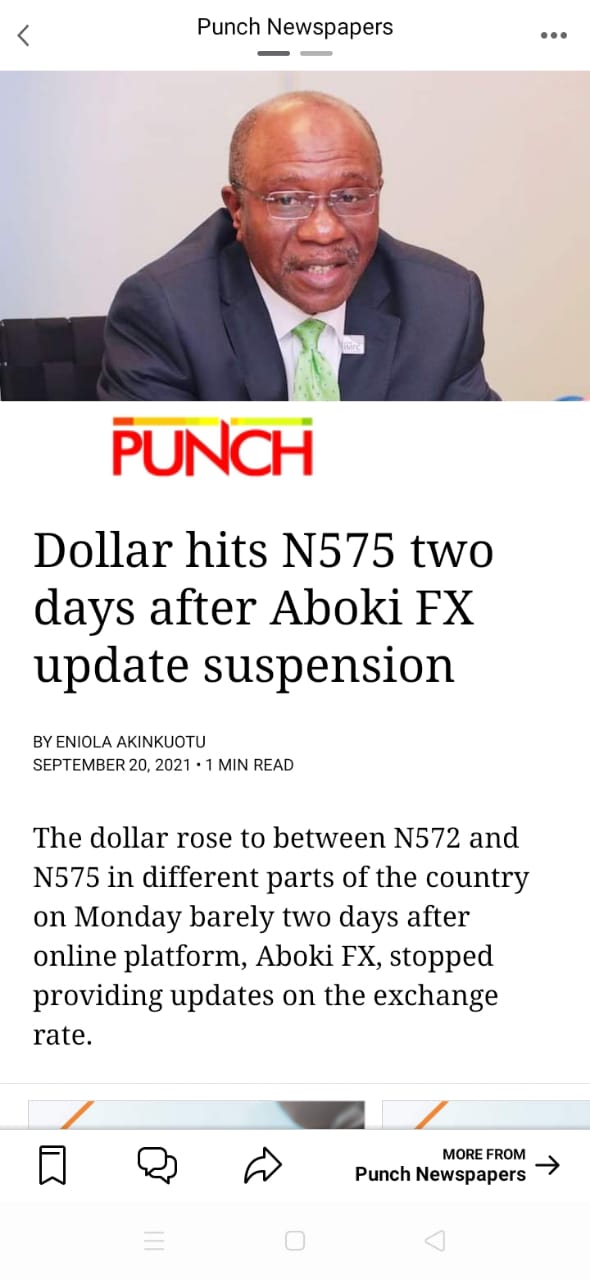
Comment #2: On Friday, the dollar exchanged at 570, today it goes for 575 two days after AbokiFX suspended operations. There is a reason why AbokiFX decided to shut down operations and anybody who knows Nigeria under these guys would know that its best to just shutdown to appease them.

My Response: the issue is not the rate. The issue is the process for the largest parallel market rate supplier in Africa. You called and got N570 possibly in Lagos. But Lagos, Aba, Kano, Owerri, etc have different rates at any time. AbokiFX quotes for Nigeria, not Aba, Lagos or Abuja. How does it come to that number. If it has that data, it does not need to suspend. AbokiFX, CBN, etc will not fix FX crises, only factories and warehouses (modern and old) will do. That is a constant.

As Nigeria Waits for Dangote Refinery on Fuel, CBN Detours To AbokiFX on Naira