DD
MM
YYYY

PAGES

DD
MM
YYYY

spot_img

PAGES

Home Blog Page 5596

South Korea Enacts Law to Scuttle Apple, Google App Stores Dominance

0

While the US is still deliberating around legal bottlenecks in its efforts to break up the big tech and scuttle their dominance, an Asian country has scored a major win with a new legislation that will change how American companies, Apple and Google run their app stores.

On Tuesday, South Korea’s parliament passed a bill that would rein in the dominance Google and Apple exert over payments on their app stores, becoming the first nation in the world to enact such a law.

South Korean lawmakers voted to approve the amendments to the Telecommunications Business Act, which bars app market operators from forcing certain payment systems on mobile content businesses by abusing their market positions.

App store operators will also be restricted from unfairly delaying reviews of mobile content.

The move comes amid growing global scrutiny against Google and Apple, who maintain a strong grip over mobile ecosystems, for requiring developers on their app stores to use their proprietary payment systems that charge fees of up to 30 percent when users purchase digital goods within apps.

Developers around the world have questioned app market operators’ exclusive in-app payment systems, opposing their relatively high commissions and demanding that they should be able to freely use other systems.

The latest legislation in South Korea is expected to give app developers the choice to use other payment systems, potentially signaling a major shift in how Google and Apple run their app markets.

The legislative movement in South Korea picked up after Google announced in September last year it would enforce its billing system on all developers on its Play store starting October this year.

Local tech groups vehemently opposed the move, calling it a monopolistic measure and saying it would likely lead to a price hike in the broader digital content industry.

South Korea is home to a robust mobile app economy, with total sales from Google’s Play store at around 5 trillion won (US$4.2 billion) last year and that of Apple’s App Store at 1.6 trillion won, according to the Korea Mobile Internet Business Association.

But the legislative movement initially faced fierce controversy amid concerns over a potential trade conflict with the United States as it essentially took aim at U.S. companies.

In March, the Office of the United States Trade Representative made mention of South Korea’s legislative movement in its National Trade Estimate report.

“The requirement to permit users to use outside payment services appears to specifically target U.S. providers and threatens a standard U.S. business model that has allowed successful Korean content developers to reach global audiences,” the report read.

Local experts say a trade dispute is unlikely, considering recent similar movements in the U.S.

“The United States is currently reviewing measures against such market dominance, so it’s unlikely for it to become a big problem for South Korea,” Ku Ki-bo, a professor of global commerce at Soongsil University, said. “The legislation will likely present an opportunity for local IT companies to expand their market presence.”

Earlier this month, U.S. senators introduced a similar bill that seeks to limit the dominant control Apple and Google have over their app stores.

The bill adds pressure on Apple and Google who are locked in legal disputes with hit video game “Fortnite” maker Epic Games Inc. over app market operations.

In July, 36 U.S. states also filed a lawsuit against Google, alleging anti-competitive behavior in its Play store operations to collect and maintain its commission.

South Korean app developers have high hopes for the revised legislation to resolve their long-held complaints against the commissions charged by app store operators.

“The legal amendment is expected to lead to an expansion of diverse payment methods for consumers within apps,” said Jung Mina, policy director at the Korea Startup Forum.

“We welcome the revision and its efforts to maintain a fair market order. We believe South Korea has become a leading example in a global movement (against app market operators’ dominance).”

Apple and Google have expressed concerns about the revisions, arguing that allowing other payment systems could lead to security and privacy risks for users.

Other international tech groups, including NetChoice, have expressed that the revision would have a negative impact on the broader app ecosystem, according to National Assembly documents.

The bill’s passage also comes after multiple attempts from Apple and Google to appease developers.

Last week, Apple reached a class action settlement in the U.S. with developers who have accused it of exerting dominance in app content distribution.

Under the settlement, Apple said it would allow developers to share information about payment methods outside of apps with its users — a move the iPhone maker had previously limited.

Apple has also cut its 30 percent commission by half for app developers that earn up to $1 million annually at the start of this year.

Google has taken similar measures, lowering its commission to 15 percent for the first $1 million of revenue earned by developers from July.

JAMB Gives Nigerian Schools Liberty to Set Admission Cut-off Marks

0

The Joint Admissions and Matriculation Board (JAMB) has on Tuesday cancelled general cut-off marks for admission into tertiary institutions, giving schools the right to decide their individual minimum benchmarks for admission.

According to Punch, the examination board took the decision at the virtual 2021 policy meeting, chaired by the Minister of Education, Adamu Adamu.

JAMB Registrar, Prof. Is-haq Oloyede, disclosing the decision said: “Some universities such as the University of Maiduguri, proposed 150; Usman Dan Fodio University, Sokoto, proposed 140; Pan Atlantic University proposed 210; University of Lagos 200; Lagos State University, 190; Covenant University 190; and Bayero University, Kano, 180.

“Institutions have now been given the liberty to decide cut-off marks; there will be no cut-off marks [stipulation] from JAMB.”

During the meeting, stakeholders delved into other matters relating to admission into higher institutions.

The report stated that the stakeholders resolved to allow the education ministry to decide on the deadline for the closure of admissions, as they could not agree on the December 31, 2021 deadline for all public institutions and January 31, 2022 for all private institutions.

Stakeholders also adopted the 2021 admission guidelines, which provide that all applications for part-time or full-time programmes for degrees, NCE, OND, and others must be posted only through JAMB.

The meeting approved that, for Direct Entry, the maximum score a candidate could present is six and the minimum is two or an E, as required by law.

These decisions mark a significant shift from what have characterized the admission process in Nigeria for ages, paving way for admission practice that will be at par with what is obtainable in other countries.

Long before now, reform advocates have called on Nigeria’s education authorities to initiate a swiffer process for admission into tertiary institutions, which involves scraping JAMB that has been described by many as a “revenue making scheme.”

Compared to many other countries where senior school examination is the only requirement for admission into college, Nigerian students seeking admission into tertiary institutions have had to pay more in time and resources. Many have had to wait for years in search of cut off marks for their desired courses, and when they got it, they got denied admission for not meeting Post-Jamb, (a further test taken after JAMB) cut off marks.

The tedious process fueled the federal government’s decision to scrap Post-JAMB in 2016.

“Our universities shouldn’t be conducting another examination; if they have any complaint against JAMB, they should come to the Ministry of Education and we will look into it,” Adamu said. “If JAMB is qualified to conduct the computer-based test and they are conducting the test, then there should be no need for students to sit another examination to get admission.”

However, the argument over JAMB’s right to set cut off marks remained since 2016, as schools pushed for the liberty to make the decisions. While the examination board’s Tuesday’s decision has put an end to the clamor, the call to scrap JAMB itself remains a decision to be made another day.

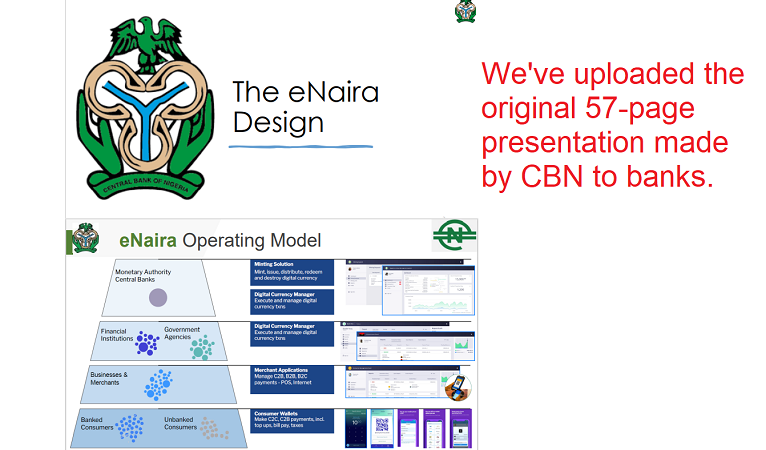
Tekedia Institute Has Uploaded The 57-Page CBN Presentation to Banks on eNaira

0

In the Board, we have uploaded the full 57-page presentation (pdf) from the Central Bank of Nigeria (CBN) to the banks on eNaira which we partly discussed during Tekedia Live today. Go to the Board and download it.

In the next edition of Tekedia Mini-MBA, we are working with some experts on potential business opportunities which innovators can run as this new phase of Nigeria’s “currency” takes shape. Notice that we will likely see some dislocations on certain things when you see how the apex bank has modeled charges and fees.

If you are not in Tekedia programs and need these documents, we ask you to register for Tekedia Mini-MBA and request access.

Tekedia Mini-MBA: We’re the most diverse school in Africa – 39 countries

0

We’re the most diverse school in Africa – 39 countries; from Singapore to Mali, Nigeria to Japan, and beyond! Read the testimonials.

What is innovation? At Tekedia Institute, we have a simple equation:

Innovation = Invention + Commercialization. But what is invention and what is commercialization? I invite you to register for the 6th edition of Tekedia Mini-MBA which begins Sept 13 for the equations. Here, we make business physics, bringing natural philosophy on fixing market frictions and advancing the wealth in nations through 140 global faculty from the best companies you admire. Join us

Welcome Bitscape Technology Services Ltd to Tekedia Mini-MBA

0

Let me welcome Bitscape Technology Services Ltd to Tekedia Mini-MBA which begins Sept 13, 2021. Bitscape “consists of a group of highly experienced information and Communications Technology (ICT) professionals with a combined background in ICT Consultancy and System Integration Services, driven by our collective desire to deliver first-rate ICT services always.

“We have set up our services primarily in Nigeria and are stretching into other regions in Africa. We believe that with our uncompromising attitude to detail and precision, backed up by our industry experience, we are in a unique position to deliver specialist and generalist ICT services tailored for the specific context of the Africa market.” www.bitscapetech.com

We welcome the tech innovators. We welcome the celebrities. We welcome the change makers. We welcome the policymakers. We welcome all to Tekedia Institute Mini-MBA.

Transform that business; come to Tekedia Institute school.tekedia.com