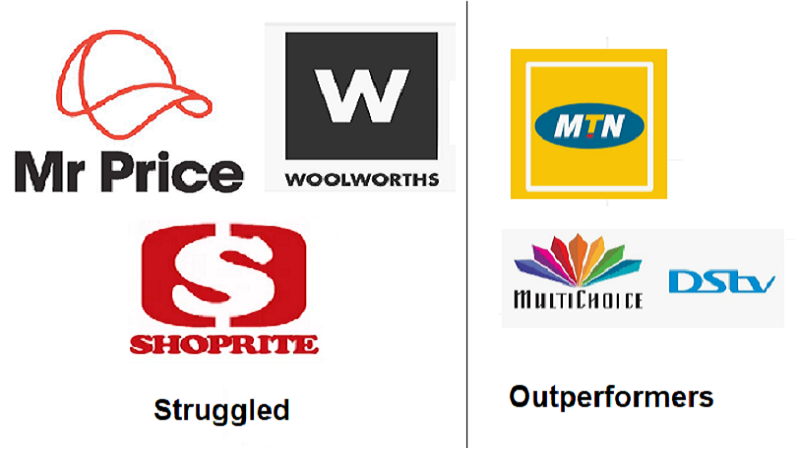
The companies on the left struggled and they were largely retailers which left southern Africa for a voyage in Nigeria. They have since returned or about returning home. Mr. Price left last year. Woolworths had departed in 2013, and Shoprite is gone, structurally. But the two on the right – MTN and MultiChoice – are from the same southern Africa, and magically have outperformed in Nigeria. The question is why?
I see three core things:
Product-Market Fit: To a large extent, formal retail in Nigeria remains highly underdeveloped due to infrastructures. While it makes sense to go to a farmer’s market in Cape Town and buy a cow, process it and dump in your deep freezer for months, large-scale shopping when there is no electricity makes no sense in Nigeria.
Economy: South Africa at close to 60 million people budgets an excess of $65 billion than Nigeria which is more than 3.5x its population. At a population of 210 million, Nigeria spends a paltry $35 billion when South Africa hits close to $100 billion. So, to a large extent, the middle class in Nigeria is very small and the purchasing power for organized retail may be limited.
Unlike South Africa, Nigeria falls within this segment which reshapes available opportunities for organized retail: “the most significant opportunity for African B2C startups lies with consumers who earn between $4 — $8 per day”. That spectrum is not a very sweet domain for organized retail. You need at least $15 per day to make it fascinating for the likes of Shoprite. So, there is a clear product-market fit dislocation and that has made organized retail challenging in Nigeria.

Also, checking the economy, South Africa collects excess of $85 billion from taxes. Nigeria’s revenue comes down to about $10 billion. This shows the scale of the disparity of the economies.
Competition: From daily to weekly open markets to shop on the street, to traffic sellers, Nigeria is a market. To win as an organized retailer, you have to beat those alternatives.But beating them when they do not tax becomes challenging. If margins remain low, issues crop up. Nonetheless, a new South African firm is in town: Pick n Pay.
But when you examine MTN and DStv, two things are evident: both enjoyed the first-scaler advantages. Yes, they did not just get to the market first, they were also the ones that scaled first. Nigeria was a blue ocean for both while in organized retail, the brands came into a red ocean.
More so, MTN and DStv pioneered pricing models which are relatively novel in Nigeria, enabling them to capture value. Despite whatever the state of the economy is, as the industry-kings, not just category-kings, they continue to capture value because the market does want the services they offer. So, there is a great alignment of product-market fit and competitive positioning. When that happens, provided there are humans, money would be made, irrespective of the state of the economy. Why? The little value available would be warehoused by the first-scalers.
Comment on LinkedIn Feed
Comment: I think on the right, owning content distribution rights (exclusivity over sport events alone makes it golden) sets Multichoice apart, whilst MTN rode in on a near monopolised licensed model, backed by its Pan African group presence. Most on the left expanded to Nigeria in the same phase as they did expanding beyond SADC, meaning they had to learn fast or fail across multiple countries & cultures. Some of your observations though are spot-on. Enjoyable as always!
My Response: Sure – we must not forget that MTN executed better than competitors. Its playbook to aggressively reach more cities in Nigeria was not built on monopoly but a sound business strategy that in-network network effects would compound over time. Econet (Zain, Celtel, Airtel) could have done the same since all began at the same time. I do not think MTN triumphed on monopolistic advantages. I do think it was a better operator with experiences working across Africa. When Glo introduced per second billing, MTN could have ignored Glo, but it responded to protect its castle, reversing itself that per sec was not technically possible. If it did not do that, by now MTN would have been history – in Nigeria.
Like Dangote Cement, when Michel Puchercos grew profit 1284% while cutting salary by 50% (his was down 10%) in Lafarge, Aliko Dangote paid all to bring him to Dangote Cement. Magically, the same man returned more than N40 billion in a quarterly tax, close to all the major banks combined (N42 billion).
There is a huge lesson here: the construct of monopoly in Nigeria is unsupported by data because most sectors are at infancy. The alleged Dangote Cement dominance would have flipped over 5 years, looking at data Lafarge was running under Michel. Sure, Aliko being a legend, brought him home, making sure the party stopped at Dangote Cement.