DD
MM
YYYY

PAGES

DD
MM
YYYY

spot_img

PAGES

Home Blog Page 5642

The Trial of Dangote, BUA and Elephant Cements in Search Interest Competition, Nigerian Stock Exchange Market

0

As new technologies evolve, businesses, individuals and governments are having opportunity of solving varied problems and providing needs. The new technologies are also increasing competition. Every business wants to be at the top and well positioned in front of the digital audience, who make decisions based on what they read, listened to and watched on different digital enabled platforms.

In this piece, our analyst examines Search Interest Competition, an emerging competition in the digital space being driven by Search Engine product of Google, Bing, Yahoo and other technology companies in the world.

The focus is on understanding how the competition is or not favouring selected cement brands in Nigeria in relation to their specific performance on the Nigerian Stock Exchange market. To the best of knowledge, this is the first piece in Nigeria that examines workability of Search Interest Competition. Our analyst studied the performance of Dangote, BUA and Elephant on Google Trends, a tool that normalised public search behaviour on the Internet through Google Search Engine. The performance of the brands on the Nigerian Stock Exchange between June 24 and July 2, 2021 was also factored into the analysis.

In our analysis, we discovered that the volume of the Nigerian population interest in Dangote reduced its trade volume by 1%. It was minus 24.2% for the BUA cement. With 18.3%, Elephant performed better. This indicates that one unit of the population interest in the brand translated to over 18 units increase in its trade volume. We found a negative connection [-21%] of the population interest in Dangote cement with BUA cement, signifying that the more the population had interest in Dangote cement the less they had interest in BUA cement. With this insight, it could be said that the population prioritises Dangote brand more than the BUA brand. This is expected to manifest in the trade volume of Dangote brand during the period.

However, analysis suggests that Elephant brand competed favourably with the Dangote cement during the period as the connection analysis shows a 7.8% linkage, which indicates that the more the population had interest in Dangote, the more they had interest in Elephant cement. With this result, it is expected that two brands would have a significant increase in their trade volume during the period. Our analysis further indicates that the interest the population had in BUA cement accounted for 5.9% of its trade volume between June 24 and July 7, 2021. Elephant cement recorded 3.3%, while Dangote had less than 3%.

Some Premises That Support the Brands’ Performance in the Competition

While our analyst believes that there are other factors which could contribute to the performance of the brands, it is instructive to note that the brands made some strategic moves that could be linked with the outcomes of our analysis. For instance, Dangote cement successfully issued N50 billion bonds for expansion projects and others during the period of our analysis. It also partners with NCF on ecosystem restoration.

BUA cement debunked the rumour that it planned to increase price. “We are now aware that Dangote Cement has increased the price of its Cement (ex-factory) by N260 effective Monday, June 14, 2021. BUA is not a part of this increase and will not seek to increase the price of its cement (ex-factory) in the foreseeable future.

BUA therefore restates its earlier position communicated on April 24, 2021, that it will not join in any increase in the prices of Cement for the foreseeable future.” Divestment of over N1 billion from the BUA Cement Plc and donation of N230m infrastructure to relocated communities in Sokoto could also be potential factors.

The Workability of IAL Model and Emergence of Abito Citta in Nigeria

0

Society needs to grow and develop sustainably. Society needs theoretical understandings of various concepts and constructs domiciled in the university, colleges of education, polytechnics and other higher education institutions that generate theoretical knowledge. As imperative as it is for the academia and industry to come together despite that the numerous benefits that would accrue to both, it has always been difficult for the stakeholders have appropriate models for overcoming stumbling blocks along the strategic partnership road.

Our check indicates that “Industrial-academia linkage (IAL) is a crucial mediator and modulator of skill development, adoption of knowledge and promotion of entrepreneurship. It also aids in the strengthening research and development investment via exploiting the synergies and complementarities present in scientific and technological capabilities. This, in turn, nurtures commercialisation and mobility of labour in both the public and private sectors. In 2019, our analyst noted that Nigerian stakeholders need to connect and fix paralyses in the R and D sector, one of the sectors that is critical to sustainable growth and development of academia and industry.

In the report, our analyst pointed out that “it is necessary that businesses and academic researchers remove barriers preventing research co-creation. As an advocate of combining academic and industry principles for understanding issues discomforting people and organisation’s growth, Academic-Applied Research Co-Creation Hub is being proposed as part of solutions to the issues in the R and D sector, using academics-professionals approach. AARCOC emerged after critical analysis of the current situation of research and development engagements in Nigeria. The hub intends to make significant contributions to sustainable academic and industrial development using scientific methods.”

From 10 members of the Hub, who reside in Nigeria and other countries in the world, the Hub has been able to produce a number of academic publications in national, regional and global reputable journals and books. It has also been able to produce popular articles and white papers that enable businesses, political leaders, policymakers and individuals made informed decision in their respective domains.

Our New Proposition and Model for Realising IAL in Nigeria

Our analyst and his colleagues in the Hub have realised, through the outcomes of the researches conducted so far, that there is a need for an information portal that will be the main repository of knowledge for the stakeholders in the academia and industry towards the formation of sustainable strategic partnerships. Therefore, Abito Citta is coming on board to provide an enabling environment for academics, students, professionals, business and political leaders.

The platform seeks to dwell on providing solution driven content rather than problem driven content being produced predominantly by the mainstream news media across the country. The Hub believes that educational institutions and research centres or institutes have more to offer the Nigerian society than perennial conflicts and crises. At the same time, both the industry and academia have more to gain when they are properly clustered and linked.

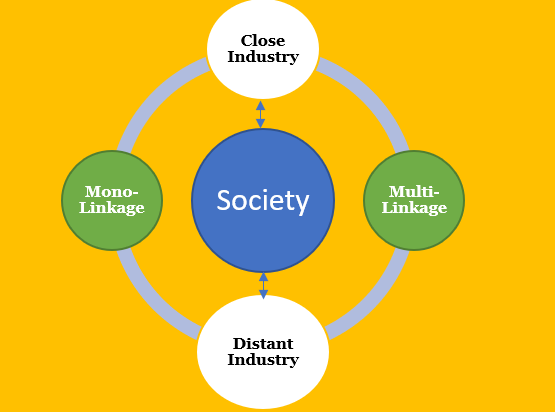
From the analysis of the data and insights that emerged from the Hub in more than two years, two categories of linkage are being proposed. These include mono-linkage and multi-linkage. The expectation is that there will be more types as actors interact and information flows freely. With mono-linkage, we envisage a situation where an academic institution or research institute collaborates with a company on a particular project [teaching, research and development, capacity building among others]. Multi-linkage is the opposite of the mono-linkage.

Whether mono-linkage or multi-linkage, Abito Citta team expects an academic institution or research institute to have collaboration with businesses in its immediate community [location] more than those outside the community. This is premised on the Hub’s analysis, which indicates that collaboration with the close industry benefit the host community more than a synergy with distant industry.

AbitoCitta IAL Model

Why we need to appreciate our Teachers, Lecturers

0

This morning, the first thought that came to my mind was “when last did I contact my teachers/lecturers?”. I discovered that over the past few years, I have transformed from someone who couldn’t read a word to someone who had started reading, writing, and even publishing a journal. Isn’t that amazing? I believe most of my readers have also witnessed this transformation. Having said that, most of us are also being overwhelmed with one thing or the other to the extent that we do not take our time to recognize the good efforts of our teachers whom have in one way or the order made us who we are today.

You don’t become an engineer, a doctor, a nurse, a lawyer,  a president or even a senator without being taught by a teacher/lecturer. How often do you contact them? Have you ever taken your time to travel down to your secondary school or university to say hello to your past mentors?  Or better still, have you ever picked your phone to call your past Professor to say hello or probably send a text? I believe our answers will be “No”. Our teachers need to be appreciated for what they do for us. Do you know how happy your teacher would be when you call him and say I am Bakare Mutiu Shola, one of your past students and that you just called to greet him/her. Remind him how he often scolded you during Physics classes and how you have become a Professor of Physics.

Do you know that by contacting your teachers to salute them, you are encouraging them to do more? For example, I came across my MSc research topic in one of my Professors’ class. After the research and publication of the work, I contacted the Professor to appreciate his wealth of knowledge. He was so happy and promised to do more. He commended me that people like me are those who make them put more effort to what they teach. Our teachers, like everyone love when we appreciate them. I know you are also thinking of one amazing teacher/lecturer. I implore you to pick up your phone to call him/her to appreciate them. Everything isn’t about money.

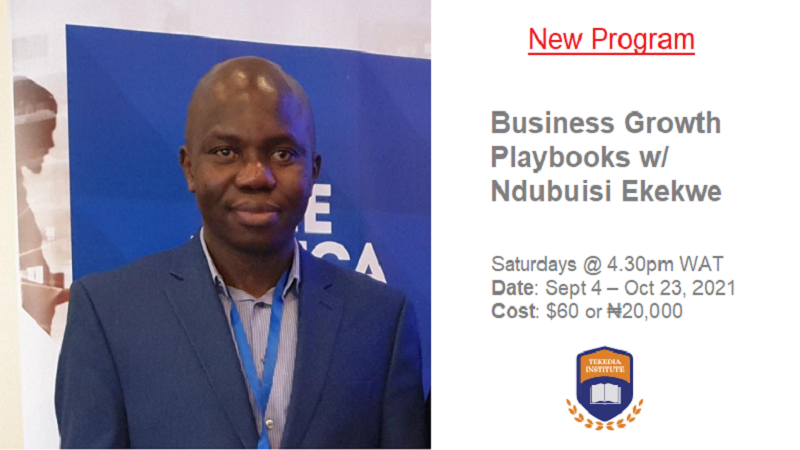
Tekedia Launches “Business Growth Playbooks w/ Ndubuisi Ekekwe”, Saturdays at Zoom

1

Tekedia Institute is excited to announce the launch of a new program: Business Growth Playbooks w/ Ndubuisi Ekekwe, a live program which will take place on Zoom. It will focus exclusively on growth strategies, mechanisms, models, frameworks, etc which businesses can deploy to win new markets and territories. In other words, the program objective is to master how companies can grow, biased for the African markets.

Program will run for 8 weeks, every Saturday at 4.30pm – 6.00pm WAT. The sessions will be recorded and archived in the portal for members who may miss them. For each session, the faculty will teach and make a presentation and then discussions/questions will follow. Yes, no pre-recorded videos or written materials but presentation slides will be shared.

  • Time: Saturdays, 4.30pm – 6.00pm WAT
  • Location: Zoom
  • Start/End dates: Sept 4 – Oct 23, 2021
  • Cost: N20,000 or $60

At the end of the 8th week, Tekedia Institute will issue a Certificate on Business Growth Playbooks to all participants. We think we can deepen the capacity to improve the efficiency of the utilization of factors of production through this way. It is for ALL – and I ask you to click here and register; space is limited.

Sample certificate to be issued to learners

MTN Declares N790.3 Billion Revenue in H1 2021 Results

0

MTN has continued with its burgeoning revenue trajectory despite the pandemic and regulatory pitfalls that are smiting its growth potential.

The South African telecom giant, on Saturday declared revenue of N790.3 billion, representing an increase of 24.1 per cent in its unedited half year results for the period that ended on June 30, 2021.

According to the report, the telco’s Earnings Before Interest, Tax, Depreciation, and Amortisation (EBITDA), grew by 27.6 percent to reach N417.2 billion. The EBITDA margin improved by 1.4 percentage points to 52.7 percent and its Capital Expenditure (CAPEX) rose by 39.1 percent to hit N186.4 billion. Its dividend per share was up about 30%, to N4.55 kobo.

However, the impact of the ongoing NIN registration was noticed in the teleco’s, loss of mobile subscribers and mobile internet users.

According to the report, mobile subscribers declined by 7.6 million to 68.9 million, due to regulatory restrictions on new SIM sales and activations. Active data users also declined by approximately 52,000 to 32.5 million.

MTN Nigeria CEO, Mr. Karl Toriola said although the regulatory restrictions impacted growth, the company used new and high quality service to offset the deficit.

“Service revenue grew by 24.1 per cent, Year-on-Year (YoY), driven by the sustained growth in data and also partly due to the lower base in comparative 2020 voice revenue that resulted from lockdowns during that period.

“Voice revenue grew by 13.1 per cent, benefitting from an 11.8 per cent increase in traffic and our customer value management (CVM) initiatives. The impact on voice revenue from the industry-wide suspension of new SIM registration was partly offset by higher usage in our active SIM base as well as migration to a higher quality of experience,” he explained, adding that data revenue continued the positive momentum from H2 2020, rising by 48.3 per cent.

He said this was driven by increased usage from the existing base, supported by the acceleration in our 4G rollout and enhanced network capacity following the acquisition and activation of additional 800MHz spectrum in Q1.

The results showed that data traffic rose by 83.0 per cent YoY, while smartphone penetration was up by 5.8pp to 49.3 per cent.

“Our 4G network now covers 65.1 per cent of the population, up from 60.1 per cent in December 2020,” he added.

According to him, Fintech revenue rose by 48.2 per cent driven by increased adoption of Xtratime and the core fintech services.

“We continue to expand our MoMo agent network and broaden our service offerings. Our registered MoMo agents increased by 121,000 in H1 2021 to more than 515,000,” he said.

Commenting further on the results, Toriola said: “In the first half of 2021, we made good progress strengthening the resilience of the business, managing the impact of the COVID-19 pandemic and enhancing support to our people, customers and other stakeholders.

“Our progress towards achieving greater business resilience is reflected in the upgrade by Global Credit Ratings (GCR) of our national scale long-term issuer rating to AAA and affirmation of our national scale short-term rating of A1+ with a stable outlook. This puts MTN Nigeria on the highest possible GCR scale for short-term and long-term ratings, providing a solid platform for growth.”

Toriola said MTN would use the opportunity of its 20th anniversary in Nigeria to expand in many areas, including CSR initiatives and widening its network coverage to more rural areas.

“As we celebrate this milestone, we are pleased to announce that our Board of Directors has approved our participation in the Road Infrastructure Tax Credit (RITC) Scheme. This is in response to the government’s drive towards public-private partnerships in the rehabilitation of critical road infrastructure in Nigeria. We intend to participate in the restoration and refurbishment of the Enugu-Onitsha Expressway. Conversations in this regard have already commenced, and further announcements will be made in due course.

“In line with our desire to plant deeper and more permanent roots in Nigeria, we have also initiated plans to commission a purpose-built, state of the art MTN Head Office, designed to act as a central hub for our network, a catalyst for creativity and innovation, and a showcase for the flexible working structures that are driving efficiency gains in this new normal working environment.

“Aligned with our wider commitment to environmental sustainability, it will meet the highest global environmental standards, demonstrating the role of green technology in our future,” he said.

Toriola promised that MTN would continue to invest in improved world class services and its network, accelerating the expansion of its 4G coverage and providing home broadband.

“As part of our rural connectivity programme, we plan to connect approximately 1,000 rural communities to our network this year with an additional 2,000 communities in 2022. We are delighted that these are translating into strong operational performance in line with the objectives of Ambition 2025. In the next three years, we will invest over N600 billion to expand broadband access across the country in support of the government’s broadband plan,” he said.