Good People, with the conclusion of Tekedia Mini-MBA edition 4 yesterday, the Certificates are now ready. Please email Admin for yours. You will receive a link to download it. I will be expecting your LinkedIn tag as you share. All certificates are automatically verifiable: just use the code on the certificate at tekedia.com/verify .
And the biggest part: from all samples, Tekedia Mini-MBA edition 4 received a rating of 4.9/5.0. To our members here, we hope you feel the same way. Remember, you have access to all course contents till Feb 2022. So, take time and go through them again.
Plus: try to share your Lab 3 with your supervisor at work. One of us is relocating from Port Harcourt to Lagos after he presented his Lab 3 which he did on his company. Now, he has to execute the playbook in the corporate headquarters.
I want to thank all members for the opportunity to co-share and co-learn at Tekedia Institute. The next edition will be better as we introduce courses on AfCFTA, Digital Commerce, Pricing Strategies, Formation of missions, etc.
“In today’s videocast, I make a case that Africa will enter the era of affordable broadband internet in 2022. That will be the year we will begin a new dawn of immersive connectivity where you can eat and surf all you can. Industry players will take off the Internet meter and then focus on service, experience and quality.
“From satellite broadband vendors to the MNCs with balloons and drones, the sector will become very competitive and service will drive growth. This has happened in the past – every decade, Africa experiences a major industrial transformation. We saw that in banking and voice telephony. 2020s, starting at 2022, will be the decade of immersive connectivity.”
As SpaceX Starlink arrives, that call is coming to pass! June 2017 seems to be a long time ago. I went to my village in Dec 2019 and the internet was bad. I was not happy. Luckily MTN came to the rescue, and broadband worked just fine while I was home. And before I left Ovim, three families offered free sites for masts. Imagine what broadband would do to Oriendu Market in Ovim. Imagine what it would do in your own village and community. This is the age of acceleration of value; a moment for optimism.
The generation’s finest innovator is coming to Nigeria with his product. Yes, Elon Musk and SpaceX are already in Abuja working with the industry regulator, Nigerian Communications Commission (NCC), for permits to pipe broadband via satellite, bringing a new domain in the ICT space in the country. I have called that an “asymmetric disruption” because it offers a new order to what the terrestrial players like MTN, Glo and Airtel offer. In 2017, I wrote an article titled “2022 – Africa’s Year Of Affordable Broadband Internet And Immersive Connectivity”. That seems to be on the money!
In today’s videocast, I make a case that Africa will enter the era of affordable broadband internet in 2022. That will be the year we will begin a new dawn of immersive connectivity where you can eat and surf all you can. Industry players will take off the Internet meter and then focus on service, experience and quality. From satellite broadband vendors to the MNCs with balloons and drones, the sector will become very competitive and service will drive growth. This has happened in the past – every decade, Africa experiences a major industrial transformation. We saw that in banking and voice telephony. 2020s, starting at 2022, will be the decade of immersive connectivity.
People, the game is changing and customers have a promise ahead – better quality at lower price. As that happens, we will see how the telco industry body lobbies: expect a new dimension of bank-led and telco-led mobile money debate to resurface, but now GSM-led and satellite-led broadband connectivity in Nigeria. Yes, would telcos expect SpaceX Starlink to come into the open party just as they have expected the Central Bank of Nigeria (CBN) to allow them to join the mobile money redesign in Nigeria. The argument was that telcos would improve the mobile money customer experience, better than banks, due to their better distribution outlets.
But here, since Starlink is coming from satellite, I do think it has a huge chance to also improve the experiences of customers on broadband connectivity, unbounded and unconstrained by the usual terrestrial challenges.
People, everything will be tested and it all depends on what the regulator does with SpaceX, because if you allow Starlink carelessly, these telcos will fade. The telcos which have made a case for mobile money, that the government should allow the best to win, have an opportunity to tell Nigerians if they truly believe in a totally free market system in our telecommunication sector.
SpaceX team in Nigeria
But this is what I expect the telcos to say: the Nigerian telecom sector should be GSM-led, and not Satellite-led, and by that, even if SpaceX Starlink comes, it must be mandated to pipe its data through partnerships with GSM-based broadband providers. The telco lobby will argue for protecting jobs and investments. It would be a fierce one.
Of course, #ENDSARS affected the lives of many young people who were attacked by law enforcement. We also just learning that the insurance industry will see lesser profits as a result of the violence many brought to a largely peaceful civil protest: “The Nigerian Insurers Association (NIA) said Thursday that insurance companies have paid N4 billion as claims as a result of last year’s #EndSARS-related violence.”
Addressing journalists in Lagos, Ganiyu Musa, Chairman, NIA, said about 2,000 insured businesses were affected by the violence.
Mr Musa also assured customers that all genuine claims resulting from the protests would be paid.
He said insurance operators were still collating claims stressing that every genuine claim would be settled.
“The number of insured businesses that were affected at the last count was about 2,000 and the industry has settled N4 billion claims out of N4.5 billion in respect of the #EndSARS protests.
“Once they are documented and completed, we have the commitment of our members that the claims will be paid timely,” he said.
Mr Musa said the association was on top of the developments and would continue to encourage its members to pay all genuine claims in line with the expand policies.
Nigeria’s oil and gas industry is plagued by various challenges, ranging from insecurity to the cost of production, policies, and regulatory issues. But among all the challenges confronting the industry, the inability of the Department of Petroleum Resources (DPR) to regulate it in line with global best practices is the biggest of all.
By the law that established it, DPR is the regulator of Nigeria’s oil and gas industry. The Department has a vision “To be a leading regulator in oil and gas sector” and a mission “to ensure the sustainable development of Nigeria’s oil and gas resources across the value chain for our stakeholders through effective regulation while entrenching world-class professionalism, accountability, and transparency.”
Effective regulation of any industry does not only build the confidence of investors, it engenders growth. Crude oil accounts for about 90 percent of Nigeria’s foreign exchange earnings and 70 percent of its revenue. This shows how important the sustainability of the industry is to the country. But with what transpired in the industry in recent months, many investors must be asking if the DPR is for or against them.
In what many see as a lack of commitment to the rule of law, fairness, and nonchalant attitude towards a stable business climate for investment, the DPR revoked four oil mining licences of Addax Petroleum in April, citing the inability of the company to develop the assets.
After the revocation of the licences, the DPR inaugurated a team of experts to assess the revoked licences from Addax Petroleum to a new operator – Kaztech/Slavic Consortium. It, however, took the intervention of President Muhammadu Buhari, who doubles as the Minister of Petroleum Resources, for the licences to be restored to Addax.
“President Muhammadu Buhari has approved the restoration of the leases on OMLs 123, 124, 126, and 137 to the Nigeria National Petroleum Corporation, NNPC which is in production sharing contract with Addax Petroleum, a company wholly owned by Government of the People’s Republic of China on the blocks. The leases belonging to the Federation were revoked on March 30, 2021.
“This development reaffirms the commitment of President Buhari to the rule of law and sanctity of contracts.
“While directing the Department of Petroleum Resources, DPR to retract the letter of revocation of the leases, the President also directed NNPC to utilize contractual provisions to resolve issues in line with the extant provisions of the Production Sharing Contract arrangement between NNPC and Addax.
“The restoration of the blocks to NNPC will boost the organisation’s portfolio, thereby making the Corporation to, in the long run, boost its crude oil production and in turn increase the revenue it generates to the Federation Account,” a statement issued by the Senior Special Assistant to the President (Media & Publicity, Garba Shehu, on April 23, 2021, read partly.
Similarly, the Department on April 6, 2021, also issued letters revoking 11 Marginal Oil Fields licences. According to the operators of the assets in a Letter to Buhari, they have invested over $400 million in these assets.
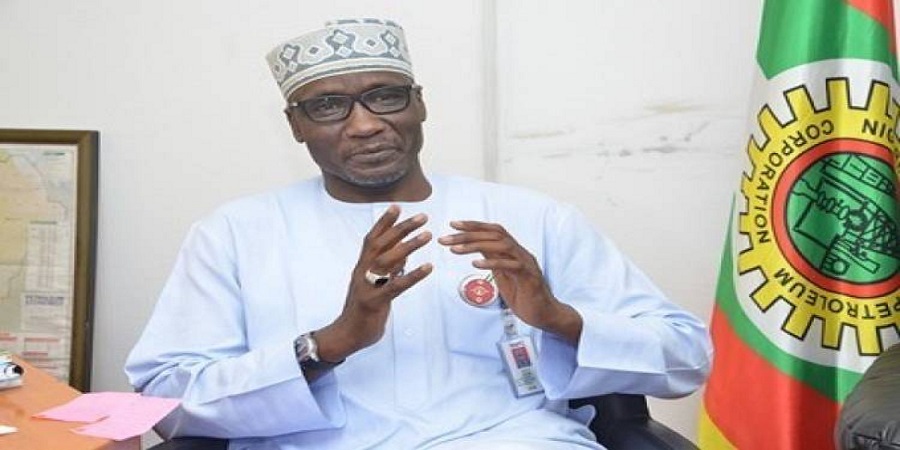
GMD Kyari mele nnpc
They explained that they were not contacted by the DPR or, giving any opportunity to make representation before the regulator issued the letters revoking their licences.
The operators noted that the revocation puts the investment of several State Governments, Nigerian entrepreneurs, and their foreign technical partners in jeopardy, and will add to the problem of Non-Performing Loans (NPLs) for the local banks. As of last year, the oil and gas industry accounted for about $8 billion in debt owed to Nigerian banks.
“Not only are the actions of the DPR at complete variance with the Marginal Field bid guidelines and the duly executed Farm-out Agreements, we are extremely concerned that the DPR has chosen to pursue such a course of action in the midst of a global economic crisis with its resultant impact on the Nigerian economy at large, and in particular the primary economic contributor thereto, being the oil and gas sector.
“The revocation of the licenses will certainly lead to litigation against the Marginal Field Operators by foreign partners and banks who have financed the development of the Marginal Fields, in addition to sending the wrong signal to both Foreign and local investors” the operators stated.
“We have conservatively invested over US$ 400 million in developing the affected fields, with a number of them in production, whilst others are in various advanced stages of development including testing of oil wells, drilling of new wells, construction of production facilities, etc.
“These investments were made despite low crude oil prices, militancy, and insecurity in the Niger Delta region, resulting in frequent shut down/ vandalization of crude export pipelines,” they added.
The Marginal Fields affected and their operators include Atala operated by Bayelsa Oil/CEPL; Dawes Island operated by Eurafric; Ofa operated by Independent Energy; Ke operated by Del-Sigma/Xenoil; Ororo operated by Guarantee/Owena; and Ekeh operated by Movido.
Others are Akjepo operated by Sogenal;, Tsekelewu operated by Sahara/Africa Oil; Tom Shot Bank operated by Associated/Dansaki; Oriri operated by Goland, and Ogedeh operated by Bicta.
In June 2019, DPR also revoked the licences of Pan Ocean Oil Corporation (OML 98); Allied Energy Resources Nigeria, (OML 120 and 121); Express Petroleum and Gas Company (OML 108); Cavendish Petroleum Nigeria (OML 110), and Summit Oil International (OPL 206), for non-payment of royalties.
Oil and gas is the mainstay of Nigeria’s economy, and for that reason, the Federal Government, and the DPR in particular, must ensure that the regulation of the industry is in line with the global best practices. Before licences are revoked, the DPR should ensure that affected companies are contacted and given a fair hearing. Also, the oil and gas industry is a peculiar industry, which means that revocation of licence should not be the immediate punishment for non-payment of royalties, or inability to develop assets.
Revocation of licences does not only lead to loss of jobs, but it also makes investment unattractive. Marginal Fields are exclusively allocated to Nigerian exploration and production companies, and the fact that these companies are indigenous should be enough reason for the DPR not to revoke their licences without giving room for dialogue, to understand their predicament or why they are unable to develop their assets or pay royalties.
Investment in the oil and gas industry is dollar-driven, and access to credit facilities in dollars is usually a big challenge for indigenous oil and gas companies. This is the reason why the DPR needs to be more judicious in carrying out its regulatory roles. The Department needs to work on how it can carry out both administrative penalties and criminal penalties without undermining investors’ confidence. This will be critical in deepening local content in the country as the world pushes towards energy transition.
The recent actions of the DPR do not give investors confidence and show a harsh business environment, which does not speak well on the ease of doing business in the country, especially in the oil and gas industry.
As we look forward to the response of Buhari to the letter written to him by the affected 11 Marginal Field operators, I hope he will do the right thing by directing the DPR to restore the licences to these companies, to save hundreds of jobs that will be lost as a result, and spare the country of facing litigation both home and abroad.