As a First Bank shareholder, I have been concerned for the health of the elephant. Recent events have not been encouraging – and things just keep evolving. But it has moved to another level now. People, the Central Bank of Nigeria has sacked the board of First Bank and its holding company, over “ bad credit decisions, significant and non-performing insider loans and poor corporate governance practices. The shareholders of the bank and FBN Holding Plc also lacked the capacity to recapitalize the bank to minimum requirements. This conclusions arose from various entreaties by the CBN to them to recapitalize”.
And stunningly, the bank reinstated Adebola Adeduntan as the GMD/CEO, a day after he was removed by the board. Notice that Ibukun Awosika, the former Chairman of First Bank board, has been cut; she initiated the huge change that has triggered the recent upheavals.
First Bank of Nigeria Limited has appointed Gbenga Shobo as its managing director/chief executive officer effective from April 28.
Mr Shobo, who until now was the lender’s deputy managing director, will take over leadership from Adesola Adeduntan, who will be retiring in accordance with the bank’s term limits for chief executives, having headed it since 2016.
“His appointment has proven the resilience of our succession planning mechanisms and the value we place on our long-standing corporate governance practices, which underpin the institution’s enduring sustainability and 127-year legacy,” Ibukun Awosika, chair of the bank’s board of directors, said Wednesday in a statement reported by The Cable.
The apex bank needs to listen to my old proposal: ban bank directors and their associated companies to ever borrow from banks they supervise while actively serving. My non-academic data shows that 90% of all bank problems in Nigeria are related to insider-deals, typically coming from loans given to directors and their cohorts. Because our managers are yes people, those things happen. These loans always underperform.
The Central Bank of Nigeria has directed the Oba Otudeko owned Honeywell Flour Mills to repay a loan to First Bank within 48 hours, according to a memo seen by TechCabal.
In the letter seen by TechCabal dated April 26, 2021, the CBN stated, “Consequently, the company (Honeywell Flour Mills) is required to fully repay its obligations to the bank within 48 hours, failing which the CBN will take appropriate regulatory measures against the insider borrower and the bank.”
Insider lending is when a bank makes a loan to one or more of its own officers or directors.
Oba Otudeko serves as the chairman of FBN Holdings PLC, the holding company which owns First Bank. Otudeko also served as Chairman of First Bank until 2010 and is also the Chairman of the Honeywell Group.
While insider borrowing is legal, it is subject to several regulations. One such regulation is that insiders do not get any special treatment, incentive rates, or other benefits not offered to regular bank customers.
I find it repulsive when AMCON takes poor people’s commonwealth to bailout “fake billionaires” who continue to live large. My solution would be: you cannot borrow from a bank while on its board. Do that, and Nigeria will solve most of these issues!
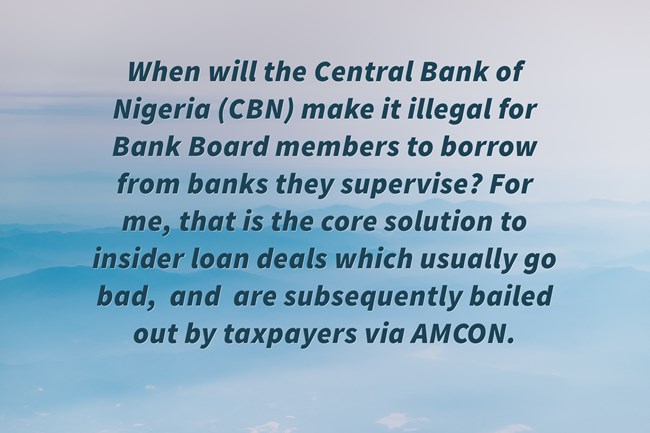
Can we make it illegal for bank directors to borrow from banks they actively supervise?
The full statement by Emefiele below…
1.0 Good afternoon ladies and gentlemen.
2.0 The media has been awash with commentaries on the purported management changes at First Bank of Nigeria Ltd (FBN) and the related regulatory inquiry by the Central Bank of Nigeria (CBN) to the Board of First Bank of Nigeria Limited. It has therefore become necessary for me to address the public to clear any misconceptions.
3.0 Ordinarily the board is vested with the authority to make changes in the management team subject to CBN approval. However, the CBN considers itself a key stakeholder in management changes involving FBN due to the forbearances and close monitoring by the Bank over the last 5 years aimed at stemming the slide in the going concern status of the bank. It was therefore surprising for the CBN to learn through media reports that the board of directors of FBN, a systemically important bank under regulatory forbearance regime had effected sweeping changes in executive management without engagement and/or prior notice to the regulatory authorities. The action by the board of FBN sends a negative signal to the market on the stability of leadership on the board and management and it is in light of the foregoing that the CBN queried the board of directors on the unfortunate developments at the bank.
4.0 As you may be aware, FBN is one of the systemically important banks in the Nigerian banking sector given its historical significance, balance sheet size, large customer base and high level of interconnectedness with other financial service providers, amongst others. By our last assessment, FBN has over 31m customers, with deposit base of N4.2trn, shareholders’ funds of N618bn and NIBSS instant payment (NIP) processing capacity of 22% of the industry. To us at the CBN, not only is it imperative to protect the minority shareholders, that have no voice to air their views, also important, is the protection of the over 31m customers of the bank who see FBN as a safe haven for their hard-earned savings.
5.0 The bank maintained healthy operations up until 2016 financial year when the CBN’s target examination revealed that the bank was in grave financial condition with its capital adequacy ratio (CAR) and non-performing loans ratio (NPL) substantially breaching acceptable prudential standards.
6.0 The problems at the bank were attributed to bad credit decisions, significant and non-performing insider loans and poor corporate governance practices. The shareholders of the bank and FBN Holding Plc also lacked the capacity to recapitalize the bank to minimum requirements. This conclusions arose from various entreaties by the CBN to them to recapitalize.
7.0 The CBN stepped in to stabilize the bank in its quest to maintain financial stability, especially given FBN’s systemic importance as enumerated earlier. Regulatory action taken by the CBN in this regard included:
i. Change of management team under the CBN’s supervision with the appointment of a new Managing Director/ Chief Executive Office in January 2016.
ii. Grant of the regulatory forbearances to enable the bank work out its non-performing loans through provision for write off of at least N150b from its earning for four consecutive years.
iii. Grant of concession to insider borrower to restructure their non-performing credit facilities under very stringent conditions
iv. Renewal of the forbearances on a yearly basis between 2016 and 2020 following thorough monitoring of progress towards exiting from the forbearance measures
8.0 The measures had yielded the expected results as the financial condition of FBN improved progressively between 2016 when the forbearance was initially granted to the current financial year. For instance, profitability, liquidity and CAR improved whilst NPL reduced significantly.
9.0 Notwithstanding the significant improvement in the bank’s financial condition with positive trajectory of financial soundness indicators, the insider related facilities remained problematic.
10.0 The insiders who took loans in the bank, with controlling influence on the board of directors, failed to adhere to the terms for the restructuring of their credit facilities which contributed to the poor financial state of the bank. The CBN’s recent target examination as at December 31, 2020 revealed that insider loans were materially non-compliant with restructure terms (e.g. non perfection of lien on shares/collateral arrangements) for over 3 years despite several regulatory reminders. The bank has not also divested its non-permissible holdings in non-financial entities in line with regulatory directives
11.0 Following further review of the situation and in order to preserve stability of the bank, so as to protect minority shareholders and depositors, the Management of the CBN in line with its powers under BOFIA 2020 has approved and hereby directs:
i. Immediate removal of the all directors of FBN Ltd and FBN Holdings Plc
ii. The appointment of the following persons as directors in FBN Ltd and FBN Holdings Plc
Holdco
- Chairman – Remi Babalola
-
Dr. Fatade Abiodun Oluwole
-
Kofo Dosekun
-
Remi Lasaki
-
Dr Alimi Abdulrasaq
-
Ahmed Modibbo
-
Khalifa Imam
-
Sir Peter Aliogo
-
UK Eke – Managing Director
Bank
- Chairman – Tunde Hassan-Odukale
-
Tokunbo Martins
-
Uche Nwokedi
-
Adekunle Sonola
-
Isioma Ogodazi
-
Ebenezer Olufowose
-
Ishaya Elijah B. Dodo
-
Sola Adeduntan – Managing Director
-
Gbenga Shobo – Deputy Managing Director
-
Remi Oni – Executive Director
-
Abdullahi Ibrahim – Executive Director
12.0 The CBN hereby reassures the depositors, creditors and other stakeholders of the bank of its commitment to ensure the stability of the financial system. There is therefore no cause for panic amongst the banking public, given that the actions being taken are meant to strengthen the bank and position it as a banking industry giant.