First, we must all acknowledge that running a heterogeneous economy like Nigeria is very complicated especially when the playbook is centralized. In a monetary policy paper (PDF) I wrote and presented at the African Union Congress, I did explain the implications, and how heterogeneous economies could suffer welfare losses as a result of currency union under a supranational banking ordinance. My doctoral research in banking & finance focused on currency and economic development, and I have worked with the World Bank and African Union, on this topic.
The economic structure of North Central Nigeria is totally different from South South Nigeria – and most times, there is no variance on our policy playbooks. A balanced, nuanced policy framework which is regionally incubated and delivered by the states would be more pragmatic in the nation. Today, that economic heterogeneity is not well captured within our policy instruments. That explains why we have many challenges.
Historically, Nigeria developed faster under a regional-based model. There is a reason for that: policies were more laser-focused on the needs of the regions, and consequently were more impactful.
Why am I bringing this up? It has to do with the shifts I have noticed since the Central Bank of Nigeria moved the official rate to N410/$. Yes, the delta between the official and black market rates have remained: “The exchange rate between the naira and the US Dollar depreciated to close at N410.25/$1 at the Investors and Exporters (NAFEX) window, where forex is traded officially. This is as the CBN Governor has suggested that the official exchange rate has been devalued. Similarly, at the parallel market where forex is traded unofficially, the naira depreciated closing at N482/$1 on Friday, February 26. This represents 0.42% drop when compared to the N480/$1 that it closed on the previous trading day.”
In other words, immediately the CBN moved from N360 to N410, the black market also moved. This does imply that closing that gap cannot come via announcements as there are fundamental factors – root causes – causing this massive non-alignment.
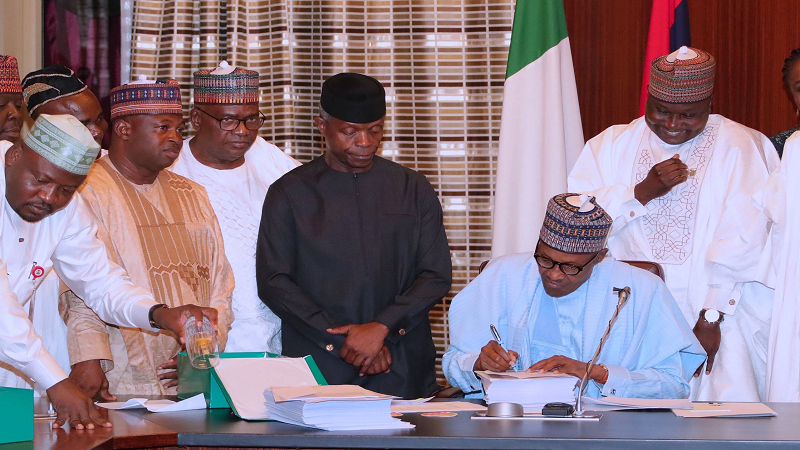
Very painful indeed: the Central Bank of Nigeria (CBN) has made it official – Naira has lost more grounds to the US dollars. According to the Vanguard, Godwin Emefiele, the apex bank governor, “who spoke at a summit on the economy by Bank CEOs on Friday, said the drop in crude oil earnings and the associated reduction in foreign portfolio inflows significantly affected the supply of foreign exchange into Nigeria”.
His words: “In order to adjust for the decrease in supply of foreign exchange, the naira depreciated at the official window from N305/$ to N360/$ and now hovers around N410/$.”
Going back to region-based policy where policies are closer to the needs of the states would be catalytic for Nigeria. The implication is that states have to band together within their geopolitical zones to pursue development policies. I do believe that pure restructuring at state levels would be great, but having a mechanism for the regions to work closely together would be best (within the restructured states), since our resources, per capita, are relatively very small for individual states to do great things.
For example, South South could decide to operate a big seaport with all the states in the geopolitical zone coming together to fund it since one state may not have the resources. These anchor projects would feed into pockets of smaller projects at state levels which are designed to address specific needs of the states.
Our nation can advance faster if the center can give out more power. We cannot manage a highly heterogeneous economy from the center, and doing that has remained why Nigeria is underperforming. Some have called this necessity economic restructuring, but restructuring at the state level without regions having a coherent region-based strategy will still not be effective.
According to government data, Adamawa attracted $20,000 as foreign direct investment in 2020. But Adamawa was amazing, as it made the list of one of the 11 states (with Abuja) which attracted investment; 26 states recorded zero! So, even if you restructure and allow Adamawa to go alone, the playbook would be sub-optimal. Simply, a region-anchored strategy within fully restructured-states would provide the resources Nigeria needs to ramp up development.
“By destination, Lagos emerged as the top destination of capital investment in Nigeria with $8.3 billion, followed by Abuja, which received $1.3 billion. The others on the list are Abia State with relatively lower $56 million, Niger with $16.4 million, and Ogun with $13.4 million. Anambra State recorded $10.2 million, Kaduna State recorded $4.03 million, Sokoto got $2.5 million and Kano got $2.4 million. Akwa Ibom received $1.05 million ahead of Adamawa, which received just $20,000.”
Unless we fix this, the variance we see on Naira between the official and black market rates, whenever the Central Bank of Nigeria devalues it, will continue to remain a moving target. Yes, even debt sales will fail!
Nigeria’s central bank is preparing an end to an era of debt sales that handed foreign investors some of the best carry returns in Africa.
Offerings to non residents of so-called Open Market Operations bills — introduced to help stabilize the naira following the oil-price collapse in 2015 — are to be phased out “once current obligations have been redeemed,” Hassan Mahmud, the bank’s director of monetary policy in Abuja, said in an interview aired during an online conference on Tuesday. He didn’t give a time frame.
Though the sales helped to shore up the currency, the debt has become too burdensome to sustain as foreigners snapped up securities that offered carry traders — who borrow in low interest-rate markets to invest elsewhere — returns of as much as 30% in dollar terms in recent years. The market for OMOs had grown to about $40 billion by the end of last year, according to Cairo-based investment bank EFG Hermes, with foreigners holding about a third.
[…]
Moody’s Investors Service warned as far back as 2019 that the cost of keeping the naira stable using OMOs would be prohibitive and leave the country vulnerable to outflows. Non-residents held $13.2 billion of the securities as of September, according to Omotola Abimbola, a fixed-income analyst at Chapel Hill Denham in Lagos.
It’s Official – Naira Falls To N410 for US Dollar; Here’s Nigeria’s Option To Strengthen Naira