DD
MM
YYYY

PAGES

DD
MM
YYYY

spot_img

PAGES

Home Blog Page 5881

Tekedia Institute Welcomes A Chinese Economic Expert and Thought-leader, Dr Henry Chan

0

Tekedia Institute is excited to welcome a Chinese economic expert and a thought-leader in the domain of digital and electronic commerce, Dr Henry Chan, to our Institute. Dr Chan has developed a course on ecommerce for Tekedia Mini-MBA. More so, we will host him at  Tekedia Live as follows:

  • Topic: Ecommerce in China
  • Date; March 9, 2021
  • Time: 12 noon WAT
  • Zoom link: in the school board

In his course at Tekedia Mini-MBA, he explained the rise of Digital China and the factors driving the Mobile-AL China.

Dr Henry Chan completed his university degree in Engineering from The University of the Philippines,  MSc in Biopharmaceutical from The University of New South Wales and PhD in Management from Singapore Management University. He is a businessman turned to scholar work with extensive experiences in agriculture, hotel management, manufacturing, banking, and investment.

Dr Chan is the senior visiting research fellow of Cambodia Institute for Cooperation & Peace and his research interest is Chinese economic development, ASEAN & China relations, technology & economic growth. He is an active conference and seminar speaker on topics ranging from climate change, regional and international geopolitics to economic development.

The New Category-King of Nigerian Banking

4

Can we say that the New Category-King is now evident? I think in the FUGAZ world, Zenith Bank has clearly overtaken GTBank as Nigeria’s leading financial institution. The impressive ascension of Zenith Bank is a case study for everyone: service excellence will win trophies in banking. Zenith’s technology leapfrogged and the balance sheet responded.

And there is a historical perspective to that: the best of Nigerian banking began when the new generation banks imposed new or higher  fees – commission on turnover (COT) – and accelerated service in early 1990s. They reduced what used to be three hours of wasted time, in bank halls, to fifteen minutes – and Nigerians responded. Yes, Nigerians paid the fees but got out of the bank halls faster!

From that experience, it is evident that the most profitable bank customers want service, not just low costs. In other words, if your fees increase marginally and you deliver value, good moments will come.

Zenith Bank’s FY 2020 results broke records: the Profit After Tax (PAT) of N230.6 billion, a 10.4% increase compared to 2019’s N208.8 billion, made it the first Nigerian bank to cross N200 billion on PAT. Hail the new king!

Now, everyone wants to be at the zenith now that Zenith is there; expect new playbooks from other members of FUGAZ.

Meet Princess Amarachi Okeoma-Ihunwo, The 9-Year-Old Who is Proficient in Over 10 Programming Languages

1

When Princess Amarachi Okeoma-Ihunwo was four years old, she asked me some interesting questions with the curiosity of a child but the expectation of an adult. How did going to school come about? What was the world like before the advent of the telephone? I was intrigued by her beautiful mind and knew right there that she was born a star girl.

And I was not wrong.

Five years later, she has become proficient in web design, JSON, Linux, JavaScript, JQuery, Python, HTML 5, CSS 3, SQL, PHP, XML, and Ajax. I quickly put clothes into my travel bag and hit the road to Warri, Delta State, in Nigeria where she, her two little brothers, and her parents reside when she called me on Whatsapp to tell me she was learning mobile app development. It was long overdue—I had to see what this young girl had transformed into. She was aware I very busy with my job as a social investment advisor in Port Harcourt—I explain this to her whenever she calls me asking when I will be come to visit her. So, she could not keep calm when I told her my leave request had been approved.

“I can help you do your office work, you know,” she boldly told me when I was worried about some backlogs I needed to clear before going into leave mode fully. Her voice did not betray a plea; she was not asking if she could help me, she was telling me she could do my work! So much self-confidence and assurance in her own abilities. I would later learn that her father seldom allowed her do ‘work’ on some of his real projects to quench her insatiable appetite for coding.

“I searched on Google to learn how to add a pdf file to my website, I didn’t know how to do that, my father didn’t teach me that… But I chose to learn it because I want to create tutorial videos with download links, I can host on my website so viewers can download my videos.”

“You know, it’s a digital world, so I just thought to expose her and her only brother at the time to basic computer applications like Microsoft Packages like Word, Excel, & PowerPoint,” Mr Okeoma Ihunwo, Princess’ father narrated, “But she picked them up too fast and I was like, okay girl, maybe we can do more programs. And she impressed me beyond my expectations.” Mr Okeoma is a programmer who has experience working with top IT firms like Intel.
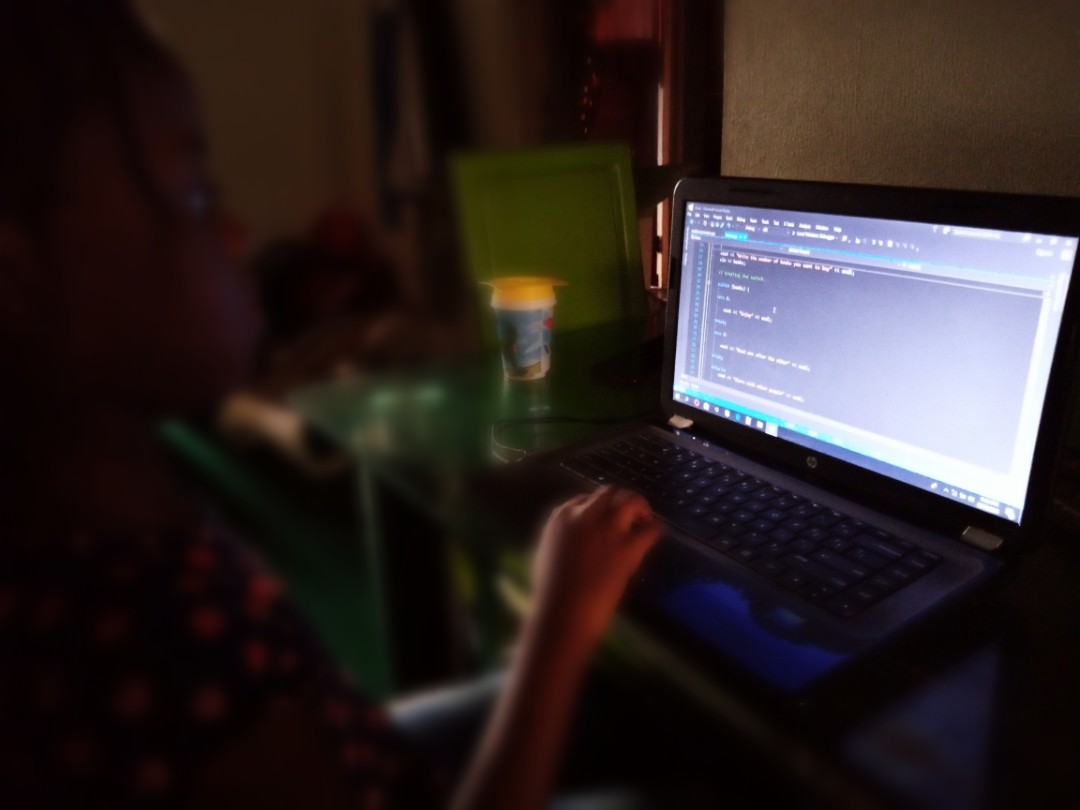
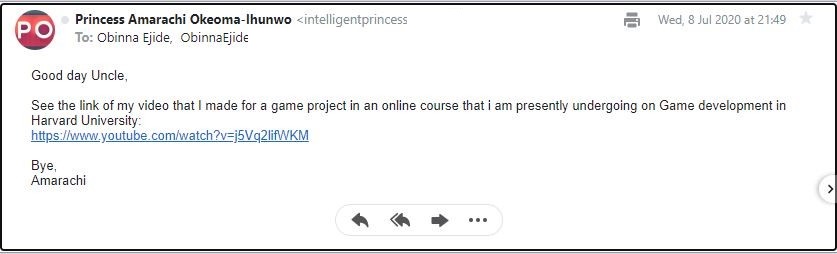
Based on her father’s recommendation, Princess took online courses from Harvard University on Game Development and has now developed her own games. The role parents or guardians play in shaping the interests of children can significantly reduce the deficit in learning opportunities available at school. Princess is gradually learning that tech education is still infantile at the early education levels in Nigeria. “I tell my classmates in school about the programs I am learning and they look at me like I am saying something strange,” she tells me I ask her if she wished she were in a circle of friends that code like her.

This low adoption of tech education at the primary and secondary education levels in Nigeria betrays the popular narrative that Africa’s tech ecosystem is growing fast. Tech is still being introduced to primary education curriculum in Nigeria like a vaccine is to a diseased host. The ideal expectation, which resonates with current global realities, is that tech should be an essential nutrient in the educational feed given our children. There are limits to how much Capital (explained as multimillion dollar series funding) can do to help develop tech, but better use of human capital nurtured from childhood is key to sustainable growth and development of the tech ecosystem in Nigeria and Africa.
“I searched on Google to learn how to add a pdf file to my website, I didn’t know how to do that, my father didn’t teach me that… I want to make some tutorial videos I can host on my website and create links that viewers can go to for download of the videos,” Princess said while explaining to me the workings of her website. Perhaps Jean Piaget’s theory is true, that everything we do for children deprives them of the opportunity to do it for themselves, summing up intelligence as not something a child has but something a child creates. But I’m intrigued by the passion she exudes about this her new found love. Whether we were about to build houses with toy blocks with her siblings or go over some problems in mathematics, her best subject, in preparation for her common entrance examinations, she would first inquire whether she could work with a laptop in the house after all work or play. I am also impressed that her love for mathematics is a fine complement to her good communication skills. We exchange emails, place calls to each other, and oftentimes I forget we’re not of the same generation.

Whether coding will turn out to be Princess’ future career is still probable. When I asked her, she noted she would like to become the CEO of a bank someday, something she is enthused about given that her mother is a Relationship Manager in one of the leading commercial banks in Nigeria. Becoming a bank CEO with a background in tech is something rare or, perhaps, non-existent in the traditional banking industry. The fintech industry, however, is fiercely challenging this norm in the competitive Nigerian financial sector with the rise and rise of young, savvy tech gurus leading tech start-ups.

Although it is hard to deny that women are grossly underrepresented as CEOs/cofounders when you consider the number of fintech founders/co-founders in Nigeria, role models like Fara Ashiru Jituboh, the woman behind Okra, Africa’s first API fintech “super-connector”, and Odunayo Eweniyi of Shapire Global Limited (the company behind PiggyBank) could be role models to help inspire Princess if she cares to dream in that direction. The right time to grow her interest and build her capacity is now, as a child. Naomi Dickson, a dental technologist-turned-software-analyst based in Lagos, Nigeria, echoes this by reliving her own experience:

“At the start of my journey I almost quit because I thought it was impossible… I encountered in a funny way most of the things I learnt as a child and realized no knowledge is a waste. I think the girl child needs the right information and encouragement. She needs to know that she can do it—and if these things are introduced to her early, she’d get a better grasp of it,” Naomi replies me when I write to her about Princess.

“I tell my classmates in school about the programs I am learning and they look at me like I am saying something strange.”

When I ask Princess the question again, if she wished she were in a circle of peers that code, and further explain the benefits of belonging to a community of kids with like interests, she nods her head. A few ideas come to my head, but I am worried about the constraints of geographical boundaries. Warri as a city is unpopular when it comes to bootcamps for coding. Edna Okeoma-Ihunwo, Princess’ mum, tells me that she wishes her daughter could be a part of a project where her coding capacity can be fully harnessed for global competitiveness. Oluwafunmilola Kesa, a software engineer that enjoys teaching kids how to build applications, thinks Princess has got the right foundation to do so. Olufunmilola is currently a PhD candidate in University of Warwick, I met her through a mutual friend when my mind was snapping with ideas about Princess.

Well, I think Princess and other kids her age need to find coding as natural and fun the same way they find themselves mimicking characters or events that they relish. Once, I found Princess in the sitting room wielding a TV remote in the approved manner of a microphone in the hands of a preacher, bouncing about the area of her imaginary stage and introducing to her imaginary audience the beneficiary of an imaginary award. I watched her furtively, awaiting the decision from her lips. “And the Best Player in the Universe is… Cristiano Ronaldo!”

Are Nigerian Youths Employable?

0

I have come across the saying – “Nigerian youths are unemployable” many times. The statement has been said repeatedly by employers, elder statesmen, and politicians alike. Many have pointed fingers at the lackadaisical attitudes and laziness of young graduates, many others stated that the educational system played a role in making Nigerian youths unemployable. Although these statements may be right or wrong, however, I argue that the bucks stop at the door of those who have held power between independence and present times.

How else can we justify the migration of many youths to other climes and the continued excellence of those youths as immigrants in those nations? How can we explain the exploits of Nigerian-Americans who have made notable contributions to their adopted nation? A month back, more than (three) Nigerians were appointed as members of the Biden’s Administration; this includes the Gbongan-born Wale Adeyemo.

Per-adventure his parents did not migrate from Nigeria, he could have been an ex-Npower graduate praying to God for miracles, and just maybe he could have been deemed unemployable by many old folks. Or, if he is lucky enough, he may be a Ph.D. graduate looking for a lecturing position all to no avail. (Data released in the third quarter of 2020 by StatiSense revealed that 17831 Ph.D. holders are unemployed.)

A critical look into the statement made by people who believe Nigerian youths are unemployable makes the statement more hypocritical. How can you say youths are unemployable when the jobs are not available? How can youth flourish when there is no enabling environment? Can youth with no access to the right tools and equipment contribute to technology and the business environment? Questions abound when such statements are said. Meanwhile, when you ask them such questions above, you hear impractical answers.

Statista revealed that the rate of unemployment grew from 4.31% to 7.96% from 2016 to 2020. Meanwhile, the economy’s gross domestic product grew from 1089.95 billion dollars to 1181.40 billion dollars during that period. Something seems amiss. As GDP grows, the employment rate has to increase. What went wrong? Yet, the buck of the blame seems to be on or goes to the youths. 

Corporate Nigeria continues to look for talent


Some even go further to malign the youth seeking an enabling environment and call them unpatriotic citizens when they get an opportunity to go to greener pastures. Yet, their children go to such an enabling environment to get a good education and required skills to become employable.

Yes, jobs nowadays are for the employable, but Nigeria is a land with numerous talents. An enabling environment is all that is needed for youths to flourish. Many possess good employability skills, while those who do not – are trainable. Others have the ability/qualities to become future employers of labour.

Nigerian leaders need to do more. Businesses need more enabling environments to flourish, while the rate of nepotism needs to drop. It is important to note that job creations could only increase with good government decisions. Employability issues are minor as far as unemployment issues are concerned employability can be taught. What is needed is More Jobs. How that would be possible in this current economic situation is left to the national leaders.

Facebook Refriends Australia, to Restore News Services Following a Deal with Government

0

Facebook on Tuesday announced it is rescinding its decision to block news in Australia. The social media platform made the announcement after negotiating changes with the Australian government on the proposed legislation that would compel it to pay publishers for their news content.

In the past few weeks, Google and Facebook have been entangled in a brawl centered on payment for news outlets in the country. The conflict escalated when last week, Facebook decided to cut Australia off from its news services. The decision drew outrage both from the government and non-governmental organizations as it happened just when the Australian government was about to kick-off its COVID-19 vaccination.

The conflict was becoming an international issue as Canada and Britain are already considering similar laws to compel Google and Facebook to pay for news contents. But Facebook and Australia went back to the negotiation table. Treasurer Josh Frydenberg and Facebook CEO Mark Zuckerberg reached a concession deal, and Facebook news services will return to Australia in coming days.

“Facebook has refriended Australia, and Australian news will be restored to the Facebook platform” Frydenberg told reporters in Canberra on Tuesday.

Australia has appeared to be spearheading the fight to protect the interest of news publishers, setting a possible template for other countries.

Facebook CEO

“Facebook and Google have not hidden the fact that they know that the eyes of the world are on Australia, and that’s why they have sought I think to get here that is workable,” Frydenberg said.

As part of the newly renegotiated terms, Australia has agreed to make four amendments, which include a change to the proposed mandatory arbitration mechanism to be used when the parties can’t reach a payment agreement.

Reuters reported that the amendments also provide more time for the parties to privately reach a deal, by including an additional two-month mediation period before the government-appointed arbitrator intervenes.

It also included a rule allowing for internet company’s existing media deals be taken into account before the rules take effect. Frydenberg said it would encourage internet companies to strike deals with smaller media outlets.

Facebook said it’s satisfied with the amendments, which give consideration to some of the concerns it raised.

“Going forward, the government has clarified we will retain the ability to decide if news appears on Facebook so that we won’t automatically be subject to a forced negotiation,” Facebook Vice President of Global News Partnerships Campbell Brown said in an online statement.

Facebook founder and properties

She said the tech giant will continue to support news efforts globally but also “resist efforts by media conglomerates to advance regulatory frameworks that do not take account of the true value exchange between publishers and platforms like Facebook.”

The amendments also underscore a shift from government’s earlier stand on the matter. Prime Minister Scott Morrison had earlier said that Australia will not back down from implementing the Media Bargaining Code, while Facebook argued that the Code does not reflect the true revenue value that news brings to its platform.

The amendments also apply to Google. Frydenberg said Google has welcomed the changes, and the competition regulator said the rules may likely govern other tech firms.

The two chambers of the Australian Parliament will need to approve the amendments before they become laws. Frydenberg said the amendments will be introduced to the parliament on Tuesday.

However, Australia seems to have ignited a movement that will disrupt the status quo in the tech and media market.

Microsoft, which has been working on the side to fill the gap in case Google makes true its threat to block news services in Australia, is now taking the campaign to Europe.

On Monday, the company said it would team up with media industry groups like the European Publishers Council to lobby for the policy in Europe.

Microsoft owns Bing, a web search engine operating in the shadows of Google. The company is counting on the current conflict to steal market share from Google, and wants the Media Bargain Code to become a global policy.

It said it would support the policy in every country where it is being debated. While Google has been working to stem the tide through its News Showcase, an initiative it created last year to compensate news publishers for their contents, Microsoft believes a legislation compelling tech companies to pay publishers is needed.