DD
MM
YYYY

PAGES

DD
MM
YYYY

spot_img

PAGES

Home Blog Page 5915

The Need for Nigerians to Embrace Informal Education

0

It is a common knowledge that the standard of education in Nigeria does not prepare Nigerians for competitive jobs, especially in the private sector. This poor education standard is caused by various factors, which include poor funding of schools by the government, use of inappropriate teaching methods by the teachers, overcrowding in public schools, dilapidating infrastructure, poor incentives for teachers, theory-based curriculum, and so on. Many parents send their children to private schools, hoping that they will obtain the best education the country could offer. However, despite efforts made by many Nigerian schools, their products encounter challenges when dealing with world class projects. They feel lost because they lack knowledge on how to handle certain issues.

To date, many Nigerians believe they should be taught everything they needed to know by their teachers. For any knowledge they lack, they blame their teachers. People like this insist that learning only takes place within the enclosure of a classroom, where a rigid curriculum is used by a teacher to impart knowledge, give tests, grade the tests, and determine the right the best person in the class based on the class grading system. These people assume that only people that pass through such an education system are bound to succeed because they have been taught everything they should know. As a result, when they leave school and meet a different world out there, which their classroom knowledge could not subdue, they turn around to blame their teachers, schools, education system, and, indeed, the country. Of course, no one should blame them because they were not told the entire truth.

However, this same Nigeria that has a low standard of education has been able to produce world class intellectuals, inventors, entrepreneurs, athletes, and so on. This makes one wonder whether those progressing pass through the same school system others did. Of course, many had the opportunity of going for further studies, training, and courses abroad before they achieved their feat but there are still those that did not cross the Nigerian border before they wrote their names with the indelible ink. The only secret here is that these men and women did not depend only on the knowledge they gathered from schools; they were products of informal education.

Informal education is simply the type of education that takes place outside the classroom. It is the type of education that is not restricted by curriculum, formal tests, grading, and other conventions found in formal schools. It is the form of education that existed in some parts of Nigeria, especially the Eastern part, before the coming of the colonialists. It is the type of education that focuses on students’ interests and nurtures them to bring out the best in them.

The importance of informal education can never be overemphasised. As implied earlier, it helps students to acquire the knowledge they missed in formal learning. Because it has no rigid curriculum students must adhere to at any given point in time, informal education makes learning relaxed and stress-free. Furthermore, its teaching method is practical and not theory-based as seen in formal education. And it teaches through real-life experiences instead of abstractions. In a country like Nigeria, where formal classroom activities could not provide students with information and prerequisite training that will give them the advantage to compete with their peers from different parts of the world, informal education is the best way out of lack of knowledge.

Sources of Informal Education

There are different places an individual can obtain knowledge outside the formal classroom. Family, religious organisation, and peer groups are the ones to come to hand easily. However, for professional development, it is best if the following avenues are considered:

  1. Webinars, seminars, conferences, and other gatherings that allow exchange of real life ideas between experts and amateurs.
  2. Coaching and Mentorship: These methods have been in existence since the beginning of time; and they work all the time.
  3. Tutorials and Courses: This can be online or offline. The good thing about tutorials is that they target those specific areas at any given time. People who avail themselves for courses and tutorials, even free ones, become experts within a short time. One of the best ways of learning something quickly right now is through YouTube channels. It has brought informal classrooms to everybody’s doorstep.
  4. Articles in blogs, newsletters, and magazines. Even though some of these articles may be opinion-based, they are still related to the writers’ experiences and perspectives. At least by reading them from time to time, you will have access to people’s experiences, discoveries, methodologies, mistakes, and victories.
  5. Books: Irrespective of topics and genres, books of any sort can pass on knowledge. There are many free e-books today donated by their writers to spread knowledge and wisdom. Those who discovered this early have been ruling the world.


Remote work is the future of work and Kreek Africa is powering the transition

0

There is no doubt that the operations of many businesses have changed over the past year. The traditional form of hiring and working has seen a drastic change, especially during this pandemic, paving the way for the growing popularity of freelancing in Africa.

Employees who are currently engaging with their employers remotely or are unemployed are constantly exploring the need to have multiple income streams. Increasingly, businesses are hiring freelancers and remote workers for both short term and long-term work. This preference arises from the simple fact that hiring freelancers is a cheaper alternative to getting quality work done.

The traditional hiring method can be costly for businesses in times such as this. It is also a barrier to creative expression for freelancers. As more businesses on the continent are exploring remote work and freelancing, it makes financial sense, especially during a crisis, to provide an African solution to a global problem.

Kreek Africa seeks to break the limitations of the standard 9-5 work structure by adding some flexibility to the work structure of many businesses. This opens up multiple streams of income for the continent’s workforce.

Who is Kreek Africa?

It is a freelance portal aimed at connecting freelancers from across Africa to businesses globally. Presenting a smart way of doing business by putting freelancers and clients in Africa on a platform to connect and collaborate, Kreek Africa has redefined the standards and perceptions of working in Africa.

What sets Kreek Africa apart from other platforms is that it believes in the African spirit of connections. It seeks to meet the needs of the African business community one connection at a time to bring together freelancers and employers in a positive way that challenges and changes the way the continent does business.

Not only is the platform unique to the freelancers and employers, but Kreek Africa is also made up of a competent team dedicated to ensuring that everything on the site is up to par. The Kreek Africa team is a group of passionate individuals with a deep understanding of the setbacks that accompany the traditional work structure. 

“We prioritize trust in the way our platform is used for secure and transparent transactions. We respect professionals and businesses from across all fields and encourage collaboration and tolerance to solve individual needs. We also value accountability in how the platform encourages all parties to take responsibility for their activities”, Suzzy Tettey, COO.

Key Features and Benefits

  1. An easy to navigate website

The greatest advantage of the Kreek Africa site is usability.

The platform is easily accessible on laptops as well as mobile phones. This means that the users will be able to access it anywhere, anytime.

  1. Safety is their priority

Kreek Africa understands the need for privacy and security. Layers of verification protocols are in place to ensure that only the best talent is enabled on the platform.

To ensure security and safety, the site has policies and procedures guiding and protecting freelancer interest. They also have guidelines for employers to ensure that project information is safe and secure. 

Suspicious activity is quickly detected and resolved. 

  1. Disputes Resolution 

This is perhaps the unique feature on the platform. It is easy for conflicts to arise over minor disagreements, especially about payment, privacy, sensitive information, or even personality differences. With this understanding, the team goes above and beyond to ensure seamless dispute resolution. This ensures that high standards of quality service delivery are maintained.

  1. Affordable plans

Subscription plans are very affordable. There are free packages for businesses and freelancers who are unable to afford paid packages. 

They run several promotions to support freelancers and small businesses in Africa. Some of such promotions are the free $20 referral promo and the free $55 promotion for freelancers and clients respectively. 

  1. Multiple categories of projects 

From accounting, graphic design, writing, transcription, web development, audio production, and more, there is a project type for every freelancer and business. 

Kreek Africa is redefining how the continent is doing business with its people and the rest of the world. Kreek Africa conducts business to empower, inspire and bring up a generation that understands the benefit of remote work, freelancing, and self-employment. 

If you would like more information, visit; https://kreekafrica.com/ 

Nigeria – Economic And Equity Market Outlook

0

In January, the equity market appreciated by 5.32%.

79 stocks appreciated, 58 recorded nil movements while 24 declined in value.

All indices closed in green with the insurance index leading the chart with 29.7% gain.

We anticipated cautious trading in January since most stocks opened the year in high valuation.

Contrary to our expectations, the market was majorly bullish as the All Share Index recorded 14 gains out of 20 trading sessions.

In the absence of major policy reversal by the CBN, we are hopeful of another positive performance as miserable yields and rates persist in the fixed income market.

In the past, February recorded more of mixed sentiments with the Bulls showing strength in the second half of the month.

Last year February was one of the few exceptions as covid-19 fever overwhelmed markets and the Bulls globally.

In this report, we reviewed key economic indicators and shared insights on the possible outlook for the rest of the year.

Without anticipating an overall market direction, we shared insights on the equity market outlook for February and recommended some stocks for your portfolio.

Click here to download the full report and stock recommendation.

Thank You Emmanuel S Akintunde for Donating to Tekedia Scholarship Fund

0

Join me to thank Emmanuel S Akintunde who just made a very generous donation to Tekedia Mini-MBA general scholarship fund. We continue to support teachers in rural communities and those working in orphanages or special needs homes.

All you need is to ask your principal/director to send us a letter on the institution letterhead; we haven approved 100% of such requests. We hope such entities can deepen productivity as they continue to serve communities. We restrict two recipients per entity.

Thank you Emmanuel for your support. He is also among some members who have prepaid for Tekedia Mini-MBA five years ahead. I am not sure there is any school in the world that can boost such where people prepay for classes five years in the future.

Also, I take this moment to thank many anonymous donors. We appreciate your kindness.

News as a Content versus News as a Product in Nigerian Media

0

Like others in the world, the Nigerian media industry has been experiencing a number of changes due to micro and macroeconomic situations in the last 10 years. Beyond this, the industry remains one of the industries with low entry barriers. This has singlehanded be one of the main reasons for the proliferation of media establishments.

However, as the news media organisations emerge easily, they have also been discovered to exit easily because of the inability to compete favourably occasioned by emerging technologies and processes that require people with adequate knowledge and skills to deploy for content production and publication.

One of the factors, our analyst has identified is the inability to create value proposition from the news values that guide reporters and editors’ choice of what get published or reported. Traditionally, news values are the principles which guide editors and journalists towards the stories that resonate most with their audiences. Over the years, the news values are impact, timeliness, prominence, proximity, bizarreness, conflict, and currency before emerging technologies change readers’ needs and news consumption patterns.

Indeed, emerging technologies are impacting the news process, production and dissemination. We are no in the era of immersive journalism [this is yet to be embraced in Nigeria]. In one of the previous analyses, our analyst notes that robot will source, write and edit news in the future.

Developing News Beyond News Values: The Place of Value Proposition

It is high time that news media rethink their approach to news development. The use of news values to only justify what audience you read, watch and listen to is no longer workable absolutely, according to our experience. To improve value capturing for consumers, advertisers, investors and society, news values should be linked with the value proposition. This has been done by a number of media organisations in Europe and America.

We have seen how some media organisations used design thinking for news content creation and dissemination. Having news values dominantly in a news does not fulfil the purpose of value capturing for the audience. They only have opportunity of knowing happenings around them, which qualifies news as a content not as a product.

When news values are only used to determine what the audience should consume, the purpose of value creation is defeated. To avert this, one or two promises must be established within the news story. Promise means the specific benefit that readers, listeners and viewers need to derive from reading, listening and watching the news report. At a glance, especially from the lead of the story, having a value proposition there helps the audience to quickly see what is in the story for them. When this happens, the news becomes a product not a content. News as a product starts from appropriation of the rights news values to the inclusion of promise(s) in lead, main and supporting details.

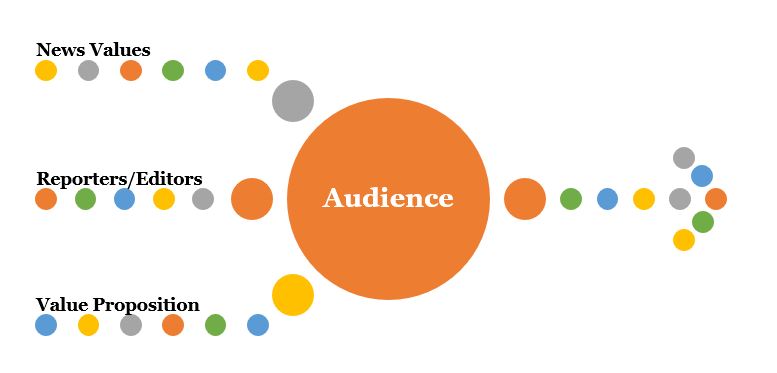
In our news values and value proposition link circus framework, reporters and editors are expected to think about the value proposition as they think about news values that guide their choice of events or happenings as newsworthy. The thinking must be done in relation to the demographics and psychographics of the potential readers, listeners and viewers.

Exhibit 1: News Values and Value Proposition Link Circus Framework

Source: Infoprations Analysis, 2021