DD
MM
YYYY

PAGES

DD
MM
YYYY

spot_img

PAGES

Home Blog Page 603

5 Best Apps to Trade Vanilla Gift Cards for Cash in Nigeria

0

Vanilla gift cards are great for online shopping, subscriptions, and digital purchases, but sometimes cash is more useful. Many Nigerians find themselves stuck with unused cards, wondering where to exchange them safely without losing value.

The truth is, not every platform that claims to trade gift cards is trustworthy. Some offer poor rates, while others delay payments or fail to protect users.

That’s why choosing the right app matters if you want a smooth and secure experience. The good news is that there are reliable platforms where you can sell your Vanilla gift cards at fair rates and get your money fast.

In this article, we’ve put together the five best apps in Nigeria, trusted by thousands of users, so you know exactly where to trade your cards with confidence.

5 Best Platforms to Exchange Vanilla Gift Cards for Cash in Nigeria

Trading Vanilla Gift Cards for cash in Nigeria comes down to trust, good rates, and convenience. Below is a quick comparison of the five best platforms, such as Cardtonic, 1minutepay, SekiApp, FlipEx, and CardCash, based on their payout speed, exchange rates, ease of use, and Google Play Store reviews.

S/N Platform Payout speed Rates Ease of use Google Play Store Review
1 Cardtonic Very Fast Consistent Clean interface, smooth process 4.3 ? (18.9K reviews)
2 1minutepay Fast Fair Simple but limited features Not available
3 SekiApp Moderate Varies by card User-friendly mobile app 4.3 ? (302 reviews)
4 FlipEx Fast Competitive Smooth interface 4.3 ? (414 reviews)
5 Cardcash Fast Decent Easy to navigate Not available

1. Cardtonic:

Cardtonic is one of the most trusted platforms in Nigeria for trading Vanilla gift cards. Its rates are fair and consistent, so you always know exactly what you’re getting without surprises.

Another big advantage is speed. Transactions are processed within minutes, so you don’t have to wait long to receive your cash. On top of that, every trade earns you reward points that can be redeemed later, giving you extra value beyond your payout.

Cardtonic also runs a referral program that pays for life. When someone signs up with your code and starts trading, you earn 10% of their transaction reward points on every single trade they do. As long as they keep trading, your reward points keep stacking, which you can later redeem as cash in your wallet.

Security is another reason Cardtonic stands out. The platform prioritises safe transactions, ensuring your gift cards and money are protected at all times.

Getting started is simple. Download the Cardtonic app from the App Store or Google Play, sign up and verify your account, then select “Vanilla Gift Card” under trade options. Enter the card details, upload, and confirm. The process is beginner-friendly and only takes a few minutes.

2. 1minutepay:

1minutepay is another reliable option for trading Vanilla gift cards in Nigeria. The platform is known for quick payouts, with most transactions processed in a short time.

Its rates are fair, though not always as competitive as some alternatives. The app itself is simple and easy to use but comes with limited features, which may not appeal to users who want more flexibility.

However, for those who value speed and straightforward trading without too many extras, 1minutepay remains a good choice. Its reputation for delivering on promises has made it a trusted option for many users.

3. SekiApp:

SekiApp offers a user-friendly mobile app that makes trading Vanilla gift cards easy, even for beginners. Its design is simple to navigate, which helps new users get comfortable quickly.
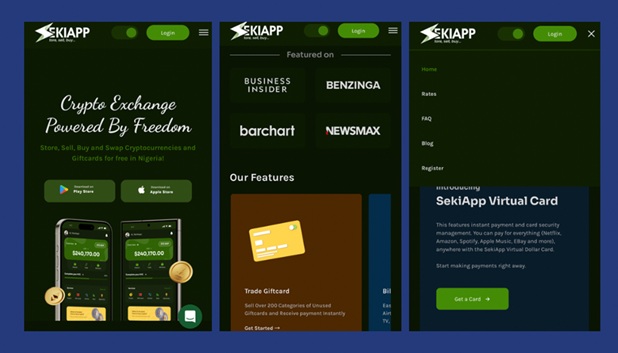
Payout speeds are moderate, so transactions may take a little longer compared to faster platforms. Rates also vary depending on the card type, which means you might not always get the same level of consistency.

Still, SekiApp strikes a balance between usability and reliability. For casual traders who want a smooth and straightforward experience, it’s a solid choice.

4. FlipEx:

FlipEx is a strong option for trading Vanilla gift cards in Nigeria, thanks to its competitive rates and quick payouts. Most trades are processed fast, giving users access to their cash without long delays.

One standout feature is flexibility. FlipEx offers both a mobile app and a website, so you can trade whichever way feels more convenient. The interface is smooth, and customer support is available if you need assistance during a transaction.

Although it’s not as widely known as some bigger platforms, FlipEx has built a solid reputation for reliability. For users looking for fair rates and speed, it’s a dependable alternative.

5. CardCash:

CardCash is another dependable platform for trading Vanilla gift cards in Nigeria. It is known for fast payouts, so users do not have to wait long to receive their money after a trade.
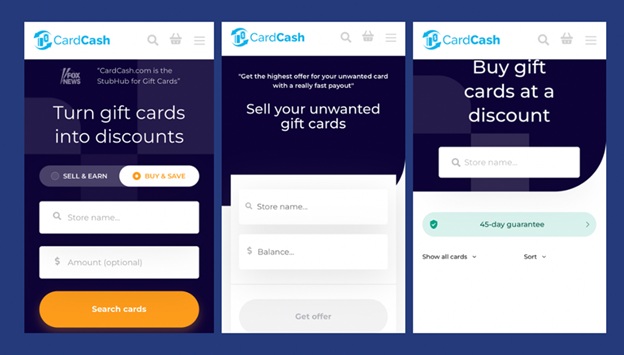
The rates are decent, although not always the highest compared to other apps. What makes CardCash appealing is its ease of use. The interface is simple to navigate, making it beginner-friendly for first-time traders.

With a smooth process and a strong reputation for reliability, CardCash is a solid option for anyone who wants quick and stress-free transactions.

Frequently Asked Questions About Trading Vanilla Gift Cards in Nigeria

  1. What is the Best App to Trade Vanilla Gift Cards for Cash in Nigeria?

The best app to trade Vanilla gift cards for cash in Nigeria is Cardtonic. The platform is fast, reliable, and secure, making it the top choice for anyone looking to trade gift cards in Nigeria.

  1. How Much is a $100 Vanilla Gift Card Worth in Nigeria?

The value of a $100 Vanilla gift card in Nigeria depends on the card type and the country of origin. On average, it ranges between ?8,000 and ?24,500. Physical cards usually sell higher than e-codes. For the most accurate value, check the Cardtonic rate calculator, which updates prices in real time.

  1. Is it Safe to Sell Vanilla Gift Cards Online in Nigeria?

Yes, it is safe to sell Vanilla gift cards online in Nigeria as long as you use a trusted and reliable platform. Always ensure you choose a service with good reviews, secure transactions, and prompt payments to protect yourself and enjoy a smooth experience.

  1. How Long Does it Take to Receive Cash After Trading a Vanilla Gift Card?

Payout time depends on the platform you use. Cardtonic is one of the fastest, with transactions completed in minutes. 1minutepay also pays quickly, while SekiApp and FlipEx may take slightly longer.

  1. Can I Trade Both Physical and E-code Vanilla Gift Cards in Nigeria?

Yes, you can trade both physical and e-code Vanilla gift cards in Nigeria. Both types are accepted, and the value you get will depend on the card category and the overall exchange rate at the time of trade.

Conclusion

Trading Vanilla gift cards in Nigeria is simple once you know the right platforms to use. Apps like Cardtonic, 1minutepay, SekiApp, FlipEx, and CardCash give you fast payouts, fair rates, and safe transactions, making the process stress-free.

Each platform has its strengths, but if you want consistent value, top security, and extra benefits like reward points and lifetime referral earnings, Cardtonic is the best place to start.


Alibaba Shares Surge as Cloud and AI Bets Pay Off, Following New Chip Development

0

Alibaba’s Hong Kong–listed shares surged more than 19% on Monday as the Chinese tech giant’s cloud computing unit drove strong quarterly results, while details emerged over its new AI chip development.

It’s the highest level for the stock since March. Investors have backed the company’s improving performance in its key cloud unit and are content with the tech giant’s investment into new areas — particularly in the so-called “instant commerce,” which has become incredibly competitive in China.

The Hong Kong rally builds on the momentum of Alibaba’s earnings report on Friday, when the company’s New York–listed shares closed nearly 13% higher.

Alibaba last week posted revenue for the June quarter of 247.65 billion Chinese yuan ($34.73 billion), marking a 2% year-on-year rise that nevertheless missed analyst expectations. On the upside, a 78% annual surge in net income came in ahead of forecasts.

The Chinese company’s cloud computing unit was a bright spot with revenue picking up by an annual 26%, which was a faster growth rate than seen in the previous quarter. Alibaba’s cloud growth has been accelerating over the last few quarters.

Like some of its Chinese and U.S. tech rivals, Alibaba has been investing in AI infrastructure and developing its own models, as well as selling AI services for its cloud computing unit. Investors see the division as key to the company’s efforts to monetize artificial intelligence, much like Microsoft or Google. AI-related product revenue “maintained triple-digit year-over-year growth for the eighth consecutive quarter,” the company said Friday.

That same day, CNBC reported that Alibaba is developing a new AI chip, which also supported the share price rally on Monday. Sources familiar with the matter told the outlet that the chip is designed for “inferencing” — the stage where AI models are deployed to perform real-world tasks such as image recognition or language processing — rather than “training,” which requires significantly larger computing power and vast data sets. The chip, yet to be launched, was also first reported by The Wall Street Journal, highlighting Alibaba’s latest move in the intensifying race among Chinese technology companies to secure homegrown semiconductors.

Alibaba’s core e-commerce business has meanwhile been showing signs of revival, while the company has jumped into China’s cut-throat instant commerce space. This is a feature introduced this year on Taobao, one of Alibaba’s main Chinese e-commerce apps, which provides deliveries of certain products in China within an hour. Investments in quick commerce weighed on Alibaba’s adjusted earnings for its e-commerce business, but investors have given the company some leeway to invest for now.

Comeback Engine After Regulatory Setbacks

The turnaround in Alibaba’s cloud and AI businesses is seen by analysts as more than just quarterly momentum. For years, the company has struggled under Beijing’s regulatory crackdown on Chinese internet giants, which began in late 2020 after founder Jack Ma’s criticism of financial regulators.

The crackdown scuttled the record-breaking IPO of Ant Group and led to antitrust probes, fines, and stricter oversight, weakening Alibaba’s dominance in e-commerce and shaking investor confidence.

At the same time, Alibaba lost ground in cloud computing to rivals like Huawei and Tencent, both of which capitalized on regulatory pressures facing Alibaba to expand their share in China’s lucrative enterprise market. While Alibaba’s cloud unit was once the undisputed leader in Asia, its growth slowed sharply during this period, raising concerns about its future as a growth driver.

But recent quarters have seen the tide turn. By doubling down on artificial intelligence — investing in infrastructure, launching proprietary models, and now developing in-house chips — Alibaba is positioning its cloud division not just as a services provider but as the backbone of China’s AI economy. The 26% surge in cloud revenue and eight consecutive quarters of triple-digit AI product growth underline the strategy’s effectiveness.

Alibaba’s push into AI and semiconductors signals that the company has found a comeback engine after years of pressure. The combination of cloud services, AI monetization, and homegrown chips offers a path for the company to regain competitiveness against Huawei, Tencent, and even global peers like Microsoft and Google, who are racing to tie their cloud businesses to the AI boom.

For the Horse To Fly in Union Bank, Feed It With Better Tech and Service

0

Wishing the horse good luck as it prepares to fly: “Union Bank of Nigeria, one of the country’s oldest financial institutions, has officially completed its merger with Titan Trust Bank Limited, following final approval from the Central Bank of Nigeria (CBN).”

Union Bank has a new opportunity because we have seen how the “elephant” [First Bank] is dancing in Nigeria. So, if an elephant can dance, a horse can fly. I truly wish the horse the best of luck because it is a good horse.

In the old Union Bank branch in Adeola Hopewell, Victoria Island, Lagos, I ran a savings account. And when I left the banking sector, with the employee bank account closed, Union Bank graciously waived some restrictions, making it possible for Diamond Bank to send me money via money market. Most banks would not have been flexible, but they accommodated me, as according to them, they knew I had left Nigeria based on a treasury bill instruction I had given weeks before.

When a horse can be that kind, that horse deserves to live stronger. The custodians must feed the horse better tech and service so that it can fly more customers. Fly better paths, horse union!

Union Bank Completes Merger with Titan Trust Bank, Marks New Chapter in Nigeria’s Banking Evolution

0

Union Bank of Nigeria, one of the country’s oldest financial institutions, has officially completed its merger with Titan Trust Bank Limited, following final approval from the Central Bank of Nigeria (CBN).

The milestone, announced on Thursday, signals not just the end of a transaction that began with a Share Sale Agreement in 2021 but also the beginning of a new era for Nigeria’s banking industry.

According to Mrs. Olufunmilola Aluko, Union Bank’s Head of Brand and Marketing, the merger consolidates Titan Trust’s agility and innovative strength with Union Bank’s 108-year legacy of stability and trust. Under the arrangement, Union Bank fully absorbs Titan Trust’s operations and assets, with the Union Bank brand continuing as the sole identity. Titan Trust Bank ceases to exist as a separate entity.

With an expanded footprint that now includes more than 293 service centers and 937 ATMs across Nigeria, as well as strengthened digital platforms, the combined bank is positioning itself to deliver greater value across retail, SME, and corporate markets.

Union Bank’s Managing Director and Chief Executive Officer, Mrs. Yetunde Oni, described the transaction as “a pivotal moment in our 108-year journey, and a launchpad for delivering greater value to our customers. By blending stability with innovation, we are better positioned to meet the evolving needs of Nigerians and to be their most trusted financial partner.”

Echoing this, the Chairman of the Board of Directors, Mr. Bayo Adeleke, framed the consolidation as “a new era of growth, collaboration, and shared prosperity. By bringing together the strengths of both institutions, we are committed to creating lasting value for our customers, shareholders, and communities while advancing Nigeria’s financial inclusion agenda.”

The bank emphasized that customers will not experience disruptions, assuring that account details remain unchanged and services will continue seamlessly. An accelerated focus on enhanced digital solutions is also underway, reflecting the wider shift in Nigeria’s banking landscape toward technology-driven service delivery.

A Backstory of Transformation in Nigeria’s Banking Sector

The Union Bank–Titan Trust merger is part of a broader restructuring trend that has shaped Nigeria’s financial industry for decades. Union Bank itself has undergone waves of transformation. Founded in 1917 as Colonial Bank, it became Barclays Bank of Nigeria in the 1920s before assuming its present name in 1979, following indigenization. For much of the 20th century, Union Bank was regarded as one of Nigeria’s “big four” banks, symbolizing stability and reach.

However, in the wake of Nigeria’s banking consolidation under the Central Bank’s reforms in the mid-2000s and rising competition from newer, tech-savvy institutions, Union Bank began to lose ground. By 2012, a recapitalization plan saw a consortium of investors led by African Capital Alliance inject funds to rescue the bank. Since then, Union Bank has fought to reposition itself in a highly competitive market dominated by GTBank, Zenith Bank, Access Bank, and others.

The entry of Titan Trust Bank in 2019—one of the youngest commercial banks in Nigeria—marked a new disruption. Despite its short history, Titan Trust quickly became a challenger, leveraging innovation, speed, and strategic capital backing to make inroads where older banks were struggling.

In December 2021, Titan Trust Bank signed a Share Sale and Purchase Agreement (SPA) with Union Global Partners Limited, Atlas Mara Limited, Standard Chartered Bank, and other core shareholders, who collectively held 93.41 percent of Union Bank’s issued share capital. The agreement paved the way for TTB to acquire 89.39 percent of Union Bank’s shares in the first tranche, with subsequent regulatory clearances confirming its majority ownership.

Its 2021 acquisition of a majority stake in Union Bank was widely seen as a bold statement of intent, signaling how younger, well-capitalized players could reshape the industry.

Implications of the Consolidation

Analysts note that the merger underscores a global trend in banking where older, legacy institutions consolidate with newer, more agile entrants to remain relevant in a fast-changing environment. For Union Bank, absorbing Titan Trust’s operational model and digital culture could accelerate its push into tech-driven banking solutions, a necessity given Nigeria’s booming fintech ecosystem and the growing demand for mobile-first services.

As the dust settles, the completion of this merger may well determine whether Union Bank can regain its stature as a leading force in Nigerian banking—this time not just by heritage but by innovation and resilience in an increasingly digital age.

Cardano Price Prediction: ADA Aims for $100 Billion Market Cap and Top 5 Ranking as Little Pepe (LILPEPE) Holders Brace for Huge Gains

0

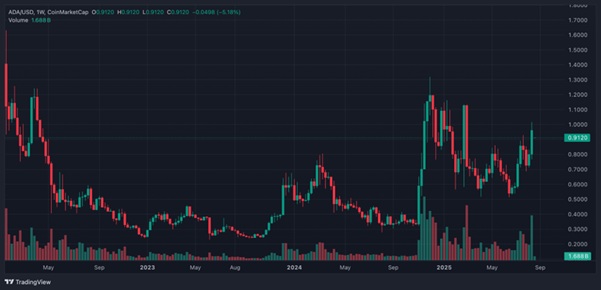
Cardano (ADA) is at $0.9298, reflecting an 8.83% increase over the past 24 hours and a trading volume of approximately $2.54 billion. Despite a slight weekly decline of 4.10%, ADA has shown impressive yearly growth, surging by 144.74%.  The latest Cardano price prediction suggests ADA is aiming to reach a $100 billion market cap and climb into the top 5 cryptocurrencies. At the same time, Little Pepe (LILPEPE) holders are closely monitoring ADA’s trajectory, anticipating huge gains as market sentiment turns increasingly bullish.

Cardano Price Prediction: ADA Targets $100 Billion

Cardano (ADA), currently valued at $0.9298, has demonstrated strong bullish momentum in recent days. With more than 65% of ADA’s supply staked, the reduced circulation is contributing to upward price pressure.

ADA Price Chart via TradingView

This structural advantage supports the latest Cardano price prediction that ADA could triple its market cap and hit the $100 billion milestone, achieving a top 5 ranking. The Cardano price prediction highlights this as more than speculation, market structure, staking activity, and technological progress provide tangible support for ADA’s push toward the top 5 rankings.

Little Pepe (LILPEPE): The Meme Coin Built Differently

While Cardano charts its path to a $100 billion market cap, Little Pepe (LILPEPE) has captured the attention of meme coin enthusiasts. Built on a dedicated Layer 2 blockchain, Little Pepe offers ultra-low fees, lightning-fast transactions, and support for decentralized applications. Unlike traditional meme tokens, LILPEPE focuses on utility and community strength, making it stand out in an overcrowded meme token landscape. From its earliest presale stages, demand for LILPEPE has been overwhelming. Starting at $0.0010, each round has sold out at record speed, with Stage 11 closing faster than expected. Stage 12 is currently priced at $0.0021, and with a projected launch price of $0.0030, early investors are already securing impressive returns.  The presale allocation of 26.5% of the 100 billion total supply has drawn in millions of unique wallets, demonstrating widespread community excitement.

Little Pepe Holders Expect Huge Gains

Little Pepe (LILPEPE) has become one of the most talked-about meme coins in 2025, with price growth potential that could soar over 67,900% from presale to peak projections. The project’s identity as “the world’s only chain where sniper bots won’t work” has added credibility among traders tired of unfair practices in other meme projects. Its roadmap showcases clear plans for expansion, with multiple utilities in the works, including NFT integrations and community-driven dApps. The project has also passed a full audit by CertiK, achieving a security score of 95.49%. This audit reinforces the trust investors place in Little Pepe, establishing it as one of the most secure meme tokens on the market.

LILPEPE’s Growing Reputation and Community Strength

Crypto experts—many of whom played roles in earlier top-performing meme tokens—are quietly supporting the project, giving Little Pepe an edge in market strategy and execution. With its listing on CoinMarketCap and increasing social media traction, the coin is quickly rising in popularity. The community-driven culture around LILPEPE is also unique. Rather than focusing purely on speculation, the project embraces humor, creativity, and strong decentralization values. From the “swamps of Solidity” to the “jungles of JavaScript,” the story of Little Pepe adds to its charm while strengthening its brand identity.

Cardano Price Prediction Meets Meme Coin Momentum

The Cardano price prediction of reaching a $100 billion market cap provides a broader bullish backdrop for the crypto space. Investors watching ADA’s progress are also allocating capital into meme coins like LILPEPE, seeking explosive growth opportunities.  As ADA advances toward the top 5 rankings, the positive sentiment could spill over into community-driven tokens that capture investor imagination. Little Pepe (LILPEPE), with its successful presale, community backing, and strong security credentials, is well-positioned for a massive breakout. Holders are bracing for gains that could define the next wave of meme coin success stories.


For more information about Little Pepe (LILPEPE) visit the links below:

Website: https://littlepepe.com

Whitepaper: https://littlepepe.com/whitepaper.pdf

Telegram: https://t.me/littlepepetoken

Twitter/X: https://x.com/littlepepetoken