


DD
MM
YYYY

PAGES

DD
MM
YYYY

spot_img

PAGES

Home Blog Page 605

Shiba Inu vs. PEPENODE: Which Meme Coin Has the Real 100x Potential?

0

New projects launch every week in the meme coin sector, and honestly, most of them vanish before you’ve even figured out how to pronounce their names.

And then there’s Shiba Inu, the old reliable that’s weathered a few crypto storms, and there’s PEPENODE, the fresh project that’s doing something pretty different from the usual meme coin playbook.

Both have their fans. Both promise big things. But here’s the question that keeps crypto enthusiasts up at night: which one actually has the juice for those legendary 100x gains?

What’s SHIB Really About These Days?

Shiba Inu used to be just another Dogecoin copycat, but those days are ancient history now. The project has come a long way since then. The team has built something that looks more like a proper crypto business now. They’ve got ShibaSwap for trading and staking.

There’s Shibarium, their own blockchain that makes transactions cheaper and faster.

The SHIBArmy community stays pretty active on social media. These folks have stuck with the project through bear markets and bull runs alike. That kind of loyalty doesn’t happen by accident. The token burns some supply with each transaction, which sounds good in theory. Less supply could mean higher prices, assuming demand stays strong.

SHIB now offers staking rewards, NFT collections, and governance voting through their BONE token. It’s not just about memes anymore. The project has real utility, even if it started as a joke. But here’s the catch – SHIB’s market cap is already massive. Getting 100x returns from here would need some serious market magic.
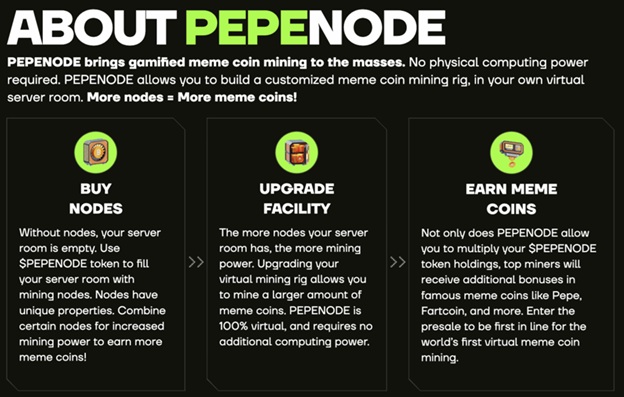
PEPENODE’s Gaming Twist on Crypto

Now PEPENODE comes along with something completely different. Instead of just holding tokens and hoping for the best, users get to play a mining game. No real mining equipment needed. No electricity bills. Just virtual nodes that you can buy and upgrade.

Think of it like a crypto version of those mobile games where you build and upgrade stuff. Users purchase virtual miner nodes and facilities to boost their mining power. The more you upgrade, the more tokens you can earn. It’s hands-on crypto participation rather than passive waiting.

Here’s where it gets interesting for token economics. About 70% of all tokens spent on upgrades get permanently destroyed. Gone forever. This burning happens as people play the game, not just during regular transactions. Plus, there’s a referral system that gives you 2% of whatever your friends earn. Not bad for just sharing a link.

The project also offers staking with estimated rewards over 3500%, though these high percentages usually come down as more people join in.

Size Matters for Big Gains

Let’s be honest about market dynamics here. SHIB already sits on most major exchanges. It has name recognition. Celebrities have tweeted about it. Your neighbor probably owns some. This mainstream acceptance brings stability, but it also means the explosive growth phase might be over.

PEPENODE starts from a much smaller base. The presale price of $0.0010325 gives early participants a chance to get in before the masses discover it. Smaller projects have more room to multiply in value.

The staking setups tell a similar story. SHIB offers steady returns through established pools on ShibaSwap. Nothing too crazy, but predictable. PEPENODE promises those eye-popping staking rewards that make people do double-takes.

Visit PEPENODE Presale

The Tech Behind Each Project

Both tokens run on Ethereum, so they work with your existing wallets and DeFi apps. SHIB has built additional infrastructure with Shibarium to handle more transactions at lower costs. PEPENODE uses Ethereum’s energy-efficient Proof-of-Stake system to keep things green.

The real difference shows up in what users actually do with these tokens. SHIB holders can vote on project decisions, buy NFTs, provide liquidity, and participate in various DeFi protocols. It’s like a Swiss Army knife of crypto utilities.

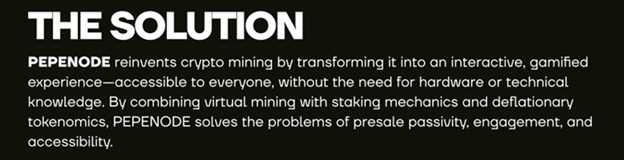
PEPENODE focuses mainly on that gamified mining experience. Virtual miner nodes simulate the mining process and generate rewards based on how much users participate and upgrade their setups. Future plans include adding more meme coin rewards and NFT features.
Getting In Early vs. Playing It Safe

SHIB has survived multiple crypto winters. It’s proven it can handle market crashes and regulatory uncertainty. The token moves with broader market trends now, which means less volatility but also less chance of those moonshot gains.

PEPENODE’s presale phase creates different opportunities. Early participants get access before public trading begins. The team plans DEX and CEX listings for Q3 or Q4 2025. New listings often create price spikes as fresh liquidity enters the market.

The presale includes anti-bot measures and fair distribution mechanisms. This helps regular people compete with automated buyers who usually dominate public launches.

Anyone curious about PEPENODE can join the ongoing presale at $0.0010325 per token. The process accepts ETH, BNB, USDT, or even credit cards through wallets like MetaMask, making it pretty simple for most crypto users.


JOIN THE PEPENODE ($PEPENODE) PRESALE NOW

 

Website    |    (X) Twitter    |  Telegram

Shiba Inu and Pepe Dollar Regain Investment Whale Interest, Here’s Why Crypto Whales Are Buying Pepe Dollar and Shiba Inu

0

The meme economy is buzzing again as whales reallocate capital into two familiar names: Shiba Inu (SHIB) and Pepe Dollar (PEPD). Long seen as a cultural staple, SHIB continues to attract whales for stability, while PEPD — still in presale — is quickly becoming the preferred growth play. The resurgence of large buyers signals renewed confidence that meme coins remain central to crypto’s next big cycle.

Pepe Dollar (PEPD): The Whale Growth Bet 

Where Shiba Inu offers security, Pepe Dollar (PEPD) delivers opportunity. Now in Stage 2 of its presale at $0.006495 with a launch price set at $0.03695, PEPD provides whales with asymmetric upside. Early allocations can translate into 5x–10x returns just by holding until launch. Beyond token economics, PEPD offers utility rarely seen in meme projects: QR-code payments, staking rewards, and an integrated meme-minting platform at Pepedollar.fun. This blend of meme branding and technical use cases has given whales confidence that PEPD is more than just a cultural flash — it’s infrastructure for the next era of memecoins.

Why Shiba Inu (SHIB) Still Holds Weight

Whales haven’t abandoned Shiba Inu (SHIB). Despite its reduced volatility compared to 2021, SHIB remains one of the largest meme assets by market capitalization. Its Shibarium Layer-2 solution continues to process billions of transactions, showing real traction even as DeFi adoption on the network lags behind competitors. For whales, SHIB represents reliability: an asset with liquidity, brand recognition, and a massive community base that will likely sustain it through future market cycles. However, the limits are clear. With a valuation in the billions, SHIB is unlikely to deliver more than 2x–5x growth, far below the meteoric runs that once defined it.

The Whale Strategy in Action 

On-chain data shows several wallets splitting capital between Shiba Inu (SHIB) and Pepe Dollar (PEPD). The logic is simple: SHIB provides liquidity and cultural anchoring, while PEPD delivers high-risk, high-reward growth. A whale might hold $5 million in SHIB as a hedge but funnel $500,000 into Pepe Dollar (PEPD) presale — a bet that even a fraction of PEPD’s potential upside would outperform SHIB’s gains. This dual-track approach reflects a broader trend of whales diversifying within the meme sector instead of putting all their weight into legacy tokens.

Why This Matters for Retail Investors 

The moves of whales often foreshadow wider adoption. Retail investors watching whale wallets are beginning to follow suit, adding Pepe Dollar (PEPD) alongside their Shiba Inu (SHIB) bags. With whales effectively endorsing the project, confidence spreads quickly across Telegram and X communities. The key insight: whales are no longer looking at SHIB alone for meme coin exposure. They’re pairing it with new entries like Pepe Dollar (PEPD) to capture both security and exponential upside.

Conclusion: Two Sides of the Same Coin 

For whales, the strategy is clear. Shiba Inu (SHIB) remains the cultural anchor with steady but limited upside. Pepe Dollar (PEPD), meanwhile, is the growth engine — the “best crypto presale” poised to deliver early investor multiples. Together, they form a complementary play that balances tradition with innovation. If this trend continues, Pepe Dollar could soon rival SHIB not just in community hype but in whale allocation, reshaping the meme coin hierarchy heading into 2026.

Join Pepe Dollar Presale:
Pepe Dollar Website: https://pepedollar.io/

Pepe Dollar Telegram: https://t.me/pepedollarcommunity

PEPD Coinmarketcap: https://coinmarketcap.com/currencies/pepe-dollar

3 Reasons Ethereum (ETH) Diamond Hands Are Buying Pepe Dollar, PEPD To revive Meme-Culture on ETH Says Top Analyst

0

Ethereum (ETH) “diamond hands”—the long-term holders who rarely sell—are increasingly positioning into Pepe Dollar (PEPD). Why? Because presale economics are compelling. Stage 2 pricing at $0.006495 offers nearly a 6× upside before launch, with the price set to debut at $0.03695. Already, $1.86 million has been raised and over 365 million tokens sold, leaving fewer than 200 million tokens in Stage 2. For ETH holders accustomed to spotting early opportunities, the upside is too significant to ignore.

Reason 2: Meme-Culture Meets Infrastructure

Ethereum (ETH) has always been home to innovation, from DeFi protocols to NFTs. But its meme coin layer, led by projects like Shiba Inu (SHIB), has lost cultural momentum. Analysts say that Pepe Dollar (PEPD) is positioned to revive Ethereum’s meme-culture with fresh energy. The project is a parody of the Federal Reserve, blending humor with functionality—offering NFT staking, gaming integration, and the Pepedollar.fun platform for minting new meme tokens. This gives Ethereum’s meme economy a structured, scalable base for growth.

Reason 3: Strategic Hedge Against ETH Volatility

While Ethereum (ETH) remains a strong long-term play—with analysts eyeing a $10,000 target—the market is volatile. ETH recently retraced to $4,352 after giving back its Powell-inspired rally. For diamond-hand holders, diversifying into Pepe Dollar (PEPD) offers a hedge: if ETH consolidates, PEPD’s presale momentum could still deliver exponential returns. This dual-track strategy means ETH remains the anchor, while Pepe Dollar (PEPD) becomes the high-growth engine. 

Ethereum (ETH) Fundamentals Support the Thesis 

Ethereum accumulation wallets now hold 24.3M ETH, showing unwavering institutional and whale conviction. ETF inflows remain strong, and ETH dominates DeFi with 65% of total value locked. Against this backdrop, meme-utility tokens like Pepe Dollar (PEPD) have a clear advantage. They allow ETH profits to rotate into high-upside plays without leaving the Ethereum ecosystem, keeping capital within its network. This synergy is exactly why ETH diamond hands are leading the charge into Pepe Dollar.

Analyst View: PEPD Could Outshine Older Memes 

Top analysts are already drawing comparisons between Pepe Dollar (PEPD) and earlier Ethereum memes like Shiba Inu (SHIB). But the difference is clear: PEPD isn’t only about hype. Its Pay-Fi layer for decentralized payments and its minting platform for new meme tokens provide staying power that SHIB never had. This hybrid model positions Pepe Dollar (PEPD) as both a meme coin and a meme-economy builder—an entirely new category on Ethereum (ETH).

Conclusion: Diamond Hands Bet on the Future 

Ethereum (ETH) diamond hands are known for patience and foresight. Their move into Pepe Dollar (PEPD) underscores a belief that meme culture on Ethereum is far from finished—it’s evolving. By backing PEPD, these investors are not just chasing quick gains but supporting a project that could redefine Ethereum’s cultural and economic layer. For those who missed SHIB’s run in 2021, Pepe Dollar (PEPD) may represent the second chance—this time with utility baked in.

Join Pepe Dollar Presale:
Pepe Dollar Website: https://pepedollar.io/

Pepe Dollar Telegram: https://t.me/pepedollarcommunity

PEPD Coinmarketcap: https://coinmarketcap.com/currencies/pepe-dollar

Pepe Dollar to Make More Ethereum Millionaires Than Shiba Inu Says Top Analyst, PEPD Shines As New Favorite on Ethereum

0

Ethereum (ETH) has entered a new phase of market conviction, with accumulation wallets now holding a record 24.3 million ETH. These wallets — largely whales and institutional buyers — are not selling but steadily building positions. This signals that Ethereum (ETH) is preparing for the next leg of its rally, with analysts setting long-term targets as high as $80,000 by 2026. Yet while ETH continues to grow as a cornerstone asset, the real millionaire-making opportunities are often found in its ecosystem tokens. One of those, Pepe Dollar (PEPD), is quickly becoming the breakout favorite.

Why Pepe Dollar (PEPD) Could Outperform Shiba Inu (SHIB)

Shiba Inu (SHIB) once captured the meme coin spotlight, but in 2025 its dominance is eroding. Analysts note that Shiba Inu (SHIB) is losing market share as new, utility-driven tokens rise. Pepe Dollar (PEPD), built directly on Ethereum (ETH), combines meme culture with utility: governance rights, NFT staking, Pay-Fi payments, and even a meme-minting platform at Pepedollar.fun. While Shiba Inu (SHIB) thrives mainly on community hype, Pepe Dollar (PEPD) is weaving utility into its DNA, making it a stronger long-term bet in the meme economy.

The Presale Advantage: Built-In Multiples For Early Buyers

The Pepe Dollar (PEPD) presale is currently in Stage 2 at $0.006495, with a launch price set at $0.03695. That’s a 5.6× multiple locked in for early participants before listings even begin. Over 365 million tokens have been sold, raising $1.86M of the $3.64M target. Whales who once poured into Shiba Inu (SHIB) are reallocating into PEPD, recognizing that early entry into meme-utility hybrids often delivers the biggest windfalls. 

Ethereum (ETH) + PEPD = The Dual Millionaire Strategy

Top analysts now argue that Ethereum (ETH) will deliver institutional stability, but Pepe Dollar (PEPD) provides the asymmetrical upside. By holding ETH for the long term and allocating into PEPD during presale, investors are stacking two powerful trends: ETH’s institutional-driven growth and Pepe Dollar (PEPD)’s viral meme-economy breakout. This dual-track approach is precisely how Ethereum (ETH) early adopters once used Shiba Inu (SHIB) to amplify gains. Only this time, PEPD has the potential to create even more millionaires.

Conclusion: The Next Ethereum Millionaire Maker

Ethereum (ETH) whales are already betting big on Pepe Dollar (PEPD), while Shiba Inu (SHIB) struggles to maintain its former dominance. With strong presale momentum, utility-backed design, and cultural relevance, PEPD is poised to become Ethereum’s next great meme coin success story. For investors, the opportunity is clear: combine ETH’s foundation with PEPD’s explosive potential, and the next wave of crypto millionaires could be minted sooner than anyone expects.

Join Pepe Dollar Presale:
Pepe Dollar Website: https://pepedollar.io/

Pepe Dollar Telegram: https://t.me/pepedollarcommunity

PEPD Coinmarketcap: https://coinmarketcap.com/currencies/pepe-dollar

Nigeria’s Private Sector Records Strongest Growth in 19 Months as PMI Climbs to 54.2

0

Nigeria’s private sector is showing signs of renewed strength, recording its fastest expansion in more than a year and a half, according to the Stanbic IBTC Bank Purchasing Managers’ Index (PMI).

The index rose to 54.2 in August, up from 54.0 in July, marking a 19-month high in new order growth and a four-month high in output.

The PMI, which has stayed above the 50.0 growth threshold for nine straight months, highlights continued improvement in business conditions despite lingering economic headwinds.

Demand Rebound and Sector Trends

The August uptick reflects sharper increases in both output and new orders, fueled by stronger customer demand and a growing willingness among clients to commit to fresh projects.

According to the survey, activity expanded in three out of four monitored sectors—services, construction, and agriculture—while manufacturing lagged. Firms responded to the higher demand by increasing staff levels for the third consecutive month. However, the pace of job creation slowed compared to July.

Purchasing activity also moderated, but remained resilient as businesses stocked up in anticipation of future growth. Significantly, companies cleared backlogs for the first time in five months, pointing to rising operational efficiency.

Despite these gains, business confidence softened for the second consecutive month. Companies cited expansion plans such as opening new branches and boosting marketing as reasons to remain cautiously optimistic about future growth.

Inflation Pressures Lose Steam

One of the key highlights of the August report was the continued easing of inflationary pressures. Input costs climbed at their slowest pace since March 2023, while output price inflation fell for the fourth month in a row—its lowest level since April 2020.

Staff cost inflation also slowed to a three-month low. Where wages did increase, they were largely linked to incentives for quicker project delivery and cost-of-living adjustments.

Muyiwa Oni, Head of Equity Research for West Africa at Stanbic IBTC Bank, explained: “The continued moderation of input and output prices suggests that inflation is likely to remain soft in the near term. This may incentivize the Monetary Policy Committee (MPC) of the Central Bank of Nigeria to adopt a more accommodative stance by September.”

Stanbic IBTC projects that headline inflation will ease further in August, to between 21.45% and 21.63% year-on-year. A sharper drop is expected by November, with inflation potentially falling to between 17.19% and 17.92%. The bank anticipates up to 150 basis points in cumulative rate cuts in 2025—a potential boost for borrowing, investment, and overall private sector momentum.

Why This Matters: Backdrop of Nigeria’s Fragile Economy

The positive PMI figures arrive at a time when Nigeria’s economy has struggled under a prolonged period of high inflation, currency volatility, and rising costs of doing business. Since 2023, businesses have faced an unprecedented squeeze from fuel subsidy removal, sharp increases in electricity tariffs, and a weakened naira that made imports more expensive.

The private sector’s resilience, as captured in the PMI, is particularly noteworthy because it signals that firms are adapting to these shocks. Still, the uneven sectoral performance—with manufacturing failing to keep pace—shows that recovery is fragile and uneven.

Nigeria’s history with inflation also complicates the outlook. Periods of easing price pressures have often been followed by sudden reversals, triggered by fuel price adjustments, foreign exchange shortages, or spikes in food prices. Analysts warn that while Stanbic’s projections are optimistic, much will depend on policy consistency and whether the Central Bank aligns monetary easing with fiscal discipline from the government.

Nigeria’s PMI and Economic Turning Points

The Stanbic IBTC Bank Nigeria PMI, compiled by S&P Global, has become one of the most reliable barometers of the country’s economic health since its launch in January 2014. Covering agriculture, mining, manufacturing, construction, wholesale, retail, and services, the index is based on surveys of around 400 private sector companies.

Historically, Nigeria’s PMI has swung in response to major economic shocks. During the COVID-19 lockdowns, the index plunged below the 50 threshold, signaling contraction across industries. Similarly, in 2016, when Nigeria slipped into recession due to falling oil prices, PMI readings underscored the depth of the downturn.

The current nine-month streak of expansion, therefore, marks an important psychological shift. It suggests that, even amid foreign exchange volatility, insecurity challenges, and uneven government reforms, the private sector is showing adaptability and resilience.
