DD
MM
YYYY

PAGES

DD
MM
YYYY

spot_img

PAGES

Home Blog Page 6108

UI VC Selection: Senate Addresses Crisis Trailing Election of Representatives

1
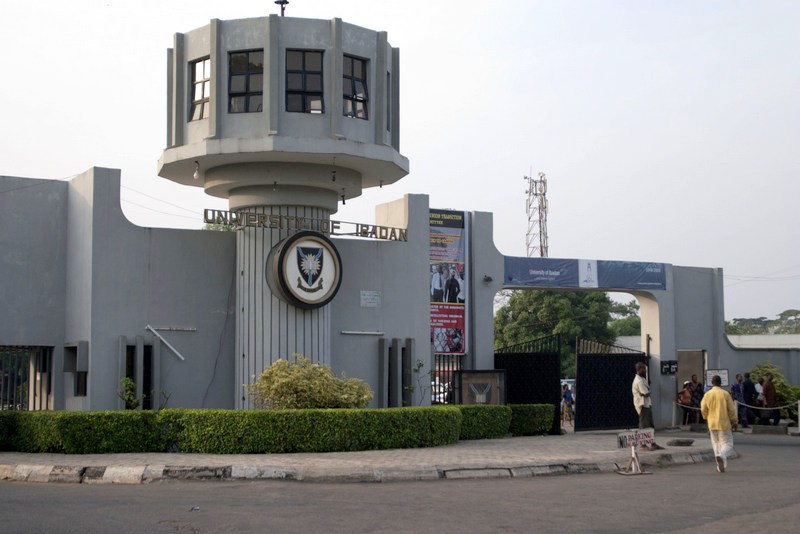
University of Ibadan, a federal university

As part of an inclusive process for the selection of a new Vice Chancellor of the University of Ibadan, the Senate of the University held a strategic meeting today to resolve the lingering crisis around the election of the representatives of the Senate. Two Professors of the University had earlier petitioned the Senate, stated that the election of Senate Representatives was fraught with irregularities.

According to information available to our analyst, the meeting was convened at the instance of the University of Ibadan Pro Chancellor and Chairman of Governing Council, Nde Joshua Mutka Waklek who directed Senate to examine the petitions filed by two Professors who had lost out in the election of members to the Senate-Council Joint VC Selection Committee.

The two aggrieved professors, Professor Ademola Dasylva (Department of English) and Professor A. Fasanmade (Department of Physiology) had challenged the process and outcomes of the election. In their petitions, they had accused the Technical Committee on e-Voting of bias, and manipulation of the process. In his second petition, Professor Dasylva as well accused the Vice Chancellor of being biased in favour of a contestant.

Four Professors (Francis Offor, Deji Omole, Abiodun Ayodele and Ayodeji Ogunjuyigbe and a Deputy Registrar (Mrs Morenike Afolabi) who were implicated in the petitions had responded to the allegations showing proofs of their innocence, and defended the integrity of the election.

The Senate meeting debated all the allegations raised in the two petitions one after the other, as well as the responses presented by the defendants.

Speaking at the end of the meeting, Professor Oyebamiji Babalola of the Department of Chemistry noted that “It was a well-attended physical, Covid-19-compliant Senate meeting. It was a very peaceful, transparent and well-conducted meeting that showed the ingenuity of UI Senate members”.

Also commenting on the meeting, Professor Wole Olatokun of the African Regional Centre for Information Science, said it was “well-coordinated in an unbiased and transparent manner. Members were given opportunity to freely express their minds on all the issues about the election petitions brought before Senate. All the proceedings were transparently and dispassionately handled from start to finish”.

Although members refused to divulge the outcome of the meeting, they noted that it was not just well-attended, it was characterised by civility and frankness.

“After every suggestion or motion, the Vice Chancellor insisted on having a dissenting opinion. He took his time. And it was after all shades of opinion had been exhausted and resolved that he moved on to another point” said Prof Ayo Ojebode, who was also at the meeting.

Members however refused to divulge the key decisions taken at the meeting in response to the pleas of the petitioners and the rejoinders.

According to Professor Adebola Ekanola, Deputy Vice Chancellor (Academic), while the University Management appreciates the importance of timely release of information to the press and to the public, it would be procedurally wrong to announce to the public or the press the decisions taken at the meeting. He said, “the University Council asked us to meet over the petitions; it is to the Council that we should report the decisions we have taken, not to the press for now.”

Another member of Senate present at the meeting, Professor of Sociology, Lanre Olutayo described the meeting as characterised by transparency, frankness and openness. In his words, the meeting was “very honest and transparent. I am proud to be privileged to be a member of UI senate”.

The significance of the Senate meeting was underscored by Professor Ayo Ojebode who said “the petitioners exercised their rights to air their grievances though their petitions should have been differently routed. The accused persons also did an excellent job, with incontrovertible proofs. I think we just had an intellectually stimulating Senate meeting. What is more important, though, is that Senate today spoke with one voice. A divided Senate is a potential disaster; we are lucky to have one strong Senate of the University of Ibadan.”

At the beginning of the meeting, the Vice Chancellor, Professor Abel Idowu Olayinka, informed Senate that the meeting should be considered a family gathering to resolve family matters. He therefore implored everyone who had anything to say to please speak out. In his words, “what matters most is that we speak frankly to the issues and remain family members after resolving it. We must eschew bitterness. Even if you have been falsely accused, please put the hurt aside for the time being.”
US Explores Options to Ban Tencent and the Ant Group

2

Jack Ma’s Ant Group and Tencent Holding Ltd have become the latest targets of Trump’s administration. The duo’s payment platforms have become popular among Americans, and now, Washington thinks it could pose a threat to the United States national security.

Bloomberg broke the news on Wednesday citing sources. The report said senior US officials are seriously debating the idea, though decision is not expected soon. The idea was discussed in a meeting held at the White House on September 30.

The sources said US officials are concerned that payments platforms of Chinese origin will likely dominate global digital payment space, and thus, give China access to banking and personal data of hundreds of millions of users.

The development however, opens a new chapter in the US vs China political playbook, and exposes both Tencent and Alipay to a future of business uncertainties.

But the move is at its early stage and will likely meet a lot of challenges. According to the report, officials acknowledged that they are yet to sort out the mechanism, and that is proving difficult to do as they are yet to find a legally sound approach. And there is no indication that the idea has been presented to Trump due to his illness. Trump tested positive for COVId-19 a day after officials met to discuss China, and the issue hasn’t made progress at senior level since then, a source said.

This is developing at a time when the Ant Group and Alibaba Group Ltd are gearing up for their blockbuster IPO on Hong Kong and Shanghai’s markets that is billed to happen simultaneously next month. The market debut is expected to surpass Saudi Aramco’s $29.4 billion last December, which still holds the largest IPO record till date.

Reuters reported that the Ant Group is seeking to raise about $35 billion in the dual IPO after assessing early investor interest and based on a higher valuation of about $250 billion or more.

The move by the US officials may stain the chance of Ant Group to reach its IPO prospectus, as it would cast doubts on the minds of investors who are already lining up to invest billions into the companies.

Although the Ant Group said in a statement that it is unaware of any administration discussions, moreover, “business is primarily in China and we are excited about our own growth prospects in the China market,” the development will affect its chances of growth in the global market.

It is not clear on what basis of authority the US officials will push the matter. However, analysis by Bloomberg showed a few options of authority that restriction measures could be implemented on.

One of the options would be to use the authorities granted under a 2019 order to protect the digital supply chain. But with the election due November 3, and its outcome uncertain, the option would likely add weeks to the administration’s timeline. Another option, which is considered speedier, would be to tread along the line of presidential executive orders that placed bans on TikTok and WeChat.

But executive orders have their disadvantages; it gives room for lawsuits, and courts may rule against the government. Just like in the case of TikTok and WeChat where the court granted injunctions halting Trump’s administration aim to ban the apps and granting temporary reprieve to the apps from being removed from online stores.

In the ruling, the court said White House may have exceeded its authority. But it may be a different story in the case of Ant Group and Tencent. One official said the administration thinks it would have an easier time in the courts if it went that route because TikTok and WeChat bans were challenged on the grounds of free-speech, a situation which is not applicable with Alipay and Tencent.

Another option on the administration’s menu is putting Ant Group and Tencent on the Treasury Department’s specially designated national list, making them radioactive for US companies, and probably, firms outside the United States, to do business with.

While everything is still under debate, any of the options would hurt the already strained relationship between Washington and Beijing.

Trump has been aiming at China on many fronts, particularly technology. A means he believes the Chinese Communist Party is using to spy on other nations and promote propaganda.

With Huawei reeling through US sanctions and TikTok and WeChat fighting to stay alive, Chinese tech companies, including the Ant Group and Tencent are learning to keep their growth mainly with China.

Trump said on Wednesday that China will pay for coronavirus, and it is not yet clear how he wants the South Asian giant to pay. However, the discussion suggests the administration is all out for a vendetta with the Chinese tech industry, if it is not as revenge for the ravages of the virus on the US, it will be as a result of China’s growing dominance in the global digital space.

SPECIAL REPORT: How Osun Government Can Approach COVID-19 Adversity in the Midst of Hidden Opportunities

0

Most African governments depend on budget estimates to finance projects. The bulk of this revenue is coming from mono source. For instance, the federal government and state governments rely on crude oil revenue for the provision of social amenities. In 2018, State Government of Osun presented a budget of N173.9 billion. In 2019 and 2020, N152 billion  and N119.5 billion were presented respectively. As of 2018 when the global price of crude oil per barrel was projected at $59.34, the state’s revenue performance ratio was 56.19% while its expenditure stood at 51.42 by the fourth quarter of the year. In 2019, when the global oil price dwindled from $61.05 per barrel in August to $59.10/barrel in October, the state’s budget performance in terms of revenue generation and expenditure were 58.97% and 57.84% respectively.

Now that Coronavirus has shut the global economy, oil price has equally been greatly affected. As of 28 April, 2020, oil price stood at $19.95/barrel. This portends a great economic woe to Nigeria and many states of which Osun is one of. Most of these states depend heavily on the Federal Government monthly allocation to run their states. This is the time State of Osun really needs to tighten up as her Q1 2020 budget performance has automatically been rendered passive. Logically, the state will not record good budget performance in the first three quarters of 2020, considering the porous state of economy of the state in the pandemic lockdown alongside the drastic drop in global oil price. In fact, the oil drop has reflected in the monthly allocations coming to the state from the Federal Government. In December, 2019, Osun received the total allocation of N3.5billion out of the N650.8billion shared among the three tiers of government in Nigeria for the month. Although it increased to N4.1 billion in January when the shared allocation increased to N716.3 billion, the decline returned in February to #3.8 billion when the federal allocation reduced to N647.3 billion.

As the reality of economic recession/downturn becomes clearer to us by the day, and considering the fragile economy of Osun State, this is the time the government needs to device creative and indigenous economic recovery plans to quickly implement after Coronavirus might have bid us farewell. Absolutely, there are hidden economic opportunities throughout the nooks and crannies of the state. All the government needs do is to evaluate this proposal that captures hidden opportunities in Covid-19 adversity in Osun, strategies for implementation as well as feasible sustainable results.

Like other states, Osun state has three senatorial districts; Osun West, Osun East and Osun Central. These districts equally have a number of federal and state constituencies making governance possible from the state to the grassroots. Its people are in millions, according to a number of sources, especially the National Population Census. Osogbo, Iwo, Ile-Ife, Ile, Ikirun and Ede are some of the cities with the highest number of people most importantly the citizens. For Osun Central, the four local governments in Ile-Ife have the highest population of 643,582 people (2006 NPC) and 886,300 (2016 projection).

A study shows that citizens of Ede reside mostly within their district, Osun West.  Osun West District comprises, Ayedaade, Ayedire, Ede-North, Ede South, Egbedore, Ejigbo, Irewole, Isokan, Iwo and Ola-Oluwa local governments.  Citizens in the state are bound to migrate to other places within the state, the country and outside. According to the International Organisation for Migration (2016) “people born in Ogun, Kwara, Osun and Imo are the most migratory, with more than 20 per cent living in other states. Only the states of Gombe, Katsina and Osun had more female return migrants than males. As heads of families, men are more likely to return to their places of origin in view of the cultural roles they perform in their homestead” than females.

Looking outward, a number of Osun indigenes are residing in other countries such as Ivory Coast, Togo, Benin Republic, Ghana and other countries in Africa, including those living in other continents of the world. Migration within the country has largely been driven by farming activities which were common features of the economy in the state (Ogunleye, Adeyemo, Bamire and Binuomote, 2013). Information has it that citizens migrate to other states and countries due to poor economic situations, most importantly lack of jobs.  Despite perceiving other places as better than the state, majority of the migrants do see reason for returning to the state and make significant contributions to its development.

However, the emergence of coronavirus outbreak has changed most intent of coming homes after several years of residing because the virus has impacted the socio-economy of their host countries or homes than expected. This has been one of the reasons for the sudden movement of the citizens to the state recently, which resulted into additional cases of the virus. Though, the movement brought negative consequence, we can also say there are opportunities in the areas of the present skill gaps, future of works and business creation in the state.

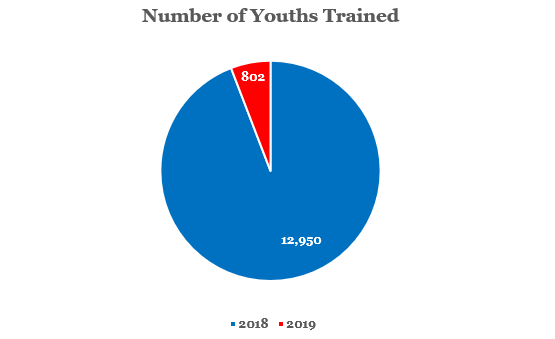
A recent estimate indicates that Osun state has over 2 million youths (59.3% of the population). Analysis further shows that each local council has 65,394 youths. Majority of these youths reside in urban and semi-urban areas in the main cities stated earlier, with little or without the skills the present and future works require. As pointed out earlier, coronavirus pandemic is a blessing for the state, considering the fact that some citizens returned home for better healthcare and possible stay.

This is pointing to the fact that the state government and private individuals need to prepare and execute socioeconomic initiatives capable of retaining them for the good of the youths and their respective towns and cities.  This is imperative because the state needs to increase the number of youths being trained through government’s agencies, local non-governmental organisations and individuals. People who have been forced to return home are most likely not to return as soon as possible because of the possible continuous impacts of the virus in their respective host states or countries.

Exhibit 1: Number of Youths Trained

Source: Newspapers, 2018-2019; Infoprations Analysis, 2020

Like their counterparts in the diaspora, Osun citizens have contributed, and are still making efforts towards economic development of their host states and countries through small, medium and large-scale businesses in sectors such as agriculture, services and manufacturing (Adesote, 2019). Between 1930s and 1960, information has it that Oyo-Osun migrant farmers played significant roles in the development of cocoa plantation in Ondo Division (Adesote, 2019). We have equally learnt that Osun citizens in countries such as the United States of America and the United Kingdom are contributing to the development of various sectors (Sanni and Makinde, 2016; Abejide, 2016; Osun Indigenes Organisation, 2018).

Since some of them have returned, the state government needs to tap their resources -knowledge and relational for more business creation in the state. Osun indigenes associations in diaspora should be identified by the relevant government’s ministry or agency and develop appropriate Diaspora Return Economic Contribution Plan (DREC), which must include creation of businesses and transferring of business skills and knowledge on the youths and adults in need of improved socioeconomic status.

Possible Sustainable Outcomes

The knowledge contribution from the citizens in the diaspora and business establishment using their skills and experiences are expected to help the state rejig the economy. Also, after the government might have identified factors pushing Osun youths out of the state and set aside practicable policies that address those push-factors, the skilled Osun youths outside the state will definitely see the reasons for coming home or investing heavily in their state. In the long-run, the effectiveness of the approaches suggested would help the state in having improved internal revenue and economic growth beyond her sole reliance on federal allocations for running the government.

Additional reports by Umar Olansile

Change and Patience Under Crisis in Nigeria: Emerging Insights from Citizens’ Politics of Reactions to the Country’s 60th Independence Anniversary

0

On several occasions, a lot has been said about Nigeria’s growth and development. From public analysts to social commentators and citizens to global political leaders, Nigeria’s growth and development are not related to her level of material, human and capital resources in the last six decades. This feeling has largely been pronounced during national and democracy day celebration, including when the country is pictured negatively in national or global reports.

Like other Presidents, President Muhammadu Buhari has been critically examined and still been x-rayed from the leadership perspective. For instance, he has been found to project his administration as people-oriented and blame, berate and condemn the past governments. Since 2015, the blame game from the President is not augur well with many public affairs analysts, social commentators, civil society organisations and foreign non-state actors. A number of citizens are not also aligned with the blame game, they want the promised change.

With this, our analyst observes that ‘change’ and ‘patience’ are under crisis in the country. It appears that the change of the President requires patience while citizens believe that the leadership approaches being used by the President are slowing the path to the realisation of the needed change in social, economic and political life of the country. In its 60th independence anniversary speech, President Buhari stressed the place of collective efforts towards the attainment of the needed change.

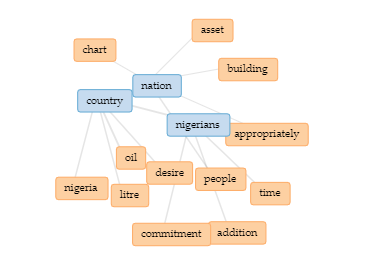
From 1,991 words, he deployed while addressing the country, Nigerians as a word was mentioned 16 times after country, which was reiterated 17 times. Our analysis further indicates that President Buhari is happy about the progress of the country in the last 60 years and expects commitment of every Nigerian towards sustainable socioeconomic and political growth.

Analysis of the first 20 people’s comments shows trends towards being happy, passionate about the country progress with constant reference to how she does not do well like her counterparts that gained independence in the same year. While the President referred to the place of the citizens in the socioeconomic and political development, our analysis reveals that citizens [in their comments] emphasized why the President must perform according to their expectations.

Exhibit 1: Link of Dominant Words in President Buhari’s Speech

Source: President Speech, 2020; Infoprations Analysis, 2020

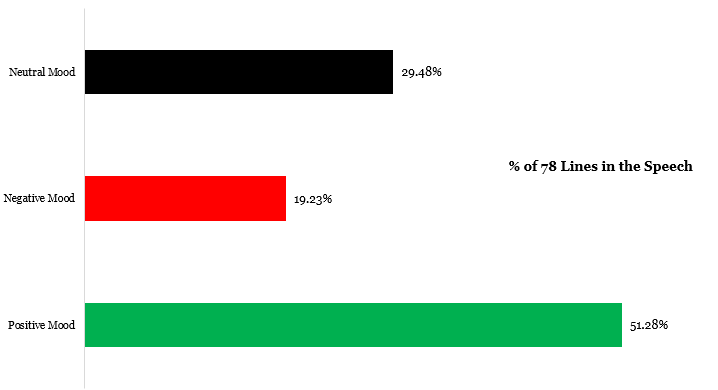
Exhibit 2: President Buhari’s Moods

Source: President Speech, 2020; Infoprations Analysis, 2020

React to the Past and Future

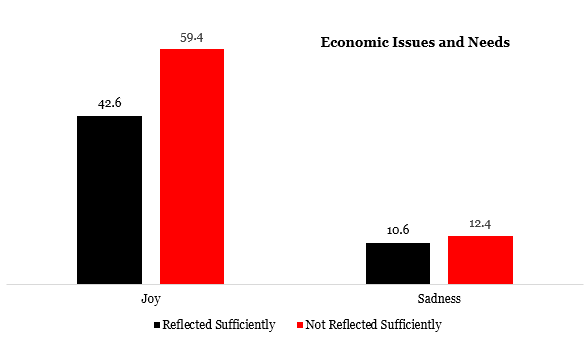
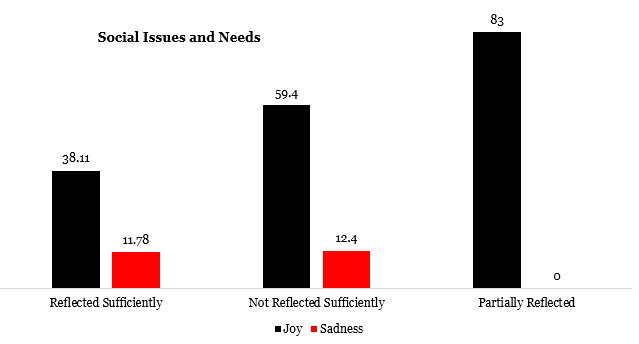
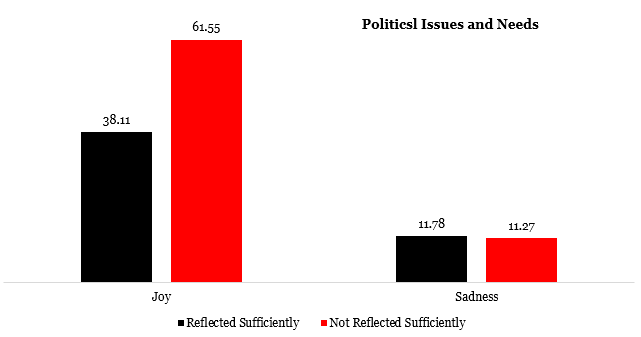
In their reactions, a total of 1,020 joy volume was found while 230 sadness volume was discovered from over 78,000 words used for appreciating the President’s efforts and express feelings about socioeconomic and political issues and needs. Analysis shows that citizens are not happy about the economic issues and needs but a little bit happy about social and political changes witnessed over the years [see Exhibit 3 to 5].

Exhibit 3: Percent of Emerging Joy and Sadness Tones in Economic Issues and Needs

Source: President Buhari’s Facebook Page, 2020; Infoprations Analysis, 2020

Exhibit 4: Percent of Emerging Joy and Sadness Tones in Social Issues and Needs

Source: President Buhari’s Facebook Page, 2020; Infoprations Analysis, 2020

Exhibit 5: Percent of Emerging Joy and Sadness Tones in Political Issues and Needs

Source: President Buhari’s Facebook Page, 2020; Infoprations Analysis, 2020

The Place of Public Perception in Discussing Nigerian Government’s Ability to Drive Growth and Progress

0

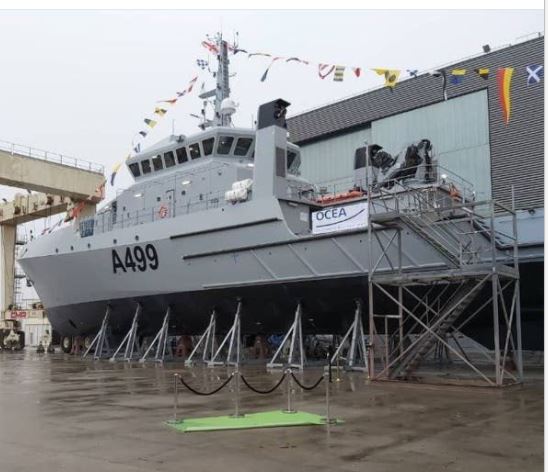
About a week ago, a Nigerian based in Indonesia who usually promotes the country and the government of Muhammadu Buhari, Nurudeen Adeyemi made a post on his LinkedIn account about the recent launch of the first ever purpose built hydrographic survey vessel by the Nigerian Navy. The survey vessel was meant to enhance maritime safety in the Nigerian water and the Gulf of Guinea. According to Adeyemi, the new vessel replaces the decommissioned NNS LANA and is scheduled to join the Nigerian Navy Fleet in 2021. In the post, he stated that Made-in-Nigeria ships and boats contributed $3.2bn to the Nigerian economy in 2019 which is 5.9% exports after mineral fuels including oil which contributes $46.7bn which is 87.1% exports.

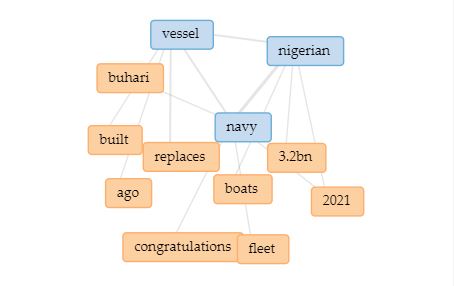
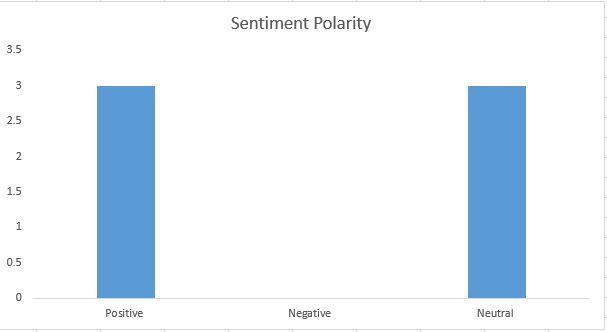
This piece of news that should ordinarily excite any Nigerian became a tug of war between the poster and his online audience on LinkedIn. However, analysis has shown that the Indonesian-based Nigerian made a post that focused on both the country and its naval forces. The post, according to analysis, paid attention to the country, the Navy and the vessels (See Exhibit 1). The post also has an equal share of positive and neutral sentiments even though the overall sentiment is positive (See Exhibit 2).

Exhibit 1: The link between the words in the post (Source: Adebiyi (2019); Adeyemi (2019))

However, comments that trailed the post suggested Nigerians are divided on this achievement. From excitement, indifference, cynicism to doubt, the emotional responses to the feat varied. Nigerians who commented on the post have shown where they lean as far as the country’s progress and growth is concerned. Ambrose Orogun Sinr was among the first to congratulate the country on the history made. ‘’I have always trusted the Professionalism of the Nigeria Navy. Congratulations!”, he said. Another commenter, Bamidele Lawal who is a Marine Engineer by the check on his profile said “I feel Nigeria as a country should be able to build a survey boat. I see the vessel it’s not more than 20 meters which means more than 6 shipyards in Nigeria including Naval Dockyard VI and Naval Shipyard PH can build a vessel of 20 meters seamlessly. It’s not so good that we celebrate a vessel made in France for Nigeria with all the Shipyards in Nigeria. The question is when this vessel needs to be maintained it would now be brought to those shipyards within Nigeria that we feel can’t build a vessel less than 40 meters.”

Exhibit 2: Sentiment Polarity of the Post (Source: Adebiyi (2019); Adeyemi (2019))


This was followed by another comment from Engr Babatunde Segun who felt wonderful with the news. He exclaimed “This is absolutely wonderful. You never know that such a thing can happen in this country. This is a good step for this administration. If we can invest more in ourselves, the sky will be the limit. Let’s develop our Engineers, many more can come. Private investors can do more than this, not only government.”

A comment from Alexandra Tchomte threw a spanner in the belief expressed in the post. She said “Please, I worked for the Nigeria’s navy. This vessel is NOT built by Nigeria. We should stop misinforming people. Nigeria has the means to build it but our politics are nonsense.” The argument began from there with people going back and forth on the issue.

In conclusion, the post has given rise to a number of questions on the level of belief and trust by Nigerians in the ability of the government to drive the country’s growth and progress.