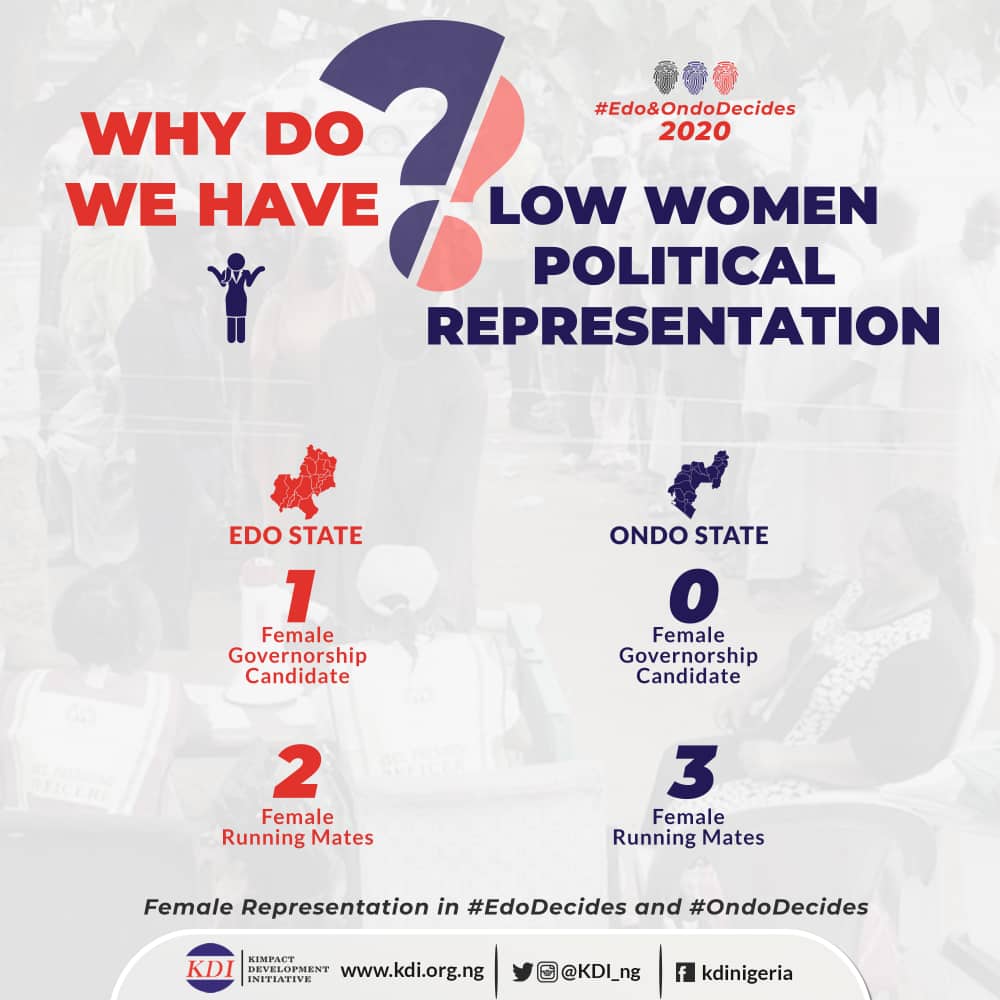
A Report has queried the low participation of women as gubernatorial candidates in the forthcoming governorship elections in Edo and Ondo States. Released by a non-governmental organisation, Kimpact Development Initiative, and titled Why do we have Low Women Political Participation, the report had a breakdown of the gender, age and qualifications of the candidates in the two forthcoming elections.
For instance, in Edo State, 14 governorship candidates are participating in the election. Out of these, only one female governorship candidate is on the list of contestants who will slug it out in the September 19, 2020 election. Analysis further reveals that two women are sharing a ticket with male governorship candidates as deputy governorship candidate.
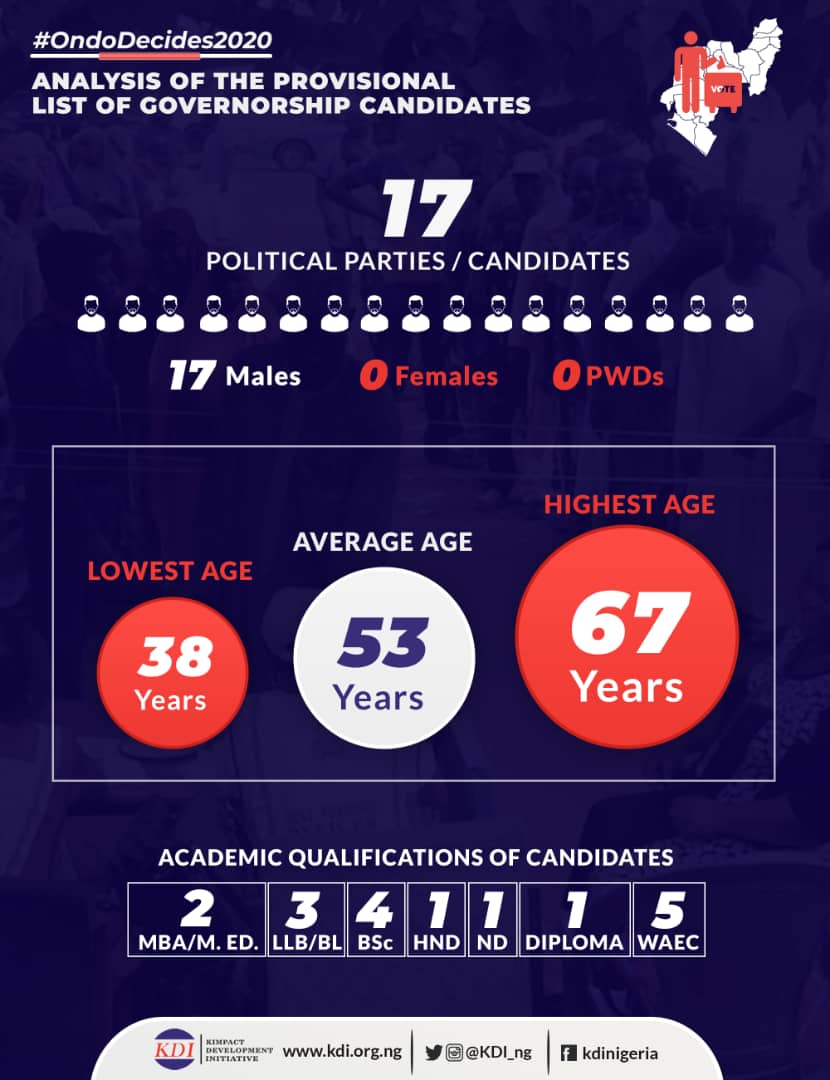
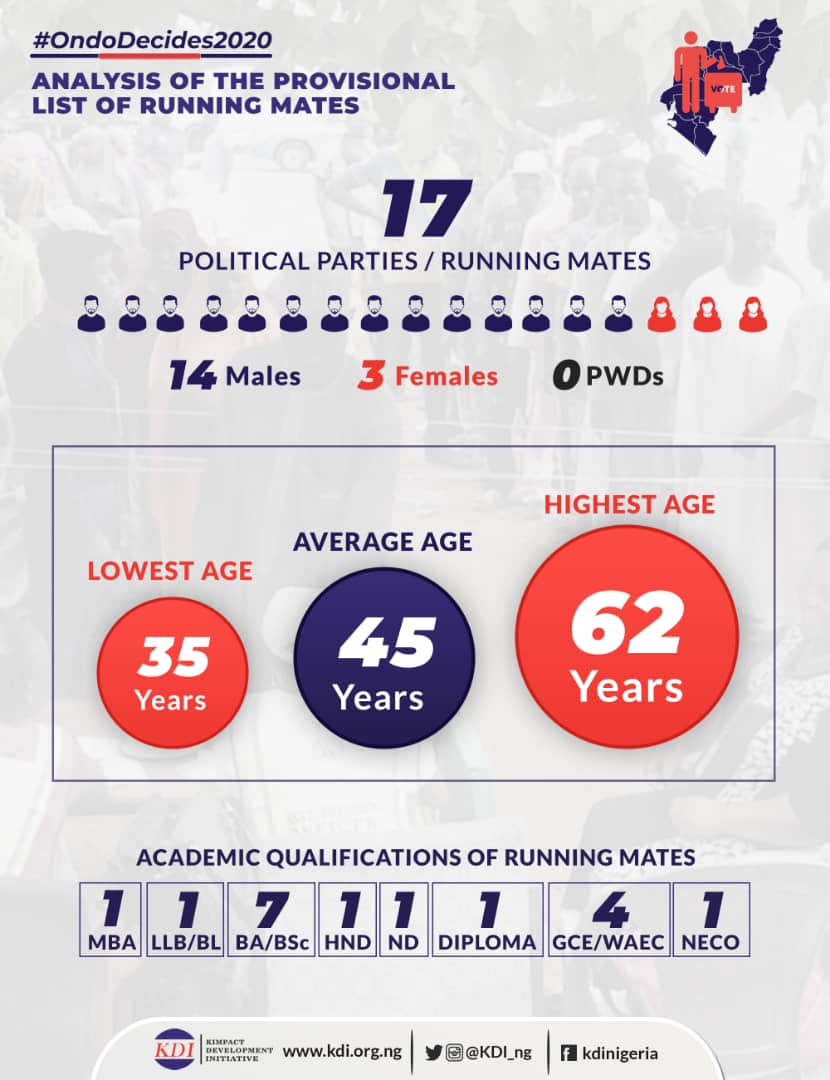
In Ondo State, insights from the report also recorded a worse dimension as there was no female governorship contestant while three of the female contestants that reflected among the 17 contenders for the governorship seat were running mates. In the state, analysis of the candidates’ qualifications breakdown indicates 5 candidates are WASSCE holders followed by 4 Bachelor’s degree holders while diploma, National Diploma and Higher National Diploma recorded 1 candidate each.
For running mates, the candidates’ qualifications records showed 8 candidates with Bachelor’s Degree, 5 candidates with West African Senior School Certificate, while 3 candidates hold Diploma, National Diploma and Higher National Diploma, respectively.
In terms of the age distribution, the governorship candidates’ ages range from 38- which was the least- to 67 being the oldest. In the running mates’ analysis of ages, the youngest of the deputy governorship contenders is aged 35years while the oldest running mate is 62 years.
Studies surrounding women participation in politics have decried factors militating against women flourishing in Nigerian politics. These problems included women’s socio-economic status, gendered economic and household inequalities, lower levels of female employment and education as well as religion or traditional practices. Others included a corrupt and patronage-based political system and violence at elections.
The previous cumulative and the new statistics about the cases of Covid-19 in Nigeria indicate a mixed trend, which shows that the country could not be said is losing or winning the war against the disease. Over the last few weeks, Lagos, Federal Capital Territory (Abuja), Kano, Oyo and Osun states recorded rising and falling cases of the disease despite various medical and non-medical measures recommended by the governments and medical experts.
A recent research, describing the disease, notes “that by April 30, 2020, the total confirmed, active, recovered and death cases stood at 1932, 1555, 319 and 58 respectively; an indication of an alarming spread. The distribution of the disease saw Lagos (the epicentre of the disease), Kano and FCT collectively accounting for 71.07% of confirmed cases, 71.45% of active, 73.67% of death, and 46.55% of recovered cases. The initial mode of spread was through contact.
As of April 30, 2020, 79% of new cases were through contact and incomplete epidemiological link, an indication of possible community transmission.” In spite of the possible community transmission, 24.43% of selected people in the Northern region asserted that COVID-19 cannot be transmitted through social gatherings and making direct physical contact with people.
But medical experts have noted that people need to maintain at least 1 metre [3 feet] distance among themselves in a crowded place. This is imperative because “when someone coughs, sneezes, or speaks they spray small liquid droplets from their nose or mouth, which may contain virus.” In addition to the physical distance initiation and maintenance, people are expected to wear face mask.
This idea when it started was strange to many. Before the disease struck, wear a face mask is not a main feature of social life in most world regions. In fact, there are regions and countries where wearing a face mask is forbidden and punishable under the existing laws. However, the emergence of the disease has made these regions and countries to change the laws, strongly enforcing wearing a face mask.
Question of Safety Over Death
In our experience, our analyst has learnt how some people in the United States of America and other countries in Europe protested against wear a face mask measure of their governments. To these people, governments are trampling upon their fundamental human rights. In Austria, the right-wing Chancellor Sebastian Kurz said that “masks are alien to our country.”
However, our check indicates that “facemasks were first prescribed as a response to a pandemic during the period of the so-called Spanish Flu of 1918/19. In Europe, the earliest laws in the 1970s and 1980s targeting face-covering, such as in Italy and Germany, referred to any device that hindered facial identification.”
Despite the effectiveness of face mask, as documented in a number of researches, it remains the most controversial measure as cases of the disease increase across the world. The controversial nature of the measure is more obvious in developing countries than in the developing ones, our analyst gathered.
Goffman has made us understand that wear a face mask should not generate arguments because wearing a face mask is not quite different from the social roles and emotional states being played and expressed by people before the pandemic. Playing social roles and expressing varied emotional states, according to Goffman, are the same with “Putting on a mask.”
Following the background information and Goffman’s view about wearing a face, our analyst explores the raging among the scholars which says “What social distancing, handwashing cannot do, to some extent face mask and lockdown can do.” This question has been examined from different settings with the consideration of COVID-19. Our analyst is interested in their findings and brought insights for stakeholders as they continue finding solutions for the total containment of the disease.
Question of Mixed Benefits
As noted earlier, an uncovered face is now a threat to the security of other people, whereas before it was a guarantor of security. When the wear a face mask policy is enforced forcefully, reports have indicated several cases of unlawful killings.
Like Goffman, Donald Low, a behavioural economist and professor, said “Putting on a mask every day before you go out is like a ritual, like putting on a uniform. And in ritual behaviour you feel you have to live up to what the uniform stands for, which is more hygienic behaviour like not touching your face or avoiding crowded places and social distancing.”
In Nigeria, a recent study depicts that “for the worst-case scenario where social-distancing, lockdown and other community transmission reduction measures are not implemented, Nigeria would have recorded a devastatingly high COVID-19 mortality by April 2021 (in hundreds of thousands). It was, however, shown that COVID-19 can be effectively controlled using social-distancing measures provided its effectiveness level is at least moderate.
Although the use of face masks in the public can significantly reduce COVID-19 in Nigeria, its use as a sole intervention strategy may fail to lead to the realistic elimination of the disease (since such elimination requires unrealistic high compliance in face mask usage in the public, in the range of 80% to 95%).”
In trials of hand hygiene, health education and masks together, hand hygiene alone was not effective, but masks were effective when used with hand hygiene. In another study, the use of face masks by the general public is potentially of high value in curtailing community transmission and the burden of the pandemic. The community-wide benefits are likely to be greatest when face masks are used in conjunction with other non-pharmaceutical practices (such as social-distancing), and when adoption is nearly universal (nation-wide) and compliance is high. Regardless of the benefits found for using face masks, a study also discovered that public interest in face mask through the Internet is not connected with spreading speed of the disease.
Not Seeing the Severity, But Masking Up Remains Top Option
From Bodija Market in Ibadan to Aba Market in Abia and Kano Market, our analyst has seen how people disregard the use of face masks. When some people used it, they either hung it on their chin or holding it. In one of his engagements with the media, Chikwe Ihekweazu, director of the Nigeria Centre for Disease Control, “We are seeing hundreds of new cases every day, with sustained community spread, in particular in Lagos. The epidemic is still increasing, but not exponentially. We are also not seeing the severity observed in other countries.”
Our analyst picked the director’s not seeing the severity observed in other countries phrase for further analysis. Analysis established that one percent of interest in understanding how to use a face mask and where to buy a face mask could be said to have contributed to reduction in number of cases between March 29 and July 13, 2020. It was 58.4% for Covid-19. These results imply the extent that people proactively engaged in understanding reasons for using face mask and silent information about the disease.
Exhibit 1: Trends of Public Interest in Face Mask, Covid-19 and Daily Cases and Deaths
Source: Google Trends, 2020; NCDC, 2020; Infoprations Analysis, 2020
Exhibit 2: Trends of Public Interest in Covid-19 and Daily Cases
Source: Google Trends, 2020; NCDC, 2020; Infoprations Analysis, 2020
Exhibit 3: Trends of Public Interest in Covid-19 and Daily Deaths
Source: Google Trends, 2020; NCDC, 2020; Infoprations Analysis, 2020
Running a supermarket in Nigeria is very challenging. Then, running a supermarket chain like the Shoprite model may be hopeless. The reason is evident: every major street in key Nigerian cities is a “market” with a security man doubling as a vendor. Then, walk a few miles, there is one market or the other. Just around Ikeja in Lagos state, you have Alade Market, the one at the junction, computer village, etc. Move a little further, there is the Oshodi Market and Ajao Estate Market. Most of those market participants do not pay tax. So, formal supermarket chains have to collect taxes and still beat them on value when quality and price are considered.
So, the news that Shoprite has failed in Nigeria should not come as a surprise. To have operated in Nigeria these years, Shoprite was running a full local government operation with its private security, waterboard, electricity, and more. But when the naira was devalued, the governance system failed as it had so much global exposure. Shoprite is a South African company.
Shoprite, the biggest retail supermarket in Africa, is reportedly leaving Nigeria after 15 years, according to the statement issued by the retail company on Monday.
“Following approaches from various potential investors, and in line with our re-evaluation of the Group’s operating model in Nigeria, the Board has decided to initiate a formal process to consider the potential sale of all, or a majority stake, in Retail Supermarkets Nigeria Limited, a subsidiary of Shoprite international Limited.
“As such, Retail Supermarkets Nigeria Limited may be classified as a discontinued operation when Shoprite reports its results for the year. Any further updates will be provided to the market at the appropriate time,” the statement said.
The South African company has experienced low sales in the past few years, prompting it to weigh the cost of staying in Nigeria among other countries outside South Africa.
More so, during a season of economic paralysis, luxury fades. Why pay N1,000 in a university canteen when you can eat in the bukka for N500? The university canteen has priced the clean tables, nice music, etc in that N1,000 meal. But the bukka did not provide those things and could effectively lower the prices of meals. Shoprite was doing great on many elements, offering standard products within a well controlled environment. But just as many students went for bukka over school canteens, Nigerians abandoned it for open markets when they raised prices to account for the currency deterioration. Naira has lost more than 20% of its value in 2020.
Like Inoted a few days ago when my friend offered a suggestion after watching our Vice President’s speech, noting “your country does not know that the only reform Nigeria needs for foreign investment now is a stable currency,” our core challenge is lack of stability in Naira. And unless we deal with this instability, Nigeria will not attain the equilibrium we expect on development.
Today, our Vice President, Prof Osinbajo, gave a speech on improving the ease of doing business in Nigeria through reforms. A friend in New York sent me the link with this comment: “…your country does not know that the only reform Nigeria needs for foreign investment now is a stable currency. Your problem has gone beyond bureaucracy”.
Shoprite may not be doing terribly bad in Naira but struggles in Rand when it reports in South Africa. It is exiting Nigeria even though it makes tons of naira. So, if a local investor acquires Shoprite Nigeria with no burden to report in USD or Rand, the currency issues could be eliminated. It is like Dangote generating more naira and still losing $17 billion in net-worth in 7 years.
I worked closely with ShopRite for years as a representative of the investors who developed the malls in finance technical role in Nigeria for ShopRite to trade in. So I can say that continued Naira devaluation killed ShopRite as mentioned by Ndubuisi. Yes, I know the numbers they make here in Naira are huge in billions but the devaluation of Naira continuously makes the tonnes of Naira worthless and made making profit difficult. Until Nigeria fix the Naira, more companies will be killed by the whipsaw called Naira devaluation.
Shoprite, the biggest retail supermarket in Africa, is reportedly leaving Nigeria after 15 years, according to the statement issued by the retail company on Monday.
“Following approaches from various potential investors, and in line with our re-evaluation of the Group’s operating model in Nigeria, the Board has decided to initiate a formal process to consider the potential sale of all, or a majority stake, in Retail Supermarkets Nigeria Limited, a subsidiary of Shoprite international Limited.
“As such, Retail Supermarkets Nigeria Limited may be classified as a discontinued operation when Shoprite reports its results for the year. Any further updates will be provided to the market at the appropriate time,” the statement said.
The South African company has experienced low sales in the past few years, prompting it to weigh the cost of staying in Nigeria among other countries outside South Africa.
Bloomberg reported that the process was initiated in November due to currency-induced inflation that compounded other business obstacles it is experiencing in the African most populous nation.
International stores (excluding Nigeria) contributed 11.6% to group sales, recording 1.4% decline in sales from 2018. South African operations contributed 78% of overall sales and saw 8.7% rise for the year.
However, COVID-19 economic downturn reduced customers’ patronage to 7.4% but the average basket spend saw an increase of 18.4%.
The decline in sales took a bigger turn in the second half of 2019, following the xenophobic attacks and the consequent retaliation in Shoprite Supermarkets outside South Africa, which forced the company to close many of them.
According to H2 financial results published by Shoprite, its Supermarket segment lost 8.1% of sales in constant currency terms at the end of the second half.
Other issues bordering on poor infrastructure and unstable currency rate aggravated the poor patronage woes. The situation, which impacts other businesses in the country, has forced another South African company to leave.
In June Mr. Price Group made plans to close its stores in Nigeria citing poor sales and high cost of operation that have placed its business at loss. Many have attributed the development to the present administration’s poor economic policies.
“Mr. Price has closed shop and left Nigeria. Apparently Shoprite too is closing its operations and leaving Nigeria after selling its stakes. Kelvin Odanz wrote on Twitter. “Very soon Multichoice and MTN might will also leave… almost a dozen big multinational companies have left Nigeria between 2015 and today, due to Buhari’s anti-Business policies.
“Buhari’s anti-Business policies affect both foreign and local Businesses. Thousands of local Businesses have been closed too. From using taxes to strangle local businesses to introducing policies that make it almost impossible for local businesses to survive.”
Shoprite had last year expressed hope of profit if there’s no further currency devaluation.
“We are confident in the absence of further currency devaluations and any unforeseen circumstances, that these operational measures will positively impact profitability,” the company said in a statement.
However, the slump in oil price resulted in naira depreciation, forcing the Central Bank of Nigeria to devalue the currency once again, exposing Shoprite and other companies to harsh exchange realities along poor infrastructure that spikes the cost of running business in the country.
The Nigerian government has been urged to maintain a unified exchange rate to woo investors and to keep existing companies. With the rate of unemployment, Nigerians are worried that more companies are going to join the train very soon if drastic actions are not taken by the government to address the forex disparity among other issues.
“If you are a foreign firm, and your profit in Nigeria grew from N364 million last year to N450 million this year, there’s no profit growth in dollars,” wrote a business analyst.
If you are an IT professional who is trying to find a place in the job market, you should consider going for a few certifications. There is no denying the fact that the credentials have become very valuable nowadays, part of the reason for this is that the companies want only the best people for the job and don’t want to use a lot of resources to train them. If you are thinking about obtaining any certificate, you need to understand that there are a lot of providers that you can choose from. Some vendors are better than others, so make sure that you make the right choice.
One of the best certification providers that you can go for right now is none other than Amazon. Its Website – Prepaway has become quite popular and people are trying to get certified in this area. The company offers many certificates but here we focus on Amazon AWS Certified Solutions Architect – Associate.
Prerequisite Exam
Earning the Exam-Labs Amazon AWS Certified Cloud Practitioner Certification Dumps – Associate certification can be one of the greatest achievements of your career, so you should exert yourself to the fullest to obtain this sought-after credential. To get your name on this certificate, you need to ace the SAA-C02 exam. It costs $150 and it is 130 minutes long. The questions are mostly based on a multiple-choice format and the candidates can take this test in one of four languages. The passing score is 720 out of 1000 and the students will need to work hard in order to get this mark. The Visit Here to Download From Website Certbolt SAA-C02 exam covers the following topics:
If you are serious about earning the Exam-Labs.com Website Here – Associate certification, you will have to work with great deliberation. One of the first things that you need to do is find the best study materials but this should not be difficult as you can find a plethora of resources online. To ensure that you understand the nature of the exam questions, you should take a look at the sample paper as it will give you some much-needed insight. No matter how hard you prepare for this test, if you don’t have some prior experience with AWS Certification , you will find it difficult to answer some questions. To nail the Visit This Website Link Click Here Now on the first try, you should take practice tests as they determine your knowledge base.
Conclusion
Click to Download Exam-Labs Here has become one of the most popular certifications that its vendor has to offer. This credential has helped many people from around the world and will also help you if you decide to pursue it. Once you earn this certificate, you will get a chance to apply for many jobs that come with a good salary. As an IT specialist, you should try to obtain as many certifications as you can, because with each of them, you will only learn new skills and become better at what you do.