DD
MM
YYYY

PAGES

DD
MM
YYYY

spot_img

PAGES

Home Blog Page 6248

Improving Cybersecurity for Small and Medium Scale Companies

0

Research has shown that over 60% of the cyber attacks in the last five years were targeted at SMEs (small and medium scale companies). This negates the notion that cyber attack is majorly targeted at large and famous companies. In fact, a Start-up company’s data was mischievously deleted by an angry ex-employee. So it is important that more than ever before SMEs should invest and pay more attention to cybersecurity. 

In this article, I will point out some important things for SMEs to know in securing the data in their hands. 

There are different data a business would have. They include :

  1. Trade Secrets, company’s internal communication, transactions and other important details which may or may not be available to the public. 
  2. Employee’s data, Recruitment process data(cv and cover letters)
  3. Personal data from clients, customers and dealers gathered in the day to day activities of the company. 

We must know that the majority of the Data protection regulations is applicable to 2 and 3 above. i. e. NDPR, GDPR and others do not regulate number 1 above. That is to say that the data protection regulations compel you to secure the personal data in your hands as a business.

However, some sectors of the economy enforce the security of the company’s data e.g. the financial sector in Nigeria, regulated by the Central Bank of Nigeria, has a cybersecurity regulation.

Now, SMEs cybersecurity is aimed at securing all the data in SME’s hands whether personal or not. Let’s look at simple cyber security tips for SMEs.

  1. Infrastructures : No matter how small the business is, it sure will have devices where data are stored whether artificially or manually. 

If manually, shelves and locker rooms must be properly secured and access should be given to only trusted employees. 

If artificially, whether cloud based or on devices, access should be limited. Remember to backup all folders offline and possibly off-site. 

  • Use updated devices.
  • Restrict devices to be connected to office PCs (Install security softwares on the devices if to be connected to PC)
  • All softwares in use should be up to date. 
  • Install strong Antivirus and Anti-malwares. (Don’t go for free products, nothing is free even in Freetown) 
  • Have a good internet firewall 
  • Do periodic assessment of devices 
  • Have proper password management practices.
  1. Policy

There may be sector specific cybersecurity policies in your business sector, find out and comply. Nevertheless, there is a need to have internal information security policies. These policies include but not limited to the following:

  1. Password Protection Policy
  2. Software Update Policy 
  3. Clean Desk Policy 
  4. Technology Equipment Disposal Policy 
  5. Email Policy
  6. Data Breach Response Policy Etc. 

Contact your infosec lawyers for more info on policies.

  1. Human Resources 

Cyber security awareness of the employees is of utmost importance. Since employees are the ones who interact with data both online and offline, employees must be well informed on proper steps to discover phishing emails, identify fraudulent links and take other cyber precautions while online. Remember, If you build a strong firewall don’t forget to build a strong human wall. Continuing education of employees is key! 

Note the following points:

  • Remove ex-employees access to facilities, devices and accounts. 
  • Have policies on how employees deal with data, softwares, password management etc. 
  • Having an internal IT (infosec) team (you may outsource the same to a reputable company) is key. 
  • Ensure employees sign a non disclosure agreement in order to prevent future leak of trade secrets.
  1. Managerial Decisions

Management must be properly aware of the importance of cyber security. They must be ready to make technical and financial decisions with cybersecurity of the business in consideration. Ensure compliance with information security policies 

Management must also ensure that threats and breaches are handled technically and properly. Be ready to spend on cybersecurity because you will pay more in case of cyber breach. 

  1. Cyber Insurance

Cyber insurance covers business risk in event of network failures and breaches of personal data. This may be a new area in most insurance companies but if your work is mostly online, you may need to insure against cyber risks you never can tell. This may sound like an expensive plan but talk to your insurance company, they can work out something for you. 

Note that if it is a risk it is insurable, cyber risks are insurable. Get a cyber insurance cover today. 

Conclusion 

Finally, there are so many things to be considered in cybersecurity and one of it is time. You can’t postpone attending to a threat. Neither should you postpone updating of software. Be on time. 

Cybersecurity is not about the length of the business but Cyber Strength
UK Bans Huawei

0
Most parts of the world have been pushing to cage Huwaei

The United Kingdom has joined the list of countries to kick Huawei out of its plan for 5G roll out. Telecom operators in the UK, such as BT and Vodafone have been given until 2027 to rid their 5G equipment of any Huawei component.

The UK government announced this on Tuesday following a series of security questions that have characterized Huawei presence in Europe. The US has been mounting pressure on its allies, including the UK to shun Huawei 5G services. the United States banned Huawei in May from using its software and chips. Digital and Culture Minister Oliver Dowden said the development has created uncertainties that ruined the trust between the government and Huawei.

“Given the uncertainty this creates around Huawei’s supply chain, the UK can no longer be confident it will be able to guarantee the security of future Huawei 5G equipment,” Dowden said.

The decision has put the UK on the side of Trump’s administration, and may start a trade conflict between them and China.

In January, London said in a decision that gave Huawei a lifeline in Europe, that the Chinese company would be allowed to operate limited 5G services. The decision however, didn’t go down well with the United States government. Secretary of States Mike Pompeo threatened to stop sharing intelligence with Britain, if it allows Huawei to carry out its 5G roll out.

Since then, the US has applied further sanctions on Huawei, restricting chipmakers in the United States from supplying Huawei with chips, a decision that’s believed to have crippling effects on the embattled company.

The Huawei ordeal which is borne out of China censorship laws has escalated throughout the west. Huawei said the UK’s decision is “bad news for anyone in the UK with a mobile phone.”

Huawei’s spokesperson Eid Brewster added that “it threatens to move Britain into the digital slow lane.” And “regrettably our future in the UK has become politicized; this is about US trade policy and not security,” he said.

Huawei has a 20 years relationship with Britain that has seen the development of 2G, 3G and 4G. Officials are warning that Huawei’s ouster would add significant cost to the 5G infrastructure. The British authorities set the 2027 deadline to curtail the cost of the decision to remove Huawei, as major part of the country’s 5G infrastructure has been developed by Huawei.

Officials said besides the additional cost the 5G roll out will incur without Huawei, it will take two more years, and the 5G wireless must be built on top of existing networks that Huawei was instrumental in constructing to reduce the risk removing its gear would bring upon the security and resilience of the network.

Besides the security concerns that have been at the center of Huawei’s troubles, the US feels intimidated by the influence of the Chinese telecom industry, particularly in the 5G deployment. It is seen as a failure of Western industrial policy.

Huawei’s lead roles in providing towers, masts and critical equipment needed to build wireless networks on the fifth generation technology has come cheaper than that of every other company.

Trump has been calling on US allies to use Sweden’s Ericsson and Finland’s Nokia in their 5G roll out, but they come at higher costs. Moreover, many western countries have other trade interests with China to protect. Germany has a huge automobile market in China that it is seeking to protect by allowing Huawei to lead its 5G roll out.

But the US’ chip and software sanction on Huawei has armstronged many of the Western countries, forcing them to review their decisions on Huawei. The telecom giant’s inability to access chips and software from US producers, including TSMC spells doom.

“Based on the current direct export rule that the US put on, I really think that Huawei’s 5G equipment business is in grave danger,” said Jefferies analyst Edison Lee.

But there is more than that. China’s annexation of Hong Kong has stirred countries to reconsider their view about the South Asian country. Considering freedom of speech and internet freedom which China censorship laws have long stood against, the development in Hong Kong, is believed to be another reason why the UK has chosen to ban Huawei.

It is not clear if there is going to be retaliation from Beijing, what is clear is that the UK’s decision has set a trajectory that other countries who have been sitting on the fence will follow.

It has also opened an opportunity for both Nokia and Ericsson to expand their 5G technology. Nokia said it has the “capacity and expertise to replace all of the Huawei equipment in the Uk’s networks at scales and speed. Arun Bansal, Europe and Latin America president for Ericsson said the company “has the technology, experience and supply chain capacity” to help the United Kingdom reach its 5G goals.

Qualcomm Invests $97 Million in Reliance Jio As the Tech World Turns Attention to India

2

Qualcomm has thrown its full weight behind Reliance Jio with $97 million investment equity to acquire 0.15% stake in the Indian telecom operator.

Reliance Jio has been ambitious in its quest to dominate the telecom industry in India. Its agility has attracted a lot of investment interests. It has raised more than $15.7 billion in four years, with Facebook being the highest stakeholder with $5.7 billion followed by Vista Equity Partners and Saudi Arabia Public Investment Fund who staked $1.5 billion respectively.

Qualcomm has become the latest to join the army of investors under Reliance Jio’s command. Qualcomm said its aim is to help Jio platforms “roll out advanced 5G infrastructure and services for Indian customers.”

In less than four years, Reliance Jio has gained over 400 million users in India to challenge other big names in the telecom industry, including Bharti Artel and Vodafone Idea.

India is the second largest market for telecommunication in the world, and Reliance Jio has exerted dominance in the country by offering cut-rate voice and data plans. It has maintained Average Revenue Per User (ARPU) that equals those of its rivals and made it the most valuable company in India.

Reliance Jio also operates a number of digital services that includes music, live TV, movies streaming and the recently added video teleconferencing. These services have made it a darling to high profile investors like Facebook, Silver Lake, General Atlantic, Intel etc. selling 25.24% stake within a short period.

With the host of services in its domain, Reliance Jio has delved into 5G roll out and Qualcomm believes it has what it takes to offer the best services in that terrain.

Steve Mollenkopf, chief executive of Qualcomm is hoping to use 5G to give Indians a new set of experience.

“With unmatched speeds and emerging use cases, 5G is expected to transform every industry in the coming years. Jio platforms have led the digital revolution in India through its extensive digital and technological capabilities. As an enabler and investor with a longstanding presence in India, we look forward to playing a role in Jio’s vision to further revolutionize India’s digital economy,” he said.

Apart from its strategies that have attracted millions of mobile subscribers, Jio is believed to be enjoying special treatment from the government. Reliance Jio is owned by India’s richest man, Mukesh Ambani, who is a close friend to the ruling party. It is believed that his relationship with the authorities is driving a lot of investors to stake a claim in Jio, with the belief that it would lower the regulatory burden they currently face in India, according to investors who spoke with TechCrunch.

Another factor that has put not only Jio but also India on the spotlight is China’s trade war with the US that is gradually becoming a global crisis. Many companies are pulling out of China, and are looking at India as a destination.

On Monday, Google CEO Sundar Pichai announced a $10 billion internet investment in India. The plan is to make the internet affordable and to promote digital economy in India by enabling access to information in every Indian language via tech and the telecommunication industry.

“This is a reflection of our confidence in the future of India and its digital economy,” Pichai said in a statement. “India’s own digital journey is far from complete. There’s still more work to do in order to make the internet affordable and useful for a billion Indians … from improving voice input and computing for all of India’s languages, to inspiring and supporting a whole new generation of entrepreneurs.”

The $10 billion investment fund is aimed at improving the tech sector for the next five to seven years through a combination of equity investments, partnerships, and infrastructural development.

India’s internet population has topped over 700 million and there are yet many to be enrolled. With the recent interest in India, the country seems keen on using the opportunity to unseat China from its dominance position in the smartphone market. China dominates India’s smartphone market where Alibaba and Tencent are the biggest investors.

India’s Prime Minister Narendra Modi has been on ‘grow India campaign’, and the recent border conflict between India and China offers an opportunity for the country to implement its digital policies and limit reliance on Chinese firms.

The US chipmaker Qualcomm appears to have read the handwriting on the wall and moved into position to establish a robust digital network in India.

“Qualcomm has been a valued partner for several years and we have a shared vision of connecting everything by building a robust and secure wireless and digital network and extending the benefits of digital connectivity to everyone in India,” said Ambani.

Four Cornerstones of Innovation: Mapping of MultiChoice DStv

0

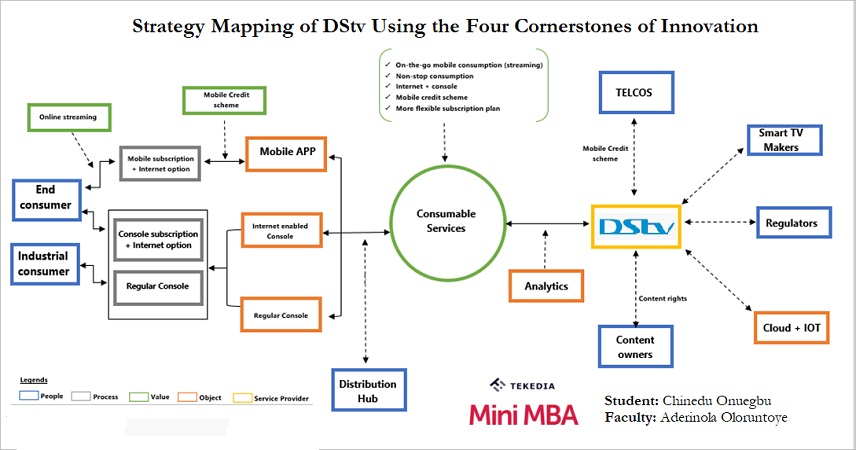
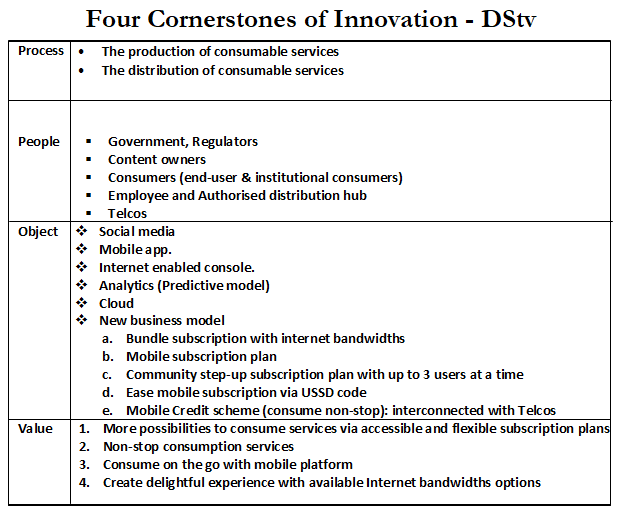
Today, one signed a contract after his innovation analysis on Andela made it into the right hands. And then this. I have the approval of Chinedu Onuegbu to share how he has examined DStv business, using a theory developed by our Faculty, Aderinola Oloruntoye. This is part of his challenge assignments in Tekedia Mini-MBA.

The picture and table were produced by Chinedu. Our learners are looking at their companies from innovation-angle, and great things are happening in companies. Make sure your company is sending staff to Tekedia Institute.

“Innovation happens when the basis of competition moves”… Professor Ndubuisi Ekekwe. I put together insights from the ongoing Tekedia mini-MBA program to craft this strategy map for DStv using the four cornerstones of innovation developed by my faculty Aderinola Oloruntoye. The idea here is to grow the consumer base of DStv by utilizing new revenue models and through digital execution. John Ugbe I am glad to be participating in the ongoing Tekedia mini-MBA program. (From Chinedu Onuegbu at LinkedIn)

Tekedia Congratulates Our Faculty, Taiwo Abraham, for Inclusion in PMI Future 50

0

Tekedia Institute is proud to congratulate our Project Management Faculty, Taiwo Abraham, PMP, for inclusion in  Project Management Institute’s Future 50. The Future 50 recognizes young project management professionals who are changing the future of work,  and transforming the workplace through collaboration, inclusion, and purpose.

In Tekedia Mini-MBA, Taiwo will lead a session on Effective Project Management and you can count that a high-ranking leader in the Board of a global project management organization will provide the template on how to lead, execute and deliver great projects. His lecture is a masterpiece across all domains of project management.

Congrats Taiwo, from all of us at Tekedia Institute.