DD
MM
YYYY

PAGES

DD
MM
YYYY

spot_img

PAGES

Home Blog Page 6280

Trans-Atlantic Trade War Looms As The US Backs Out of Negotiation With The EU on Digital Tax

0

The quest to tax online tech companies in Europe suffered setback as the US President Donald Trump withdrew from the international negotiations on the best way to effect the taxation.

There has been years of long talks on how to tax multinational corporations such as Amazon, Google and Facebook in countries outside North America. Members of the European Union have been leading the talks, hoping it would materialize to a consensus until the Trump administration abruptly left the negotiation table.

The push to get the tech giants to pay taxes for their online services in countries outside the US was intensified by the outbreak of coronavirus pandemic. As many businesses were forced to close in a bid to contain the spread of the virus, many countries, especially in Europe turned attention to big tech companies whose businesses are online.

But the US government made a sudden turnaround from the negotiations. Treasury Secretary Steve Mnuchin wrote a letter to the finance ministers of France, the UK, Italy, and Spain, saying that negotiations were at “impasse,” threatening to retaliate “with appropriate commensurate measures” against any country that attempts to unilaterally Impose digital services taxes on US-based tech companies.

“The United States remains opposed to digital services taxes and similar unilateral measures.” Mnuchin wrote in his letter. “As we have repeatedly said, if countries choose to collect or adopt such taxes, the United States will respond with appropriate commensurate measures.”

EU leaders have expressed their disappointment at the sudden turn of events, and many fear it could lead to trans-Atlantic trade war. French finance minister Bruno Le Maire said the US backed down when they were close to sealing a deal on digital taxation on only companies that offer hope in the midst global health crisis.

“We were inches away from an agreement on digital taxation at a time when the digital giants are the only ones in the world to have benefited immensely from the coronavirus crisis,” he said.

European capitals, Paris, Madrid, London and Rome led the campaign to tax the tech companies. They said that US-based tech companies are making enormous gain from the European markets while making little contribution to the public coffers.

But Mnuchin, in his letter said that move is premature, and “a distraction” considering the health crisis that every country around the world is battling right now.

“Attempting to rush such difficult negotiations is a distraction from far more important matters. This is a time when governments around the world should focus their attention on dealing with economic issues resulting from COVID-19,” he said.

The US said they would resume the talk later in the year, but European countries seem eager to move on with the taxation plan. The UK Treasury said on Wednesday that British law empowers them to do so. The tax proposal will take effect in 2021.

The Financial Times reported on Thursday that the Organization for Economic Co-operation and Development (OECD) had proposed a compromise with two pillars. The first suggested countries would be allowed for the first time to have some rights to tax profits made on the basis of sales in their jurisdiction. This means that the US will have equal right of taxation on European tech companies operating in the US soil.

The second pillar was that there would be a global minimum corporate tax rate to prevent countries from lowering corporate tax rates in an attempt to shift company headquarters to their jurisdictions.

Mnuchin said negotiations based on the second pillar are still on the table, but the US would want more time as the focus is on COVID-19 for now. But it appears that the US is buying time to conduct an investigation on digital tax plans of European countries to ascertain the measure its retaliatory response will be if they go ahead to impose it on US-based tech companies.

Le Maire said on Thursday that the US decision to back out of negotiation is a “provocation” for European countries negotiating in good faith. He added that France will go ahead to reimpose its suspended 3% tax on digital services if OECD nations fail to reach a deal at the end of the year.

“So it is a provocation… to all the citizens of the world who say that it is still legitimate for all the digital giants to pay their taxes. It is also a provocation to the US allies. What is this way of treating US allies- the British, Spanish, Italians, French by threatening us with sanctions?” he said.

The New York Times reported on Wednesday that many European countries are already rolling out plans to impose an unfriendly tax regime on the US tech companies.

The report said: “Several European countries, led by France, have been rolling out digital taxes, which would fall heavily on American internet companies. Italy, Spain, Austria, and Britain have all announced plans to levy digital taxes, which impose duties on the online activity that takes place in those countries, regardless of whether the company has a physical presence.”

But Spanish government spokesperson, Maria Jesus Montero said the intent of the tax plan is not to damage the interest of other countries.

“We are not legislating to damage the interest of other countries. We are legislating so that our tax system is orderly, fair, and adapted to current circumstances,” he said.

The idea has been to make tech giants pay taxes everywhere their products are consumed. That would amount to billions of dollars in revenue. If the EU succeeds in implementing the digital tax, many other countries will follow suit.

Nigerian Finance Minister, Zainab Ahmed said earlier in the month that the federal government has plans to introduce digital tax targeting social media and ecommerce companies offering products and services in Nigeria.

If the EU countries defy the US’ threat and impose the tax, it will trigger a new global digital tax regime that will slash the earnings of tech giants who have had it free for years.


Registration Continues for Tekedia Mini-MBA

0

Registration continues for Tekedia Mini-MBA; early bird benefits end June 22. Class begins tomorrow. We also report that we have dozens of Non-Resident Fellows (NRF), industry subject matter experts, to help our Learners on the journey. With our Faculty and the NRF,  Tekedia Institute is very confident that this business management journey would be amazing.

Good People, registration continues on Tekedia Mini-MBA.

Register if you have not done so; click here.

https://www.tekedia.com/mini-mba-2/

The Challenge of a Nation

2

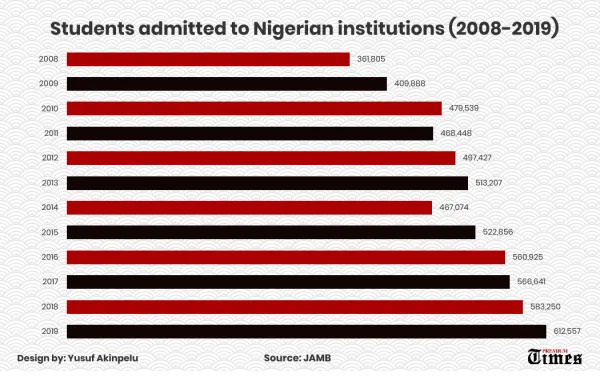
In Fall 2019 Semester, above 18.2 million students enrolled in U.S. post secondary educational systems. When you add the Spring and Summer of that year, you could be hitting close to 25 million students. In Nigeria, in 2019, two million applied for post secondary education but only about 613,000 enrolled due to mainly limited space; Nigeria has capacity for 600,000 students in our post secondary schools. The U.S. has a population of 328 million, Nigeria has 200 million.

If you run the numbers, you will see the massive gap: A 328 million-nation sends 25 million to post-secondary schools; another of 200 million people does only 613,000! Yet, we do read those – “Africa will leapfrog the West”, “It’s our century”, etc – because we are making mobile apps. But in reality, close to one million students stay home because Nigeria does not have space for them, even when they have passed the entrance exam and meet other requirements.  Certainly, online education which removes the challenge of space should be considered as part of the future to fix the paralysis.

Nigeria needs to fix this challenge. It is an unfortunate career ceiling on the millions of our young people. Do not tell me there are no jobs for graduates upon graduation. Sure, that is unfortunate but the core reason for going to school is not to find jobs, but to liberate the mind. We need to make space available!

Across all the educational institutions in Nigeria, two-thirds of about two million Nigerian candidates who applied for tertiary education in 2019 were not admitted, according to the JAMB.

Data from the Joint Admissions and Matriculation Board shows that this is not because they did not pass, but because there is not enough room for all of them.

While about two million students applied for the Unified Tertiary and Matriculation Examinations and Direct Entry, the country’s institutions had a target of 600,000, but they ended up admitting 612,557 as of June.

The admission data released by JAMB shows that the nation’s universities admitted a total of 444,947 students; polytechnics and monotechnics, 96,423; colleges of education 69,810; and innovation enterprise institutions, 1,377.

Meanwhile, of the two million students who applied, a little above 1.7 million scored 140 and above, the cutoff.

Pollstalker: The Essential Services you Need in a Digital Product

0

 Even some software and digital companies had business limitations in this pandemic period. We see how the shared business model or the uberisation business model was hardly hit. That happened because some digital companies are partly digital and partly offline in operation.

 So, while the digital component is usually the software technology, the offline component is usually the economic agents that need to come together physically for business to take place.

 This was the problem Codecitty also faced in this pandemic disruption. The start-up was testing a shared economy business model idea when the pandemic came to disrupt the fabric of the idea. According to one of the co-founders, “What we needed to do was to pivot and innovate by  leveraging digital tools.”

 As the World Economic Forum highlighted remote working as one of the business trends that a sustainable model can be built on, a business model that will run  remotely must completely be a digital business. So, Codecitty pivoted to  remote work policy and developed a digital platform business called Pollstaker.

 This analysis is about how this start-up innovated with pollstaker in order to adopt the remote work policy that will cut the cost of operation for the business. We shall analyse how the pollstaker digital platform works and how it can benefit you.

 Let’s get started.

 The Value Proposition of Pollstaker Business Model

The platform was developed with this in mind; a business can run fully digital without a physical contact with the target market and still be profitable. So, the platform value proposition is to use this digital platform to solve problems that are associated with education, unemployment and online shopping directory.

 With these value propositions, the team working on the business can maintain the platform from different regions of the world remotely but with collaborations.

 The Offerings of Pollstaker Business Model

Tech or digital business business models thrive on the freemium model as a marketing strategy. That is how Linkedin, Google, Youtube, Facebook etc operate. But, from the business perspective, Freemium is not free but a means to an end, the end is to generate  revenue.

The offerings of the Pollstaker platform are collectively called “Pollsuit”. A suit where you can access three key offerings; education offering, tech job offering and lowest product search directory.

  • Educational offering:

This platform is a community of people that aspire to study in other countries. The market targets are always in search for scholarship, fellowship and grant information to further their education in degree level, masters level and Phd level.

So, the platform provides free and credible information to these target markets. Though, international travel has been restricted but this supports remote working.

  • Online Shopping Offering:

This section of the platform is a product online directory which makes it from a business online directory. Lowest price product can only be found in this section. The offering is to list products that have the lowest price so that shoppers can always go there to search for the product with the lowest price in a city and the shop that sells it.

Retail stores, malls and supermarkets can list their products on this platform for people to search and make purchases.

It is a search engine for products with lowest prices in major cities of the world.

  • Tech Job Offering:

Many employees have lost their job and sources of livelihood. While there is social distancing, there are certain skills that can make you employable, the digital skill. So, Pollstalker jobs portal is a niche specific job portal for just tech and digital jobs.

The platform is updated with credible tech, software and digital skill job vacancies across the world. The platform also helps to recruit for businesses that want the best brains on their tech team.

Visit the platform to explore and benefit from the great value of the offerings.

Pollstalker is one of the products of Codecitty. Codecitty is a software/digital company that provides B2B and B2C software solution services. This period ,this startup is committed in pivoting businesses from brick and mortar operations to digital operations through their mobile application development, website development and digital marketing services.

 To help others, the startup demonstrated by helping itself to pivot into a fully digital company that can support remote working policy. The start-up has applied the same strategy to help other businesses transition from brick and mortar to online and digital businesses.

Happy Father’s Day

0

It is certainly the top job for any man. A job description that requires 24/7 commitment: to raise little angels to become men and women who serve communities with honor, decency and values. Yes, a big call to mission. I want to wish all children, fathers and mothers (you cannot miss them, I will call in sick on this job without Ifeoma) a Happy Father’s Day. More great days ahead in wisdom, wealth and good health.