DD
MM
YYYY

PAGES

DD
MM
YYYY

spot_img

PAGES

Home Blog Page 629

Bitcoin Remains Sensitive to Global Liquidity and M2 Growth Correlations

0

Historically, Bitcoin’s price has shown a strong correlation (often cited around 80-89%) with global M2 growth, particularly when liquidity increases due to central bank policies like rate cuts or quantitative easing. However, deviations occur, and recent analyses suggest such a divergence happened around June 2025.

Crypto analyst Colin noted in June 2025 that Bitcoin’s price deviated from global M2, similar to a divergence seen in February 2025, but emphasized this was short-term and didn’t break the broader correlation, which holds about 80% of the time.

These deviations often occur near cycle tops or during crypto-specific events (e.g., institutional buying or market corrections) and don’t negate the long-term trend where Bitcoin tends to rally with rising M2. For instance, global M2 hit $108.4 trillion in April 2025, and Bitcoin’s price surged to $104,000 by May, though it later corrected to around $80,000 before rebounding.

The largest deviation in the past two years likely stems from Q1 2024, when Bitcoin rose sharply due to spot ETF approvals and halving anticipation, despite muted M2 growth, leading to a temporary negative 30-day correlation. By April 2025, the correlation realigned at 0.67, with a 90-day lagged M2 increase of 2% corresponding to a 70% Bitcoin price surge.

This suggests Bitcoin sometimes “front-runs” liquidity trends or reacts to crypto-specific catalysts not captured by M2 data. Continued M2 growth, especially outside the U.S. (e.g., China, India, Europe), and institutional accumulation via ETFs suggest Bitcoin’s price may realign with liquidity trends, potentially targeting $132,000-$170,000 by mid-2025, per analysts’ projections.

Bitcoin’s deviation from M2 suggests it’s increasingly driven by crypto-specific factors (e.g., ETF inflows, halving cycles, institutional adoption) rather than solely macroeconomic liquidity trends. This could mean Bitcoin is maturing as an asset class, less tethered to traditional monetary metrics.

When Bitcoin decouples from M2, its price can become more unpredictable, as seen in Q1 2024 with ETF-driven surges. Investors may face sharper corrections or rallies, requiring careful risk management. Large deviations often signal speculative fervor or market sentiment shifts, like retail FOMO or institutional accumulation.

For instance, June 2025’s divergence coincided with Bitcoin hitting $80,000 post-correction, hinting at sentiment-driven moves. If M2 growth slows (e.g., due to tighter monetary policy) but Bitcoin rallies, it could indicate a disconnect from broader economic conditions, potentially signaling overvaluation or a bubble.

Conversely, if M2 surges and Bitcoin lags, it may suggest underperformance or market hesitancy. Investors relying on M2 correlation for Bitcoin price predictions may need to incorporate additional indicators (e.g., on-chain data, ETF flows, or halving effects) during deviation periods to avoid misjudging market trends.

Despite short-term deviations, the 80-89% historical correlation with M2 suggests Bitcoin remains sensitive to global liquidity. Continued M2 growth (e.g., $108.4T in April 2025) could support Bitcoin’s long-term bullish outlook, with targets of $132,000-$170,000 by mid-2025.

Significant deviations might prompt regulators to scrutinize Bitcoin’s role in financial markets, especially if it moves independently of monetary policy tools like M2, potentially affecting future crypto regulations.

In summary, while deviations highlight Bitcoin’s evolving role and short-term volatility, its long-term tie to liquidity suggests these are temporary. Investors should monitor crypto-specific catalysts and global M2 trends for strategic positioning.

Pantera Capital’s $1.25B Solana Treasury Company Could Significantly Accelerate SOL Liquidity

0

Pantera Capital is reportedly planning to raise $1.25 billion to establish a U.S.-listed Solana treasury company, tentatively named Solana Co., by converting a Nasdaq-listed company into a dedicated Solana (SOL) treasury vehicle.

The fundraising will occur in two phases: an initial $500 million raise, followed by an additional $750 million through warrant issuance. Pantera itself plans to invest $100 million in the venture. If successful, this could create the largest corporate Solana treasury, surpassing the current combined value of public Solana treasuries, which hold approximately 3.44 million SOL tokens worth around $650-$695 million (0.69-0.7% of SOL’s total supply).

This move aligns with Pantera’s broader strategy, having already deployed over $300 million in digital asset treasury (DAT) firms across various tokens and regions. They argue DATs generate yield and increase net asset value per share, offering higher return potential than direct token holdings or ETFs.

Pantera has also backed Sharps Technology’s $400 million Solana treasury initiative and previously acquired 25-30 million SOL tokens from the FTX bankruptcy estate in April 2024. Other firms, including Galaxy Digital, Jump Crypto, and Multicoin Capital, are also pursuing a $1 billion Solana treasury project, signaling growing institutional interest in Solana.

However, analysts warn that a single entity holding such a large Solana reserve could reduce free float and increase price volatility, similar to concerns with Bitcoin treasury firms like MicroStrategy. Solana’s current price is around $188.67, down 5.38% daily but up 3.97% weekly, reflecting short-term volatility amid rising institutional adoption.

Pantera’s initiative, alongside other firms like Galaxy Digital and Multicoin Capital, signals growing institutional confidence in Solana as a high-potential blockchain. A dedicated Solana treasury company listed on Nasdaq could attract traditional investors, bridging crypto and conventional finance.

Potential Price Impact and Volatility

A large Solana treasury holding (potentially millions of SOL tokens) could reduce the token’s free float, as a significant portion of the supply would be locked in the treasury. This could lead to price appreciation in the short term due to reduced supply available for trading.

The creation of a high-profile Solana treasury company could boost market sentiment, positioning Solana as a leading layer-1 blockchain alongside Ethereum and Bitcoin. This could attract more developers, projects, and users to the Solana ecosystem, further driving demand for SOL.

Conversely, if the fundraising falls short or the treasury company underperforms, it could dampen enthusiasm and lead to negative sentiment. A Nasdaq-listed Solana treasury company would operate under U.S. regulatory scrutiny, potentially setting a precedent for how crypto treasuries are structured and regulated.

Compliance with securities laws could enhance investor confidence but may also impose constraints on operations. The two-phase fundraising ($500M + $750M via warrants) suggests a complex financial structure, which could affect how quickly capital is deployed and how it impacts Solana’s market dynamics.

Pantera’s move comes amid competition from other firms pursuing similar Solana treasury initiatives (e.g., Galaxy Digital’s $1B project). This competition could accelerate Solana’s ecosystem growth by incentivizing more investment in infrastructure, DeFi, NFTs, and other Solana-based projects.

How It Will Accelerate Liquidity

A Nasdaq-listed Solana treasury company would likely attract institutional and retail investors who prefer exposure to SOL through a regulated equity vehicle rather than direct token purchases. This could drive trading activity in both the treasury company’s stock and SOL tokens, increasing overall market liquidity.

The involvement of Pantera, a prominent crypto investment firm, could draw attention from hedge funds, asset managers, and other institutional players, further boosting trading volumes. By offering SOL exposure through a publicly traded company, Pantera’s initiative lowers barriers for traditional investors who may lack access to crypto exchanges or custody solutions.

This could bring new capital into the Solana ecosystem, increasing liquidity as more investors buy and sell SOL indirectly through the treasury company’s shares. The warrant issuance in the second phase ($750M) could further amplify liquidity by allowing investors to acquire additional equity exposure, which could translate into more SOL trading activity.

Pantera’s pitch for digital asset treasury (DAT) firms highlights their potential to generate yield and increase net asset value per share. If the Solana treasury company engages in yield-generating activities (e.g., staking SOL or participating in DeFi protocols), it could reinvest profits into acquiring more SOL or funding Solana-based projects, enhancing ecosystem liquidity.

Staking, in particular, could provide a steady flow of SOL rewards, which, if reintroduced to the market, could support liquidity without significant sell pressure. The influx of capital from Pantera’s initiative could fund Solana-based projects, such as DeFi platforms, NFT marketplaces, or layer-2 solutions, which typically increase on-chain activity and token circulation.

Higher transaction volumes on Solana’s blockchain would naturally enhance SOL liquidity. For example, increased DeFi activity could lead to more SOL being used for transaction fees, collateral, or liquidity pools, all of which contribute to market liquidity. A large Solana treasury could create arbitrage opportunities between the treasury company’s stock price and SOL’s market price.

Market makers and traders could exploit price discrepancies, increasing trading activity and liquidity in SOL markets. Additionally, the treasury company’s activities (e.g., periodic SOL purchases or sales) could provide consistent liquidity to exchanges, stabilizing SOL’s market depth.

A Nasdaq listing would expose Solana to a global pool of investors, including those in regions with limited access to crypto markets. This broader investor base could increase demand for SOL, leading to higher liquidity as more tokens are bought and sold across exchanges.

If the treasury company amasses a large SOL reserve, it could lock up a significant portion of the circulating supply, potentially reducing liquidity in the short term and causing price spikes or illiquidity during low-volume periods. If the treasury company or its investors decide to liquidate holdings, it could flood the market with SOL, temporarily reducing liquidity and causing price drops.

Pantera Capital’s $1.25 billion Solana treasury  initiative success in enhancing liquidity will depend on its ability to balance SOL accumulation with active ecosystem participation (e.g., staking, DeFi, or project funding) while managing potential risks like reduced free float or regulatory hurdles. If executed well, this could position Solana as a more liquid and accessible asset, further solidifying its place in the crypto market.

European retailers are reaching a breaking point

0
European retailers are adopting crypto payment gateway solutions to cut rising card fees and gain more financial control.

Faced with ever-increasing interchange fees from card giants like Visa and Mastercard, major merchants across the continent are demanding change. But instead of waiting for regulators to act, many are exploring a faster, borderless alternative: cryptocurrency. As stablecoins and digital assets gain traction in consumer payments, the shift toward blockchain-based infrastructure is no longer theoretical – it’s operational. This is where a crypto payment gateway becomes more than just a tech solution – it’s a strategy for independence.

How infrastructure is catching up

The promise of crypto payments was once limited by poor infrastructure. Even merchants willing to try new technologies struggled to find solutions that worked with their existing systems. That is changing fast. Today’s payment tools are easier to use, easier to integrate, and more reliable than ever before. Digital wallets now offer smooth interfaces. Point-of-sale devices are being upgraded to support more than just cards. Merchants no longer need to be technical experts to access alternative rails. The tools are becoming as intuitive as traditional platforms – but far more flexible.

Merchants across Europe use stablecoins like USDC and USDT via crypto payment gateways to improve cash flow.

A crypto payment gateway plays a central role in this evolution. It connects customers paying in digital currencies to merchants receiving stable value in their preferred format. This bridge removes the complexity that once held businesses back. It converts crypto into local currencies or stablecoins, making daily operations easier to manage. Some platforms now support payments in widely used stablecoins like USDC and USDT. For merchants, this means they can benefit from the crypto economy without exposing their revenue to price swings. As infrastructure grows, so does trust. More companies are realizing that adopting a crypto payment gateway is not a bet on the future – it’s a step into the present.

Among the services driving this shift is Sheepy crypto payment processor, which allows businesses to accept cryptocurrency directly from customers. The platform simplifies integration and supports both web-based and in-store payments. With built-in options for USDC and USDT, companies can provide a stable experience for both sides of the transaction. A crypto payment gateway like this reduces reliance on banks and opens new channels for growth. The barriers that once made crypto adoption difficult are being removed piece by piece. What emerges is a market that rewards agility – and one that is rapidly moving beyond the card.

The breaking point: Why card fees are triggering rebellion in Europe

Across Europe, frustration is building. For years, retailers have paid steep fees every time a customer used a card. These charges, called interchange fees, are set by powerful players like Visa and Mastercard. Since 2018, these fees have risen by nearly 34 percent. For many small and mid-sized businesses, that number is more than a statistic – it’s a growing threat to profit margins and long-term sustainability. Large companies can negotiate better rates, but most retailers are left with little choice but to absorb the costs or pass them to customers.

The pressure is mounting, and the reaction has reached Brussels. Leading retailer groups have joined forces, asking the European Commission to act. Their message is clear: card fees are out of control, and the system lacks transparency. Merchants don’t always understand what they’re paying for, and many feel powerless to challenge these charges. As a result, lobbying efforts have intensified, with calls for stronger regulations, pricing transparency, and even antitrust investigations into dominant card networks. The rising card fees Europe now faces are not just a financial issue – they represent a deeper power imbalance between global finance giants and local commerce.

While policy debates drag on, businesses are seeking alternatives. One solution gaining traction is the crypto payment gateway. These systems offer a way to process payments without relying on traditional banks or card schemes. Retailers see this not just as a form of protest, but as a strategy to regain control. A crypto payment gateway helps reduce fees, streamline operations, and protect businesses from future increases they cannot influence. As tensions between merchants and card providers escalate, the gateway model offers a digital path forward – flexible, borderless, and independent. For many, it’s no longer a matter of innovation. It’s a necessity.

Why crypto makes economic sense for merchants

For retailers facing high processing costs, every saved cent matters. Traditional card payments often come with a long chain of intermediaries – each taking a fee. From acquirers and banks to card networks and payment processors, the full stack of charges is rarely visible until the bill arrives. Crypto offers a cleaner, more direct path. With blockchain, the movement of funds can skip many of the layers that inflate fees. Merchants are beginning to realize that reducing friction in payments isn’t just about convenience – it’s about survival in a competitive market.

A crypto payment gateway gives merchants the tools to bypass expensive card networks altogether. Instead of paying fixed percentages on each transaction, many crypto solutions offer flat or lower fees, which don’t eat into thin margins. For high-volume businesses, the savings can be substantial over time. Settlements are also faster. While card payments may take days to clear, crypto transactions can be settled in minutes, depending on the network used. This speed offers cash flow benefits that are hard to ignore. A crypto payment gateway becomes a financial lever – not just a tech choice – helping businesses keep more of what they earn.

Chargebacks are another pain point for merchants. When customers dispute a card transaction, retailers often lose both the money and the product. With crypto payments, that risk almost disappears. Transactions are final, removing a major source of loss and stress. Stablecoins like USDC and USDT also play a critical role. These digital assets offer price stability, allowing merchants to accept crypto without the volatility of coins like Bitcoin. A crypto payment gateway that supports stablecoins gives businesses confidence in everyday operations.

What once felt like a niche solution now makes clear financial sense. For merchants doing the math, crypto isn’t just futuristic – it’s functional.

Real-world signals of adoption

Crypto is no longer just an idea. Across Europe, it’s showing up at the checkout. In Lisbon, people use stablecoins to pay for groceries. In Paris, small shops are quietly testing digital payments. These are not headlines. They’re habits. Local cafés, bookstores, and fashion stores are doing business in crypto. It’s happening in the real world, not just in tech blogs. And it’s growing. Slowly, but steadily.

Crypto payment gateway tools help businesses reduce transaction costs and avoid bank overdependence in global commerce.

The shift is being led by younger customers. Gen Z doesn’t think of crypto as something unusual. For them, it’s normal to move money from a phone. They want payments to be fast and direct. They don’t want to wait three days for funds to clear. And they don’t want to pay more just to use a card. When they see a store that accepts crypto, they notice. That’s how loyalty begins today – with speed, choice, and control.

On the business side, things are getting easier. Regulation in the EU is catching up. MiCA is creating rules that make crypto payments safer. PSD3 is also on the way. This gives shop owners confidence. They see that crypto is no longer the “wild west”. It’s becoming part of the financial system. And with the right tools, merchants don’t need to worry about price swings or technical headaches. A crypto payment gateway helps them plug in without starting from zero. Businesses that use a crypto payment gateway gain access to faster settlement, fewer fees, and a customer base that’s growing by the day. That’s how adoption spreads – one transaction at a time.

The strategic shift: Crypto as merchant leverage

Retailers in Europe are rethinking their place in the payments ecosystem. For years, they have depended on banks and card networks to move money. That relationship has not always been equal. With limited control over fees, chargebacks, and access, many businesses have operated within systems that don’t serve their interests. Crypto is changing this. It offers a new set of tools – ones that let merchants choose how they want to get paid, when, and in what form.

The shift is not only about saving money. It’s about gaining leverage in a landscape that has long been tilted in favor of large financial institutions.

By using a crypto payment gateway, businesses open the door to greater flexibility. They can accept funds from customers worldwide without dealing with traditional gatekeepers. They can avoid censorship or sudden service freezes that sometimes come with politically or financially sensitive transactions. They can operate on their own terms, not someone else’s. This is especially powerful for online stores, marketplaces, and service platforms. With the rise of borderless commerce, the ability to move money across currencies and regions is no longer optional. It’s essential.

The larger trend is clear. Businesses that diversify how they accept payments become more resilient. They are less exposed to changes in card fee policies or regulatory delays. They are better prepared for shifts in consumer behavior, especially as crypto becomes more common in digital wallets. A crypto payment gateway doesn’t just process transactions – it gives merchants a new kind of autonomy. It breaks the pattern of dependency and replaces it with choice. And in a world where payments shape experience, having choice is the difference between reacting and leading. For merchants with vision, crypto is no longer a gamble. It’s a strategy.

Rethinking the checkout

The way we pay is changing. For years, cards ruled the counter – now, their grip is loosening. Merchants are no longer waiting for permission to innovate. They are finding better tools, faster rails, and smarter ways to serve their customers. What started as a response to rising fees has become something bigger: a quiet reset of power in payments. Retailers are not just adapting – they are rewriting the rules. In this shift, control moves closer to the people who run the shops, build the systems, and carry the vision. The checkout is changing – and so is the balance of control.

Author: Peter Yung

After Searching Diseases, What Nigerians Searched Next, Will Search by 2029

0

Public search interest is one of the clearest mirrors of public curiosity, concern, and behaviour in the age of emerging technologies. In healthcare, search engines have become the first point of consultation for millions of Nigerians seeking information about symptoms, treatment, and care facilities. Between 2020 and 2024, public’s search data reveals an extraordinary story, shaped by the pandemic, recovery, and stabilization. Through the data, our analyst notes that stakeholders can understand not only what Nigerians searched in the past, but also what they are likely to search for by 2029.

The Pandemic Years: A Surge in Health Queries

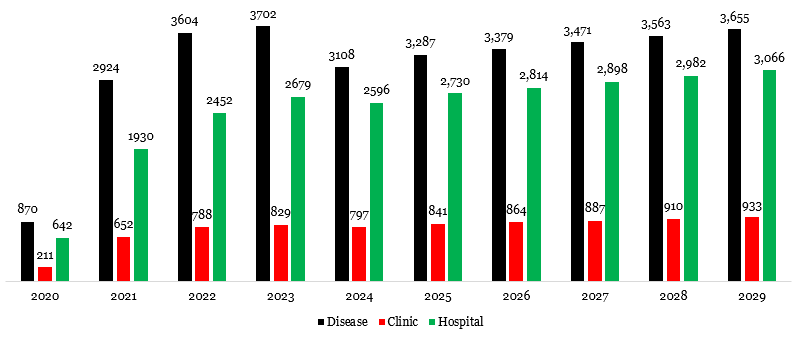
The year 2020 set a modest baseline with just 870 searches for “disease,” 211 for “clinic,” and 642 for “hospital.” By 2021, the situation was very different. As COVID-19 spread, disease-related searches exploded to 2,924, a growth of more than 236 percent. Nigerians were urgently seeking explanations, updates, and guidance about the health crisis. The pattern continued into 2022, with searches for disease surpassing 3,600, and interest in hospitals rising to 2,452. Clinics also gained attention, moving from 211 in 2020 to 788 in 2022.

This was more than digital curiosity. It reflected a population looking for answers in a moment of fear and uncertainty. After searching for diseases, Nigerians began to focus on solutions. They turned to queries about clinics and hospitals, indicating a transition from understanding symptoms to finding treatment options. In a way, search data tracked the nation’s collective movement from confusion to action.

The Slowdown: Stabilization After the Crisis

By 2023, the pattern shifted again. Searches for diseases increased only slightly, while clinic and hospital queries grew modestly. Then in 2024, interest in all three categories declined. Disease searches dropped by 16 percent, clinic queries fell by nearly 4 percent, and hospital searches slipped by just over 3 percent.

Exhibit 1: Public search interest in disease, clinic and hospital between 2020 and 2029 (with projection)

Source: Google, 2020-2024; Infoprations Analysis, 2025

This slowdown was not surprising. With the most intense phase of the pandemic behind them, Nigerians no longer searched with the same urgency. Instead, health-related searches began to reflect a return to normal rhythms. People could rely on offline knowledge from healthcare providers, community resources, and public campaigns. The search engine was no longer the only source of reassurance or information. What had been a spike of emergency-driven interest gave way to a calmer, more balanced pattern.

The Forecast: Steady Growth Through 2029

Looking ahead, projections suggest that health searches will continue to grow, but at a more stable and modest pace. Between 2025 and 2029, searches for diseases are expected to rise gradually from 3,287 to 3,655. Clinic searches are projected to move from 841 to 933, while hospital searches will grow from 2,730 to 3,066. These increases amount to roughly two to three percent growth per year.

The data indicates that Nigerians will not return to the extreme spikes of the early 2020s, but neither will interest decline further. Instead, a steady climb reflects the maturity of search behavior. Health topics remain important, but searches will increasingly be about ongoing care, preventive health, and accessible treatment. The transition from volatile growth to steady progress suggests that Nigerians are developing a long-term digital relationship with healthcare rather than reacting only to crises.

What This Means for Healthcare Leaders

This evolution in search behavior carries important implications for the health sector. For healthcare providers, the steady rise in searches for clinics and hospitals highlights the need for strong digital visibility. Nigerians will continue to search for care locations, so clinics and hospitals that provide clear online information will remain competitive.

The stabilization of disease searches creates room for preventive education. Public health communicators should take note of this. Nigerians are no longer searching in panic, which means they may be more receptive to campaigns about chronic conditions like hypertension, diabetes, and maternal health.

The trend suggests that search behaviour is a barometer of trust. The shift from self-diagnosis to searching for care institutions indicates that Nigerians are prepared to engage with the health system if access is clear and affordable. Investments in healthcare infrastructure will reinforce this trust and strengthen outcomes.

For technology and digital health innovators, the steady growth curve signals opportunity. Nigerians will increasingly value platforms that connect them to providers, offer telemedicine consultations, and deliver verified health content.

Bitcoin Records Modest Gains With Bulls Targeting Fresh Highs

0

Bitcoin showed modest gains in the latest trading session, sparking optimism among investors that the cryptocurrency may be gearing up for another push toward record levels.

After a period of consolidation, and bearish price action, the asset is gradually returning, with traders eyeing stronger momentum as market conditions stabilize. The price of BTC on Wednesday, climbed 0.9% over 24 hours to trade above the $111,000 price.

Analysts suggest that renewed buying pressure, coupled with improving risk appetite, could pave the way for fresh highs in the coming weeks. Despite the slight recovery, analysts warn that the cryptocurrency is at a “make-or-break” point, with $110,000 emerging as the most crucial support level in the short term.

Swissblock, a private wealth manager, described $110,000 as Bitcoin’s “lifeline support,” stressing that bulls must defend this zone to keep the uptrend intact. “BTC has proven resilience above $100K, but survival above $110K will decide if the trend continues bullish or tips into structural weakness,” the firm wrote in an X post.

Critical Levels in Focus

Analyst AlphaBTC highlighted the $110,000–$112,000 range as the key battleground for Bitcoin. According to the trader, a four-hour candlestick close above this zone could trigger a rebound, while failure risks a slide to $105,000.

Bitcoin is currently trading about 11% below its August 14 all-time high of $124,500, per Cointelegraph Markets Pro and TradingView data. Several bearish signs suggest a retest of lower levels is possible, but some analysts remain optimistic about Q4.

Seasonal Trends and Long-Term Outlook

Historically, September has been Bitcoin’s weakest month, with BTCUSD never closing more than 8% higher during the period. “The drawdown reflects a perception that the market may be overextended,” noted CryptoQuant analyst Gaah.

Even so, network economist Timothy Peterson projects “positive” performance for Bitcoin in the fourth quarter, predicting average gains of 44% by Christmas. Some bullish forecasts even see Bitcoin targeting $160,000 before the current cycle ends in late October 2025.

The broader market is also reflecting on Bitcoin’s cyclical history. While BTC defied expectations in 2022 by plunging below its 2017 high after the FTX collapse, many analysts argue the asset is entering a more “mature” phase of steady, structural growth rather than extreme boom-and-bust cycles.

Ether Whales Signal Market Rotation

Meanwhile, attention is shifting to Ethereum (ETHUSD). Nine massive whale addresses recently purchased a combined $456 million worth of Ether from BitGo and Galaxy Digital, according to blockchain data from Arkham.

Analysts interpret these moves as part of a “natural rotation” of capital out of Bitcoin and into altcoins. “A lot of this looks like investors locking in profits from Bitcoin’s run and moving into other tokens to catch potential upside,” said Nicolai Sondergaard, research analyst at Nansen.

He added that Ether in particular is benefiting from strong momentum, bolstered by demand from treasury companies and broader investor mindshare.

Looking Ahead

While Bitcoin’s battle for $110K continues, the market dynamic suggests capital is spreading beyond the world’s largest cryptocurrency.

For seasoned investors who have weathered past crypto winters, the message is clear: Bitcoin may still move in cycles, but the ecosystem is maturing, with altcoins like Ethereum increasingly commanding a larger share of attention.