DD
MM
YYYY

PAGES

DD
MM
YYYY

spot_img

PAGES

Home Blog Page 630

Klarna Revives U.S. IPO Plans at Sharply Lower Valuation After Workforce Cuts and Market Jitters

0

Swedish fintech giant Klarna is set to revive its long-awaited initial public offering (IPO) in the United States next month, targeting a valuation of between $13 billion and $14 billion, Reuters reports, citing two people familiar with the matter.

The move marks a significant step forward for the buy-now-pay-later (BNPL) pioneer, but at a valuation far below the $50 billion peak it once commanded during the pandemic-era boom.

The company, which had paused its listing plans in April after President Donald Trump’s sweeping tariffs rattled global markets, appears emboldened by the recent resurgence in U.S. equities and a string of blockbuster IPO debuts that have rekindled investor appetite. Klarna had previously considered going public in 2021 but opted to wait.

Shares sold in the offering could be priced at between $34 and $36 as early as this week, one of the sources said. The company is expected to raise close to $1 billion through the IPO.

A Leaner Klarna Ahead of Market Debut

A major backdrop to Klarna’s renewed listing attempt is its sharp workforce reduction, which has fundamentally reshaped the company. In May, Klarna revealed that it had cut nearly 40% of its workforce, attributing the downsizing to a mix of artificial intelligence integration and natural attrition.

Chief Executive Officer Sebastian Siemiatkowski, speaking on CNBC’s Power Lunch, confirmed the scale of the cuts.

“The truth is, the company has shrunk from about 5,000 to now almost 3,000 employees,” he said. “If you go to LinkedIn and look at the jobs, you’ll see how we’re shrinking.”

While Klarna described the reductions as part of a broader technological shift, analysts believe the cuts are also linked to the company’s IPO preparation, aimed at presenting a leaner, more profitable profile to investors after years of rapid but costly expansion.

Valuation Slide

The anticipated $13–$14 billion valuation marks a steep decline from Klarna’s once lofty heights. At its peak in 2021, amid a global surge in e-commerce and BNPL adoption, Klarna was valued at close to $50 billion, briefly making it Europe’s most valuable startup. Even earlier this year, its valuation exceeded $15 billion before recent market recalibrations.

The scale of the drop underscores the sobering reality for many fintechs that soared during the pandemic but have since faced investor skepticism about long-term profitability, regulatory scrutiny, and rising competition from traditional banks and tech giants expanding into payments.

IPO Tailwinds

Despite the lower valuation, Klarna’s timing may be favorable. Equity markets have shown strength in recent months, buoyed by robust earnings and an improved risk appetite. The IPO window, which had been largely frozen during much of 2022–23, has reopened with notable success stories.

Design software maker Figma and stablecoin operator Circle have delivered extraordinary gains since their listings this year, with shares peaking 333% and 864% above their IPO prices, respectively. Data compiled by LSEG shows that the 20 biggest U.S. IPOs this year have averaged a 36% first-day share price rise, fueling optimism for upcoming offerings like Klarna’s.

Operationally, Klarna has continued to show resilience even amid restructuring. Earlier this month, the company reported that its second-quarter revenue rose 20% year-on-year on a like-for-like basis to $823 million, while adjusted operating profit climbed to $29 million, up by $1 million from the prior year.

Customer growth has also been strong. Active users rose 31% year-on-year to 111 million, signaling continued global demand for its BNPL services, particularly among younger consumers seeking flexible payment options at checkout.

Klarna’s revival of its U.S. IPO plan highlights a balancing act between investor confidence, market conditions, and its own restructuring. The workforce cuts suggest an effort to realign its cost structure with profitability goals, especially as AI-driven efficiencies reduce the need for human labor. Yet the steep drop in valuation illustrates how fintech optimism has been tempered since 2021, when cheap capital and booming online shopping fueled sky-high valuations.

The company’s ability to raise close to $1 billion, if achieved, would provide fresh capital to support expansion and fend off intensifying competition from rivals such as Affirm in the U.S. and PayPal’s BNPL services. But investor sentiment may hinge on whether Klarna can sustain profitability without sacrificing growth. However, the confluence of stronger equity markets and robust IPO performance gives Klarna a much-needed tailwind.

Directing 97–99% of Fees Toward HYPE Buybacks Creates a Strongly Deflationary Token Model

0

Hyperliquid has been directing 97% of its fees toward HYPE token buybacks through its Assistance Fund, a new upgrade specifically increasing this to 99%.

Hyperliquid’s current buyback mechanism allocates a significant portion of trading fees to purchase HYPE tokens, reducing circulating supply and creating upward price pressure. For example, the Assistance Fund has amassed over $1.2 billion in buybacks, with daily buybacks averaging around $1 million and single-day peaks reaching $3.97 million.

The platform’s dominance in decentralized derivatives, capturing over 70% of on-chain volume, supports this strategy, with fees from trading activities fueling the buybacks. If a new upgrade were to increase the buyback allocation to 99%, it would likely amplify the deflationary effect on HYPE’s supply, potentially strengthening price momentum further, especially during periods of high trading volume or market volatility.

By allocating 97–99% of trading fees to buy back HYPE tokens, Hyperliquid reduces the circulating supply of tokens. This creates a deflationary pressure that can support or increase the token’s price, assuming demand remains stable or grows.

For instance, with over $1.2 billion in buybacks already executed, including daily averages of $1 million and peaks up to $3.97 million, the consistent demand for HYPE tokens via buybacks can act as a price floor, especially during volatile market conditions.

Hyperliquid’s dominance in decentralized derivatives (over 70% of on-chain volume) generates substantial trading fees, which fuel the buyback program. This high allocation signals to users and investors that the platform prioritizes token value appreciation, potentially attracting more traders and liquidity providers seeking exposure to a deflationary asset.

Increased platform activity could further amplify fee generation, creating a virtuous cycle of buybacks and price support. Directing 97–99% of fees to buybacks leaves only 1–3% for other purposes, such as platform development, marketing, or user rewards.

While this strengthens the deflationary model, it could limit investments in ecosystem growth, new features, or community incentives, potentially impacting long-term competitiveness against other decentralized exchanges (DEXs). A buyback program of this scale signals strong confidence in HYPE’s long-term value, which could attract speculative interest from investors.

Depending on how buybacks are executed (e.g., tokens burned or held by the Assistance Fund), there’s a risk of centralizing token ownership. If bought-back tokens are held rather than burned, the fund could accumulate significant control over the supply, raising concerns about governance or manipulation.

Deflationary Effects

Buybacks directly reduce the number of HYPE tokens in circulation. For example, if Hyperliquid generates $1 million in daily fees and allocates 99% ($990,000) to buybacks, this consistent removal of tokens shrinks the available supply over time. With a fixed or slowly growing total supply, this creates scarcity, which can drive price appreciation if demand persists.

Hyperliquid’s high trading volume (e.g., $1.5 billion in daily perpetual futures volume during peak periods) generates substantial fees. Allocating 99% of these fees to buybacks amplifies the deflationary impact during bullish or volatile markets, as more tokens are removed when trading activity spikes. This could lead to exponential price effects during market upswings.

Over time, sustained buybacks could significantly reduce HYPE’s circulating supply, making the token increasingly scarce. If Hyperliquid maintains its market share in decentralized derivatives, this scarcity could position HYPE as a premium asset in the DeFi space, similar to how BNB’s burn mechanism has supported its value.

While buybacks reduce supply and support price stability, they can also exacerbate volatility. If market sentiment shifts or trading volume drops, the reduced circulating supply could amplify price swings, as fewer tokens are available to absorb sell pressure. Conversely, during bullish phases, the scarcity could lead to sharp price spikes.

The deflationary impact depends on whether bought-back tokens are burned (permanently removed) or redistributed (e.g., to stakers or liquidity providers). If burned, the effect is purely deflationary, permanently reducing supply. If redistributed, the deflationary impact is diluted, as tokens re-enter circulation.

Allocating 97–99% of fees to buybacks may strain Hyperliquid’s ability to fund operations or innovation. If trading volume declines the reduced fee pool could limit buyback impact, potentially weakening price support. Large-scale buybacks could attract regulatory scrutiny, especially if perceived as market manipulation. However, as a decentralized protocol, Hyperliquid may face fewer risks than centralized exchanges.

Compared to other DEXs, Hyperliquid’s aggressive buyback strategy differentiates it by prioritizing token value over immediate platform reinvestment. This could appeal to investors but may cede ground to competitors focusing on user rewards or ecosystem expansion.

Nigeria: Rising Job Hunger, Declining Job Creation in 2024

0

Nigeria’s labour market in 2024 reveals a sobering reality. Public interest in jobs has grown steadily, reflected in rising search activity, but the actual creation of jobs has moved in the opposite direction. For a country with one of the fastest-growing youth populations in the world, this contrast between demand and supply is deeply concerning. It signals not only a strain on the economy but also an urgent challenge for policymakers, businesses, and society at large.

A Year of Early Promise and Rapid Decline

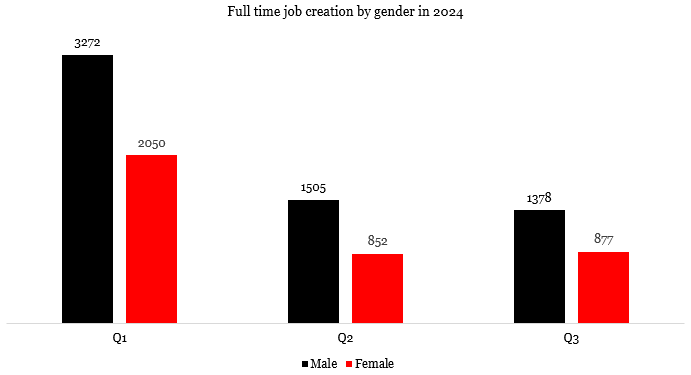
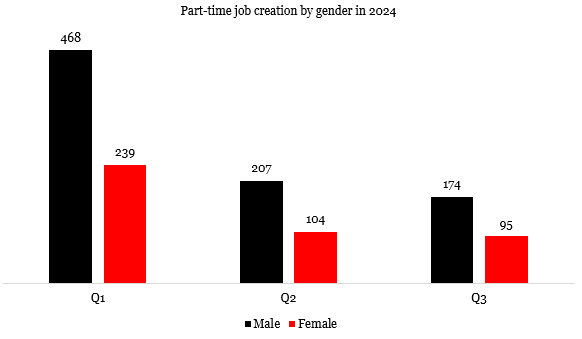
The year began on a hopeful note. In the first quarter, over 3,200 full-time jobs were created for men and just over 2,000 for women. Part-time jobs added another 700 roles across both genders. This surge suggested renewed confidence in the economy, perhaps linked to seasonal factors, fiscal spending, or early private sector expansion.

Unfortunately, this momentum quickly evaporated. By the second quarter, full-time opportunities for men had dropped by more than half to 1,505, while women’s positions fell to 852. Part-time employment followed the same path, slipping to 207 for men and 104 for women. The third quarter brought no recovery, with job creation continuing its downward slide. By then, barely 40% of the jobs created in the first quarter remained.

This pattern reveals a fragile system where bursts of opportunity are not sustained. Without deeper reforms, investments, and consistent growth strategies, the Nigerian labor market risks repeating this cycle of early optimism followed by steep contraction.

Source: NBS, 2025; Infoprations Analysis, 2025

Gendered Opportunities in a Shrinking Market

Across all quarters, men secured more opportunities than women, both in full-time and part-time roles. In the first quarter, the gender gap in full-time jobs was wide, with men gaining 1,222 more positions than women. By the third quarter, this gap had narrowed to just over 500. Part-time employment showed a similar trend, with the gap shrinking from 239 in the first quarter to 95 in the third.

At first glance, the narrowing gap might suggest progress toward equality. In reality, it reflects the fact that jobs declined sharply for both genders, leaving less room for disparity. Women are not gaining ground, but rather are falling at the same pace as men. This points to structural vulnerabilities, especially in sectors where women are concentrated, such as services and retail, which often bear the brunt of economic downturns.

A more deliberate effort is needed to improve women’s participation in the labour market. This could include targeted incentives for employers, programmes that build women’s skills in high-demand fields such as technology, and better access to financing for female entrepreneurs. Without such measures, gender inequality will persist even if headline numbers appear to show convergence.

Source: NBS, 2025; Infoprations Analysis, 2025

Rising Job Searches, Falling Job Opportunities

Perhaps the most striking observation from 2024 is the growing mismatch between job seekers and available opportunities. Public search interest in jobs rose steadily throughout the year, from 933 in the first quarter to 1,081 in the third. This rise reflects the growing determination of Nigerians to find employment.

Yet as interest increased, actual job creation fell sharply. Thousands fewer jobs were available even as more people actively searched for work. This indicates that unemployment pressures were high, frustration among job seekers was intensified, and the risks of social and economic instability increased during the year.

Source: Google Trends, 2024; NBS, 2025; Infoprations Analysis, 2025

For Nigeria to address this challenge, policymakers must act decisively. The first priority is to stabilize job creation by investing in industries that can absorb large numbers of workers, such as infrastructure, manufacturing, and energy. The second is to design deliberate measures that reduce gender disparities and expand women’s opportunities. Finally, integrating alternative data sources such as search trends into employment monitoring can give early warnings of distress and allow faster, more responsive policymaking.

Ready for Massive Gains? Discover Labubull – The Best Meme Coin of 2025 Before It Blows Up!

0

Timing in crypto often separates life-changing profits from missed opportunities. Today, Labubull ($LXB) is winning as the best meme coin of 2025 narrative with its whitelist offering. Positioned among the best crypto presales under $1, Labubull offers 16 presale stages, community rewards, and the chance to capture up to 10,000% ROI for those who secure a whitelist spot early.

Why Joining the Labubull Whitelist Matters

The Labubull whitelist is not just early access — it’s the key to the lowest entry price and the highest ROI potential. Each of the 16 stages brings a higher price, meaning those who act now can lock in maximum upside. Early whitelist buyers benefit from:

  • Cheapest entry point before later presale stages raise token prices.
  • Exclusive bonuses that disappear once the whitelist closes.
  • Direct pathway to long-term staking rewards and airdrops.

Joining is simple: visit the official Labubull site, submit your email, and confirm through the whitelist sign-up. With demand rising, missing this entry could mean missing the biggest presale ROI of 2025.

ROI Potential: Why Labubull Leads Meme Coin Presales

Labubull’s presale structure projects up to 10,000% ROI for Stage 1 buyers making it the best meme coin of 2025. This isn’t speculation — the 16-stage system ensures that every new stage sells at a higher price, creating built-in momentum. Investors in the whitelist don’t just get in early, they buy into the growth curve of the entire presale model.

Add to this the 80% APY staking rewards and regular token burns, and the project builds both scarcity and ongoing yield for holders. Unlike one-dimensional meme coins, Labubull combines entertainment with tangible financial mechanics.

Unique Selling Points (USPs) Driving the Frenzy

  • 16 Stages of Presale: Each stage unlocks a new collectible Labubull character and a higher token price.
  • 80% APY Staking: Long-term holders can earn consistent returns.
  • Token Burns: Supply reduction builds scarcity over time.
  • Community Giveaways: Mischief Drops and surprise rewards keep holders engaged.

These mechanics fuel continuous interest while rewarding the most loyal community members.

Lock Your Spot On The Labubull Whitelist — Just 3 Steps

Step 1:  Visit our website and input Your Email
 Your email is your ticket to the presale.

Step 2: Press Submit
 One tap secures your place.

Step 3: Receive Alerts First
 Exclusive news and benefits arrive straight to you.

That’s it. Quick, simple, and done in under a minute. Act now before the whitelist fills up.

By completing these simple steps, you ensure access to the most promising crypto presale under $1 in 2025.

Final Thoughts

Based on the latest research, buy meme coin in presale opportunities like Labubull, Pepe Unchained, Shiba Reboot, Dogeverse, and Baby Grok stand out for early investors. Labubull leads the charge with its 16-stage model, staking rewards, burns, and giveaways. The whitelist is live now, and it represents the best chance to catch the wave before the price surges. Act fast, secure your whitelist spot, and ride the bull before it leaves the gate.

Frequently Asked Questions (FAQs)

  1. Why is Labubull considered the best meme coin whitelist of 2025?
    Because it combines staged price increases, collectibles, staking, burns, and community rewards into one presale model.
  2. How do I buy Labubull in presale?
    Join the whitelist at Labubull.io, confirm your email, and secure tokens at the lowest available price.
  3. What are Mischief Drops?
    They are surprise airdrops and rewards given to whitelist members and holders, keeping the community active.
  4. What makes this presale different from other meme coins?
    The 16-stage structure ties culture and collectibles to financial growth, creating a unique gamified system.
  5. What is the ROI potential for early investors?
    Stage 1 whitelist buyers could see up to 10,000% ROI if they hold through the full presale cycle.


4 Best Crypto Presales to Buy Now as This New Kid on the Block Is the Breakout Pick

0

What happens when meme coins stop being jokes and start rewriting the rules of wealth creation? The past few years have seen tokens born from internet culture surge into the spotlight, defying skeptics and outperforming legacy assets in speed, scale, and community backing. From Dogecoin’s improbable ascent to Solana-native Dogwifhat’s viral explosion, the meme coin arena has become the modern-day gladiator pit where communities rise, whales circle, and fortunes can be multiplied in weeks.

Enter BullZilla ($BZIL), the behemoth preparing for its grand presale launch on August 29. Unlike traditional coins, BullZilla isn’t just banking on hype, it’s engineered for compounding growth. With a progressive presale model where price climbs every 48 hours or at every $100K milestone, this ERC-20 titan doesn’t wait for the market to move; it forces it. The presale price is already fixed at $0.00000575, but early believers stand at the gateway of potential 1000x returns. With 24 stages in play, each step forward tightens supply through Roar Burns, amplifying scarcity while staking, dubbed the HODL Furnace, prepares to deliver explosive rewards. Few projects in history have fused lore, mechanics, and community ignition the way BullZilla is about to.

And yet, the stage isn’t BullZilla’s alone. Dogwifhat (WIF), Mog Coin (MOG), and Brett (BRETT) are already reshaping meme coin markets with viral culture, insane liquidity runs, and cross-chain buzz. Together, they define the evolving meme coin ecosystem of 2025. But there’s a reason BullZilla sits at the front of this pack. The whitelist is open, the presale countdown is ticking, and joining early isn’t just a play; it’s the only way to capture the maximum perks before this monster roars into its full form. For anyone scanning the horizon for the best crypto presales to buy now, BullZilla is where the ground shakes first.

1.  BullZilla: Forged in Chaos: Why It is the Apex Presale

Bull Zilla doesn’t just enter the battlefield; it mutates it. At its core is the Progressive Price Engine, a presale mechanic that guarantees constant upward momentum. Every $100K raised or every 48 hours triggers a price increase, meaning hesitation comes at a real cost. Add to this a 24-stage roadmap and a presale start price of $0.00000575, and the equation is simple: the earlier the entry, the bigger the potential.

But mechanics alone don’t create legends. BullZilla’s Roar Burn Mechanism adds a layer of mythic scarcity. At each presale milestone, tokens are permanently removed from circulation, mimicking Ethereum’s deflationary burn system but with a meme coin twist. Every burn tightens supply, fueling both narrative and price action.

Then comes the HODL Furnace, a staking system offering a roaring 70% APY. In an era where traditional savings barely scrape 3%, this mechanic isn’t just attractive, it’s magnetic. Holders are rewarded for commitment, turning passive accumulation into an active wealth machine. Layered over this is the Roar-to-Earn referral system, where community members earn 10% on referral purchases while newcomers enjoy a 10% bonus. Such symbiosis ensures virality isn’t optional, it’s coded into the DNA.

2.  Dogwifhat (WIF): The Solana Underdog That Went Viral

Dogwifhat, or simply WIF, became one of Solana’s most significant cultural exports. The concept was almost absurd, a Shiba Inu wearing a pink knitted hat, yet that absurdity turned into fuel for one of the most viral meme coin runs in recent memory. In early 2024, WIF surged past $2 billion in market cap, showcasing the power of a unified community on Solana.

WIF’s strength lies not in utility but in cultural dominance. It has become a symbol, a joke turned digital badge of belonging. The Solana ecosystem’s low fees and lightning-fast transactions gave WIF holders a playground for speculation and memes, reinforcing its viral momentum. Unlike ERC-20 projects like BullZilla, WIF thrives on the raw electricity of meme culture, amplified by Solana’s expanding user base.

While some critics dismiss WIF as a fad, the coin has demonstrated resilience. Its community-driven liquidity pools, NFT integrations, and social campaigns have kept it relevant long past its expected expiration date. In the meme coin space, survival itself is proof of strength.

3.  Mog Coin (MOG): Ethereum’s Community Amplifier

Mog Coin is another cultural force, but this time rooted in Ethereum. Dubbed the “internet’s coin,” MOG captured attention with its viral, meme-heavy branding and massive community activity. It quickly found its footing as an ERC-20 token riding the wave of Ethereum’s expansive ecosystem.

MOG’s real strength comes from its ability to amplify online trends. Unlike WIF, which locked itself to a single meme, Mog embraces the chaos of meme culture as a whole. Its flexible branding and active community ensure it can ride any wave—whether that’s a viral TikTok, a celebrity endorsement, or a Twitter movement. In crypto, adaptability is everything, and Mog has it in spades.

Market-wise, MOG has seen surges into billions in capitalization. It thrives on rapid exchange listings, intense social campaigns, and user-generated content. The token’s liquidity and trading volume cement it as a force, especially among younger traders who treat it as a cultural playground rather than just an investment.

4.  Brett (BRETT): The Base Chain Wild Card

Brett is the self-proclaimed “face of Base,” a meme coin that has rapidly become the poster child for Coinbase’s Layer-2 network. Named after a character from Matt Furie’s Boy’s Club, Brett embodies the crossover between internet nostalgia and blockchain innovation.

What makes Brett intriguing is its network effect. As one of the first major meme coins on Base, it carries the advantage of being the chain’s unofficial mascot. This has drawn liquidity, speculation, and community attention into Base, reinforcing Brett’s role as a cultural anchor.

Unlike WIF and MOG, Brett ties its growth to an emerging ecosystem. As Base gains adoption through Coinbase’s integration, Brett benefits by being at the center of its meme economy. The community has pushed it into billion-dollar valuations, and exchange listings have further legitimized it as more than just a fad.
Conclusion: What Are the Best Crypto Presales to Buy Now?

Based on the latest research, the BullZilla, Dogwifhat, Mog Coin, and Brett stand as the defining meme tokens shaping 2025. Each represents a unique strength: WIF with cultural absurdity, Mog with community amplification, Brett with ecosystem positioning, and BullZilla with structured mechanics that blend hype with sustainability.

But the spotlight here is clear. BullZilla’s whitelist is live, its presale ignites on August 29, and its mutation mechanism ensures the price never sleeps. With Roar Burns tightening supply, a HODL Furnace rewarding holders at 70% APY, and a presale price of $0.00000575, the math for early entry speaks for itself. Those scanning for the best crypto presale to buy now don’t need to look further; the beast is here, and it’s only just begun to roar.

This article is for informational purposes only and does not constitute financial advice. Always do thorough research before making investment decisions.

For More Information:

BullZilla Official Website

Join BZIL Telegram Channel

Follow BZIL on X  (Formerly Twitter)


Frequently Asked Questions for 4 Best Early Stage Crypto Investments

What is BullZilla?

BullZilla is a community-driven meme coin that blends fun with solid tokenomics, aiming for long-term growth and mass adoption.

Is BullZilla in presale right now?

No, BullZilla is currently in the whitelist stage. The presale will follow soon after.

How can I join the BullZilla whitelist?

You can secure your spot by visiting the official website and registering before the presale goes live.

What makes BullZilla different from other meme coins?

It combines meme culture with scarcity-driven tokenomics, community governance, and ecosystem expansion.

Can BullZilla really hit 1000x returns?

While no investment is guaranteed, BullZilla’s mechanics and growing hype position it as a high-potential project.

Glossary of Key Terms

BullZilla ($BZIL)

A meme coin built on Ethereum with a unique presale model. It features progressive price increases, deflationary burns, and high staking rewards, making it a standout among 2025’s top crypto presales.

Presale

A fundraising stage before a cryptocurrency is listed on exchanges. Investors can buy tokens at lower prices, often with tiered price increases that reward early entry.

Progressive Price Engine

BullZilla’s presale mechanism where the token price increases either every 48 hours or whenever $100,000 is raised, ensuring constant upward movement.

Roar Burn Mechanism

BullZilla’s deflationary system that permanently removes tokens from circulation at every presale stage, reducing supply and increasing scarcity.

HODL Furnace

BullZilla’s staking program offering a 70% APY, rewarding holders who commit their tokens for long-term growth.

Roar-to-Earn

A referral system where BullZilla community members earn 10% on referrals while newcomers receive a 10% bonus, boosting viral adoption.

APY (Annual Percentage Yield)

The real rate of return earned on an investment over a year, factoring in compound interest. In crypto, it typically refers to staking or yield farming rewards.

Staking

The process of locking tokens into a protocol to earn rewards, often measured as APY. It secures the network and incentivizes long-term holding.

Keywords:

BullZilla presale, Best meme coins to invest in 2025, BullZilla vs Dogecoin, Progressive Price Engine BullZilla, Top new meme coins presale, Roar Burn mechanism, HODL Furnace staking rewards, Dogwifhat crypto, SPX6900 meme coin, Meme coin investment opportunities.

Disclaimer

This article is for informational purposes only and does not constitute financial advice. Participation in cryptocurrency presales, including BullZilla ($BZIL), Dogwhifhat (WIF), and Mog Coin (MOG), involves significant risk. Market performance, investor sentiment, and token utility can impact results, and there are no guarantees of returns. Readers should perform their own research, assess their personal risk tolerance, and consult with a licensed financial advisor before making any investment decisions. Past performance or future projections are not indicative of guaranteed success.