

Develop sufficient policy for users and organization It’s an all too known practice for many IT teams: disaster hits, whether it’s a security breach, Crypto locker infection or outage. The culprit? User error, because of unsafe computer exercises. Your organization has a security policy, but it’s tedious, outdated, and most users just sign the bottom […]
26.1 – Privileges and Access Rights

In order to carry out their responsibilities, managers require the permissions to perform tasks such as system configuration, software installation, resource allocation, user permission management and more. With this privileged access, managers practically always also have access to the services and data that run on the systems they handle. Further, manager’s teams have usually shared […]
26.0 – Attacks, Tools for Defending Against
Cyber attacks can be poisonous for your online presence. It can damage it in minutes and seize your online functions to your irritation. It’s very important that you become familiar with what risks are creeping in in the cyber world that can damage your existence. Here are some of the common cyber attacks which will […]
Kaizen Business Model: A Leeway for Companies and Entrepreneurs in Post Covid-19
“Thrift is poetic because it is creative; waste is unpoetic because it is waste.”- G. K. Chesterton in his essay titled “What’s Wrong with the World.”
Tellingly unpleasant as the situation is now, it is certainly not a better time for the world and its habitants much less the world economy. The world economy is ravaged, devastated and plummeted like the Oloibiri Oil Groove in Niger Delta, South-South, Nigeria. The Nigerian economy nay any other is not insulated to the eerie but now novel coronavirus better known as COVID-19; this period can now be likened to the “Great Depression” of the 1930s when the world economy was brought to its very knees.
Even the great Nostradamus with his prognostication prowess of a flu or epidemic from Far East China, and that would ravage the world in a twin year (2020) never in his wildest imagination thought the pandemic would be this cataclysmic and seismic. Alas, it is even more. Companies, NGOs, Government offices, all Education Offices, Small and Medium Scale Enterprises, and all forms of self-owned businesses have closed operations owing to global lockdown and fear of the pandemic; and some are at shut-down point because of COVID-19. The level of global unemployment as we have it now was last seen in the 1930s. Inflation rate has doubled and businesses are already filing for bankruptcy. In sane countries of Europe and America, governments are supporting businesses with various packages like tax cuts or exemption for a period; packaging financial lifelines through their various central banks as a way to keep them afloat or at least, not sack their employees. In spite of all of these, many businesses and corporate organisations that are profit-centred are struggling to survive.
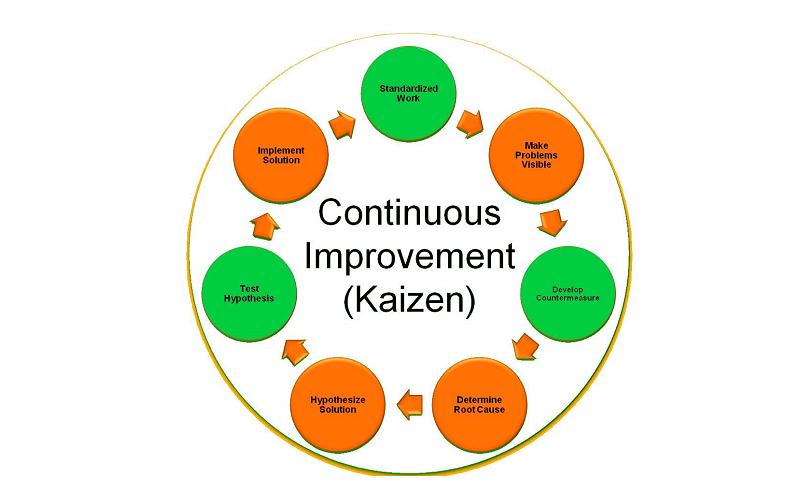
It is therefore imperative to pen down internal panacea that are practicable for entrepreneurs, companies and other profit-centred organisations to stay operationally efficient or at least healthy as a leeway out of this Post COVID-19 consequences. And this internalized model is the Kaizen Model of Optimality which is geared towards cutting wastes. Kaizen has its etiology from Japanese language of two words which are Kai, meaning change; the other part: Zen means good. Contextually, however, the Kaizen Model of Optimality has found its way into global business and has won the hearts of business and tech gurus because of its benefits to business space. Kaizen is in fact a philosophy of its own. Kaizen aims at continuous improvement in operations, and involves all employees with respect to enhancing productivity.
An organisation that is fat in budget should prune itself of bourgeoisie’s remuneration which is largely self-inflicted. It is in the bourgeoisie’s perquisites that most companies and profit-centred organisations burn a good percentage of running cost which adds up to operations cost. The stakeholders and Board should as a matter of exigency come to a round table and agree on what is moderately acceptable for their superordinate or top echelon staff. This is the number one cost saving technique.
Another Kaizen principle that should be embraced is the Principle of Agility. Agility which obviously has its etymology from Agile is a business terminological exactitude associated with high speed coupled with output delivery. Agile thrives on adaptive culture where team members are quick to change if expectations are more benefitting and productive. So, every organisation needs to introspect on its business ideation, and determine which it should use the arsenal of its financial muscles to pursue and add to the bottom line. Here, flagship or the main product of the company should be examined vis-à-vis its contribution to total revenue.
More important and breviloquent is the issue of corporate culture and belief system which is enshrined in the organisation’s corporate governance. The corporate governance requires that checks and balances should be adequately put in place in order to block any resource conduit pipes of leakages. No company engaged in manufacturing or any other thing that has to do with material management should look away from its waste products. For companies which do not have effective waste disposal management would continually lose millions of naira because of smart-roguery employees, who are mendaciously pilfering and profiting from the negligence of management under the pretense that it is waste they move away.
The concept of Kaizen, according to Marshakk Hargrave, encompasses a wide range of ideas. It involves making the work environment more efficient and effective by creating a team atmosphere, improving everyday procedures, ensuring employee satisfaction, and making a job more fulfilling, less tiring and safer. Positive change can come from any employee anytime and Kaizen recognises that small changes now can have big future impacts (source: Investopedia).
Again every organisation should redefine its culture of efficiency and uniformity to all stakeholders. Many employees have lost focus of their core competencies and the reason for continuous earning of their paycheck. It is therefore pertinent to have their personal goals and aspirations aligned with the goals, cultural beliefs and value system of the company or organisation they work for. This will to a very large extent avoid conflict or clash of interests.
Lastly, every organisation should carry out the 360 degree evaluation of their staff with the use of technology where respondents are anonymous and their responses cannot be subjected to witch-hunting by their superiors. A lot will be discovered and then, proactive management will be armed with the right information and can block loopholes of financial rascality, thievery, gangster corruption or organised corruption, and many other corporate abuses.
Conclusively, COVID-19 will not be a thing of the past too soon. The effects are likely to last another two years and above. No profit-centred company should avoid or exit because of COVID-19 effects. Great things are born out of adversity. I will leave you with the words of great Aristotle “the beauty of the soul shines out when a man bears with composure one heavy mischance after another, not because it does not feel them but because he is a man of high and heroic temper”.
Why Nigerians Did Not Feel the Impact of the Covid-19 Palliatives

The call for palliatives during this pandemic was too loud. Every decision made by the government to extend the lockdown reminds people that the government is not providing the citizens with what they need to manage the bite of the partial economic inactivity. At a stage, the lockdown actually looked more like a punishment than a preventive measure.
The calls for providing palliatives were answered from different quarters. The federal, state and local governments did the best they could to provide food and other necessities for the citizens. Private individuals, organisations and associations also did their best. Many rural communities received one form of palliatives or another from well-meaning Nigerians and organisations. But all in all, these kind gestures did not stop the loud cry for palliation from Nigerians.
The fact that people complained about being neglected by the government during this lockdown shows that the impact of the palliatives was not felt. It is either these outcries came from people who have not received any kind gestures during this pandemic or from those who received “little”. These complaints are actually signs that Oliver wants some more.
But then, it should be understood that palliatives can never solve the hunger situation in Nigeria, especially during this pandemic. The reasons for this are noted below:
- Many Dependents
An average Nigerian home is made up of 5 biological children. When you add up the number of cousins, nieces, nephews, helpers, brothers, sisters, grandmothers, and other extended family members, you may find about ten people in a household and they are all taken care of by one man. Note that I didn’t include wife to the number of dependents because I’m assuming that wives also work and contribute towards the upkeep of homes. So, if you look at all these people in one man’s house and you now give him one painter of garri, one painter of rice, five super-pack Indomie, and things like that, how will he care for his family with them? Of course, the palliative will only serve as a snack while the family waits for the main course.
- Inflation
When the federal government shared 20k to some households in Nigeria, people were more interested in identifying the beneficiaries of this palliative. One thing a lot of people didn’t consider is the purchasing power of twenty thousand naira in today’s Nigerian open market. A 25kg (it is not even up to that) bag of Abakaliki Rice sells currently at #8,500, and it is not even up to 100 cups of rice. Now, remove that amount from the 20k and tell me what remains. Believe me that money will disappear immediately when it finds its way into the market and its impact will be forgotten almost as fast as the money disappears.
- Inconsistency with Palliative Distribution
The irregular way palliatives are distributed will not help people that much. If the distribution is done in such a way that the beneficiaries receive something say every two weeks, it will be better. But here, once something is shared, that is it. People don’t know if another one will come from that same quarter or if they should turn to another direction and expect help from there. The effect of this inconsistency is that it creates anxiety in the minds of those that depended on palliatives.
- Population Explosion
I think part of the reasons the quantity of things shared are so small is that the number of beneficiaries are much. The population of the country is actually going up but the problem isn’t just the increasing population. The problem here is that the few palliative providers are overwhelmed by the huge number of beneficiaries. For instance, in my hometown, private individuals and associations send in tens of trailers of food stuff to be shared in their different clans. These food stuff, when still in the trailers, appear so massive. But when they are shared amongst the available families within the clan or village, the food items seem so small because these people will go home with half “Bagco” bags or the “noise-maker” poly bags of food stuff.
- Corruption
Although this has not been proven, it is possible that corruption is part of the reason palliatives are not reaching the people that need them. It is possible that some of the people that benefit from this exercise are not those it is meant for. And it is also possible that funds and food stuff are diverted during this practice. One thing that is so certain here is that there was no transparency with how palliatives were shared.
It is good that the lockdown is gradually coming to an end. It is also good that many Nigerians survived the period. Hopefully, in a few weeks time nobody will depend on palliatives to survive (except the very poor in our midst). However, it is hoped that Nigerians have learnt not to depend on others for all their needs because they may get disappointed. It is also time for the concerned authorities to put in place measures and facilities that will help Nigerians to save for a rainy day.