DD
MM
YYYY

PAGES

DD
MM
YYYY

spot_img

PAGES

Home Blog Page 6383

Covid-19 And Building The Ant-Hills Of Nations

0

As the world battles Covid-19, I refer you to this piece I wrote in the Harvard Business Review which has been translated into many languages and cited by organizations in leadership training. The Catholic church incorporated it in a leadership manual in New England.  Like the African proverb – “the ant-hills are not built by elephants, but by the collective efforts of the little rejected ants” – we are learning that a critical part of those who build our societies are not really just those we see on TVs daily, but most times the collective efforts of just ordinary people – the cleaners, garbage men, nurses, mail women, drivers, doctors, etc. 

A wise man in my village – Chief Okechi Kanu, the elder brother of former governor of Imo and Lagos states, Admiral Ndubuisi Kanu – corrected me many years ago, cancelling out “rejected” when I quoted that proverb as I pushed for more funds to be allocated for our local public secondary schools. 

He was the president of the Ovim Community League, and I wanted him to support undergraduate students to return to the village, during vacation, to teach students in our secondary schools preparing for JAMB and WAEC, ahead of their upcoming exams. Yes, “Ndubuisi, the Students Union may be little, but Ovim can never reject its future”, he wrote in a reply as he approved the request.

May post Covid-19 bring decency, respect, and honour for ALL humans irrespective of pay grade or education attainment!

Covid-19 Impact: Kobo360 Losing Millions of Dollars As 3,000 Trucks Are Grounded

0

As the world continues to count its losses from the ravages of coronavirus, from life to economy, some businesses are getting badly hit. Though oil is taking the center stage for now, logistics and haulage are among those that have been brought to a near standstill.

In Nigeria, the story of logistics companies sound the same as their counterparts around the world. Kobo360, a notable name in the Nigerian logistics industry has cried out over the losses stemming from the effects of the pandemic.

Following the Federal Government of Nigeria’s lockdown order that has restricted movement in the Federal Capital Territory (FCT), Lagos and Ogun States, the activities of logistics companies have been largely put to a halt. Kobo360 said about 3,000 of its trucks have been grounded and their services put on hold due to their unclarified place in the category of essentials.

The decision to ground the trucks has been mainly drivers’ who complain of incessant harassment by law enforcement agents. Kobo360 attributed the development to lack of clarification by the authorities as to what constitutes essential service.

Tayo Oyegunle, the VP Global Operations of Kobo360 told TechNext that the government failed to explain to the law enforcement what essential services entails and that has subjected the drivers to the oppression of policemen and other law enforcement agents on the roads.

“The government announced the cessation of movement – within this remit it stated that businesses involved in food and distribution are exempt. However, that does not seem to be clearly communicated to law enforcement or the fact that distribution vehicles may not necessarily be branded for them to be identified as essential goods, resulting in the drivers being stopped and at times being harassed,” he said.

Oyegunle said the situation has a ‘grey area’ owing to the unclear understanding of essential services which created a standoff between drivers and law enforcement officers. He said the right of movement depends on how it is interpreted, and the law enforcement agents have interpreted it wrongly, and it has subjected the drivers to harassment, forcing them out of the roads.

The situation has apparently resulted in loss of millions of dollars by the logistics company. Oyegunle said in an attempt to resolve the misunderstanding, the company has reached out to relevant authorities.

“Since the restrictions, we have written to arms of the Nigerian government stating the urgency in clarifying the announcement made on March 29 and to support the logistics industry with documentation for our drivers to give them the freedom to move within the country. This is a new territory for us all, but we’re willing to work with the government in order to ensure that we keep essential supplies moving,” he said.

The vice president noted that the drivers were being harassed because the trucks are not branded. And the company is trying to save the situation by providing the drivers with identity cards and other means of identification.

However, he said the company is not crying foul, that it has been the decision of the drivers to stop work. And if the measures the company is taking fail to remedy the situation, Kobo360 will stick to the decision of the drivers.

“3,000 of our trucks are parked. There is certainly no crying foul here and that is not a stance Kobo360 is taking. Our drivers are on the frontline, they are the ones who are facing these obstacles with law enforcement and have taken it upon themselves to stop transporting goods based on their experiences, knowing that they will be losing income. This has been communicated to us by our drivers, we have to support them and we have to get them back on the road to complete the distribution of essential goods,” Oyegunle said.

The excesses of law enforcement agents in the face of lockdown is rapidly escalating. Over 18 persons have been killed so far as the police try to save them from coronavirus by enforcing the stay at home order. The brutality thriving on impunity has become a norm that even road users are wary of; a reason Kobo360 wouldn’t urge their drivers to get onto the roads.

On the other hand, Kobo360 runs a Uber kind of haulage model that allows drivers to make their choices and protects their interest. Before now, many truck drivers in Nigeria face the challenge of handling their cash as they get paid after each trip. They always run into the ambush of armed robbers who lie in wait for their hard earned money.

Kobo360 has, however, developed a payment pattern that limits the amount of money in the driver’s hand to the barest minimum. 70 percent of their pay is wired into their bank accounts before their trip, leaving them with insignificant amounts that makes them less targets of armed robbers.

The model is believed to have endeared drivers to the company as it is seen as a gesture of goodwill.

The Choices As Covid-19 Lockdown Debate Continues

0

It has become a debate before the American people – to open or not to open? The lockdown has crippled the economy, businesses are dying, workers are losing their jobs and the government is running out of intervention funds. On the other hand, people are dying, more people are getting infected by coronavirus and hospitals are getting overwhelmed.

The debate hangs on these two situations. Those on each side of it have reasons to believe that it’s time to open the economy or extend the lockdown.

Over 24 million Americans have filed for unemployment benefits since March, as more companies apply for a government bailout, meaning more workers are going to be laid off in coming weeks. They will struggle to pay their bills and live up to some other financial responsibilities – a nightmare many don’t want to have on a broad day.

On the other hand, over 800,000 Americans have tested positive for COVID-19, pushing toward the 1 million mark. Over 50,000 people have died, and the way it is going, many more are going to die in the coming weeks as the world searches for cure.

So to the American people, the choices before them are more like choosing between the Devil and the deep blue sea. And their choice depends on the side of the situation they find themselves in.

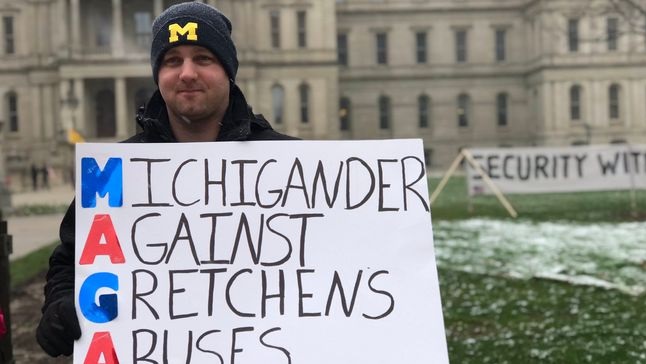
Last week, conservative backed protests erupted in some states against the lockdown. They were calling on the governments to lift the locks and allow people to go back to work. The US president Donald Trump who has been itching to open the economy amidst the escalating health crisis threw his weight behind the protesters. The economy needs to be open – but at what cost?

Doctors, nurses and medical staff took to the streets in a counter-protest that calls on the people to stay at home. It is a divided country fighting a mutual enemy, and each side of the divide is making huge sacrifices, though some are paying a higher price for the battle.

Everyone’s reason is genuine – if you don’t work how would you earn a living? But if you are not living, how would work?

Divided mostly through party lines, Republican led states like Georgia and Tennessee are calling for opening, stating that the lockdown is doing more harm than good. While Democratic led states like Virginia, Michigan and New York are more restrictive. In this tumultuous time of health crisis in the American history, everyone has got something to sacrifice; it’s just a question of – on what altar?

While the push to open the country garners momentum across Republican led states, health officials are concerned that the defiance will blow the pandemic into larger proportions and undermine the progress that has been made so far – and they are equally right.

The argument causing the divide.

The New York Times asked for opinions on the “to open or not” debate, and they pour in with different reasons that can’t be excused in entirety.

“I work at a hospital in the Fairfield County. People I see ignoring the guidelines on the news or in my travels have no idea of how bad the coronavirus is. Sometimes there is very little we can do to save these patients. Even the ones we send home from the E.R. are really sick and can take 2-3 weeks to recover. While the surge is diminishing there are still patients who are really slow to recover. I know everything seems fine wherever you look, but watch some hospital footage and listen to some registered nurse interviews, then decide if you want to skip the mask or congregate together,” said Sean Vigneau, from Fairfield, Connecticut.

One of the major concerns of lifting the lockdown is people forgetting that the world is in the middle of a pandemic and living life like it is 2019.

“Our much-less than enlightened mayor, who clearly drinks the Trump Kool-Aid daily, opened our beaches last Friday and earned national coverage. That has unwittingly given permission to folks to do horribly stupid things. The most egregious? I actually saw parents removing the yellow tape that the police had wrapped around the public park playground equipment – a playground that had signs on it saying that the equipment was not sanitized – and allowed their young children to play on it. I am so deeply angry that these shortsighted, selfish men are making decisions that put my health in danger, and that I have no control over it at all,” Lizanne Bomhard said from Jacksonville Beach, Florida.

People appear to be running out of patience, the government’s social programs seem not enough for them at home for a prolonged period of time – and some of them don’t like house arrest.

“I am a divorced single mother trying to live on disability insurance, child support and the under-the-table hustles I do while my daughter is at school. Well, they closed the schools so I can’t work! Now they will be closed all the rest of the year too? That is wrong! This is a form of house arrest and I did not do anything! I have been a “yellow dog Democrat” my whole life and I have voted in every election since I turned 18, but this time, on this issue, I have to say that I agree with the conservatives! I have the right to work and the government is taking it away! I can’t pay bills and already had to borrow from a friend for my car payment this month. We are hitting the food pantries and the pet food bank. If this doesn’t stop soon, my daughter and I will be homeless. It is just a fact of math. And right now, the math looks really bad,” Joyce Chandler, from Columbus, Ohio said.

From the young and old perspective, everyone has got a view that represents and at the same time contradicts a common view. The aged are worried about their freedom to play golf and enjoy the rest of what life has left for them. While the young are worried that their life could be cut short by this thing – and they will never live to grow old.

A crowd is gathering on the corridor of freedom, job security and the economy, and another crowd is gathering on the platform of health and life. In the fight for survival, these two factors are key. But the present predicament has made it a dilemma. As the push comes to shove, reality beckons with different strokes for different folks’ kind of situation, but in the end, there is a huge price to pay for the choices.

We Will Appreciate More The Freedom We Used To Enjoy After COVID-19 War – Dr. Jibril AbdulMalik

0

Dr. Jibril AbdulMalik is a mental health professional with not less than 15 years in practice. The Senior Lecturer at the Department of Psychiatry, University of Ibadan shared insights on the emotional impact of COVID 19 on frontline workers such as health personnel and journalists. He also shared coping strategies and his expectations of life after the pandemic. The excerpts of his interview with Rasheed Adebiyi are  as shared here. 

Tell us about yourself

My name is Dr Jibril AbdulMalik I am a consultant psychiatrist with the University College Hospital, Ibadan. I am also a Senior Lecturer with the Department of Psychiatry,   College of Medicine, University of Ibadan. I am the founder of Asido Foundation. Asido Foundation is a not-for-profit mental health advocacy organization that was launched last year in 2019 with the aim of promoting better understanding and awareness around mental illness, reducing the shame and stigma that is usually associated with it in our society as well as helping individuals and the affected families and their caregivers to be able to access the care and the support they need. Our hope and motivation is to have a society that is mentally healthy. A society that is free from shame and discrimination for any individual who has a mental health problem as there is none for physical health conditions. That is ultimately what we aim to do. Through our website and social media handles, we engage with the youthful and literate population to push out a lot of positive messaging to encourage people, to inform people and humanize the experience of mental health challenges. That is what we do.

Could you tell us more about Asido Foundation? What motivated its establishment?

In the course of over my one and a half decade of working in mental health across the country, it’s become very clear to me that the biggest challenge we have is that of ignorance, stigma and discrimination. A huge proportion of our population still do not understand what  mental health or mental illness is all about, there is still a lot of superstitious beliefs and on account of this many affected individuals are taken to prayer houses, to traditional healing homes and so on and so forth where unfortunately a lot of human right abuses take place. Last year, the Human Right Watch presented a report on the state of mental health services in Nigeria. Shortly after that there were a lot of police arrests in Oyo State and Kaduna State where illegal treatment facilities where hundreds of people were chained in very inhumane situations and circumstances.

So this is the reality of what we are dealing with in the context of our society that people do not have access to the right information and so therefore those who are affected with mental health problems suffer a lot of abusive practices, disregard of their human rights and lack of access to quality mental health service even when it is available. In a nutshell, a lot of suffering is going on. And we feel that if we just remain in the teaching hospital and wait for those who know to come to our clinics, the number of patients we see is pitifully small. Even though, we are busy as we are. It is still pitifully small compared to the magnitude of the burden within the society itself. And so what that means is that I would estimate roughly that we see less than 20 percent of the burden. The remaining 80 percent are in traditional healing homes, religious homes or they are locked up and chained in the villages so that they will not embarrass their family members. So, our motivation therefore was to try and put out the right information out there so that people would be armed with information and they can seek the right treatment so that they can get better and also to reduce the stigma, the embarrassment and the shame as well as the human right abuses. So this is the motivation. We started by writing weekly articles for The Tribune on Thursdays for a column titled Your Mental Health and You. That has been running consistently since August, 2016. Launching the Asido Foundation last year was to amplify the impact of what we have been able to do with the weekly column we have been writing so that we can pool more resources and get volunteers and together all of us can have a more impactful change in our society at large and the entire continent in the long run.

As a mental health professional, what are the likely mental issues that may arise as a result of the COVID-19 pandemic?

As a mental health professional, the mental issues that may arise from the COVID-19 pandemic stems from the fact that as human beings there is a lot of fear associated with the pandemic; fear of being infected, fear of losing loved ones, fear of losing income as well as the uncertainty because the situation is so drastic now and nobody can say for sure how long this is going to take and  when it’s going to be over and so can that we can plan.  And for us as human beings when we lose that sense of control over our life and we feel helpless and we are constrained because of the lockdown to stay at home and so on and so forth. That feeling of vulnerability, the uncertainty we have to deal with, the fear of infection, the anxiety over challenges that are coming up, the loss of income, the restrictions, all of these place a lot of stress on individuals that are coping with their emotional wellbeing. There are likely to be cases of anxiety, depression especially for those who are previously vulnerable, even new people are developing these problems. Some people are turning into alcohol and drug abuse in other to cope with it which again is harmful to their mental wellbeing. We should know that prolonged anxiety and stress is harmful to our immune systems and the immune system is our best option to fight against the Coronavirus as there’s no treatment at the moment.

The immune system is the best option to fight against it and when you’re stressed and anxious for a long time it weakens your immune system which makes you more vulnerable to developing this. Some individuals have Post Traumatic Stress Disorder (PTSD) because of the trauma of being infected, or seeing someone who has been infected, losing someone who is a loved one dying from it. All of these things are mental health challenges; anxiety, stress disorder, depression, substance use problems and disorder especially PTSD are the most common mental health problems that we may see resulting from the isolation, the loneliness, the loss of control and the difficulties, loss of income, and so on that is associated with the lockdown.

For those at the frontline of the battle against the virus- health workers, journalists, security personnel- what are the mental health issues they could be exposed to while on duty?

For those at the front line, the health workers, the journalists, the security personnel, they are more likely to experience a higher degree of the problems I had listed earlier. For a health worker for instance, who has to wake-up, dress up and go to work everyday not knowing whether the patients they are going to see have corona virus because it is not written on the forehead. Some patients are asymptomatic, they will not have the symptoms of corona virus. They may have come to do something else at the hospital. At the same time, so while taking all the precautions and wearing the protective equipments where it is available. It is still not possible to guarantee that you won’t get infected. They go to work every day with a lot of anxiety and worries, they are stressed because they are trying as much as possible to be careful and then when they go to work and interact with patients, they still have to come back home to their families and there is also the risk that they may bring the infection to come and infect their family members. So this places a lot of stress on the health workers and that all health workers would have to show up, I mean other offices can shut down. Health workers still have to show up, they can’t shut down, so that’s the situation.

Of course, journalists have to report the COVID19 pandemic because it’s topical because they have to report on the number of new cases, number of deaths, number of total infected and so on, what causes it and also report the human angle side of people who are suffering, on admission, how they are feeling, and those who have recovered, how it works for them. These are very intimate details of the pandemic that may also increase their own anxiety, predispose them to developing depression and other mental health problems including Post Traumatic Stress Disorder because they are like indirectly experiencing what is going on and having to write it up and report on it, so they are also going through it. And also the security personnel that have to be at the forefront of ensuring that implementing the lock down and so on and so forth. They are also at the front line of exposed risk.

Experts have continued to hammer on drastic changes post COVID 19. What are your expectations after the war against the virus might have be won?

My expectations after the  COVID19 pandemic is over is  that it will help all of us to take a second look at our life and re-strategize.  For instance, we need to get our priorities right. If  you previously thought that you couldn’t do without travelling for vacation every summer outside the country, now there is lockdown and there is no vacation. You can’t even travel outside your state or city or outside your town, yet you will not die because you cannot travel for summer.

So if you like wearing, buying plenty of shoes and other things and I know that this experience has shown us that when push comes to shove, we need very minimal things to be content and to live a happy life. We don’t need all the things we previously used to love. If you used to love going to the cinema, you can’t go to the cinema now. If you used to love watching premiership matches, there are no premiership matches to watch. If you can’t do without watching the Champions League, there are no matches to watch. There is no sporting activity that you say I must not miss as all sporting activities are cancelled. Even the Olympics has been postponed for one year and so on. So, in essence the point is that there is nothing that we can’t do without. So we need to re-strategize our life and reappraise our priorities to see what are the aspects of my life after the pandemic I want to resume and which aspects do I need to delete because they’re not really helpful and they’re not contributing to my life. That is number one.

Number two, the different approaches to doing business. Many universities are doing online courses.  Many jobs and offices are now having to work from home and offline. What all this means is that life as we knew it before the pandemic is likely to change after the pandemic and we have to be ready to embrace new models of doing business, new models of social interactions and so on and so forth

And for us as human beings too, we are likely to appreciate more the liberty and the freedom to go out and interact with other human beings at social events freely without fear unlike now that we are practicing social distancing when you can’t shake hands, you can’t gather together in mosques or churches for any ceremony and all of that so this is going to transform how we relate for us to appreciate the value of being able to interact and mingle freely with other human beings.  It is something to savour, treasure and be grateful for. We also need to be grateful for good health. I also hope that our government at all levels will begin to pay more  attention to fundamental things like our healthcare services to ensure that our healthcare services at primary care level, secondary care level and tertiary level are all invested in. Our government has not been investing in our healthcare services as well as education.

We hope that this will be a wake-up call that would encourage them subsequently to pay attention. Now nobody can travel abroad for any treatment. And we have to use the services we have in our country. These services have previously been neglected. This is a wake-up call. I hope that all Nigerian citizens would make sure that it is on the front burners so that we do not go back to business as usual after all of this and forget to save for the rainy days so to speak. This is because it is not until the pandemic comes that we begin to run helter skelter. It is before it that we should struggle to invest in our health care services and strengthen it. Even well developed countries are struggling despite the level of their quality healthcare systems hitherto. For us, we are at sub optimal capacity which makes us more vulnerable. Our prayer is that we do not have a significant level of community transmission that would put us under distress.

What coping strategies do you suggest?

We shouldn’t just talk about the problems without providing solutions to them as to how to cope with them. Some of the things that are helpful to make us cope including  ensuring that we stay calm  and we control our anxiety. There are so many pieces of fake news on social media and anxiety provoking messages that we have to ensure that we avoid. If watching news network and reporting of the event is becoming too much for us to swallow, then we should switch off from them. Also, we should rely on reliable sources of information such as the WHO, the NCDC or any official government organs responsible for disseminating accurate and responsible information. Even though we are locked down at home, we can deploy technology, we can have video calls with family, friends. We can call friends we have lost touch with for a long time, create time to reconnect with them and find out what’s going on, now that we have the time, we can deploy that time to invest in social relationship and build our networks. We should also not be involved in spreading fake news and sharing alarming information unless we verify it to be true. We can try to use this opportunity to acquire new skills. If there’s a book you have always wanted to read, you always wanted to use Microsoft word, Excel , PowerPoint and you didn’t have time, now you have the time, anything you want to learn there are YouTube videos that are very helpful, this is the time to improve yourself, invest in your self-development and acquire new skills.

We should also most importantly comply with the preventive strategies: wash your hands regularly,  stay at home except it’s absolutely necessary to go out. And observe social distancing.  It’s also helpful to exercise regularly, it doesn’t mean you have to go to the gym. You can dance for 30 minutes, jog or use skipping rope and do many things within your home or around your compound. That’s helpful. When you do that, when you exercise your muscles, it causes them to relax which reduces your stress and anxiety. It also releases feel good chemicals or hormones in our body that make you feel better and lift your mood and then it helps to sleep better when your muscles are tired.

So exercise is a very positive thing to do. It’s important to bond with our family. Many families have become strangers sleeping under the same roof. This is the opportunity for couples to rekindle their relationship, strengthen it, spend time with the children. Siblings too should spend time with each other and strengthen their ties of family of bonding. That is something that is positive that we can use this opportunity to do very well.

Lastly, it’s important to eat healthy diets, drink plenty of water, rest well and don’t forget that our biggest weapon is our immune system okay and to nurture the immune system, you need to get a balanced diet. You should do things that make you happy. Anything that makes you happy, create time for it. If you like watching movies, reading, reading different types of novels and so on, please do them. This is so that you can stay positive and optimistic. Have fun, play games. You savour each moment so that you look at the glass not as half empty but as half full.

Thank you for your time

You are welcome


When Software Is Not Enough – And Not Eating The World

3

Marc Andreessen is the father of the techie philosophy – Software is eating the world – and has cleverly posited that everything would fall to software, from agriculture to logistics, healthcare to education, and beyond. Some of us trained in electrical engineering would laugh; I always tell people that before you can run any software, someone has to build a microprocessor. Of course, we get the big picture of Marc’s point – and it remains valid that software creates leverageable positioning which cannot be found in any other sector, enabling scalable advantages which are unbounded and unconstrained across many metrics.

My own theory is that we are in the middle of a dramatic and broad technological and economic shift in which software companies are poised to take over large swathes of the economy. More and more major businesses and industries are being run on software and delivered as online services — from movies to agriculture to national defense. Many of the winners are Silicon Valley-style entrepreneurial technology companies that are invading and overturning established industry structures. Over the next 10 years, I expect many more industries to be disrupted by software, with new world-beating Silicon Valley companies doing the disruption in more cases than not.

Why is this happening now?

Six decades into the computer revolution, four decades since the invention of the microprocessor, and two decades into the rise of the modern Internet, all of the technology required to transform industries through software finally works and can be widely delivered at global scale. Over two billion people now use the broadband Internet, up from perhaps 50 million a decade ago, when I was at Netscape, the company I co-founded. In the next 10 years, I expect at least five billion people worldwide to own smartphones, giving every individual with such a phone instant access to the full power of the Internet, every moment of every day.

On the back end, software programming tools and Internet-based services make it easy to launch new global software-powered start-ups in many industries—without the need to invest in new infrastructure and train new employees. In 2000, when my partner Ben Horowitz was CEO of the first cloud computing company, Loudcloud, the cost of a customer running a basic Internet application was approximately $150,000 a month. Running that same application today in Amazon’s cloud costs about $1,500 a month.

With lower start-up costs and a vastly expanded market for online services, the result is a global economy that for the first time will be fully digitally wired — the dream of every cyber-visionary of the early 1990s, finally delivered, a full generation later.

But his new piece – It’s Time to Build –  makes the  investing philosophical “movement” even more fascinating. Yes, Marc now thinks that we need to build – houses, roads, factories, etc. These are things software has struggled to eat! And I can give a cheat sheet here: software has a marginal chance because you actually have to build roads, houses, factories, etc.

You see it in housing and the physical footprint of our cities. We can’t build nearly enough housing in our cities with surging economic potential — which results in crazily skyrocketing housing prices in places like San Francisco, making it nearly impossible for regular people to move in and take the jobs of the future. We also can’t build the cities themselves anymore. When the producers of HBO’s “Westworld” wanted to portray the American city of the future, they didn’t film in Seattle or Los Angeles or Austin — they went to Singapore. We should have gleaming skyscrapers and spectacular living environments in all our best cities at levels way beyond what we have now; where are they?

You see it in education. We have top-end universities, yes, but with the capacity to teach only a microscopic percentage of the 4 million new 18 year olds in the U.S. each year, or the 120 million new 18 year olds in the world each year. Why not educate every 18 year old? Isn’t that the most important thing we can possibly do? Why not build a far larger number of universities, or scale the ones we have way up? The last major innovation in K-12 education was Montessori, which traces back to the 1960s; we’ve been doing education research that’s never reached practical deployment for 50 years since; why not build a lot more great K-12 schools using everything we now know? We know one-to-one tutoring can reliably increase education outcomes by two standard deviations (the Bloom two-sigma effect); we have the internet; why haven’t we built systems to match every young learner with an older tutor to dramatically improve student success?

Of course, I understand his pains: how can we have Silicon Valley  and American cities begging for masks, gloves, etc? How can we have Silicon Valley and doctors and nurses are dying because of protective gowns?  And how can small Chinese firms be serving the world with masks, gloves, etc during this Covid-19 pandemic? Yes, doctors have refused to fight even when equipped with gadgets running software unless they have a mask!

There is no confusion – Marc’s big picture is clear and his message applies to all of us: unless you build, your position is nothing by transient, software or no software. Nations that build win – and lead. It applies to America, Nigeria and everyone!