DD
MM
YYYY

PAGES

DD
MM
YYYY

spot_img

PAGES

Home Blog Page 643

AI Agent for Customer Support [video]

0

This AI agent has saved a company many hours for customer support. Do you have an agent for your operations? In Oct 2025, Tekedia AI Technical Lab will be teaching people how to design, create and deploy AI agents from first principle.

No programming skills required and no understanding of calculus necessary. Just come with what you think an AI agent can do for you. Ask your company to pay for you here https://school.tekedia.com/course/ailab/

Cardano Futures Surge to $1 and HYPE Eyes $70 While BlockDAG Builds Toward $600M

0

Markets are heating up as traders rally behind familiar names and a presale giant quietly sets up a more practical long-term play. Cardano’s futures action is climbing toward $1 with record open interest, while HYPE price predictions suggest $70 targets on institutional demand and dominance in DeFi perpetuals. Yet BlockDAG is carving a path that goes beyond short-term speculation. Its smart contract model promises real-world adoption, fueling transaction demand across sectors like healthcare, finance, and supply chain management. With $383M already raised, it may be the coin with the strongest foundation heading into 2025.

BlockDAG: Real Profits Through Smart Contracts

BlockDAG is not positioning itself as just another blockchain, it is targeting corporate adoption by reengineering how smart contracts deliver efficiency. Its framework is designed to reduce execution costs and increase throughput, enabling adoption in industries where scalability and security matter most. Supply chain systems, healthcare data platforms, and global financial transactions are among the immediate focus areas, where enterprise demand can directly translate into higher network use and sustained coin value.

The presale has already proven its strength. Over 25 billion BDAG coins have been sold across 29 batches at $0.0276, raising more than $383 million to date. Early batch participants are sitting on eye-popping paper returns, with Batch 1 buyers up over 2,660%. A fixed listing price of $0.05 already ensures short-term upside, while analysts forecast $1 by 2027 and up to $5 by 2030 if adoption scales as planned.

What separates BlockDAG from hype-driven launches is the funding allocation and structure. With a $600M hard cap, presale resources are earmarked for liquidity pools, major exchange listings, and ecosystem scaling, ensuring that the coin hits the market with both depth and demand. This, combined with its smart contract-driven real-world usage, has many suggesting BDAG is the best crypto coin to buy for those looking beyond speculation into utility-backed growth.

Cardano (ADA) Futures Surge Signals Bullish Setup

Cardano is once again in the spotlight as ADA futures show powerful momentum. Trading volume has surged close to $7 billion, marking a five-month high, while open interest continues to build. ADA recently broke free from a symmetrical triangle pattern, approaching $1 with analysts eyeing targets between $1.10 and $1.25 in the short term. Longer projections extend toward $2 if whale-driven demand and ETF speculation hold steady.

Much of this action has been fueled by whale accumulation, with large wallets scooping up tens of millions in ADA. On top of that, speculation around a potential Cardano ETF gained momentum after Grayscale filed a trust in Delaware. Odds on Polymarket jumped from 59% to 81% for ETF approval, strengthening the narrative. In South Korea, ADA trading volumes even doubled Coinbase activity, reflecting strong regional demand. With futures interest building and whales active, Cardano’s breakout potential remains high.

HYPE Price Prediction Points Toward $70

HYPE is making waves of its own, with analysts pointing to an upside path toward $70. After defending the $40 level, the token rallied nearly 25%, climbing to $46.19 on strong divergence signals. Technical resistance sits near $48, but if that level breaks, Fibonacci projections mark the next zone between $64 and $70.

Institutional inflows are helping drive this optimism. HYPE currently commands nearly 80% of the DeFi perpetuals market, processing over $30 billion in daily activity. That level of dominance sets it apart from competitors and cements its role as the go-to option for derivatives trading. As long as $40 support holds, technical setups favor the bulls, with analysts framing $70 as a realistic near-term target. With momentum, dominance, and large inflows aligning, HYPE remains a centerpiece of current trading discussions.

Closing Take

Cardano’s futures surge and HYPE’s bullish price outlook highlight how speculation and trading momentum continue to fuel crypto headlines. ADA is gaining traction on whale activity and ETF rumors, while HYPE’s control over DeFi perpetuals positions it for significant price extensions. Both offer strong setups for short-term traders, but BlockDAG offers something fundamentally different.

With its $383M presale, fixed listing price, and smart contract architecture designed for real-world adoption, BlockDAG aligns growth with practical usage. Forecasts of $1 by 2027 and $5 by 2030 don’t just rely on speculative charts, they’re built on transaction demand from industries ready to adopt its efficient systems. For those searching for the best crypto coin to buy, BlockDAG represents a rare blend of immediate listing upside and long-term utility-driven growth.


Presale: https://purchase.blockdag.network

Website: https://blockdag.network

Telegram: https://t.me/blockDAGnetworkOfficial

Discord: https://discord.gg/Q7BxghMVyu

24,000 Bitcoin Sale Has Plunged BTC Price, As Selling Pressure and Liquidity Flow to other Chains

0

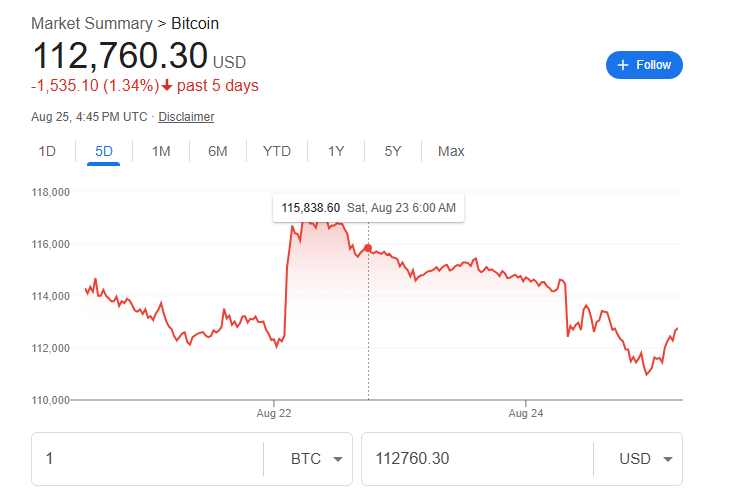
A Bitcoin whale sold 24,000 BTC, worth approximately $2.7 billion, on August 24, 2025, triggering a rapid $4,000 price drop in Bitcoin within minutes, contributing to a 4% decline in the total crypto market cap, with Bitcoin’s price currently trading around $112k as per CoinMarketCap data.

This event led to $250 million in long position liquidations within 30 minutes and a total of $840 million in liquidations over the previous 24 hours. The whale, holding coins dormant for over five years, transferred the BTC to the Hyperunite trading platform, with some reports indicating a rotation into Ethereum, including 416,598 ETH ($1.98 billion) purchased and 275,500 ETH ($1.3 billion) staked.

This sell-off amplified market volatility, with Bitcoin dropping to around $111,600-$112,700, while the broader crypto market cap fell to approximately $3.84 trillion. Analysts note that such moves by early Bitcoin OG can significantly influence market dynamics due to the large capital required to absorb their sales.

The sale of 24,000 BTC caused Bitcoin’s price to drop by approximately $4,000 within minutes, reflecting the immediate impact of large-scale liquidations on a relatively illiquid market. This contributed to a 4% decline in the total crypto market cap, bringing it to around $3.84 trillion.

Such rapid price drops can erode investor confidence, particularly among retail traders, leading to panic selling and further downward pressure. The sale triggered $250 million in long position liquidations within 30 minutes and $840 million over 24 hours.

Liquidations occur when leveraged positions are forcibly closed due to insufficient margin, amplifying price declines as automated systems sell assets to cover losses. This cascade effect disproportionately affects leveraged traders, exacerbating market downturns and creating a feedback loop of selling.

High-profile whale sales, especially from early Bitcoin holders signal to the market that large players may be exiting or reallocating their positions (e.g., rotating into Ethereum, as seen with the whale’s purchase of 416,598 ETH). This can spark fear, uncertainty, and doubt (FUD), prompting smaller investors to sell.

The visibility of such transactions, often tracked on-chain, amplifies their psychological impact, as traders interpret them as indicators of market tops or strategic moves by insiders. Large sales require significant liquidity to absorb, and in a market with limited immediate buyers, prices drop sharply to match available demand. This highlights Bitcoin’s sensitivity to large transactions, especially when executed on centralized platforms like Hyperunite.
Bitcoin’s price movements heavily influence altcoins and the broader crypto market. A 4% market cap drop reflects correlated declines across assets, as traders adjust portfolios or exit positions in response to Bitcoin’s fall. The whale’s reported rotation into Ethereum may temporarily bolster Ethereum’s price but could also signal a shift in capital allocation, potentially pressuring other assets.

How High-Profile Sales Trigger Sell Pressure

Bitcoin’s blockchain allows real-time tracking of large transactions. When a whale moves 24,000 BTC from a dormant wallet to an exchange, tools like Whale Alert broadcast this to the public, signaling potential selling intent. Traders react preemptively, selling to avoid anticipated losses, which initiates sell pressure even before the actual sale.

The crypto market’s high leverage (common in futures and margin trading) means small price movements can trigger large liquidations. The $4,000 Bitcoin price drop forced $250 million in longs to liquidate in 30 minutes, as traders’ stop-loss orders or margin calls were hit. These forced sales flood the market with additional supply, intensifying downward pressure.

Large sales on exchanges like Hyperunite deplete buy-side liquidity in order books, causing prices to drop until new buyers step in at lower levels. Market makers, anticipating further declines, may widen spreads or reduce buy orders, exacerbating the price fall.

Retail and smaller institutional traders often follow whale movements, assuming they reflect superior market insight. A high-profile sale triggers FUD, leading to a herd mentality where traders sell to cut losses or avoid further declines, amplifying sell pressure.

Speculators and algorithmic trading bots react to price drops and whale activity, often selling automatically based on technical indicators. This creates a self-reinforcing cycle of selling, as seen in the $840 million in liquidations over 24 hours.

Bitcoin’s dominance (often 50-60% of total market cap) means its price movements ripple across altcoins. The whale’s sale not only pressured Bitcoin but also dragged down correlated assets, contributing to the broader 4% market cap decline.

Over time, new buyers (institutions, retail, or other whales) may absorb the excess supply at lower prices, stabilizing the market. The whale’s rotation into Ethereum suggests capital remains in crypto, potentially supporting other assets.

While whale sales still move markets, growing institutional adoption and deeper liquidity pools may reduce their impact over time. External factors could either exacerbate or mitigate sell pressure. For instance, positive developments like ETF approvals or favorable monetary policy could offset whale-driven volatility.

The $2.7 billion Bitcoin sale by a whale underscores the crypto market’s vulnerability to large transactions, triggering sell pressure through on-chain signals, leverage liquidations, and herd behavior. The immediate $250 million in liquidations and $840 million over 24 hours highlight the market’s fragility, while the 4% market cap drop reflects Bitcoin’s outsized influence.

Remittix Gains Liquidity Through BitMart, While BlockDAG Delivers $383M Presale and 20 Exchange Listings

0

Some presales build traction step by step, while others arrive with everything already in place. Remittix has recently passed the $20 million milestone and confirmed its first exchange listing on BitMart, a move that gives early participants access to trading and sets the stage for its rollout. The project’s focus on remittance payments has added weight to its pitch, but its path forward still relies on gradual expansion and additional listings to build momentum.

BlockDAG (BDAG), on the other hand, is already operating at an entirely different scale. With $383 million raised, 25.3 billion coins sold, and agreements secured across 20 centralized exchanges, including MEXC, LBank, BitMart, Coinstore, and XT.com, BDAG removes the uncertainty around launch. Instead of waiting for exchange confirmations, its structure guarantees global access and liquidity from day one. The contrast highlights two distinct approaches: Remittix’s progressive build versus BlockDAG’s ready-made market impact.

Remittix Secures BitMart but Faces Questions on Speed

Remittix has attracted attention with its $20M raise and BitMart confirmation, a move that instantly reassures participants about tradability. BitMart’s global reach will provide reliable liquidity from day one, and the project’s presale continues to benefit from its roadmap centered on cross-border remittances in more than 30 countries.

Its future plans include a native wallet and compliance tools, giving it potential appeal among fintech partners if execution matches ambition. But the challenge is speed: one confirmed listing is a positive step, yet more will be needed to sustain momentum. Without them, Remittix risks losing ground in a space where attention shifts quickly.

BlockDAG Readies Global Access With 20 Exchange Listings

BlockDAG has set itself apart in the presale market by prioritizing access and scale over speculation. Instead of waiting for post-launch negotiations, the project has already locked in agreements with 20 centralized exchanges, including major platforms like MEXC, LBank, BitMart, Coinstore, and XT.com. This guarantees that once the $600 million presale cap is met, BDAG coins will be tradable instantly across multiple venues, eliminating the uncertainty that often surrounds new launches.

This multi-exchange rollout creates several advantages. By distributing trading volume across a wide network of platforms, BlockDAG reduces the risk of sharp volatility spikes and price manipulation, two issues that commonly plague fresh listings. The numbers underscore the strength of this approach: $383 million raised, 25.3 billion coins sold, and Batch 29 priced at $0.0276, representing a staggering 2,660% ROI for those who participated in Batch 1.

Smaller presales often depend on a single exchange to generate momentum, which can create bottlenecks and uneven price discovery. BlockDAG’s strategy ensures broader participation from the outset, allowing for smoother liquidity, fairer trading conditions, and sustainable growth. With no delays, users will be able to trade, stake, and engage with the ecosystem immediately after launch, a rare feature among presale projects.

By combining massive presale traction with guaranteed market access, BlockDAG is building one of the most launch-ready frameworks in 2025. Its approach delivers not just hype, but infrastructure designed for long-term adoption and global reach.

Remittix vs. BlockDAG: Two Paths, One Clear Advantage

Remittix is building its presence incrementally, using each listing as a milestone. That strategy generates short bursts of attention but delays broader accessibility. With just one confirmed exchange, market entry could remain limited until further deals are announced.

BlockDAG, in contrast, has engineered a launch-ready framework. Its 20-exchange rollout provides immediate access and global scale, while its strong presale performance ensures liquidity from day one. It’s not waiting for traction, it has already secured it.

Final Word

Remittix deserves credit for reaching $20M and securing BitMart, with its remittance focus offering a clear use case. But BlockDAG is on another level. With $383M raised, 25.3B coins sold, a presale price at $0.0276, and a 2660% ROI already locked in for early participants, BDAG’s infrastructure-first approach sets it apart.

The choice is straightforward: Remittix is a developing story, while BlockDAG is already delivering access, liquidity, and reach. For those prioritizing stability and scalability, BlockDAG has turned presale ambition into immediate execution.


Presale: https://purchase.blockdag.network

Website: https://blockdag.network

Telegram: https://t.me/blockDAGnetworkOfficial

Discord: https://discord.gg/Q7BxghMVyu

RCBO in Power Distribution: The Essential Guide to Dual Protection

0

When it comes to protecting your home or business from electrical hazards, one device stands out as a modern solution: the RCBO. Short for Residual Current Circuit Breaker with Overcurrent protection, an RCBO combines two critical safety functions into one compact unit. It not only safeguards your circuits against overloads and short circuits but also protects people from potentially deadly electric shocks caused by current leakage.

In today’s increasingly electrified world—where homes, offices, and industries rely on more devices than ever—the role of dual protection has never been more important. Global electricity demand is expected to rise by more than 25% by 2030. With this growing reliance, ensuring your distribution systems are safe is no longer optional—it’s essential.

What Is an RCBO and How Does It Work?

An RCBO is a hybrid device that merges the functions of two traditional breakers:

  • MCB (Miniature Circuit Breaker): Protects against short circuits and overloads that can damage wiring or appliances.
  • RCCB (Residual Current Circuit Breaker): Detects leakage currents caused by faulty wiring or damaged insulation and prevents electric shocks.

By combining these two, the RCBO continuously monitors electrical flow. If it senses either an overcurrent event or a leakage imbalance between the live and neutral conductors, it trips immediately, cutting off the supply to prevent harm.

This rapid response is crucial because even a leakage current as small as 30 milliamperes can be dangerous to humans. The CHINT RCBO has the ability to detect and disconnect within milliseconds can literally be life-saving.

Why Dual Protection Matters for You

You might wonder, why is this dual layer of safety so essential? The answer lies in the different risks each protection addresses.

Overcurrent Protection

Overcurrent protection is one of the most critical features of an RCBO, ensuring that both your electrical system and connected devices remain safe. By monitoring the flow of electricity, it acts as a first line of defense against dangerous overloads and short circuits.

  • Prevents wiring from overheating.
  • Protects your appliances and equipment from damage.
  • Reduces fire risks associated with overloaded circuits.
  • Complies with safety codes that require circuit overcurrent protection.

Residual Current Protection

Residual current protection focuses on keeping people safe by detecting electricity that flows where it shouldn’t, such as through water or faulty wiring. It provides rapid disconnection to prevent electric shocks, making it essential in high-risk areas of your home or workplace.

  • Protects people from electric shock due to leakage currents.
  • Provides safety in high-risk environments such as kitchens, bathrooms, or outdoor installations.
  • Meets strict international safety standards, such as IEC 61009, which governs RCBO performance.

When both protections work together in a single RCBO, you’re not only protecting infrastructure but also ensuring human safety—something that should always be the top priority.

Where Should You Use an RCBO?

RCBOs are versatile and can be applied across residential, commercial, and industrial environments.

Residential Use

In residential settings, safety and convenience go hand in hand, and RCBOs are designed to address both. By providing protection at the individual circuit level, they ensure your home remains safe without interrupting the entire electrical system.

  • Protects individual circuits for sockets, lights, and household appliances.
  • Provides added safety in areas with water exposure, such as bathrooms, kitchens, and gardens.
  • Allows tailored protection—each circuit can have its own RCBO, meaning if one trips, the rest of your home continues running smoothly.

Commercial and Industrial Use

In commercial and industrial environments, even a small electrical fault can lead to costly downtime or equipment damage. RCBOs provide targeted protection, allowing you to safeguard critical systems while keeping the rest of your operations running smoothly.

  • Safeguards sensitive equipment like servers, medical devices, or manufacturing machinery.
  • Supports scalable installations in high-rise buildings or large facilities where downtime can be costly.
  • Helps you comply with occupational health and safety regulations.

A practical example: In an office tower, assigning RCBOs to each floor or department ensures that an issue in one area doesn’t bring the entire building offline. This minimizes disruption and maximizes productivity.

Advantages of Choosing an RCBO

Installing RCBOs provides both immediate and long-term benefits:

  • Space-Saving: Combines two functions in one, freeing up room in distribution boards.
  • Enhanced Safety: Faster response to both overcurrent and leakage incidents.
  • Flexibility: You can assign individual RCBOs to critical circuits instead of covering the whole system at once.
  • Reliability: Reduces downtime by isolating only the affected circuit, keeping the rest of the system running.
  • Compliance: Meets or exceeds the electrical standards required in most countries.

Challenges and Considerations

While RCBOs are an excellent choice, there are factors to keep in mind:

  1. Cost: They are more expensive than single-function devices, but the protection offered often outweighs the difference.
  2. Selection: Choosing the correct rating for your circuit is essential. For example, the wrong sensitivity level may cause nuisance tripping or insufficient protection.
  3. Maintenance: Regular testing ensures your RCBO is functioning correctly. According to IEC guidelines, testing should be carried out at least every six months in residential settings and quarterly in commercial or industrial environments.

RCBO vs. Separate MCB + RCCB

Here’s a quick comparison to help you understand why RCBOs are often preferred today:

Feature RCBO Separate MCB + RCCB
Overcurrent protection ?? ??
Residual current protection ?? ??
Space efficiency High Low
Fault isolation Circuit-specific Group of circuits
Ease of installation Simple More complex
Reliability during faults High Moderate

The Future of Power Protection

As power consumption grows with renewable energy systems, electric vehicles, and smart devices, the need for reliable protection will only increase. Modern RCBOs are being designed to integrate with smart monitoring systems, allowing you to:

  • Track energy usage in real-time.
  • Detect unusual current flows remotely.
  • Schedule preventive maintenance before issues escalate.

These innovations mean that RCBOs are evolving from being simple protective devices into intelligent tools for energy management—perfect for the connected homes and smart cities of the future.

Why It Matters for You

Electrical safety is not an area to compromise on. By using RCBOs, you:

  • Ensure the safety of your family, employees, and property.
  • Stay compliant with evolving safety standards.
  • Acquire a future-ready solution that adapts to modern energy needs.

CHINT adds further value with its integrated overload, short-circuit, and residual current protection, durable design, and compliance with international safety standards. Whether you’re securing a residential property or managing a large-scale facility, our products are designed to deliver the dual protection you need today and the scalability you’ll need tomorrow.

Conclusion

An RCBO is more than just another breaker—it’s a smart choice for anyone who values both safety and efficiency in power distribution. By offering dual protection against overcurrent and residual current faults, it reduces risks, saves space, and ensures compliance with modern electrical standards.

When it comes to safeguarding people and infrastructure, RCBOs provide the assurance that your electrical system is protected—now and for the future. By investing in quality RCBOs today, you’re not only enhancing safety but also increasing the reliability and longevity of your electrical system. With the right setup, you can confidently manage your power distribution while minimizing downtime and potential hazards.