DD
MM
YYYY

PAGES

DD
MM
YYYY

spot_img

PAGES

Home Blog Page 647

Elon Musk Sues Apple And OpenAI Over Alleged Antitrust Collusion in AI and Smartphones

0

Elon Musk’s companies X and xAI filed a lawsuit Monday against Apple and OpenAI, accusing the two tech giants of colluding to maintain dominance in the smartphone and generative AI markets.

The complaint, lodged in U.S. District Court for the Northern District of Texas, alleges that Apple has unfairly favored OpenAI while suppressing rival applications such as xAI’s Grok chatbot.

According to the suit, Apple deprioritized so-called “super apps” and generative AI competitors in its App Store rankings, disadvantaging xAI’s Grok while promoting OpenAI’s ChatGPT integration into iPhone, iPad, and Mac devices.

“In a desperate bid to protect its smartphone monopoly, Apple has joined forces with the company that most benefits from inhibiting competition and innovation in AI: OpenAI, a monopolist in the market for generative AI chatbots,” the filing states.

Earlier this month, Musk warned he would sue Apple, calling its App Store practices an “unequivocal antitrust violation.” On X, he claimed Apple’s actions made it “impossible for any AI company besides OpenAI to reach #1 in the App Store.”

Musk vs. Altman: A Long-Running Rift

The case is the latest chapter in a deepening feud between Musk and OpenAI CEO Sam Altman. Musk co-founded OpenAI with Altman in 2015 but exited in 2018 after clashing over the company’s direction. He later criticized OpenAI for abandoning its nonprofit mission, which originally aimed to build AI “for the benefit of humanity broadly.”

Musk sued OpenAI and Altman last year for breach of contract, accusing them of prioritizing profit by partnering with Microsoft and converting the lab into a commercial entity. In contrast, Musk incorporated xAI in 2023 as a Nevada public benefit corporation, pledging to make social impact and transparency part of its mission.

Central to the complaint is Grok, xAI’s chatbot, which is both a standalone app and integrated into Musk’s other businesses, including X and Tesla’s infotainment systems. Musk claims Apple has deprioritized Grok in App Store rankings in favor of OpenAI.

However, Apple’s defenders point out that other chatbot apps, such as DeepSeek and Perplexity, have reached the No. 1 spot in the App Store since Apple announced its OpenAI partnership.

Apple has previously said its App Store is designed to be “fair and free of bias” and that rankings are determined by multiple factors. OpenAI dismissed the lawsuit as harassment, with a spokesperson saying, “This latest filing is consistent with Mr. Musk’s ongoing pattern of harassment.”

Altman also pushed back, writing on X: “This is a remarkable claim given what I have heard alleged that Elon does to manipulate X to benefit himself and his own companies and harm his competitors and people he doesn’t like.”

While Musk presents Grok as a competitor to OpenAI’s ChatGPT, the chatbot has been plagued by controversy. Critics say Grok has generated hateful and false content on X, including antisemitic posts, climate change denial, and praise for Hitler.

In July, xAI released Grok 4 without disclosing any details on safety testing or guardrails, raising concerns about the model’s oversight. Despite its rocky rollout, Musk has leaned heavily on Grok as a cornerstone of xAI’s strategy to challenge OpenAI.

Looking ahead

The lawsuit adds to mounting regulatory and competitive pressure in both the AI and mobile ecosystems. Apple has faced longstanding antitrust scrutiny over its App Store practices, while OpenAI has come under fire from both former co-founders and regulators for its growing dominance in generative AI.

For Musk, the legal battle reflects both his ambition to disrupt AI through xAI and his personal rivalry with Altman.


China Pushes AI as Growth Engine, Builds Unified National Computing Network

0

China is banking on artificial intelligence (AI) to become a new growth engine, with projections suggesting it could add several trillion yuan to the economy by 2035 amid a sweeping national push for computing power and a unified data market.

At the China Computing Power Conference held in Datong, Shanxi province, over the weekend, Beijing showcased the depth of this ambition. Officials announced that 10 provinces and municipalities – ranging from Shanghai and Zhejiang in the east to Qinghai and Xinjiang in the west – had joined a unified computing platform designed to match surging business demand with underused resources across regions.

The initiative marks a critical step in knitting together China’s patchwork of regional computing hubs into a seamless national grid. State broadcaster CCTV reported that the platform had already onboarded more than 100 service providers, 1,000 industry users, and nearly 100 AI models, underscoring the speed at which Beijing is mobilizing both state and private sectors to build capacity.

This drive comes after years of heavy investment in data centers and semiconductor development as part of China’s self-reliance campaign, particularly amid escalating technology tensions with the United States. Over the past five years, China’s overall computing capacity has expanded by about 30 percent annually. This expansion is set to accelerate: smart computing power, tailored for AI applications, is projected to grow by 43 percent this year alone, according to an AI-computing-power assessment by the International Data Corporation and Inspur Information.

The International Data Corporation also projected that between 2023 and 2028, China’s smart computing power would grow at a compound annual rate of 46.2 percent—far outpacing the 18.8 percent growth expected for general-purpose computing.

Rao Shaoyang of the China Telecom Research Institute framed the potential scale of this transformation, stating that AI could contribute more than 11 trillion yuan (about $1.5 trillion) to China’s GDP by 2035. If realized, this would cement AI as one of the country’s primary engines of economic growth.

This effort mirrors a similar push in the United States, where Washington has made AI infrastructure central to future competitiveness. The Biden administration supported federal funding for advanced chips, new data centers, and AI research hubs through initiatives tied to the CHIPS and Science Act. The U.S. is also building a more distributed AI ecosystem, with national labs, major universities, and cloud providers expanding computing clusters to serve researchers and private companies.

President Donald Trump, in January, announced Stargate, a $500 billion AI investment initiative aimed at cementing America’s leadership in artificial intelligence. But unlike China’s centrally coordinated approach, the U.S. model relies on partnerships between government, academia, and industry, with companies like Nvidia, Microsoft, SoftBank, and Google Cloud playing an outsized role in supplying computing resources.

The parallel efforts underscore how the world’s two largest economies are racing to make AI the backbone of future growth. While China is banking on a state-led, unified data and computing system to supercharge its AI economy, the U.S. is banking on a mix of private sector innovation and government-backed infrastructure. Both see AI not just as a technological frontier but as an economic pillar that could define global leadership in the decades ahead.

Against this backdrop, China hopes to reduce inefficiencies, cut reliance on foreign technology, and build a data infrastructure that can support industries from finance to healthcare and advanced manufacturing by weaving together its computing resources.

Beijing’s approach contrasts sharply with Western markets, where computing resources are often fragmented across competing private providers. China is betting that scale and coordination will give its industries an edge in the global race for AI dominance by building a centralized, state-backed platform.

The broader strategy reflects a recognition that AI leadership will depend as much on raw computing power and data as on algorithms. As the U.S. continues to tighten restrictions on high-end chips and cloud services available to Chinese firms, Beijing’s response has been to accelerate its domestic capabilities.

With the unified computing power network already attracting a critical mass of users and models, analysts say the challenge ahead will be ensuring interoperability, maintaining security across provinces, and driving adoption in traditional industries.

AI Agent for Customer Support [video]

0

This AI agent has saved a company many hours for customer support. Do you have an agent for your operations? In Oct 2025, Tekedia AI Technical Lab will be teaching people how to design, create and deploy AI agents from first principle.

No programming skills required and no understanding of calculus necessary. Just come with what you think an AI agent can do for you. Ask your company to pay for you here https://school.tekedia.com/course/ailab/

Cardano Futures Surge to $1 and HYPE Eyes $70 While BlockDAG Builds Toward $600M

0

Markets are heating up as traders rally behind familiar names and a presale giant quietly sets up a more practical long-term play. Cardano’s futures action is climbing toward $1 with record open interest, while HYPE price predictions suggest $70 targets on institutional demand and dominance in DeFi perpetuals. Yet BlockDAG is carving a path that goes beyond short-term speculation. Its smart contract model promises real-world adoption, fueling transaction demand across sectors like healthcare, finance, and supply chain management. With $383M already raised, it may be the coin with the strongest foundation heading into 2025.

BlockDAG: Real Profits Through Smart Contracts

BlockDAG is not positioning itself as just another blockchain, it is targeting corporate adoption by reengineering how smart contracts deliver efficiency. Its framework is designed to reduce execution costs and increase throughput, enabling adoption in industries where scalability and security matter most. Supply chain systems, healthcare data platforms, and global financial transactions are among the immediate focus areas, where enterprise demand can directly translate into higher network use and sustained coin value.

The presale has already proven its strength. Over 25 billion BDAG coins have been sold across 29 batches at $0.0276, raising more than $383 million to date. Early batch participants are sitting on eye-popping paper returns, with Batch 1 buyers up over 2,660%. A fixed listing price of $0.05 already ensures short-term upside, while analysts forecast $1 by 2027 and up to $5 by 2030 if adoption scales as planned.

What separates BlockDAG from hype-driven launches is the funding allocation and structure. With a $600M hard cap, presale resources are earmarked for liquidity pools, major exchange listings, and ecosystem scaling, ensuring that the coin hits the market with both depth and demand. This, combined with its smart contract-driven real-world usage, has many suggesting BDAG is the best crypto coin to buy for those looking beyond speculation into utility-backed growth.

Cardano (ADA) Futures Surge Signals Bullish Setup

Cardano is once again in the spotlight as ADA futures show powerful momentum. Trading volume has surged close to $7 billion, marking a five-month high, while open interest continues to build. ADA recently broke free from a symmetrical triangle pattern, approaching $1 with analysts eyeing targets between $1.10 and $1.25 in the short term. Longer projections extend toward $2 if whale-driven demand and ETF speculation hold steady.

Much of this action has been fueled by whale accumulation, with large wallets scooping up tens of millions in ADA. On top of that, speculation around a potential Cardano ETF gained momentum after Grayscale filed a trust in Delaware. Odds on Polymarket jumped from 59% to 81% for ETF approval, strengthening the narrative. In South Korea, ADA trading volumes even doubled Coinbase activity, reflecting strong regional demand. With futures interest building and whales active, Cardano’s breakout potential remains high.

HYPE Price Prediction Points Toward $70

HYPE is making waves of its own, with analysts pointing to an upside path toward $70. After defending the $40 level, the token rallied nearly 25%, climbing to $46.19 on strong divergence signals. Technical resistance sits near $48, but if that level breaks, Fibonacci projections mark the next zone between $64 and $70.

Institutional inflows are helping drive this optimism. HYPE currently commands nearly 80% of the DeFi perpetuals market, processing over $30 billion in daily activity. That level of dominance sets it apart from competitors and cements its role as the go-to option for derivatives trading. As long as $40 support holds, technical setups favor the bulls, with analysts framing $70 as a realistic near-term target. With momentum, dominance, and large inflows aligning, HYPE remains a centerpiece of current trading discussions.

Closing Take

Cardano’s futures surge and HYPE’s bullish price outlook highlight how speculation and trading momentum continue to fuel crypto headlines. ADA is gaining traction on whale activity and ETF rumors, while HYPE’s control over DeFi perpetuals positions it for significant price extensions. Both offer strong setups for short-term traders, but BlockDAG offers something fundamentally different.

With its $383M presale, fixed listing price, and smart contract architecture designed for real-world adoption, BlockDAG aligns growth with practical usage. Forecasts of $1 by 2027 and $5 by 2030 don’t just rely on speculative charts, they’re built on transaction demand from industries ready to adopt its efficient systems. For those searching for the best crypto coin to buy, BlockDAG represents a rare blend of immediate listing upside and long-term utility-driven growth.


Presale: https://purchase.blockdag.network

Website: https://blockdag.network

Telegram: https://t.me/blockDAGnetworkOfficial

Discord: https://discord.gg/Q7BxghMVyu

24,000 Bitcoin Sale Has Plunged BTC Price, As Selling Pressure and Liquidity Flow to other Chains

0

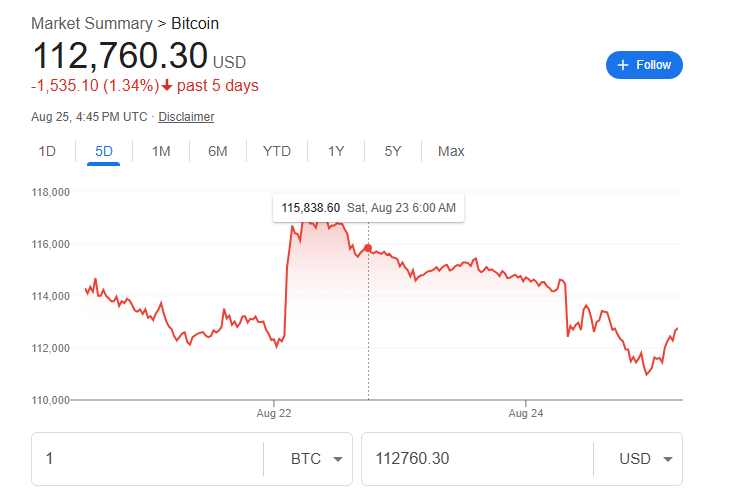
A Bitcoin whale sold 24,000 BTC, worth approximately $2.7 billion, on August 24, 2025, triggering a rapid $4,000 price drop in Bitcoin within minutes, contributing to a 4% decline in the total crypto market cap, with Bitcoin’s price currently trading around $112k as per CoinMarketCap data.

This event led to $250 million in long position liquidations within 30 minutes and a total of $840 million in liquidations over the previous 24 hours. The whale, holding coins dormant for over five years, transferred the BTC to the Hyperunite trading platform, with some reports indicating a rotation into Ethereum, including 416,598 ETH ($1.98 billion) purchased and 275,500 ETH ($1.3 billion) staked.

This sell-off amplified market volatility, with Bitcoin dropping to around $111,600-$112,700, while the broader crypto market cap fell to approximately $3.84 trillion. Analysts note that such moves by early Bitcoin OG can significantly influence market dynamics due to the large capital required to absorb their sales.

The sale of 24,000 BTC caused Bitcoin’s price to drop by approximately $4,000 within minutes, reflecting the immediate impact of large-scale liquidations on a relatively illiquid market. This contributed to a 4% decline in the total crypto market cap, bringing it to around $3.84 trillion.

Such rapid price drops can erode investor confidence, particularly among retail traders, leading to panic selling and further downward pressure. The sale triggered $250 million in long position liquidations within 30 minutes and $840 million over 24 hours.

Liquidations occur when leveraged positions are forcibly closed due to insufficient margin, amplifying price declines as automated systems sell assets to cover losses. This cascade effect disproportionately affects leveraged traders, exacerbating market downturns and creating a feedback loop of selling.

High-profile whale sales, especially from early Bitcoin holders signal to the market that large players may be exiting or reallocating their positions (e.g., rotating into Ethereum, as seen with the whale’s purchase of 416,598 ETH). This can spark fear, uncertainty, and doubt (FUD), prompting smaller investors to sell.

The visibility of such transactions, often tracked on-chain, amplifies their psychological impact, as traders interpret them as indicators of market tops or strategic moves by insiders. Large sales require significant liquidity to absorb, and in a market with limited immediate buyers, prices drop sharply to match available demand. This highlights Bitcoin’s sensitivity to large transactions, especially when executed on centralized platforms like Hyperunite.

Bitcoin’s price movements heavily influence altcoins and the broader crypto market. A 4% market cap drop reflects correlated declines across assets, as traders adjust portfolios or exit positions in response to Bitcoin’s fall. The whale’s reported rotation into Ethereum may temporarily bolster Ethereum’s price but could also signal a shift in capital allocation, potentially pressuring other assets.

How High-Profile Sales Trigger Sell Pressure

Bitcoin’s blockchain allows real-time tracking of large transactions. When a whale moves 24,000 BTC from a dormant wallet to an exchange, tools like Whale Alert broadcast this to the public, signaling potential selling intent. Traders react preemptively, selling to avoid anticipated losses, which initiates sell pressure even before the actual sale.

The crypto market’s high leverage (common in futures and margin trading) means small price movements can trigger large liquidations. The $4,000 Bitcoin price drop forced $250 million in longs to liquidate in 30 minutes, as traders’ stop-loss orders or margin calls were hit. These forced sales flood the market with additional supply, intensifying downward pressure.

Large sales on exchanges like Hyperunite deplete buy-side liquidity in order books, causing prices to drop until new buyers step in at lower levels. Market makers, anticipating further declines, may widen spreads or reduce buy orders, exacerbating the price fall.

Retail and smaller institutional traders often follow whale movements, assuming they reflect superior market insight. A high-profile sale triggers FUD, leading to a herd mentality where traders sell to cut losses or avoid further declines, amplifying sell pressure.

Speculators and algorithmic trading bots react to price drops and whale activity, often selling automatically based on technical indicators. This creates a self-reinforcing cycle of selling, as seen in the $840 million in liquidations over 24 hours.

Bitcoin’s dominance (often 50-60% of total market cap) means its price movements ripple across altcoins. The whale’s sale not only pressured Bitcoin but also dragged down correlated assets, contributing to the broader 4% market cap decline.

Over time, new buyers (institutions, retail, or other whales) may absorb the excess supply at lower prices, stabilizing the market. The whale’s rotation into Ethereum suggests capital remains in crypto, potentially supporting other assets.

While whale sales still move markets, growing institutional adoption and deeper liquidity pools may reduce their impact over time. External factors could either exacerbate or mitigate sell pressure. For instance, positive developments like ETF approvals or favorable monetary policy could offset whale-driven volatility.

The $2.7 billion Bitcoin sale by a whale underscores the crypto market’s vulnerability to large transactions, triggering sell pressure through on-chain signals, leverage liquidations, and herd behavior. The immediate $250 million in liquidations and $840 million over 24 hours highlight the market’s fragility, while the 4% market cap drop reflects Bitcoin’s outsized influence.