DD
MM
YYYY

PAGES

DD
MM
YYYY

spot_img

PAGES

Home Blog Page 6494

The Succession Lesson from LinkedIn As Jeff Weiner Takes a New Role

0

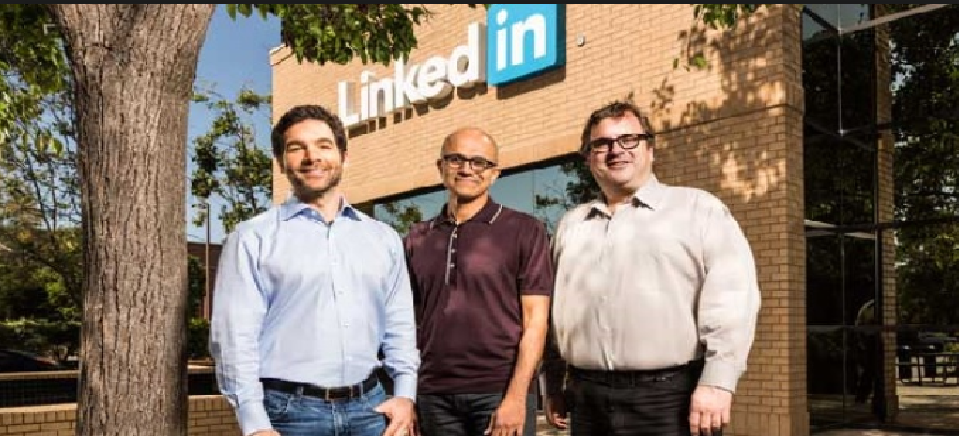
Two days ago, the CEO of LinkedIn, Jeff Weiner announced that he will be stepping down to take the role of Executive chairman of LinkedIn, and Ryan Roslansky will take his place as CEO.

“Last summer, I began talking with Satya about transitioning from my current dream job to my next one and helping him decide on my successor as CEO. Today, I am excited to announce that effective June 1, 2020, I will be stepping into the role of Executive Chairman of LinkedIn and Ryan Roslansky, currently our global head of product, will become LinkedIn’s next CEO. Ryan will report directly to Satya and serve as a member of his senior leadership team, in the same way I have over the last three years,” the statement said.

When Jeff Wiener became the CEO of LinkedIn in 2008, the career social media platform was having 33 million users only. His 11 years on the job at LinkedIn saw a transformational experience and massive growth; the platform saw increase in users to the tune of 675 million and counting.

Weiner’s prodigious leadership in the company has provided scintillating experiences for companies, HR professionals and job seekers. LinkedIn has become a mediator bridging the wide gap that used to exist between these parties. The basic version is free, providing limited but essential features for users in the career field, while the premium offers extra features at a cost. However, the platform has given people the opportunity to share ideas, connect with professionals, advertise jobs, and get jobs, all at the comfort of their fingertips.

Weiner’s ideas and approach to work has resulted in LinkedIn’s expansion to Ireland, where the social media platform is currently employing 1,200 staff led by Sharon McCooey. The next destination of its expansion is Dubai…

LinkedIn went public in 2011, and was purchased in 2016 by Microsoft at the cost of $27 billion, the biggest acquisition the software has made. The social media giant has since taken a leap to the success side of business, commanding a workforce of over 16,000 employees and generating $7.5 billion in revenue. And as Weiner noted, “it feels like LinkedIn is just getting started.”

Notably, the progress wasn’t as a result of Weiner’s solo efforts only, others in LinkedIn have augmented his visionary leadership ever since he joined the company from Yahoo.

“When you’re fortunate enough to work at the right company, with the right people, at the right time, a job can become something much greater than just a job.” Jeff Weiner said. “The company’s mission and vision become indistinguishable from your own true north, helping you find even greater clarity and sense of purpose.”

Ryan Roslansky is one of the figures in LinkedIn who helped shape the company. He was the first employee hired by Weiner and has gone ahead to win the praise of his boss with his innovativeness.

“He has been essential to the company’s success ever since,” Weiner said of Ryan. “Ryan has been a key architect in reshaping LinkedIn’s increasingly complex consumer and enterprise applications into a single, holistic, global ecosystem. In doing so, he has helped lead one of the best performing stretches in the company’s history.”

Another notable character in the success story is Tomer Cohen, who Jeff described as “an inspiring leader” and who has been instrumental in shaping their product ecosystem strategy. Tomer worked in many departments of LinkedIn and stood out in all, a reason he was chosen to take the place of Ryan.

“Tomer exemplifies the best of collaboration at LinkedIn by working without boundaries across the organization and has an unwavering focus on building products that drive significant value for members and customers. I couldn’t be more confident in the future of our product team and strategy under his leadership,” Weiner said.

One significant lesson in this succession changes is “grooming.” Each one of them has been prepared, mentored to take the position with ease, a strategy for preservation of a successful legacy. Weiner acknowledged the mentorship of LinkedIn’s founder Reid Hoffman, and pledged to do the same to others who will be stepping into bigger shoes.

“As for my role going forward, Ryan and I discussed the value of serving as Executive Chairman as Reid Hoffman, the founder of LinkedIn, did for me.” Weiner said in acknowledgement of Hoffman’s mentorship. “This is especially meaningful given there is no individual who has had more influence on my tenure as CEO than Reid. As LinkedIn’s new Executive Chairman, I hope to serve in much the same way.”

So it appears that while Reid was grooming Weiner for the position of Executive Chairman, Weiner was grooming Ryan for the role of Chief Executive Officer, and Ryan was doing the same for Tomer. This common sense principle of in-house breeding of successors defies the norm of dependence on already made CEOs and top executives. It doesn’t only preserve the work space relationship; it creates opportunity of growth for the company and its employees.

Upon acquisition, Microsoft allowed LinkedIn to operate independently, a decision that has undoubtedly spurred its growth and development. LinkedIn’s co-founder Allen Blue told CNBC: “All the growth we’ve been seeing has been in the way we’ve been operating our own businesses.”

Apparently, LinkedIn caved out a niche for itself as it is evident in the recent changes in roles at the company.

The Lagos’ Google Developer Space

0
Google continues a push into Africa, unlocking opportunities and changing landscapes

A week ago, Google launched its first Developer Space for Africa in Lagos. The hub of creativity was established as part of the tech giant’s aim to expand its tech assistance programmes in Africa. Google’s plan is to provide a hub where entrepreneurs could access the amenities they need to thrive. That includes funds, broadband, mentorship and creation of space for developers and investors in the tech industry.

Google’s country manager, Juliet Ehimuan said the hub is part of the company’s efforts to establish entrepreneur-enabling facilities that will boost the chances of those in tech. It is part of the 2017 series of events that culminated in Launchpad of several tech initiatives under “Google in Nigeria.”

Google’s CEO, Sundar Pichai and other executives of the company were in Lagos to explore and initiate tech opportunities through the “Google for Nigeria” event. The launch of the developer’s space is a follow up of the events that started then in 2017, and has since fostered about 47 startups by providing the platform that helped them get funding and mentorship they need for growth.

The new Google’s Developers Space is situated at Gerald road Ikoyi as the first of its kind in Africa. It has 120-seating capacity hall, meeting rooms, lounge/café, among other facilities. And it is free according to the Launchpad accelerator Africa head of operations Onajite Emerhor.

“It will be available for individual use, code labs, hackathons, tech events, training, boot camps, startup related programmes, and other Google initiatives,” she said. She also noted that the space will be free for all approved events, only sponsored programmes are not allowed.

Emerhor also spoke about the process of admittance to Space. She said all intended businesses must be tech-based and aimed at promoting digital knowledge. Individuals who wish to use the facility will use the online application through a person of contact (POC). The POC arrangement is to manage applications and avoid overcrowding, by not allowing multiple events at the same time.

She also explained that extended usage of the hub is not allowed unless for Google Launchpad accelerator alumni and investors meetings from outside Africa.

The Ministry of Communication and Digital Economy has thrown its weight on the initiative and promised to collaborate with Google in the future to promote digital knowledge in Nigeria.

The head of Nigerian Communications Satellite (NIGCOMSAT), Abimbola Alale promised to avail space within the agency’s campus if Google wishes to extend the initiative to Abuja.

Lagos State Government established such a hub for tech entrepreneurs in the State back in 2019 – the Eko Innovation Center, for the incubation of startups. Victor Afolabi, the pioneer of the Center said the idea is not only about incubation of startups, but it is also designed to offer platforms and opportunities for collaborations to entrepreneurs in the tech community.

“The motivation was the need to create an enabling environment for young people to develop innovative solutions and create employment while leveraging on technology,” he said.

The State Government has promised to support Google’s innovative initiatives so as to keep pace with global technological trends, and empower young people to explore and make innovative creations that will result in job creation.

Google has established development hubs in San Francisco, U.S.A and Singapore, making it only three in its name around the world.

There have been other tech hubs in Nigeria, but most of them are commercialized which makes it difficult for newbies with creative ideas to access, due to the cost of the space.

Lagos has 35 innovation centers, Abuja has 13 and Rivers has 5. These numbers have yielded employment for the youth and placed Nigeria in a position of competition with other African countries. There are over 440 active tech hubs in Africa with South Africa (59) Nigeria (55) Egypt (34) Kenya (30) and morocco (25) these countries lead with about 45% of the hubs in their region.

The launch of Google’s Development Space has added to Nigeria’s lead in the African tech industry. However, it falls short of what is expected as most of the hubs in Nigeria are privately owned and do not measure up to the tech needs in the country.

How The World Became Richer

0
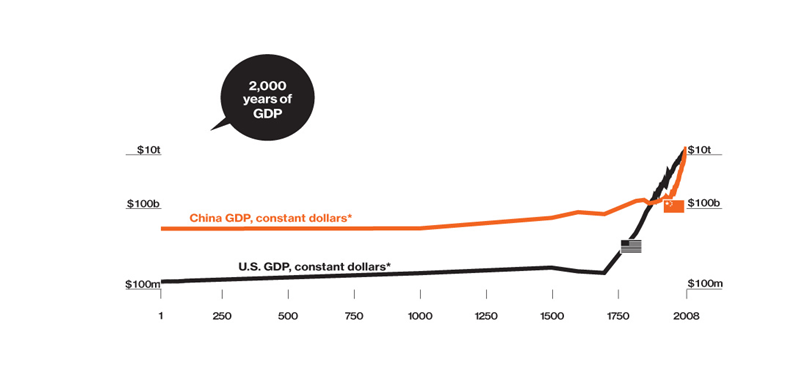
Figure 1.1: 2,000 Years of GDP (Source: Bloomberg, World Bank)

Let’s continue the conversation where we stopped yesterday, on the road to Monday when the four-month long Tekedia Mini-MBA begins (registration still ongoing). We tried to understand why the “old world” was inventive even as the modern one is clearly innovative. Sure, there would not have been the modern world without the elemental pieces built in the old one: those math equations, science experiments, etc all contributed to the advancements we see today. But things do not just happen by chance all the time, and that brings me to the question today (in the mini-MBA’s Challenge assignment for Week 1, participants will examine this at the level of firms and business sectors).

For more than 17 centuries, from AD 1 (Year 0001), the gross world product (adding all the GDPs of all countries) was largely flat. There was minimal economic expansion or growth. But shortly after 1800, the GWP (gross world product) began to rise, in some cases exponentially, clearly showing an expanding world economy with massive productivity gains and human welfare. What do you think caused that?

Join this conversation on Tekedia Audio where AI will read everything for you – Register for Tekedia Mini-MBA

Figure 1.1: 2,000 Years of GDP (Source: Bloomberg, World Bank)

Let me attempt to answer: the world was changed on July 31, 1790 when Samuel Hopkins was awarded the first United States patent. In my 2009 book – Nanotechnology and Microelectronics – which received 2010 IGI Global Book of the Year award, I explained that the patent system with the broad intellectual property rights could be considered one of the greatest policy innovations in economic history. With the regulations in the books, merchants who had the money but preferred to put them in pillows started looking for scientists and inventors with good ideas they could make money on. 

Now those “financially poor” inventors and scientists would suddenly have funds to improve their works, and then make them relevant for the markets by solving people’s problems. Before the patent system, merchants kept their monies, as there was no drive to spend money, to take an idea on a lab shelf to the market, only for your neighbor to copy it for no consequence. But with the exclusivity period the patent law offers, they knew they could recover any investment before the patent expires. Magically, money flowed and inventors advanced and the world became better. Simply, the world became innovative: 

Innovation = invention + commercialization

https://www.tekedia.com/mini-mba/

This Week in the Nigerian Capital Market (03-07/2/20): Government, Stock Market, Coronavirus

1

One of the most prolific ways to build a profitable business is to key into the policy direction of the Government of the day. Sadly, the same Government can be a catalyst in the destruction of your business if you find yourself on the opposite end of their policy direction, knowingly or unknowingly.

Most times, honey flows and profits follow when you are on the same page with the Government, but if you are on the wrong page with them, profits easily evaporate and losses follow.

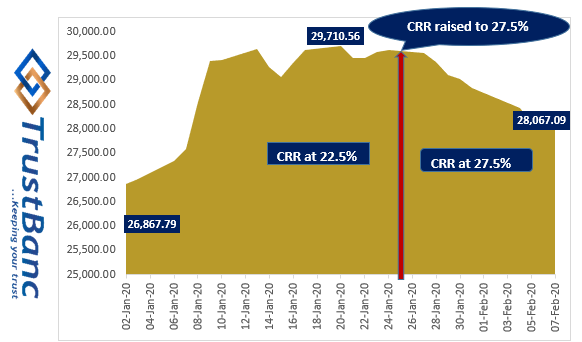
The ban of ‘Okada and Keke’ in Lagos effective 1st February 2020 left c.$400 million (N122-145 billion) capital sitting on gunpowder. In a similar vein, the increase in Cash Reserve Ratio (CRR) for banks from 22.5% to 27.5% by the Central Bank of Nigeria (CBN) killed the rally in the equities market; in a matter of days billions of gains recorded in previous weeks evaporated into the air.

Equities Market Update

We have had just 27 trading days in the year but it’s feeling like 270 days already, Investors have seen very good times and experienced sustained turbulence too. The first 17 days felt like the Market was on steroids recording stellar performances that ranked Nigeria’s equities market as the best performing globally, all these happened before 24th January 2020.

Then came CRR, you would recall that we gave several updates on Tekedia on the liquidity surge in the system, too many billions stranded as a result of declining treasury bill rates and interest rates generally.

On 24th January 2020, the CBN turned up to arrest those stranded funds, they increased CRR from 22.5% to 27.5% and that withdrew approximately N800 billion from the system. The withdrawal stifled the flow of cheap funds into the equities market, no matter how sweet a company’s fundamentals are, if there are no funds to purchase the stock, it won’t gain.

Cash Reserve Ratio (CRR) refers to a certain percentage of total deposits commercial banks are required to maintain in the form of cash reserve with the central bank. It is a monetary policy tool used to influence the country’s borrowing and interest rates by changing the amount of funds available for banks to make loans with.

The market opened low with an All Share Index (ASI) of 26,842.07 but closed in the green on the first trading day of the year at 26,867.79. The gain was sustained for 8 straight trading days to rank as the best performing ASI in the world; it peaked at 29,710.56 on 20th January. Recall, ASI is the daily ‘GPA or Jamb Score’ of the equities market, a higher ASI is an indication of gain or positive performance.

The ten trading days since the CRR changed has seen the equities market lose nine times, this is the power of Government directives or policies, it can change everything in a very short time. There is a lesson here for diversification, always position your investments to gain from low and high times, from positive and negative policies.

Economic Consequences of the Coronavirus

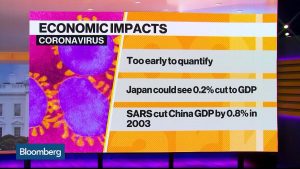
“SARS sickened 8,098 people and killed 774 before it was contained. The new coronavirus, which originated in the central Chinese city of Wuhan, has already killed more than 700 people and infected over 34,400 across 25 countries and territories. Chinese officials have locked down Wuhan and several other cities, but the virus continues to spread” CNN

The outbreak of the coronavirus is a textbook example of an exogenous shock. It forces a rethink of the scenario for growth for the next months by looking at the demand and the supply-side effects.

Exogenous shock results from when something really bad occurs – outbreak of disease, earthquake, which has a significant, enduring negative effect on prices. An event that’s outside the realm of everyday competition among companies, the cyclical rhythms of a nation’s business cycle or the interaction among countries.

On the demand side:

Household consumption is impacted because people have to stay at home, suffer from an income loss, feel uncertain and hence postpone big-ticket purchases. Foreign travel declines as well as purchases of foreign goods, so imports declines. Public spending will tend to increase, either to build health care facilities, or, possibly, to support growth (this could also happen via tax cuts or spending incentives).

Corporate investment will decline because of reduced demand but in particular, increased uncertainty. Companies will probably hold off investing until they have enough confidence that the epidemic will not spread further. The decline of imports and tourism represents a direct spillover effect to the rest of the world. Exports can also suffer because of what happens on the supply side. William DE VIJLDER

On the supply side:

Production declines because of a drop in demand and a shutdown of factories, shops and offices. Global value chains cause international repercussions, all the more so because substitution effects will be small in the short run, because customers prefer to wait rather than switching to another brand, or simply because it’s impossible to reorganise the value chain at short notice. In addition, for a temporary shock, this would make little economic sense. Another consequence is massive destocking. William DE VIJLDER

How this one take concern Nigeria?

If you export or import from China, your operations can’t be the same again. Prices of most supplies from China will surely go up if they have not gone up already. Expect the prices of some goods in the market to skyrocket in the coming weeks.

Please take action now because inaction may cost your company a lot this year.

“Car plants across China have been ordered to remain closed following the Lunar New Year holiday, preventing global automakers Volkswagen, Toyota, Daimler, General Motors, Renault, Honda and Hyundai from resuming operations in the world’s largest car market” CNN, and similar factories, this will definitely affect spare parts market in Nigeria.

Introducing TrustBanc Group

I have left Capital Bancorp to join TrustBanc Group as Group CFO – responsible for the group’s finance, investment banking and strategy.

Capital Bancorp was amazing but TrustBanc presents an opportunity to learn from a visionary leader, one that is irresistible. Abu Jimoh is the Founder of TrustBanc, the transformation legacy he left at Coronation Merchant Bank will remain a legend in merchant banking for a long time.

  • Reach out if you have a digital product that speaks directly to our market, our structure is youthful and we keep a disruptive mindset.
  • Reach out if you need a seasoned private equity partner.
  • Reach out for your investments – equities, money market or commodities, our products are well packaged and balanced to appropriately diversify your investments and preserve your capital.
  • Reach out for credits and loans, our rates are not destructive, they are friendly and competitive.

There are probably a hundred other ways we can touch you and your associates, watch this space closely.

The Rise of Innovators, The Growth of Firms [Video]

0
Innovation lives in Africa

Our program begins on Monday – I am asking you to get ready. It would be an excursion into the mechanics of markets. Innovation wins territories. It is about Growth through innovation on market systems, processes and mechanisms. Join this excursion.

As Monday arrives for Tekedia Mini-MBA, I have two questions today: (1) Why do we need to have companies? (2) Why did extremely intelligent people who crafted the fundamental constructs of chemistry, physics and mathematics die (relatively) poor, centuries ago? Share your answers below as we co-share and co-learn.

Let me begin by attempting: We need companies because companies are huge forces which make it possible for us to fix frictions (impediments) in markets. Because demand and supply cannot effectively come into perfect equilibrium due to the friction between them, companies emerge to help. Linkedin has fixed a friction, making it possible for me to write and for you to read, and vice versa. For that, LinkedIn exists, as it has a purpose to fix professional connection friction in markets.

#1 – Let me begin by attempting: We need companies because companies are huge forces which make it possible for us to fix frictions (impediments) in markets. Because demand and supply cannot effectively come into perfect equilibrium due to the friction between them, companies emerge to help. LinkedIn has fixed a friction, making it possible for me to write and for you to read, and vice versa. For that, LinkedIn exists, as it has a purpose to fix professional connection friction in markets.

#2: Those pioneers were inventors – most did not address any market friction. They just did experiments on physics, chemistry and solved mathematical challenges. But they did not translate those solutions into solving people’s problems (or frictions in people’s lives). Coming up with great ideas does not put money in the pocket. It is only when you have fixed problems by turning those ideas into products and services people buy. Until those products/services emerge, you cannot have growth because growth is possible when you sell things. Those pioneers sold nothing, and they could not make money. That explains why many were legends but were poor for their families to afford graveyard when they died. Today, INNOVATORS, not inventors, are turning those ideas and becoming wealthy people. Those innovators are fixing market frictions and earning revenue along.

For the debates, follow here on Linkedin.

https://www.tekedia.com/mini-mba/