DD
MM
YYYY

PAGES

DD
MM
YYYY

spot_img

PAGES

Home Blog Page 6527

The Dow And The Goddess of Productivity

2

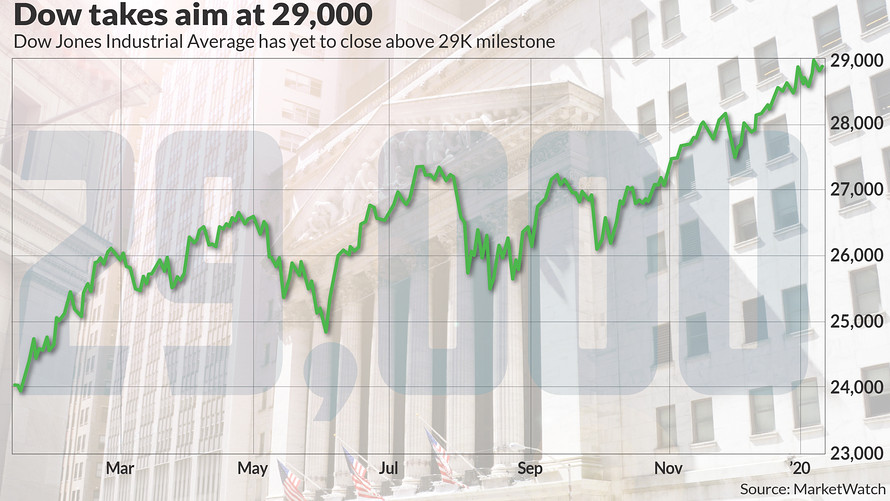
The Dow,  a stock market index that measures the stock performance of 30 large companies listed on stock exchanges in the United States, was inaugurated in 1885. It took 72 years to hit 1,000 points in 1972. But from 20,000 to 29,000 points, it was under 3 years. Simply, there is a massive acceleration on wealth creation at an unprecedented level in this age where Amazon, Apple, Google’s Alphabet and Microsoft have touched the face of T-alpha. Yes, $1 trillion market cap. The T-alpha is unified by one thing: technology, the goddess of productivity. Sure, there is a concern that the wealth may not be distributed fairly and equally, but that does not mean the goddess did not create or accelerate wealth creation.

The Dow Jones Industrial Average on Wednesday closed at the psychologically significant 29,000 milestone, marking the first finish at or above that level for the blue-chip benchmark.

The Dow closed out Wednesday’s action, following the signing of the first phase of a multi-staged trade pact between China and the U.S., up 0.3% to 29,030.22, a gain of 90.55 points.

The gain marks the 40th trading day since its last milestone on Nov. 15, and the fastest such ascent for the Dow since January of 2018 when it took only eight trading sessions to close at 26,000


This productivity is everywhere: “In 2019, Africa had 110 companies listed on the London Stock Exchange, with market capitalization of $197 billion”, from a Remarks Delivered by Dr. Akinwumi A. Adesina, President of the African Development Bank Group at the London Stock Exchange, London United Kingdom, January 22, 2020

Good morning!

I would like to thank Don Robert, the Chairman of the London Stock Exchange Group for inviting me to the exchange. It’s great to be here! It’s such an honor and privilege to be asked to open the market today.

The London Stock Exchange is the 3rd largest in the world with a market capitalization of about $4.6 trillion.

And Africa is tapping into the London Stock Exchange.

In 2019, Africa had 110 companies listed on the London Stock Exchange, with market capitalization of $197 billion.

As wealth grows in Africa, it leads to wealth right here also in the United Kingdom.

African economies are growing strong and the prospects for greater wealth creation are compelling.

Last year 17 African countries grew by 3-5% and 20 countries grew by 5% and above. Indeed, six of the fastest-growing economies in the world are in Africa.

Foreign direct investments to Africa grew at 11% last year, far exceeding the 4% growth in Asia, even as FDI declined by 13% globally and by 23% in developed economies.

This is a resurgent Africa!

The Africa Continental Free Trade Area is worth $3.3 trillion, making it the largest free trade zone in the world.

Africa can no longer be ignored!

That’s why I am excited about the UK-Africa Investment Summit held on Monday right here in London.

It’s time to recalibrate UK-Africa trade and investment. And a good place to start on investments is on infrastructure.

The continent’s unmet infrastructure demand is worth $68-108 billion a year, offering huge opportunities for global investors.

The London Stock Exchange can help to unlock a lot of capital for meeting Africa’s investment opportunities.

The Africa Development Bank has been a close partner of the London Stock Exchange. We participate on the Board of the London Stock Exchange Africa Advisory Group. And we are delighted with our partnership on the Companies that inspire Africa report.

The Africa Investment Forum, launched by the African Development Bank, helped to attract investment interests worth $40.1 billion last year, in less than 72 hours.

We want to do more to leverage institutional investors.

With institutional investors holding £8 trillion of assets under management in the UK, and only 1% of that going to Africa, it is time to change the trend.

The African Development Bank looks forward to working with the London Stock Exchange to deepen the development of capital markets in Africa, and to attract UK institutional investors to Africa.

The synthetic securitization of $1 billion issued by the Bank has attracted global institutional investors to infrastructure in Africa. The Bank is also working on improving African Capital markets access to domestic and international markets passive investment flows.

The Bank will be working with the London Stock Exchange Africa Advisory Group to attract a greater portion of the $5 trillion in global Exchange Traded Fund assets under management into African capital markets. And we look forward to developing green bond markets with you in Africa.

We are excited about the recent listing of Kenya’s Acorn Holdings, the country’s first green bond in the Nairobi and London Stock Exchanges in January 2020.

The African Development Bank also hopes to partner with the London Stock Exchange on our planned initiative to unlock dormant capital from existing fixed assets across Africa, with an estimated value of $4-5 trillion.

My ringing of the bell here today marks the beginning of a new, exciting, strategic and impactful engagement between the African Development Bank and the London Stock Exchange to jointly expand wealth creation in Africa and the UK.

So let’s get the partnership on its way.

And let the trade begin
Excellent Apps to Learn More About Renewable Energy

0

Introduction

Our planet is not exactly in the best condition. The effects of pollution and global warming are beginning to be felt everywhere. The ice caps are melting, the sea levels are rising, fires are destroying large chunks of ancient forests, and many animal species are disappearing before our very eyes. Scientists have confirmed, time and again, that a good deal of this is due to human meddling in the delicate balance of the ecosystem. Much damage has been done and we need to reverse the clock as soon as possible.

Attend courses online if your knowledge is slim

Luckily, all is not lost. We still have time to save our planet. The more people get involved, the more likely we are going to make it through the storm. If you would like to join, the first step is to learn as much about the change you can create as possible. Sustainable energy is an option that is available to many yet not enough people are taking advantage of it. In order to implement it into your life, you can attend courses in renewable energy (either in person or over the internet) and learn how you can improve the state of the environment. It won’t even take up too much of your time. I attended an online course that barely took 20 minutes a day from my schedule.

Learn how to use solar energy to avoid high electricity bills

Contrary to what many believe, sustainable energy can also be cheaper. You don’t have to spend 1000s of dollars to help the environment. Quite the contrary. Solar technology, for example, can enable you to harvest the power of the Sun in order to heat, cool and run your home. Investing in such a system can pay off within a matter of two years. Taking a solar energy course will help you learn the basics and understand how you can best take advantage of the empty spaces on your roof to create a cost-effective and eco-friendly source of power. You can save money, save the planet, as well as create a sense of independence we all crave.

Find work in the energy industry to help prevent further problems

The more you learn about renewable energy, the more you are likely to realize that every little bit of help counts. If you’re really passionate about saving the Earth, perhaps you may even want to get a job in the energy industry. While not the easiest one to get into, it is worth the effort as you will be able to create a positive change for everyone. Doing your research first is crucial. While looking to learn more about sustainable energy, I found this selection of apps that have proven quite useful.

Apps to Learn about Renewable Energy

The battle for the survival of our planet is ongoing. The more people join, the more likely it will be a success. The future of many is at stake.

Conclusion

Our planet is in jeopardy – there is no doubt about it. Human influence has disrupted the balance and we have to work hard to bring things back to normal as much as we possibly can. Renewable energy is a push in the right direction. Still, many of us don’t know much about it. Taking an online course could help you better understand the advantages of it. You can learn how you can employ solar power or even get a job in the energy industry to transform the system from within. The time to act is now.

Flutterwave Raises $35 million

1

He is eminently a visionary. He understood that before any commerce could flourish online in Africa, payment must be working. I have admired him from afar. Then, one day, a big bank flew me from U.S. to give a keynote speech in a program. I spoke and delivered a business sermon on banking, fintech, innovation and competition. Then, he took the podium. I was about going to meet some executive directors from the bank. As I walked out, I heard words like “partnership, cooperation, synergies”. I quickly ran to the big people, and excused myself to return to the talk.

There, I saw a wise man who deviated from the typical – “crush, disrupt, annihilate” – the banks. It was a great mind knowing that for fintechs to thrive in Africa for a long time, banks have to be empowered due to the current ordinances we have. When you come peacefully, you make friends and good things happen. He has built a category-king company on the ideals of those words, linking Alibaba’s Alipay, Worldpay, etc.

GB, Olugbenga Agboola, is the CEO of Flutterwave – Nigeria’s leading fintech.  I know it is the leading because my team added it this week for our mini MBA program: they usually build matrix before making their selections. For the fact they picked Flutterwave, it is the king in that sector. 

Flutterwave belongs to my paytech+ category: payment technology companies which build domain expertise across many sectors, with the payment services acting like an operating system in the relationships. Yes, they serve schools, churches, businesses, governments, etc, helping those entities improve their primary businesses. Think of Silicon Valley Bank in U.S: “ … “the U.S. bank’s entry, which was encouraged by Danish companies and investors, is seen as filling a kind of multifaceted funding-lending-consulting-networking-cheerleading gap that traditional local banks have a hard time closing.”

Now the big news – Flutterwave has raised $35 million series B funds. That is huge for an indigenous African company. 

San Francisco and Lagos-based fintech startup Flutterwave has raised a $35 million Series B round and announced a partnership with Worldpay FIS for payments in Africa.

With the funding, Flutterwave  will invest in technology and business development to grow market share in existing operating countries, CEO Olugbenga Agboola — aka GB — told TechCrunch.

The company will also expand capabilities to offer more services around its payment products.

[…]

In 2019, Flutterwave processed 107 million transactions worth $5.4 billion, according to company data.

{…[

The new round makes Flutterwave the payment provider for Worldpay  in Africa.

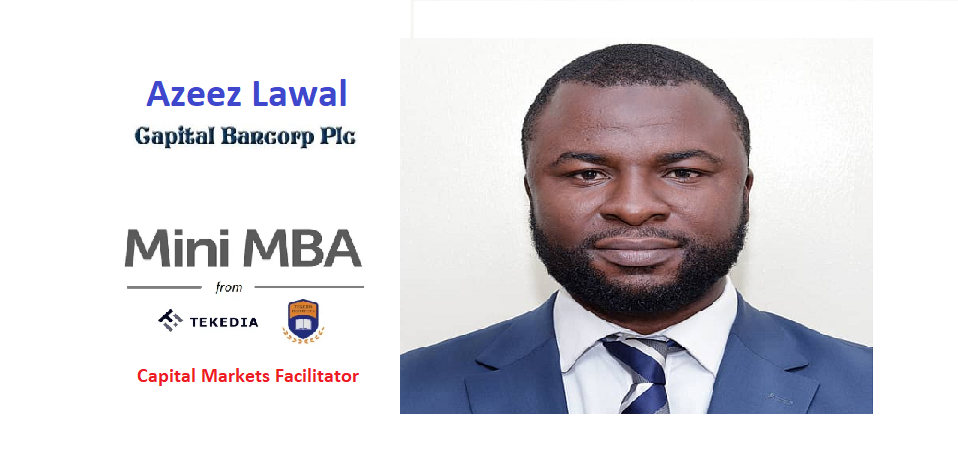
Azeez Lawal – Capital Bancorp Plc – Facilitator, Tekedia Mini-MBA

0

He is a dean of the capital markets, leading Capital Markets & Research Department at Capital Bancorp Plc, one of Africa’s leading financial advisory firms. His writings are insightful, and supremely fresh, with piercing perspectives only those that serve as high priests on the altars of market mechanism can deliver. On this social community service, the Tekedia mini-MBA (click to learn more), Azeez Lawal will lead a session on Capital Markets, Investing & Fundraising. On Tekedia, his weekly articles are now shared more than all works there, including mine. We think we have the best – and I want you to join him, from Feb 10. Click and REGISTER here.


https://www.tekedia.com/mini-mba/

Organizing an Issue-Driven Youth Development Programme: Lessons for Youth Development Advocates

0

As a youth development advocate, I have always aligned with the school of thought that believes that youth development programmes should be built around issues affecting them and solutions proffered around that as well. So, commencing a six-month youth development programme for youths drawn from different parts of  Osun state. This piece is about the lessons learnt in the process of conceiving and organizing the first month of the five months. Tag along.

#Data Driven Approach.We are in 2020 and activities organised around development work should be data driven. It is data that would indicate the enormity of the problems and how to handle them. A specific example of this in my recent experience on the issues of entrepreneurship among youths in Osun. My observation was that those young entrepreneurs in the state do not have the right information on accessing funding. It tallies with the statistics earlier quoted in one of my previous articles. To be on top of any issue, there is a need to know the numbers very well.

#Social Capital. It is described as the goodwill gathered over the time by a person from others who have had a cause to trust such individuals. This makes people to key into whatever the person with the credible social capital brings. This reflected in my attempt to put the first meet up together. From the facilitators to the venue used and even the chairs and refreshment, people were willing to  donate to the cause. Integrity and clear intentions are ingredients of a robust social capital. To get the facilitators and other donors for the Skillup, social capital was at work.

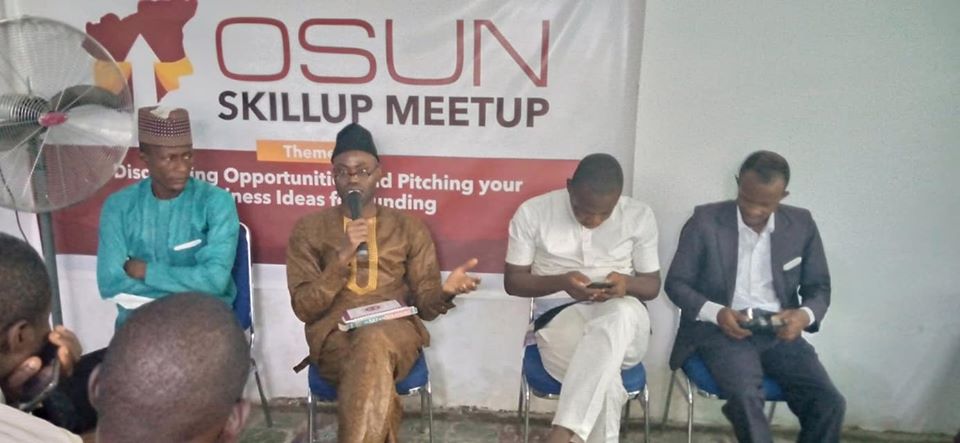
Panelists at the Panel Session

#Team Spirit. For every development worker, working in teams is a special asset. For youth development advocates, the need to build a team cannot be over emphasized. For the Osun MeetUp SkillUp, it was indeed a team work. Young men and women who saw the benefits were willing to volunteer. The convener was equally open to such mechanism. Resources maximization was utilized to the fullest. A good example was in the selection of the participants. The convener and the two facilitators were involved in the selection process. We had 54 applicants and 30 was selected to take part.

#Networking. It is important to network. It is good to know those who are fully involved in the aspect of the development work you are involved in. It makes execution easier. It also assists in getting those who you need for your programme. For a programme to be run on crowd sourcing, you need the networks that give your work some credibility.

#Crowdsourcing. This term used to have a meaning that is very abstract to me. I once believed it could only be achieved online. But, in the course of organizing the SkillUp MeetUp, I have learnt we could have a hybrid of online and offline crowd sourcing. It could do wonders. People would get you recommendations. And you would get your needs in minimum time possible. There is absolutely nothing you could not crowd source.

I am sure as we progress on this six-month journey to create a sustainable path for young entrepreneurs in my state, there are still many more lessons to learn. We are certain that successes and failures would be recorded. But, we are already developing a mindset to leverage on both of them to come out stronger.