DD
MM
YYYY

PAGES

DD
MM
YYYY

spot_img

PAGES

Home Blog Page 6527

Tesla’s Journey to America’s Most Valuable Automaker

0

The year was 1990, an Engineer named Marc Tarpenning was returning home from Saudi Arabia where he was working for a company called Textron. At home in California, his longtime friend, Greg Renda was working for Wyse technology based in San Jose. Tarpenning went into the office on the invitation of his friend to see what he was working on. He saw the terminals that Renda was working on, he also saw Martin Eberhard, an engineer whose personality goes beyond the nuts and screws. He had entrepreneurial and companionship trait that Tarpening didn’t fail to notice.

In the next few days, the duo became bonded in entrepreneurial ideas that would defy the odds that have stifled some automotive inventions and stalled its progress. It was a beginning of a technical adventure that would cause a stir in the future of the automobile.

The first significant product of the duo was “tzero,” an all-electric two-seater, which could go from 0 to 60 in under 4 seconds. That was the beginning, in the days when the future of a company named Tesla Motors was hanging on hope, though it was promising.

In 2003, Eberhard and Tarpenning had pushed the company to the limelight, making Tesla a name that the future of electric cars could count on – Tesla Motors was born. It was at this time that the two friends realized that they needed more hands, more funds, to foster the idea of NEV beyond a garage housing a few cars; although the original idea was to develop electric sports car, it appeared in no time, that the American people will be demanding more of what they have been shown. So they got a brilliant young man with some millions to throw in – the co-founder of Paypal, Elon Musk.

Eberhard was Tesla’s CEO then and Tarpenning, its CFO. With Musk on board, it’s a game on. In 2004, Musk would serve as the Chairman of the new venture, and in the four years that followed, the union gave birth to its first complete electric car, the Roadster. The Roadster was a monster, commanding speed and unprecedented durability. In company’s test, it achieved 245 miles (394 km) on a single charge; it was a record for electric car. Roadster was powered by lithium-ion cells often used on laptop batteries. And like the tzero, it could accelerate from 0 to 60 in less than 4 seconds and could reach a top speed of 125 miles (200 km) per hour.

Without internal combustion engine, the tailpipe emission of Roadster was zero, a feat environmentalists rated high and it put the car on the verge of wide approval. The car’s efficiency ratings were equivalent to a gasoline mileage of 135 miles per gallon (57 km per liter). These features put Roadster at the cost of $109,000, even though it had federal tax credit of $75,000. It was a luxury many couldn’t wait to have. And it defied the logic of challenge and impossibility to pioneer the path that keeps getting better with time.

In 2007, Eberhard resigned as the CEO of Tesla Motors and joined the advisory board. Tarpenning too, who was serving as the vice president of electrical engineering of the company, and was directly supervising the development of electronic and software systems for Roadster, resigned in 2008. Elon Musk became the CEO, and moved to change vehicles on Tesla’s menu from sports to family-friendly sedan. But fund posed a problem, and Musk appealed to the US Government who through the Advanced Technology Vehicle Manufacturing (ATVM) loan scheme, provided the company with a whopping $465 million loan. It was the lifeline the company needed to stay in business and expand its all-electric vehicles business.

Two years later, the result was stated boldly in the stock market. In 2010, there was $226 million Initial Public Offer (IPO) for Tesla. It was another big leap in the journey that humbly started seven years ago.

In 2012, Tesla turned its attention away from the Roadster to concentrate on its new Model S Sedan, the recent addition to the family. Model S came with three different battery options with some changes compared with the Roadster. It has underneath space, creating extra storage space in front because its center of gravity is low. But it shared the same speed performance with tzero and Roadster.

The Tesla autos was spreading quickly across the US and Europe that the company saw a need to build Superchargers, charging stations designed to charge Tesla vehicles free of charge for users. The Superchargers were later renamed Tesla Stations, where services like battery replacement were offered to customers.

In 2014, the autopilot initiative came into play, a semi-autonomous driving idea that was introduced with the Model S, and subsequently, other models. The next year, the Model X came into play with a battery range of 295 miles (475), it was designed with seven seats.

But Tesla cars were expensive and the cost dampens the wish of many to own one, the situation prompted the debut of Model 3 in 2017, a four-door sedan with a range of 220 miles, and the price at $35,000. Well, the Model 3 didn’t break the sales-lock soon, not until 2019 when the order numbers started counting high, changing the financial status of Tesla.

In 2018, a tweet from Elon Musk got him into trouble. He had made a series of tweets about taking Tesla private, claiming that he had secured funding. That didn’t go well with the US Securities and Exchange Commission (SEC), and Musk was charged with fraud. The Commission alleged that he was lying and misleading investors with his tweets. But Tesla’s board rejected a settlement proposed by SEC because Musk threatened to resign, and the situation set the company’s stock crashing, forcing Tesla and Musk to accept $20 million fine, in a less generous deal which includes Musk stepping down as chairman at least for three years, though he was allowed to stay as the CEO.

The 2019 opening of Tesla factory in Shanghai was a milestone in the company’s decade. The demand from the world’s most viable electric vehicle market is adding pillage to the posture of the company. Tesla said it has delivered 112,000 vehicles in the fourth quarter, which exceeds the consensus estimate among analysts.

It is 2020, and Tesla’s market cap has crept all the way up to $85.8 billion, a staggering amount delivered within a decade and a half, which surpassed the combined market cap of GM and Ford; both have existed for decades before the birth of Tesla.

From Elon Musk’s Spacex project to solar panel to Tesla’s Shanghai Factory in China, it has been a decade to be proud of for the company and its 49 year old CEO, who is now the 34th richest person in the world. And with many new projects unfolding eventually, the innovation behind Tesla is yet to be born.
7.0 – Conclusion

0

5G represents a shift from consumer technologies to industrial technologies as it promises to lead to the development of a highly automated and intelligent environment which would revolutionise many industries including automotive, transportation, supply chain, manufacturing, energy and utility services, retail, fintech, e-commerce, agriculture, health, education etc.

It is also clear that 5G networks must be able to provide diversified services, support accesses of multiple standards and coordinates multi-connectivity technologies.

For this to happen, the radio layer is being densified with small cells and in some instances, with technologies of different air interfaces, thus leading to the development of a Heterogeneous Network. All forms of cooperative schemes among radio nodes are been developed to meet the increased demand for bandwidth, at the physical layer.

Besides, a new radio air interface, the 5G NR, has been designed to work within different bands, operate with the various air interface technologies and maximise signal reception using various spatial multiplexing gain techniques.

The core has also been re-designed and evolved towards a service based architectural network. It has been designed such that it is able to respond dynamically and seamlessly to the wide varying needs of the 5G network on the fly. This has thus triggered the development of new business models e.g. Network as a Service, Mobile Virtual Network Operators Slicing etc. and other market opportunities which would no doubt justify the investment in 5G.

This has also facillated virtualization and softwarization within the network and led to the separation of the control plane from the use plane and facillated the use of techniques like slicing, NFV, SDN, MEC etc. to meet the low latency and other requirements of 5G use cases.

Virtualization is also been expanded to the radio interface and equally serving as a means to foster the co-existence of terrestrial and satellites technologies for use within a 5G network

As highlighted in one of the preceding chapters, the heterogeneous nature of 5G networks imply that the spectrum needed for 5G services would be realized in different bands. As such, spectrum harmonization will be of vital importance, if the world is to witness a successful deployment of 5G networks.

There are however risks and issues that need to be addressed before a successful deployment of 5G networks occur worldwide. For example, the different technologies required for the varied requirements must work seamlessly within the 5G network. How do you respect privacy and security concerns during the provision and delivery of slices to various verticals within the same network? How do you prevent IoT devices from being used for spying or eavesdropping on individuals, homes or corporations? Usually regulation plays catch up with technological development, therefore it is important that these risks and ethical questions are given some serious thoughts before deployment.


Back to Table of Contents.

6.0 – Other Technologies and Developments

0
5G network, adaptable business model

This chapter discusses the reader to other technologies and developments relevant to a 5G system.

6.1 Other Technologies

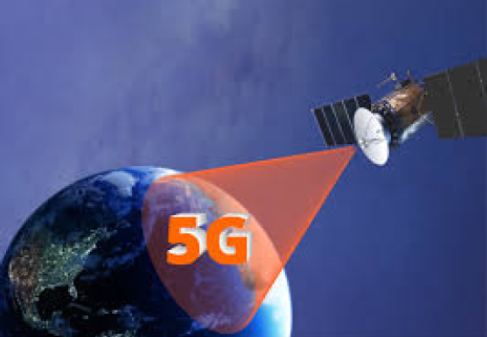
Figure 6.1: Satellites for 5G [31]
There are of course other technologies e.g. Satellites which may have not been mentioned previously but have a key role to play in the deployment of 5G. For example, Satellites (see Fig. 6.1) could be used for backhaul, to offload traffic from base stations, deliver broadband services in underserved areas or emergency regions, safety services and for IoT devices. The integration of terrestrial and satellite domains within the 5G network is all due to Virtualization [20].

6.2 Waveforms and Access Technologies

There is currently research on the development of new waveforms and access technologies e.g. Non-Orthogonal Multiple Access (NOMA), Sparse Code Multiple Access (SCMA), Quadrature Amplitude Modulation Filter-Band Multi-Carrier (QAM-FBMC) etc. for use in a 5G network.

6.3 Security and Privacy

The virtualization of the network raises complex issues for critical services and security.

The heterogeneous nature of the 5G network also means that each layer of the network could be owned and operated by different virtual operators; therefore privacy become a major issue.

Interoperability is key for the different technologies to work within the heterogeneous environment; this also raises important questions on ethics, security and privacy concerns.

6.4 Green Communication Technologies

There is a target within the Communications Industry to reduce energy consumption by 90% without a reduction in performance and cost. For this reason, Green Communication technologies are being researched for implementation within a 5G network to reduce energy consumption and improve energy efficiency [20].


Back to Table of Contents.

5.0 – 5G Core (5GC)

0
Figure 5.5: Mobile Edge Computing [30]

The 5GC represents the heart of the 5G network and has evolved towards a service based architectural system. A service based architecture enables components within a network to work together, independent of vendors, products and technologies. The service based framework has also triggered virtualisation and softwarisation within the 5GC which allows the network to meet the varied requirements of the various 5G use cases. The evolution within the 5GC has also resulted in the separation of the data and control plane. This chapter introduces the reader to the evolution and innovative concepts implemented within the 5GC.

5.1 Network Slicing

The three use cases of 5G have different stringent requirements e.g. latency, ultra-high bandwidth, dense traffic etc. It therefore becomes a challenge to support all these services within the same physical infrastructure [14].

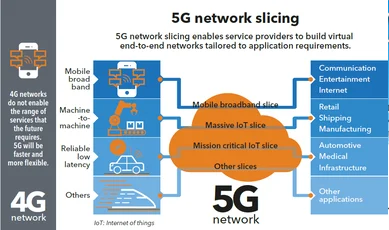
Figure 5.1: Network Slicing [27]
Furthermore, the network has to be able to react to the demand of the users regardless of their geographic locations.

To address these challenges, end to end Network Slicing, has been introduced. A network slice is simply an end to end logical network running on a shared physical infrastructure as depicted in Fig. 5.1 above.

In essence, the network is sliced into multiple virtual networks to support different radio access technologies or services with different requirements transported within the same physical infrastructure e.g. a slice would be developed for low latency applications while another slice is developed for high bandwidth applications. These slices are different and would be transported within the same physical infrastructure. This is clearly illustrated in Fig. 5.1 above [14, 15, 16, 17].

Network slices can further be customized depending on the requirements of the vertical or even the operators. For example, an automated car may require high bandwidth for its infotainment and low latency for assisted driving; these services could be delivered on different slices packaged together as a business bundle [15, 16].

Furthermore, a vertical requiring two or more services may request for a unique hierarchy for delivering these services. Thus, network slicing offers the opportunity to meet personalized requests [17].

Slicing can further be categorized as vertical or horizontal. Vertical slicing refers to the development of slices to serve the different requirements of the verticals, as illustrated above [16, 18].

Whereas, horizontal slicing implies developing similar slices to meet the needs of different machines or users with similar requirements. For example, a horizontal slice could be developed to simultaneously serve the needs of a consumer in a smart home and sensors within a smart industry, since they have the same requirements [16].

5.2 Network Function Virtualization

In order to facilitate the smooth transport of the virtual slices within the network and control slices on the fly (based on application requirements), Network Function Virtualization (NFV) has been introduced. The Service based architectural framework of the core has also facilitated the use of NFV which has seen architectural elements now defined in terms of network functions rather than actual physical network entities. The recent advancement in general purpose technology, cloud computing and software defined networks [18] has also triggered the use of NFV.

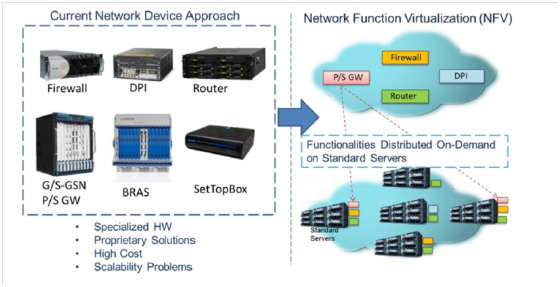
In simple terms, NFV refers to the virtualization of network functions like routers, firewalls, evolved packet core etc.; these network functions now run on virtual machines within a cloud infrastructure, as depicted in Fig. 5.2.  It thus represents a shift from hardware to software within the network and leads to a reduction in capital expenditure [17, 18].

Figure 5.2: Network Function Virtualization [28]
NFV thus enables the network to become programmable, agile and dynamic and reduces the costs associated with purchasing hardware for network entities. NFV would also enable the network to be able to react to the demand of the users, which is a key necessity for 5G applications [17, 18].

5.3 Software Defined Networking

In the previous chapter, it was pointed out that 5G would most likely be represented by a large heterogeneous network. And as a network becomes bigger, agility, flexibility, control and management etc. become very difficult. Such network therefore require some form of remote control from a distance via logical interfaces. In order to overcome these challenges, Software Defined Networking (SDN), an intelligent network architecture, is introduced for use in 5G networks [19].

SDN simply replaces traditional hardware with programmable software services and separates the control plane from the data plane. It allows for a simplified network management and introduces flexibility within the network. SDN also allows for the dynamic reconfiguration of the network and thereby give users the perception of infinite capacity for their applications, as depicted in Fig. 5.3 [17, 18, 19, 20].

Figure 5.3: Software Defined Networking within a 5G system [29]

5.4 Control User Plane Separation (CUPS)

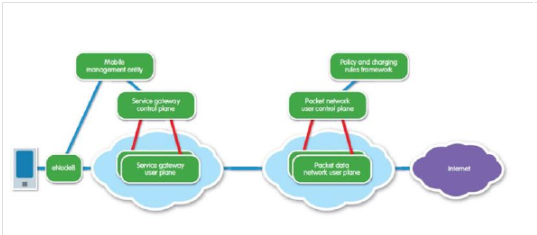
The service based architecture of the core has accelerated softwarisation within the network, and this has triggered the separation of the gateways in the EPC of the 4G network into a control plane and user plane in order to meet the low latency requirement for certain 5G use cases.

The control plane refers to a forwarding plane for exchanging signalling information needed to support the operations of the service delivered to the user. The user plane, on the other hand, represents the forwarding path for the user’s data (as depicted in Fig. 5.4) and supports other functionalities like charging, policy enforcement and a wide range of network capabilities.

With the CUPS technique (greatly facilitated by virtualisation and softwarisation), one could easily deploy a control plane within a centralized location whereas a user plane is deployed closer to the user. This has also accelerated the use of the MEC technique discussed in the next section.

Figure 5.4: Separation of gateways within the 4G network into User plane and Control plane [33]

5.5 Mobile Edge Computing

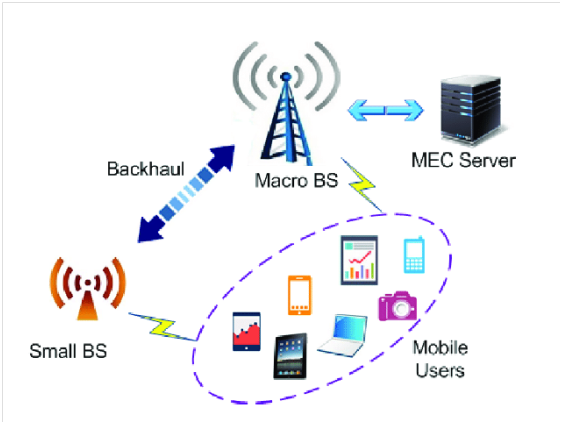
The softwarisation of the network has enabled the introduction of newer technologies like Mobile Edge Computing (MEC). This simply means bringing the cloud/IT services closer to the edge of the network or the users, as depicted below in Fig. 5.5. Here, the contents are stored on the MEC Server closer to the user. Anytime a user requires a service, it is served with little delay because of the close proximity to the MEC Server. This therefore gives the user a perception of infinite capacity.

MEC reduces latency, improves the quality of experience, allow for contextualized services and efficient use of resources [15, 17].

Figure 5.5: Mobile Edge Computing [30]

5.6 Summary

The 5GC has been designed as a service based architectural network which would allow logical entities within the virtual network to communicate via protocols. This has greatly aided softwarisation and virtualization within the network. The virtualization and softwarisation of the core has encouraged the separation of control plane from the user plane and greatly facilitated the use of techniques like Network slicing, NFV, SDN, MEC, Artificial Intelligence (AI), Machine Learning (ML) and Data Analytics etc. which all serve to meet the varied requirements of 5G applications and allow for the network to be flexible, agile, dynamic, reconfigurable and able to react and respond to the demands of the users/verticals on the fly.


Back to Table of Contents.

4.0 – 5G System Architecture

0

The 5G network has been designed based on a new architecture which features a new air interface, called the 5G NR, which will be briefly introduced in this section. The 5G NR also presents two system architectures for migrating from 4G to 5G networks, which will be discussed in this section.

4.1 5G New Radio (NR)

The 5G NR represents a new air interface and radio access network (RAN) developed to meet the varied requirements of the 5G use cases such as high bandwidth, low latency, energy efficiency etc.

Some of the key features of the 5G NR include

  1. Radio Spectrum: As discussed and depicted in chapter 2, 5G NR would work across a wide range of frequency bands.
  2. Orthogonal Frequency Division Multiplexing (OFDM): 5G NR will use OFDM as its underlying modulation scheme [32].
  3. Beam-forming: As highlighted in chapter 2, 5G NR will support the use of beamforming to achieve higher throughput.

4.1.1 Carrier Aggregation

Carrier Aggregation is a technique applied at the physical layer (5G NR). 5G clearly requires the use of different frequencies in different bands, as mentioned in Chapter 2. Carrier Aggregation thus allows for the combination of carriers either within the same or different bands.

For example, it is common for the primary control channel to be anchored on the macro cell using a lower frequency for reliability and coverage whereas the data channel can operate from the small cell using a higher frequency to provide for higher data rate and network capacity [12]. The separation of the data and control channels would be discussed further in Chapter 5.

In the next sections, the reader will be introduced to the two architectural routes for migrating from 4G to 5G.

4.2 Non Stand Alone Architecture

In a non-stand alone architecture, the 5G NR is used in conjunction with the 4G networks. This allows 5G based radio technology (5G NR) to be used with the existing 4G networks and represents a faster route towards commercial deployment of 5G networks.

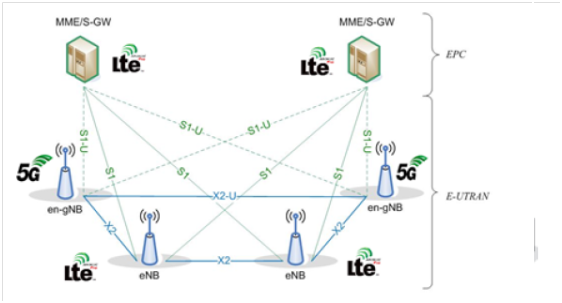
Figure 4.1: Non Stand Alone Architecture [32]
As depicted in Fig. 4.1 and as defined in 3GPP Release 15, the 5G NR (depicted as en-gNB) connects to the enhanced Node B (eNB) via the X2 interface, an interface previously exclusive for eNB connections only whereas the Evolved-Universal Telecommunication system terrestrial Radio Access Network (E-UTRAN) connects to the Evolved Packet Core (EPC) network via an S1 interface.

The Non stand alone architecture serves as a temporary step towards full 5G deployment.

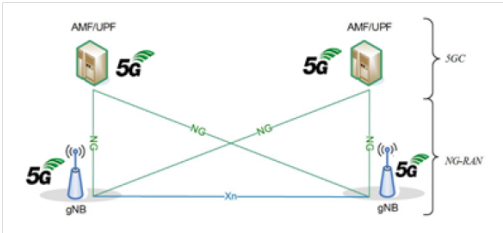
Figure 4.2: Stand Alone Architecture [32]

4.3 Stand Alone Architecture

This represents the full 5G deployment and is obviously a slower route towards commercial deployment. Here, the 5G NR is connected directly to the 5G Core (5GC) network. In essence, the 5G system is made of the UE, 5G NR and 5GC.

As depicted above in the figure, the NR (depicted as gNB) connects to each other via the Xn interface whereas the New Radio -Radio Access Network (NG-RAN) connects to the 5GC via the NG interface.

4.4 Summary

In this section, we discussed two main routes towards the commercial deployment of 5G networks. One represents a faster route and involves the use of the 5G NR on a 4G network whereas the other represents a slower route and involves the full utilization of the 5G NR on a 5GC network.


Back to Table of Contents.