DD
MM
YYYY

PAGES

DD
MM
YYYY

spot_img

PAGES

Home Blog Page 6543

The Nigeria’s 30% Drop in Fuel Usage After Border Closure

1
Buhari New Appointments
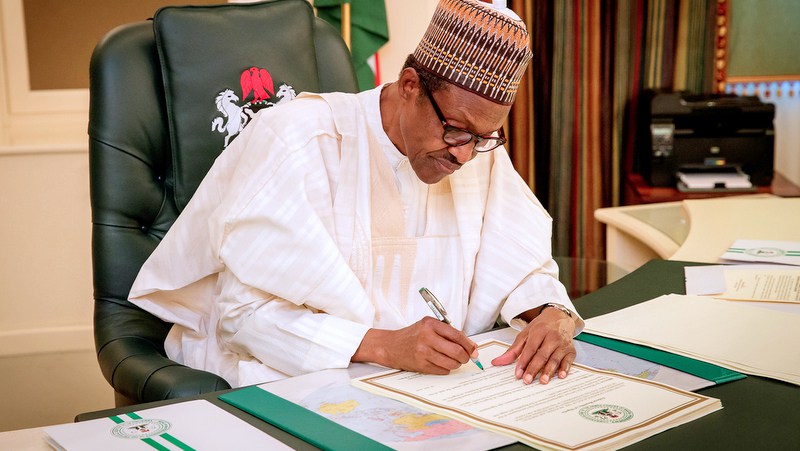
Mr. Buhari, President of Nigeria

Yes, it is a bombshell – with the closure of the land borders Nigeria has with some countries, the consumption of petroleum products in the nation has dropped by 30%: “The president said Nigeria’s domestic fuel consumption had dropped by more than 30 per cent since the closure, thus suggesting that about a third of reported fuel consumption by Nigeria was being smuggled to neighbouring countries where petrol price is much higher.”

While our President has used that as part of his justification to continue the closure, I personally think that the data is exposing the challenge in our nation. First, excluding Nigeria, Lagos state is the largest economy in West and Central Africa. Also, a local government area (LGA) in Lagos state like Eti-Osa LGA is bigger than the economies of most of the neighbouring countries. For these pockets of small countries to be using 30% of the fuel shipped out of Nigerian depots does imply that they are more economically dynamic since energy drives economies.

Mr Buhari said his administration’s directive on the border closure was meant to curb smuggling, especially rice, and that so far, the closures had saved the country huge sums on import bills.

He said his administration was betting on same measures to rekindle the country’s agricultural rebirth.

The president lauded actions taken by the President of Niger Republic, Muhammadou Youssoufou, including the dismissal of officials and a ban on use of the country as a dumping ground for Nigeria-bound smuggled goods.

This is what I think is happening: many factories in Nigeria are closing or reducing production due to the land border closure since most firms serve these small neighboring countries from Nigeria. And with those business decisions, the demand for fuels has dropped in the nation. The impact in West Africa is not accounting for up to 10% of this 30%. There are Nigerian companies who export exclusively to neighboring countries as they find better margins therein than in a more relative competitive Nigeria.  

Yet, there is one clear winner in this land border closure – security has improved in border communities in Nigeria. I do think that is really what the government should be focusing its case, as the fuel usage case is weak, as it is killing local production and giving these countries the opportunity to build resilience to decouple from Nigeria.

Remember: when America banned Huawei from using its technology, Huawei went and produced Mate 30 with no single American component (WSJ research). Now, the country has relaxed some of the restrictions, but Huawei is telling most U.S.. firms that the ship has sailed.  Lesson: that simple decision gave Huawei the opportunity to activate Option B. Nigeria should think twice on how we deal with our neighbors. That they come to Aba, Kano and Onitsha to buy things should not be taken for granted.

According to a report in the Wall Street Journal, the Chinese tech giant’s Mate 30 smartphone contains precisely zero American parts. The discovery was made thanks to an analysis of the Mate 30 by UBS and Tokyo-based tech lab Fomalhaut Techno Solutions, which disassembled the phone

Meanwhile, here are some other things to know:

We need more diesel in the courts.

Scores of litigants, including lawyers and witnesses, on Wednesday left the High Court of the Federal Capital Territory in Nyanya, Abuja, disappointed after the judge, Peter Kekemeke, cancelled the day’s sitting due to a power outage. “Besides, there is no diesel to run the generator. It is obvious we have to take a date and come back when electricity supply has been resolved,” Justice Kekemeke said.

Policy Disintermediates Discos on electricity:

The Federal Ministry of Power‘s new electricity distribution policy called “Willing Seller, Willing Buyer” was designed to bypass middlemen and sell power directly to consumers, a statement on Wednesday by Aaron Artimas, the Special Adviser (Media and Communications) to the Minister of Power, has said. Under the differential power distribution policy, electricity will be wheeled directly from the generation companies (GenCos) to willing consumers who are ready to fully settle their bills.

The Challenge of Mental Attitude for Advancement of Nigeria

0

In a nation characterized by good climatic conditions, abundant natural resources and well-positioned geography, one would expect that such a nation would blossom economically and in every wise in the advantage bequeathed her by nature. But reverse is the case in Nigeria.

Nigeria is known to possess all the requisite resources in terms of mineral and human for her development in every sphere but instead she has been on a path of constant retrogression. Now, the question is, “what is the root cause of Nigeria’s constant retrogression?”

Over the years, it has been constantly reiterated that human beings are the life-giving force of the cosmic system. Every activity or phenomenon we see in display is built upon the bedrock of human function. According to Sir Isaac Newton’s first law of motion which states that every object will continue to remain at rest or uniform motion unless acted upon by an external force. Human beings are the external force charged with the responsibility to plan, initiate and coordinate the necessary actions required to take every object out from rest and put the planet in an animated state of being.

Given this understanding, it should be reiterated that the source of every action or behaviour is rooted in a word called “mindset”. Mindset refers to a way of thinking. It is the regular pattern of a particular thought process. Mindset is so critical to the creation or development of any phenomenon. It dictates the reason why actions are taken, why people act the way they do. The issue of mindset is the starting point of every philosophy or value system adopted by every organisation and national society. The value system upheld by anybody of people is tied to the mindset or mentality they possess.

For more than two decades, different administrations have been on a quest to solve Nigeria’s problems but all to no avail. The reason being that they have failed to identify the root cause of the nation’s problems which is “wrong mindset or mentality”, that has been subtly built into the subconscious mind of the populace.

Nigeria has so drowned deep into the ocean of decadence that the abnormal has become a norm in the society. Doing the right thing today in Nigeria puts one in a position of crime while the real criminal offences are (disguisedly) celebrated and even awarded accolades. Today, we see thuggery being celebrated at the expense of respectable endeavours including education. We see graduates with outstanding results given peanuts while immoral acts are celebrated with stunning quantum of financial remuneration.

The issue now is “what is the solution to this menace that has plagued the mental residence of the Nigerian people?”

John F. Kennedy, the 35th President of the United States of America once said; “the progress of a nation is no swifter than the progress in education. And in progressing in education, the human mind is the fundamental resource.” John C. Maxwell concurs to this statement by stating that so much emphasis should not be laid on growing an organisation so much that it neglects working on the people’s attitudes. Further stating that an organisation that focuses on working on its people’s attitudes would experience 10 percent growth overnight. This is true not only for an organisation but also a macro-organisation like a nation.

Statistics has shown that Nigeria is the global capital for poverty and out-of-school children with an estimate of 13 million. This reveals a correspondence between poverty and undeveloped minds indicating that any nation with a high level of undeveloped or poorly developed minds will attract retrogression.

The principal solution to the problems of the Nigerian state is education. And by education we mean the transformation of the mental attitude or mentality of the populace not just the traditional acquisition of attitudinal skills of reading and writing. Emphasis should be placed on civic education where patriotism, morality, etc are preached. Imparting individuals with the information on the need to contribute their quota to the development of their nation both through their character and acquired knowledge, not depending and blaming the government for their malfeasance instead taking responsibilities as patriotic citizens.

Civic education should not be limited to secondary level of education but also incorporated into the tertiary framework of the educational sector. Every student irrespective of their disciplines should be mandated to take the course, civic education since they are all citizens.

Furthermore, a law should be enacted mandating all children to attain the primary and secondary levels of education. This will greatly reduce the number of out-of-school children in the country and automatically reduce the poverty level. More so, the government should endeavour to tap into the potentials of the society outcasts commonly called “area boys” who are seen on the streets and roads of the nation causing mayhem. This should be done by creating rehabilitation centres for these ones where their minds would be worked on and restored to “factory setting”. Subsequent to this, they should be employed for the government into areas where they can perform best. This would increase national citizenship behaviour or what is popularly called patriotism.

In conclusion, it is stated that the root cause of Nigeria’s problems is mentality and not anything else. And if the mentality of the people both the rulers and the ruled can be changed to the right one, the nation would be able to attain her maximum potentials.

Distribution: What Makes The Addressable Market of Nigeria Tough to Navigate

2

Reminiscing of Dr. Ola Brown’s article on Nigeria market size in Nigeria for all who cares to know, and the recent comment of Tosin Olaseinde about “massive market for affordable, simple, ready furniture and home décor” in Nigeria, it appears to me that there seems to be a lag in articulating what market size in Nigeria.

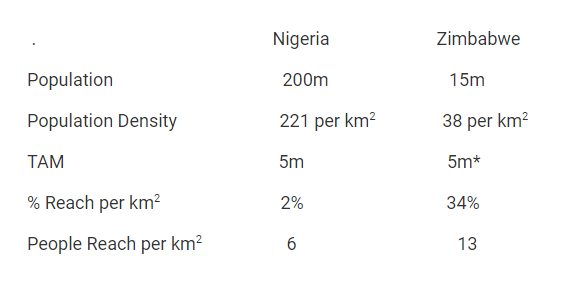
Tosin compared 5 million customers to be somewhat about one-third of the population of Zimbabwe’s market in reply to Dr. Brown. While that might sound juicy on a face level a further breakdown of the distribution of 5 million market size from a population of about 200 million will reveal a thing relative to a market size of 5 million with a population of 15 million.

Let’s think about it this way, what is the addressable market per land mile in Zimbabwe relative to Nigeria?

*NB: this is assuming 5m as the Total Addressable Market of Zimbabwe.

As our data reveals, per km square travel in Nigeria, you will meet approximately 6 of your customers, while the same distance travelled in Zimbabwe will bring you close to 13 of your addressable market. This is highly important especially when you factor in the concept of distribution cost. What will it cost you to reach your last mile customer? This dilemma of what to characterize as one’s customer plagues the e-commerce ecosystem in Nigeria and it simple anchored on a broken distribution system.

Moving on to distribution cost with from a perspective of last-mile delivery. Think about what distribution option is available to cater for our addressable market. The last-mile delivery cost in Nigeria is greater than 3,000 naira (about $10 – by extrapolation). While it will cost much less in Zimbabwe – I can simply conclude on this based on my calculation on % reach per km square which is higher than that of Nigeria. But a comparison of Zimbabwe with Nigeria is not the focus of this article.

Now note that what the addressable market participants are purchasing here is key and there is a point in which it is not economically viable to make purchases where distribution cost is involved. Take this, for example, let’s say an item cost of production is N3,000 and an e-commerce platform chose not to make a profit on this item if purchases are made on her platform i.e. sale at total full cost if you but on say Jumia. The same vendor chooses to make a 30% margin (N3,900) in retail outlets. Invariably, it means the total cost of making purchases online cannot be more than N3,900 or it will be absolutely off point to make purchases online than the kiosk beside my house.

The truth is what it will cost to reach the last mile customer in my scenario will be way above the price ceiling of N3,900 (it will actually cost + or – N6,000). And in effect, the erstwhile person mapped as part the addressable market will be automatically ousted from the cluster. 5 million minus one already and minus one more and more.

The above analysis begs the question of the addressable market in Nigeria, especially where physical delivery of goods is required (mainly e-commerce). What really can be regarded as Total Addressable Market (TAM) in Nigeria?

Broken Logistics, Nigeria Business Bane

In my time of working with Opeoluwa Shea Butter, one of the major issues we have to constantly battle is logistics; balancing cost with value. The selling price of the product cannot allow us to utilize formal logistics outlets like GIG Logistics (even though they were ready for concessions). Hence, we had to constantly innovate around our distribution cost and delivery. In the end, we refuse to take up some order because it is not economically viable to do so. The problem we faced at Opeoluwa is faced by all businesses in Nigeria and we all attend to the challenges differently.

In light of a broken logistics system, the question of TAM becomes more fluid, what will constitute an addressable market to one will be different to another even if they operate in the same industry.

What a lot of e-commerce (and other businesses) has done to mitigate the downside of last-mile delivery is to limit the circumference of operation, in other words, limit their addressable market. Yes, that may look like, why will you limit the number of people you want to potentially sell to. But when you factor in the cost of selling to that person relative to what the person would get it for otherwise, you realize that it is not an adventure worth pursuing. In effect, the addressable market of Nigeria is not as huge as we may think it to be based on distribution cost paralysis.

While thinking about the associated cost of running an e-commerce or any business that requires physical delivery of goods that utilizes technology or otherwise, this video by Ndubuisi Ekekwe detailed out a breakdown of your adventure and needed considerations while providing more perspective into why e-commerce is not yet a viable adventure in Nigeria.

Using Cell Phone Tower Data To Monitor Traffic Congestion In Lagos

0

Imagine a scenario where you are able to obtain real time traffic information from your mobile operators (on your mobile device) for various travel routes, as a service. This would no doubt save you time, enable you to decide whether to work from home or step out and prevent you from being stuck in traffic.

A common sight that meets the eye in Lagos is the proliferation of cell towers within the city. This is obviously an attempt by mobile operators to achieve a universal wide coverage within the city. Infact, the Nigeria Communications Commission (NCC) recently disclosed that the country has achieved a 90 percent coverage in terms of 2G (Global System for Mobile communication (GSM)).

Can we therefore put to good use the data being gathered from these cell towers, scattered at various locations within the country? The answer is in the affirmative.

Data from cell phone towers could be used for various applications e.g. monitoring of traffic congestion on Lagos roads. Traffic monitoring can be achieved by understanding how mobile phones communicate with cell phone towers.

Usually, when a phone is either in use or not (sleep state), the phone constantly transmits or receives radio signals from cell towers (antennas). For example, if a cell phone tower, say tower A, is located on Ikeja road, all users close to Ikeja road would communicate via tower A. This means that, using tower A’s data, one can easily predict that there is a large/fewer number of road users on Ikeja road, at a particular point in time.

Also, the road user would typically be connected to the closest tower (tower with the least distance from the user) and this implies that on a congested road, say Ikeja road, all road users’ phones would be communicating with tower A, assume tower A is the closest tower on Ikeja road.

Now, when users move at high speeds, which occurs when there is no traffic, the closest cell phone tower (tower A) hands over to the next closest tower to the user (say tower B); whereas, when users are stationary for a long time, hand over does not occur, i.e. their phones would continuously communicate with Tower A.

In essence, by observing the data of road users (anonymised, in order to obey data privacy laws) communicating with various towers and specifically monitoring the rate of handovers between towers located along a specific road and the volume of data handled by the cell tower located on the road, all within certain time frames, one can easily predict whether there is traffic on a certain road or not.

With the advent of 5G which would involve a densification of antennas within traffic hotspots, indoor areas, public areas etc., the accuracy of tower data obtained to predict real time traffic update would significantly increase.

Of course, this idea may require testing, modifications, some clever design from MNOs to perhaps aggregate such data, where it could easily be mined/analysed, and an output where such information can be communicated to road users, at a specific charge.

If implemented, this service would help road users avoid traffic hotspots, take alternative routes and assist MNOs in generating additional revenue.

Softcom Is Connecting Nigerians With Meaningful Innovation for Socio-Economic Development

0

Softcom is a forward thinking company which has acquired deep capabilities over the past 12 years to connect people and businesses with meaningful innovation by designing and implementing customer centric solutions for its clients, in the public and private sectors, while adding value and accelerating the adoption of technology enabling visibility, accountability, cost savings and effective decision making.

It believes in an inclusive and connected Africa where all its citizens can access opportunities for their socio economic development, and is focused on fixing frictions in Identity, Education, Payment and Data.

Its product offerings include:

Koya

As digital technology is transforming how people access education for their personal development and with the African scenario in view, Koya is a platform which is redesigning the delivery of quality, personalized learning experiences for individuals, enterprises and governments. It aims to provide lifelong learning  which will help in changing the continent’s narrative from commodity to knowledge-driven.

Data Beaver

Data Beaver is an integrated data collection platform which provides the enterprise with a means of collection and analytics of various data sources such as Biometric Data, Geographic Data, Demographic Data, Images and Video(Multimedia) Data and Textual and Numerical Data, etc. It helps in making informed decisions, powering growth and entry into new frontiers, defeating the competition and optimizing internal processes. Data Beaver’s capabilities include

Guarantee of Data Integrity: Each data point collected by Data Beaver is submitted in a non editable format with a geotag and timestamp. As entries are submitted by field agents, they are validated based on metrics set by the organization with instant notification to agents once the entry is accepted or rejected.

Offline and Online Data Collection: Data Beaver enables data collection in underserved communication infrastructure areas. The data submitted offline is stored locally on the mobile device and its sync feature enables the synchronization of offline entries once the field agent is able to access broadband connectivity on the mobile device.

It enables agents and organizations to access and work on multiple projects simultaneously. The Data Beaver admin platform empowers organizations to create and manage the end to end delivery of  data collection project.

Automated Payment System: Data Beaver enables integration to Eyowo, a digital wallet which enables transactions using only your phone number to agents on the go.

Eyowo

Eyowo is a peer to peer payment system which allows people to save, spend and receive money using only their phone numbers which will provide quicker, seamless and secure payment experience for individuals and businesses across Nigeria aimed at deepening financial inclusion and economic empowerment for everyone. Over 3.5 million have received financial value since it launched operations.

Pass ID

Pass ID enables seamless, enrolment, validation and verification of identities within any given ecosystem. It has engineered capabilities in Unique Identity Recognition, Offline Capabilities, Onboarding, User Management, Insights and Analytics amongst others.

Nigeria’s state owned identity management agency, National Identity Management Commission has granted it the ability to issue National Identity Numbers or Cards, enrolment and verification of any identity and it also supports harmonization and integration with other organized identity networks.

Softcom’s Value Adding Programmes

Softcom Value Centres: Softcom’s value centres are physical structures in underserved communities where Nigerians can walk in and access critical services across its four focus areas(Identity, Learning, Payments and Data). These value centres were established with the objective of giving every Nigerian equal access to opportunities for him to succeed.

Softcom believes in the right of every Nigerian whether they are out of school children, jobseekers, undergraduates, potential entrepreneurs or young adults seeking paid employment to be able to access quality education to significantly improve their lives and chances at success. It’s aim is for every Nigerian to be able to access financial services i.e deposits, withdrawals, access interest free loans and single digit medium term loans to significantly grow their businesses and livelihoods thereby increasing their quality of life through the Value Centres in their various communities.

It also aims to provide every Nigerian with important growth data, business trends and economic indices which is understandable and inaccessible for those at the bottom of the pyramid.

Correct Life: This initiative was launched to fix the friction which exists between the non inclusion of informal economy which constitutes over 80 percent of the workforce in Nigeria and an annual growth of about 9 percent into government economic policies and decision making which has resulted in loss of levies and taxes from them by empowering and developing them to create value for the government.

Future Ready Initiative: The Future Ready programme is a model of an ideal environment aimed at improving the learning outcomes of the 21st Century tertiary education student by meeting their needs with relevant content to increase their capabilities for productivity.

The Future Ready ecosystem consists of a student connected to digital(hardware, networking, software and content) capabilities for effective monitoring and mobile access to resources for best learning outcomes. The role of the Teacher is now redesigned to that of a facilitator or instructor effectively delivering knowledge unbounded and unconstrained with innovative, collaborative methodologies assisted by smart technology.

Softcom needs to double down on its efforts in its four key areas of focus while expanding into new frontiers to unlock the potential for economic transformation and aiding in lifting millions out of the poverty trap in line with the UN SDGs.